Art and Life in Rembrandt’s Time
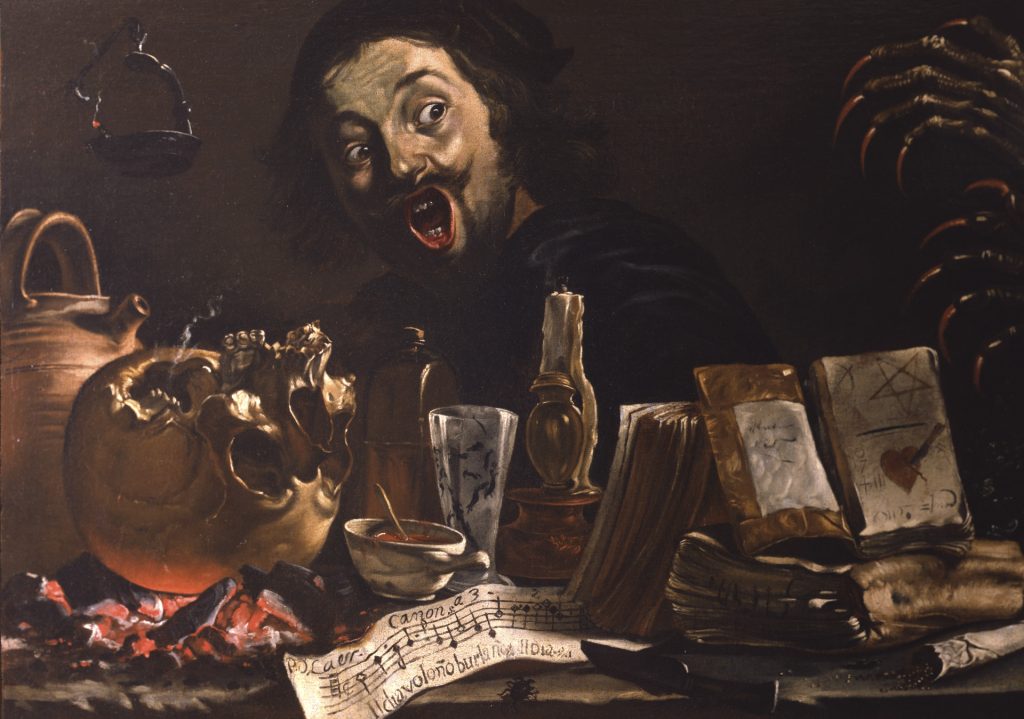
The exhibit is arranged by theme rather than by chronology, artist, or city. Different spaces are devoted to Portraying Amsterdam’s Elite, Everyday Sensibilities, From Market to Kitchen, and other topics. The entryway contains four paintings under the heading Meet the Painters. It consists of self-portraits of some of the painters represented elsewhere in the collection, including the rather shocking one below.
Pieter van Laer Had Issues
It looks as though Pieter van Laer had a lot rolling around in his head. Here we see him recoiling away from a pair of claws reaching in from the right to grab him. Perhaps this is a hallucination induced by whatever he has been mixing up with the mortar and pestle on his table. Maybe the recipe came from one of the notebooks on the table. The page we can see has some mysterious formulas and a drawing of a heart pierced with a knife. He has used a human skull resting on a bed of hot coals as a sort of precursor to the Bunsen burner to prepare his concoction. The musical passage at the bottom of the scene says, “The Devil Does Not Jest.” Quite an introduction to a collection of otherwise serene paintings from the Dutch Golden Age.
Gerrit Dou—A Favorite of Salvador Dalí
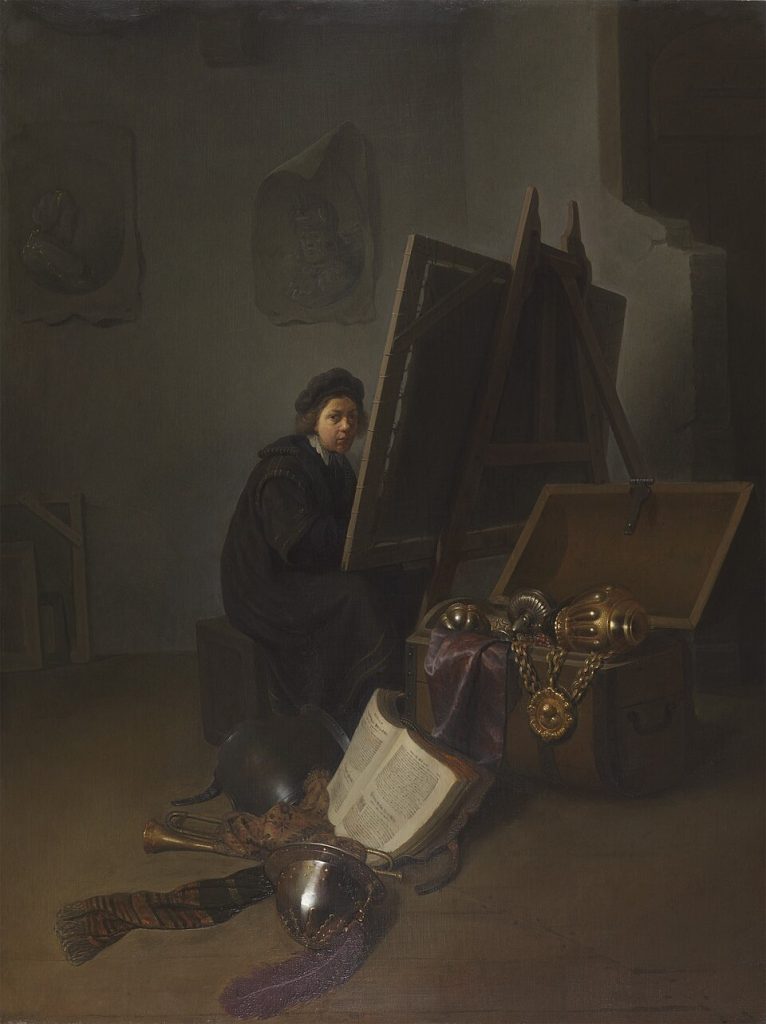
One of the other self-portraits near the beginning of the exhibit is this one, attributed to Gerrit Dou.
Gerrit Dou was Rembrandt’s first student, and perhaps one of his most prolific. Curiously, Salvador Dalí was a great admirer of Gerrit Dou and, in fact, owned two of his paintings. Dalí repeatedly singled out Dou—along with Vermeer—as exemplars of what he called “hand-made photography.” Dou is best known for small paintings that frequently depict scenes through a window. There are 14 Dou paintings in The Leiden Collection, and nine are on view at this exhibit.
Dou probably did this self-portrait in Rembrandt’s studio, so it is not surprising to have the big trunk overflowing with props at his side. Rembrandt and his students would frequently depict characters in interesting costumes or with interesting props. I can imagine Rembrandt’s studio looking a bit like a thrift store, spilling over with a collection of theatrical miscellany, much like the chest in this painting.
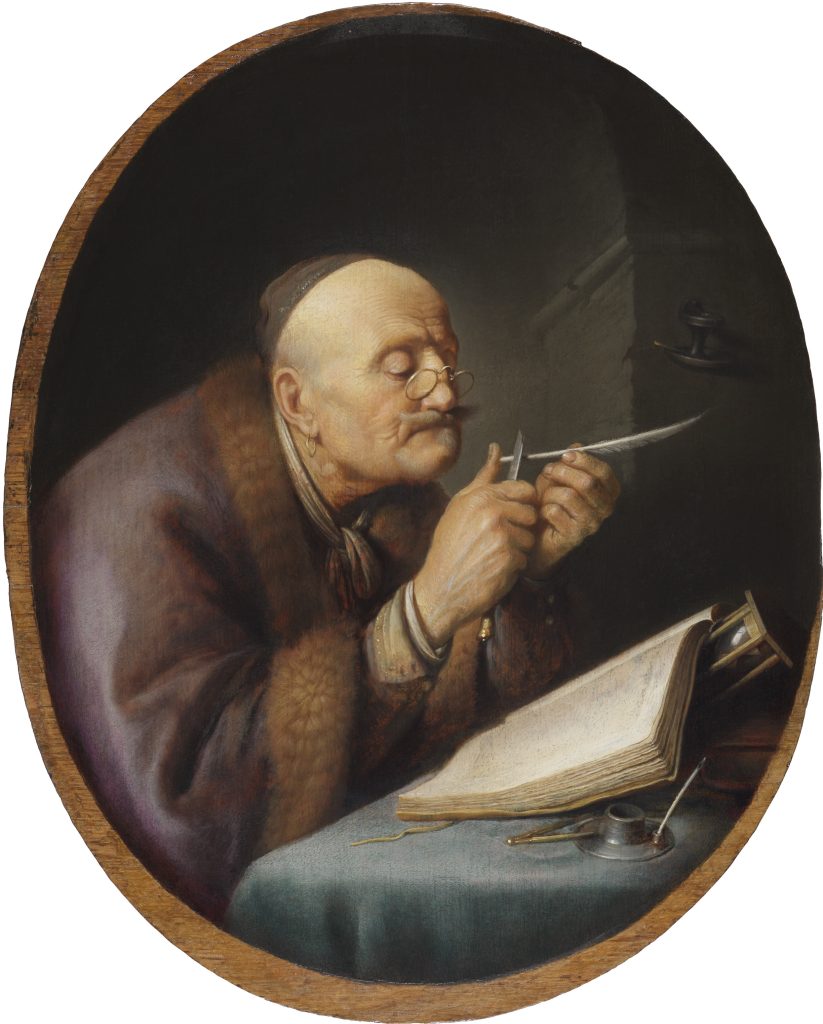
Interestingly, the canvas on the easel displayed in the painting is so large. Gerrit Dou never painted anything as large as that. Perhaps in his student years, he had designs on painting much larger pieces, but then devoted his energies to smaller works. The eight other Dou paintings in the exhibit are all such examples of smaller works, including this one below, in a section called Intellectual Life.
Paintings in this section of the exhibit honor scientists with telescopes, apothecary equipment, globes, and letters. This painting is unusual because of the humility of the scene—the scholar is simply sharpening his quill, the 17th-century equivalent of someone using a pencil sharpener before getting to work on a project.
A Push-and-Pull Between Catholicism and Protestantism?
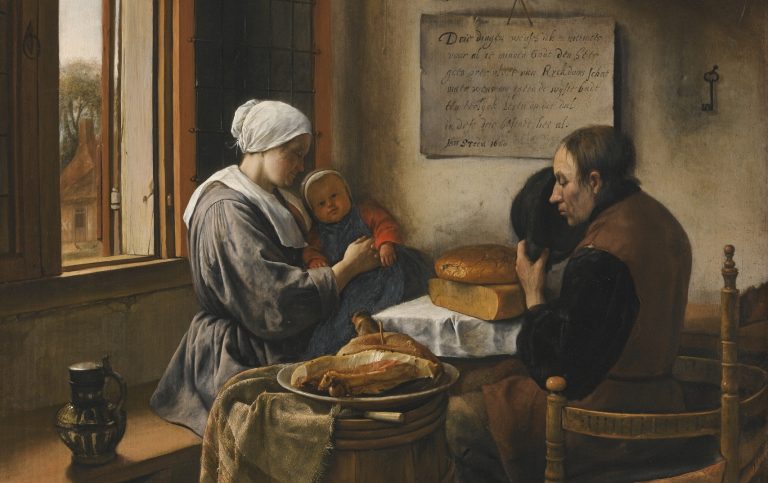
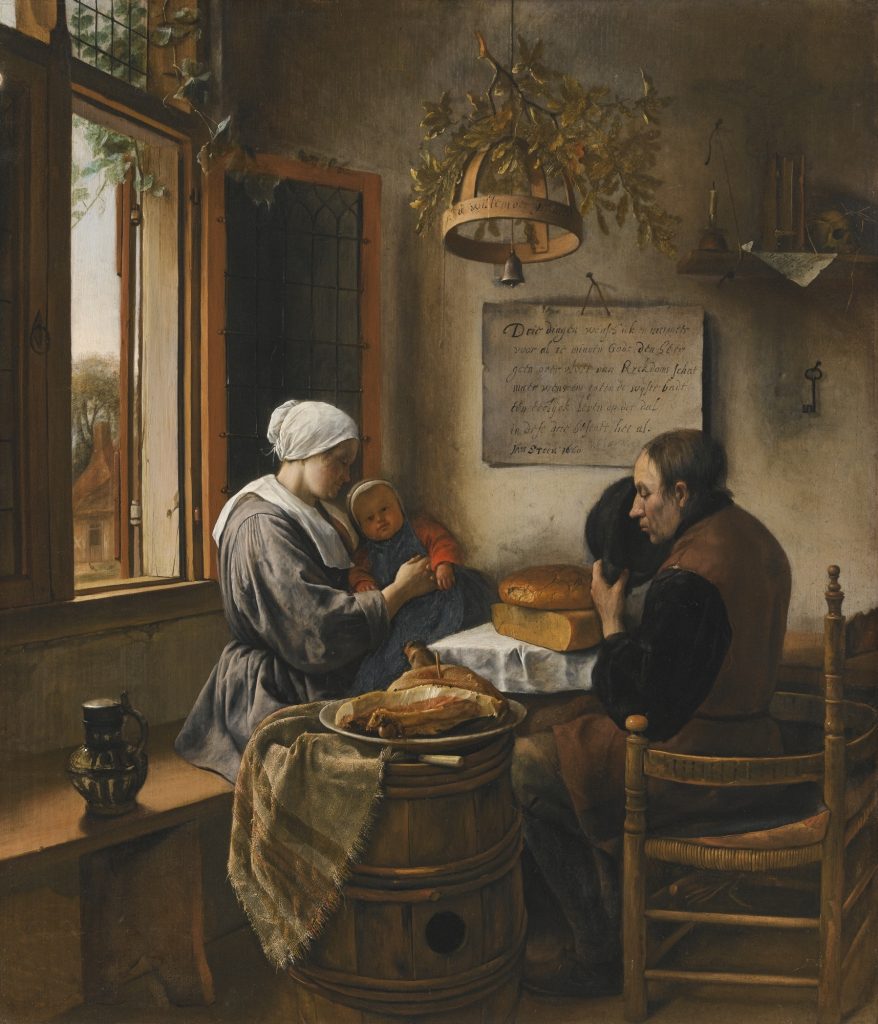
One of the joys of Dutch painting is interpreting the symbolism the artists use to tell stories in the scenes they portray. This painting by Jan Steen has a great collection of symbols to unravel.
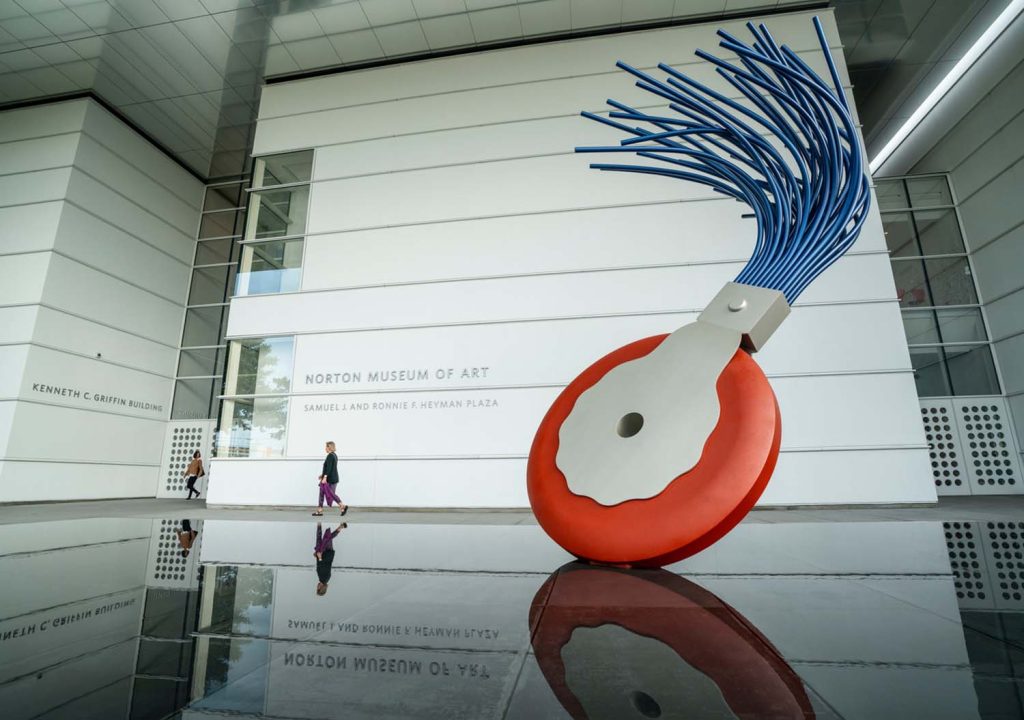
Visitors to the Norton Museum of Art can explore Rembrandt’s world through intimate scenes of daily life, faith, and artistic ambition. Here we see a poor family about to have a meal of bread, cheese, and ham at their modest table, giving thanks for what has been given to them. But the details Steen has chosen to include are a delight to unpack.
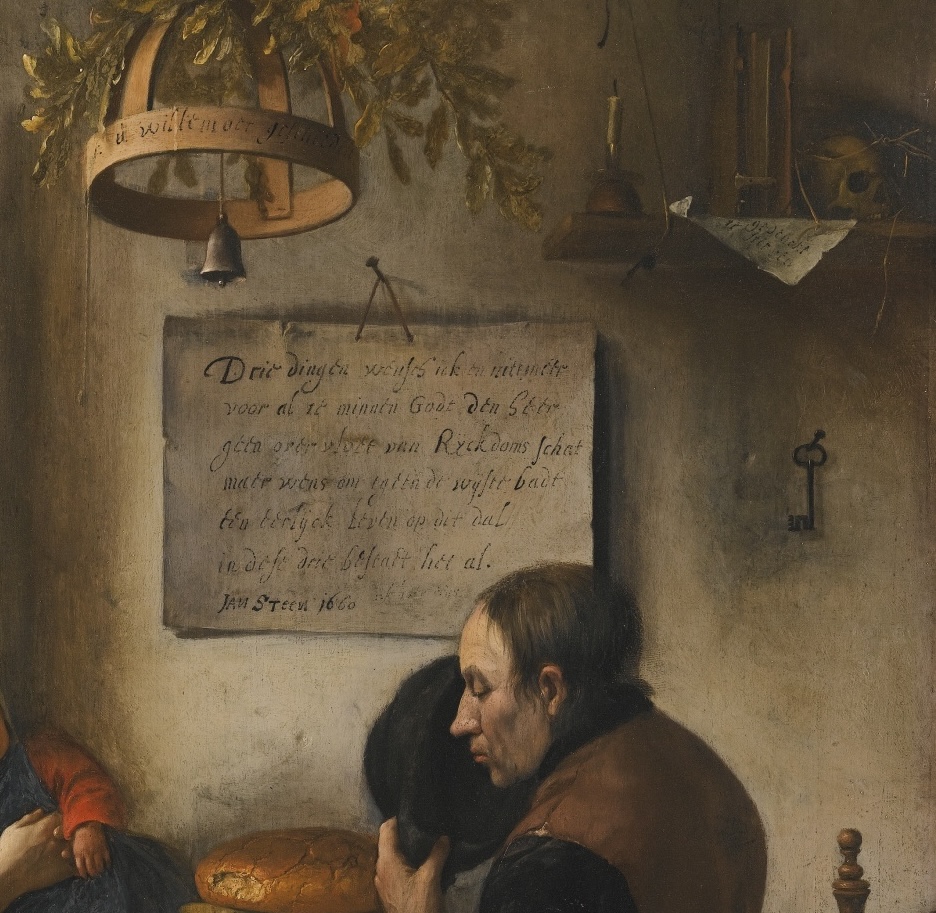
Steen originally had a crucifix on the wall behind the family. He ultimately painted it out, but we can still see the shadow of the crucifix on the wall. In its place, Steen has placed a shelf that replaces the crucifix’s crossbeam. The shelf contains a candle, a candle snuffer, and a skull, all reminders of our immortality.
Below the shelf hangs a key on the part of the wall that is well-lit. To the left of the key, in a darker part of the wall, is a nail hole where the key may have hung. Is Steen perhaps showing us, symbolically, that the key to spiritual serenity lies in moving from the darkness of Catholicism into the light of the Reformed Church?
Does Love Ultimately Win Out Over War?
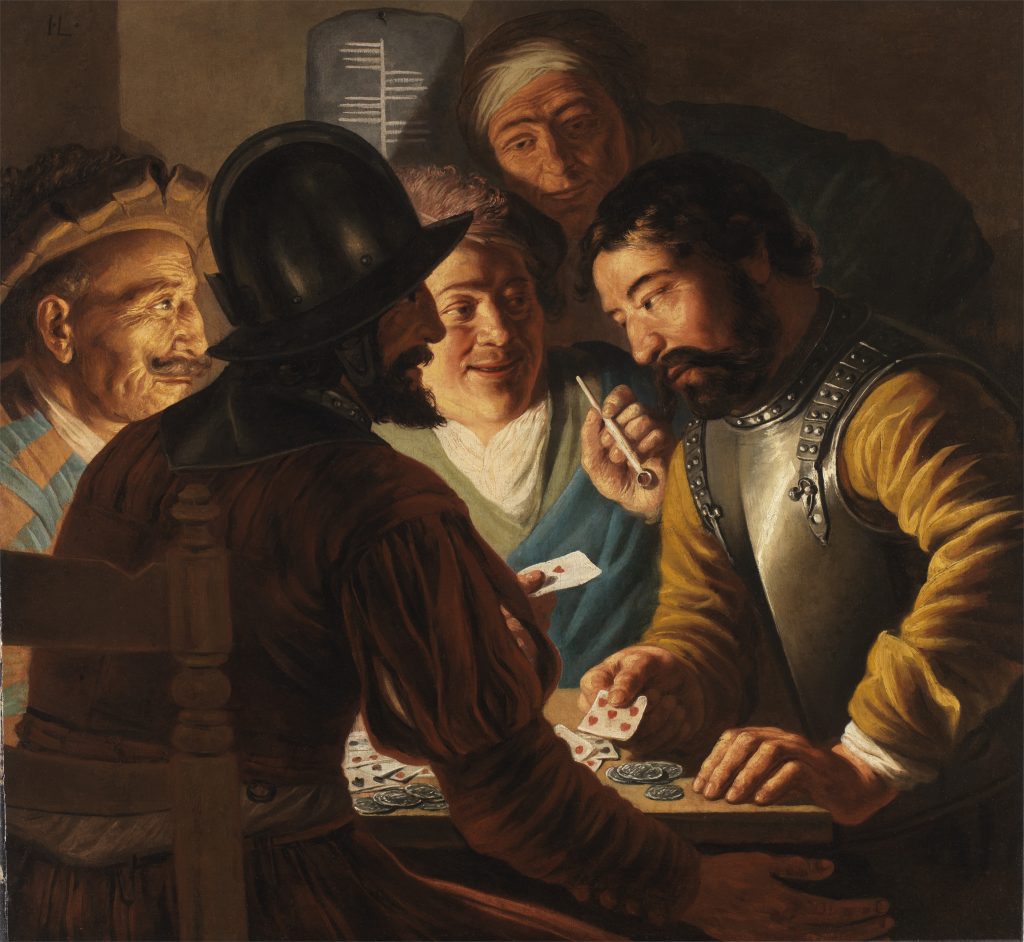
Jan Lievens was a contemporary of Rembrandt’s. He is sometimes described as his student, sometimes as a friend, sometimes as a colleague, and sometimes as a competitor. Here, Lievens portrays two soldiers in a card game with three barflies looking on. The model for the fellow with the pipe might well be Rembrandt himself. The chalkboard on the wall is tallying the bar tab, and clearly, there has been some drinking going on this evening. The soldier with the breastplate is disappointed to see that his five of hearts is trumped by the helmeted soldier’s ace.
Interestingly, Steen chose the ace of hearts to be the winning card. If there is a playing card that is the opposite of warfare, it is this one. He could have told the story using spades, clubs, or diamonds, but he chose hearts. Perhaps Lievens is giving us a message that, in the long run, love is more powerful than war?
Rembrandt in His 20s—Just Getting Started
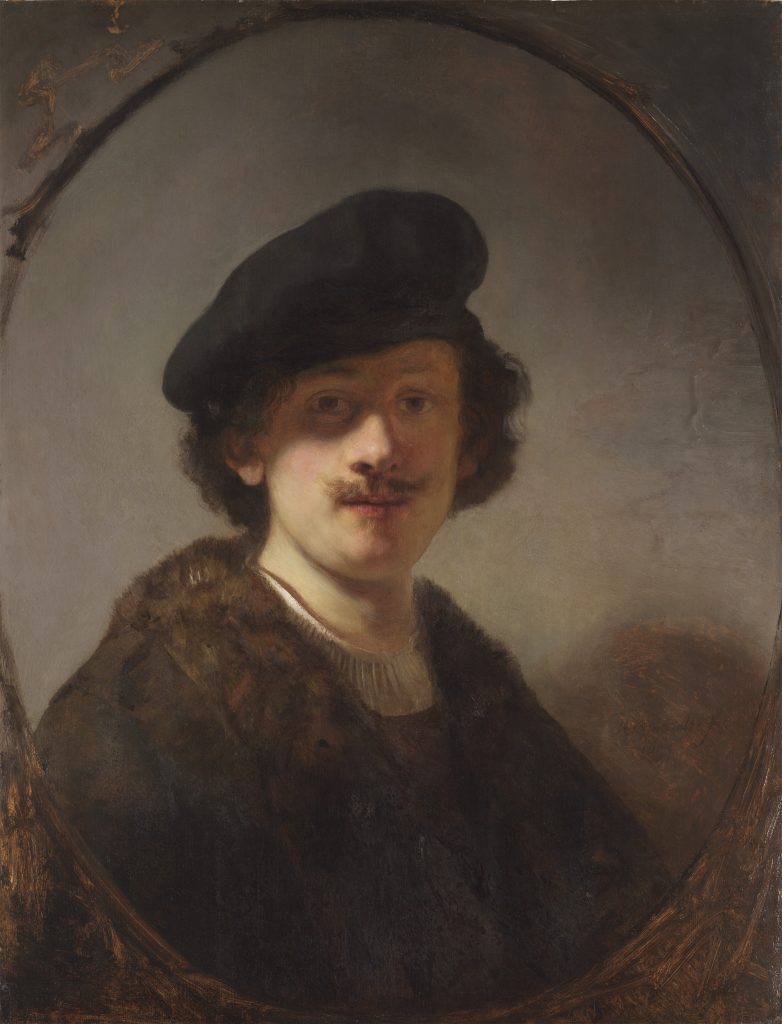
With 17 Rembrandts on display, it is inviting to try to pick a favorite. This one might be mine.
Rembrandt painted some 49 self-portraits during his life. This one would be one of his earliest, done when he was 28. He is much younger here than in most of his more familiar self-portraits made when he was middle-aged or older. Here, he seems to be looking directly at us through an oval aperture, set slightly off center. He shows himself to be a serious artist—he wants us to take him seriously.
It’s Worth the Trip
The exhibit will only be here for another couple of months, but it is well worth a visit. The Norton Museum of Art not only exhibits masterworks by Rembrandt, as one would expect from the exhibit’s name, but also showcases the wondrous works of his students and contemporaries from the Dutch Golden Age, giving a sense of life in Holland at the time. The good news is that because the paintings in The Leiden Collection are frequently on the road, they might well be coming to a museum closer to you sometime soon.
Art and Life in Rembrandt’s Time: Masterpieces from The Leiden Collection is on view at the Norton Museum of Art, West Palm Beach, FL, USA, through March 29, 2026.