



Queen of Chicago: American Surrealist Gertrude Abercrombie
Gertrude Abercrombie’s barren landscapes, cats, female figures in long dresses, and other repeated imagery built a complex body of haunting...
Theodore Carter 5 June 2025
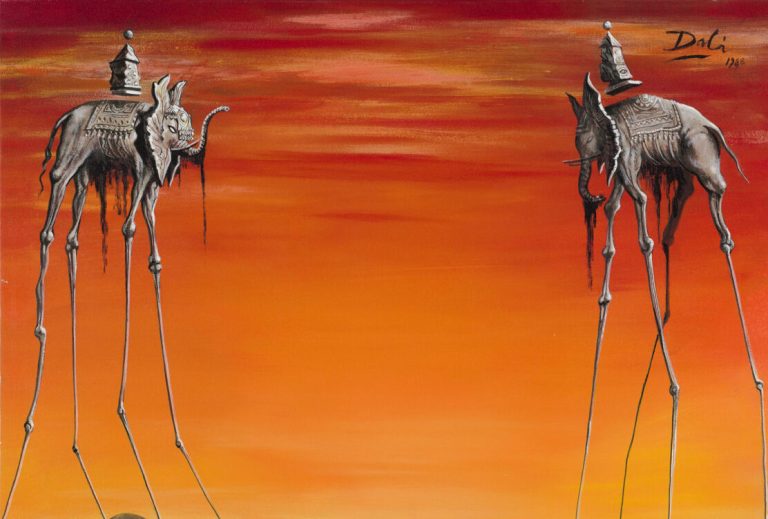
Salvador Dalí, The Elephants, 1948, private collection. Singulart. Detail.
Salvador Dalí (1904–1989) is celebrated as one of the most imaginative and influential artists of the 20th century. His unique vision extended across painting, sculpture, design, photography, and even jewelry, creating a world where dreams and reality intertwine. Let’s explore 10 remarkable Salvador Dalí artworks, showcasing his creativity, surrealist style, and lasting impact on art and culture.
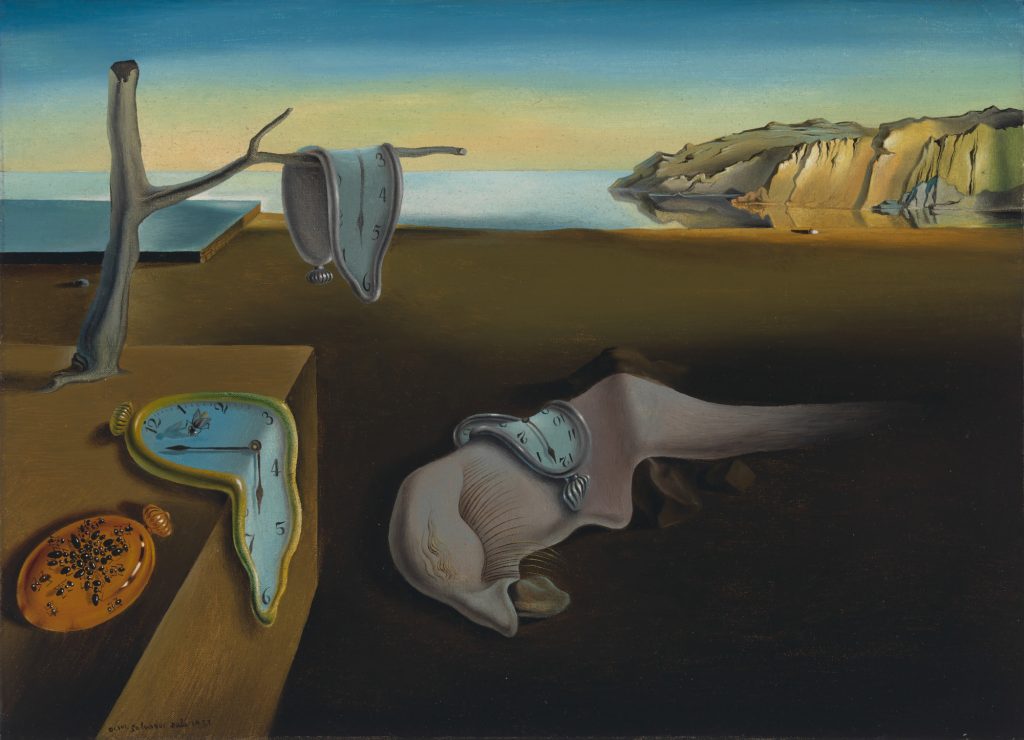
Salvador Dalí, The Persistence of Memory, 1931, Museum of Modern Art, New York City, NY, USA.
The Persistence of Memory is one of the most iconic Dalí artworks and a defining image of Surrealism. Salvador Dalí painted it in 1931, drawing inspiration from the Catalan landscape of his youth. At first, the quiet coastal setting suggests stability and stillness. However, melting clocks quickly disrupt this sense of order and challenge conventional ideas of time.
Dalí presented time as flexible and subjective rather than mechanical and absolute. Additionally, ants crawling across one clock introduce themes of decay and anxiety. Near the center, a distorted, sleeping figure evokes Dalí’s own profile and suggests a dream state. This form reinforces the painting’s connection to the unconscious mind. Meanwhile, the sharp cliffs in the background contrast with the soft, sagging objects in the foreground. As a result, permanence and fragility coexist within the same space.
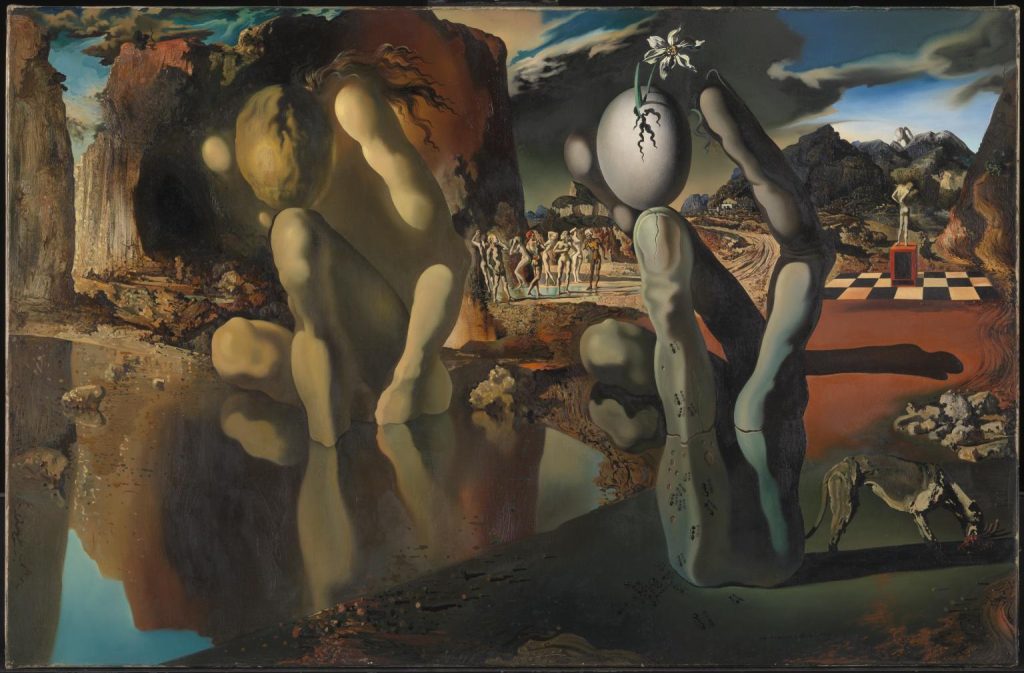
Salvador Dalí, Metamorphosis of Narcissus, 1937, Tate Modern, London, UK.
The Metamorphosis of Narcissus marks a pivotal moment in Salvador Dalí’s Surrealist development. He painted the work in 1937 while deeply engaged with psychoanalysis and myth. He reinterpreted the classical story of Narcissus as a study of obsession and transformation. At first, the viewer sees a kneeling figure gazing into water. However, this form gradually mirrors a stone hand holding an egg. From the egg, a narcissus flower emerges, symbolizing rebirth. Through this visual doubling, Dalí emphasized the idea of metamorphosis itself.
Moreover, the barren landscape reinforces themes of isolation and self-absorption. The artist used a precise, academic technique to heighten the illusion. As a result, the impossible transformation appears logical and controlled. The painting also reflects Dalí’s “paranoiac-critical” method, which encouraged multiple interpretations. Consequently, viewers shift between images without settling on one meaning.
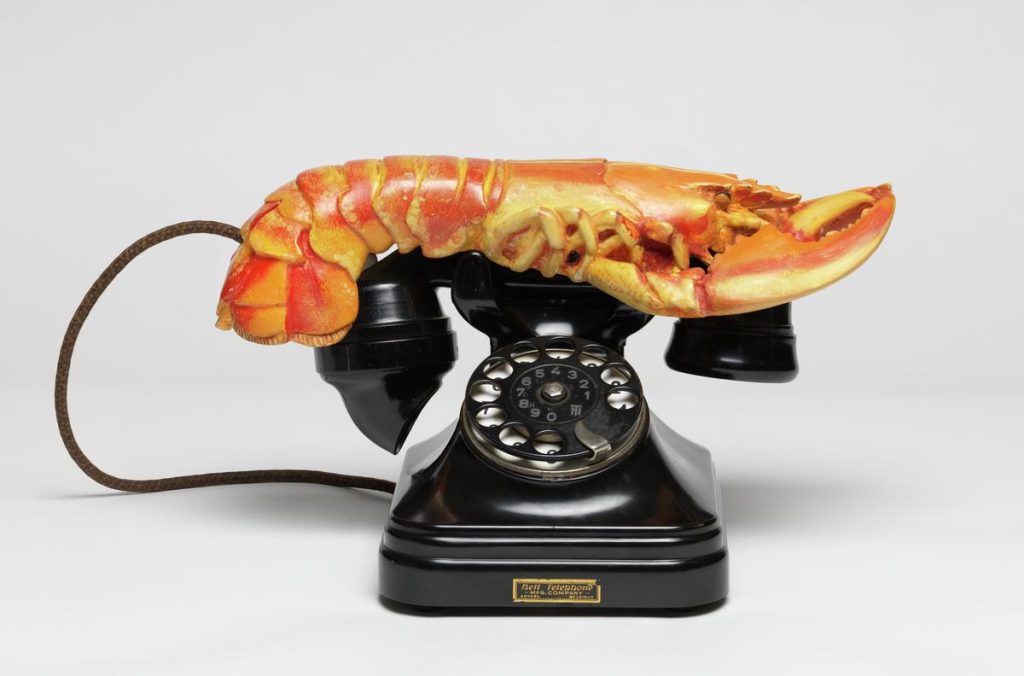
Salvador Dalí, Lobster Telephone, 1938, Tate Modern, London, UK.
The Lobster Telephone represents one of the most provocative Salvador Dalí styles, blending humor with disruption. Created in 1936, the object combines a real lobster with a standard telephone receiver. Dalí deliberately selected familiar items to heighten their strangeness when paired. Instead of serving a practical purpose, the telephone becomes irrational and unsettling. Through this unexpected union, Dalí challenged conventional logic and bourgeois comfort.
Furthermore, the lobster carried strong erotic and symbolic associations in his work. By placing it on a device associated with communication, Dalí suggested desire, anxiety, and miscommunication. The piece also reflects Surrealism’s interest in chance encounters. Unlike painted dreamscapes, this object intrudes directly into everyday life. As a result, the viewer confronts surrealism in physical form. Dalí blurred the boundary between art and object without explaining, much like any Surrealist would have done.
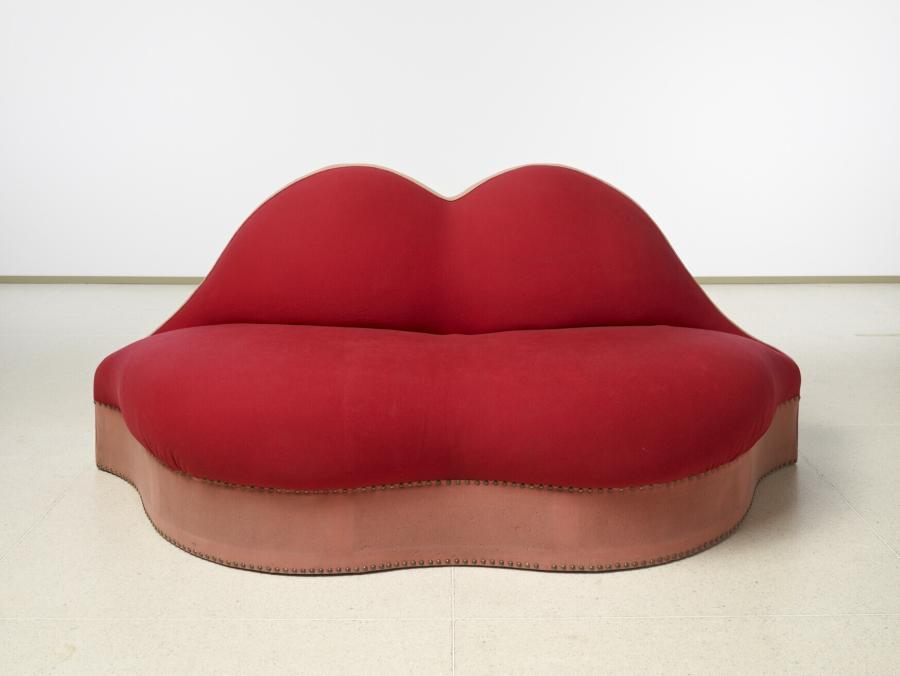
Salvador Dalí, Mae West Lips Sofa, 1938, Museum Boijmans Van Beuningen, Rotterdam, Netherlands.
Dalí designed the Mae West Lips Sofa between 1937 and 1938 as part of a larger exploration of portraiture and space. Rather than painting the actress, he translated her features into an interior environment. The bright red lips immediately dominate the object, demanding attention. At the same time, the sofa functions as usable furniture. This tension between utility and fantasy defines the work. Dalí drew inspiration from Hollywood glamour and mass culture.
By isolating Mae West’s lips, he reduced celebrity to an exaggerated symbol of desire. The piece also reflects his fascination with the female body as landscape. Unlike traditional sculpture, the sofa invites physical interaction. Viewers can sit on a mouth, crossing boundaries between intimacy and design. Through this gesture, Dalí collapsed distinctions between fine art and decoration. The work later influenced pop art and experimental furniture design.
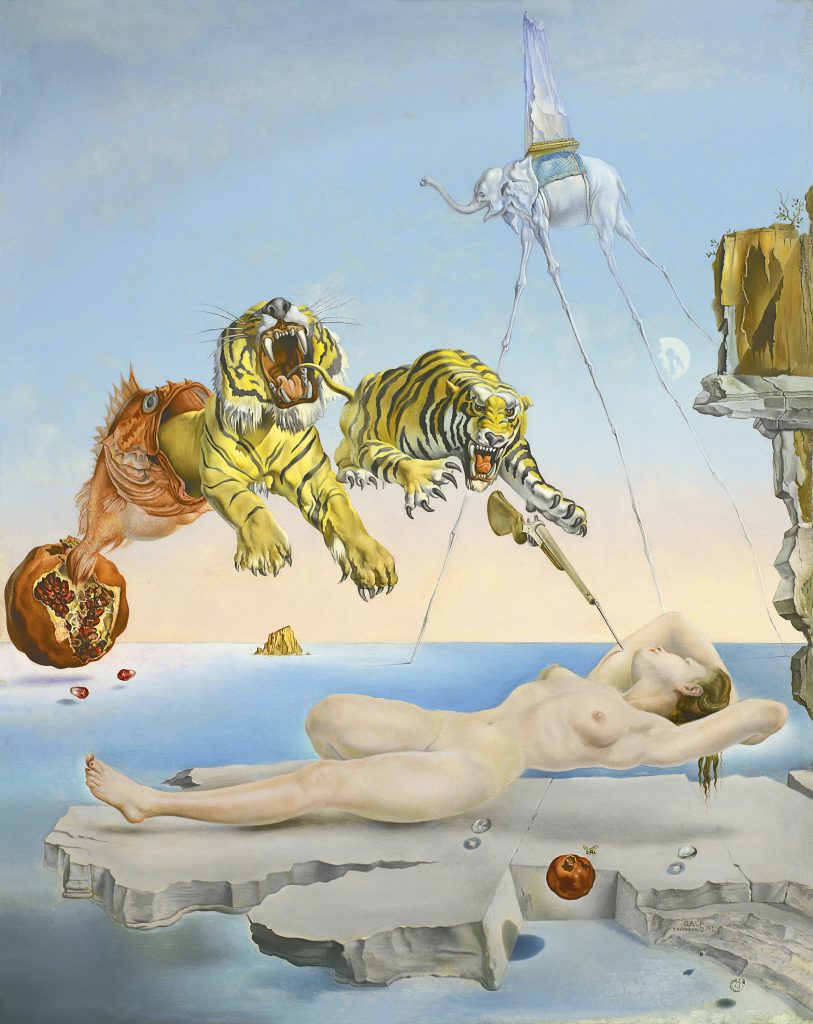
Salvador Dalí, Dream Caused by the Flight of a Bee Around a Pomegranate a Second Before Awakening, 1944, Thyssen-Bornemisza Museum, Madrid, Spain.
Dream Caused by the Flight of a Bee Around a Pomegranate a Second Before Awakening stands as one of the most technically refined Salvador Dalí artworks. The artist painted it in 1944 during his period of heightened interest in dreams and scientific clarity. The composition captures a single suspended moment before waking. A sleeping figure, modeled after Gala, floats above a rock formation. From a small pomegranate, a chain of violent images erupts. Two tigers leap forward, followed by a bayonet aimed at the sleeper’s arm. Dalí visualized how minor sensations can trigger intense dream imagery.
Meanwhile, a calm seascape stretches across the background. This serenity contrasts sharply with the explosive action in the foreground. Dalí used crisp outlines and smooth surfaces to control the chaos, resulting in a precise rather than blurred image of the dream. At the same time, the painting demonstrates his belief that dreams follow their own internal logic.
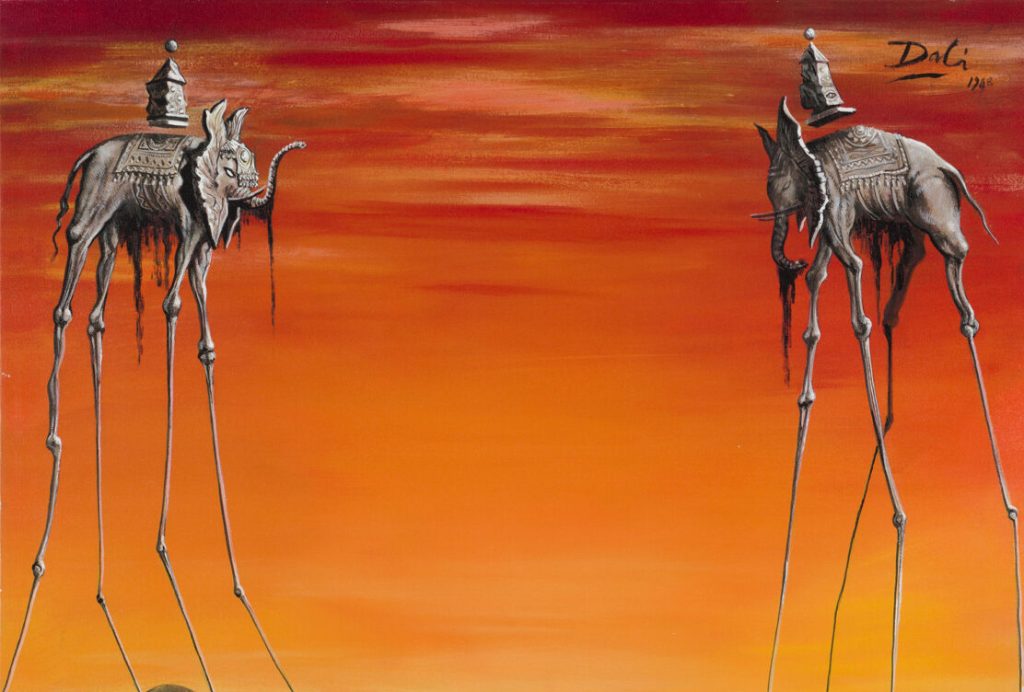
Salvador Dalí, The Elephants, 1948, private collection. Singulart.
The Elephants reveals Salvador Dalí’s ability to balance monumentality with fragility, while reflecting his mature style. Painted in 1948, the work features towering elephants supported by impossibly thin legs. Dalí borrowed the elephant motif from a Roman sculpture of Bernini’s obelisk carrier. However, he stripped the symbol of its traditional stability. The elongated legs create a sense of weightlessness and tension.
Each elephant carries an obelisk, reinforcing ideas of power and burden. Yet the animals appear vulnerable rather than dominant. A barren, twilight landscape enhances the dreamlike atmosphere. Small human figures move beneath the giants, emphasizing scale and distance. Dalí used warm, glowing light to soften the scene, preventing the image from looking threatening. Instead, the painting suggests uncertainty and balance. It remains one of the most iconic Dalí artworks that defined the Surrealist movement.
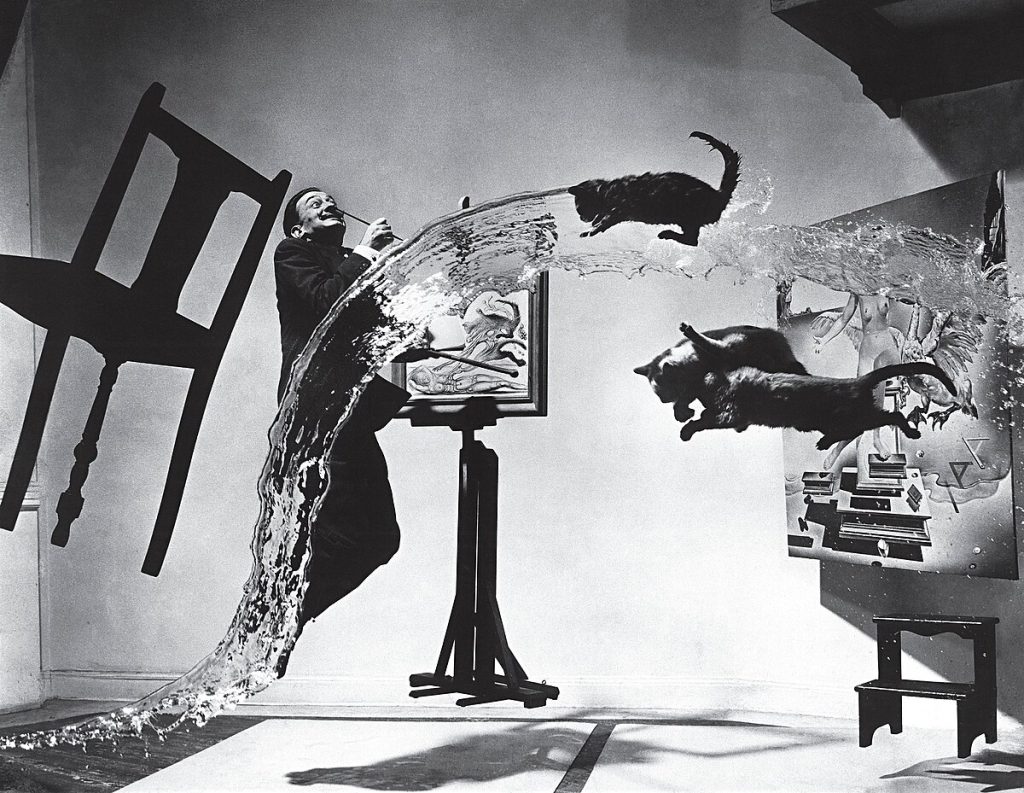
Philippe Halsman, Dalí Atomicus, 1948. Wikimedia Commons (public domain).
This photograph captures the theatrical energy behind some of the most celebrated Salvador Dalí artworks. Created in 1948 with photographer Philippe Halsman, the image documents a carefully staged moment of controlled chaos. Dalí appears mid-air as objects float around him. Cats leap, water splashes, and furniture hovers without visible support. The photograph required repeated attempts rather than manipulation or montage. Each element depended on precise timing and physical coordination.
The title references Dalí’s interest in atomic theory and suspended matter. After World War II, he became fascinated with particles and instability. This image translates those ideas into visual form. Unlike painting, photography freezes real motion instead of imagined scenes. As a result, the surreal effect feels immediate and physical.
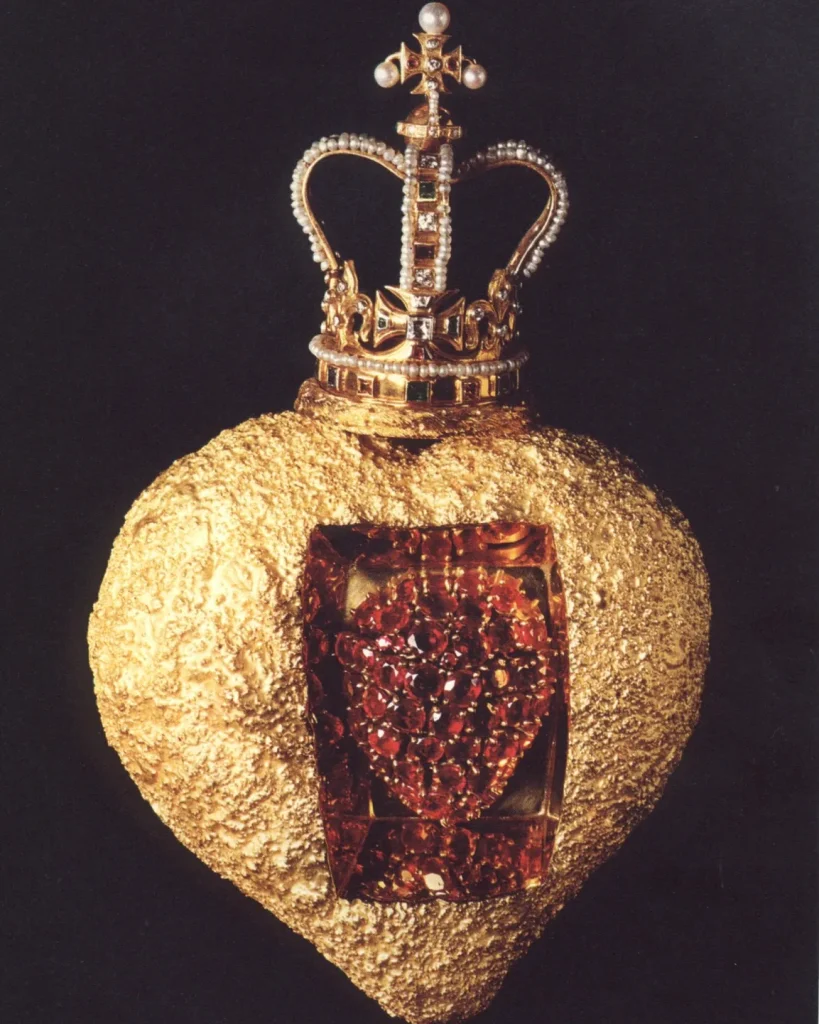
Salvador Dalí, Royal Heart Jewelry, c. 1953. Natural Diamonds.
This piece of jewelry reflects Salvador Dalí’s ambition to bring Surrealism into luxury objects. He designed the piece in 1953 as one in a series of high-end jewels. The heart appears anatomically inspired yet idealized. Rubies, diamonds, and gold form its surface with meticulous craftsmanship. At the center, a mechanical mechanism causes the heart to beat. This movement transforms the jewel into a living object.
Dalí often described the heart as a symbol of emotional excess. Here, he combined romance with obsession and control. The piece blurs boundaries between sculpture, design, and adornment. Unlike traditional jewelry, it prioritizes concept over wearability. Royal Heart left a mark in history, inspiring several artists, such as Daniel Roseberry for house Schiaparelli and his FW 25 collection.
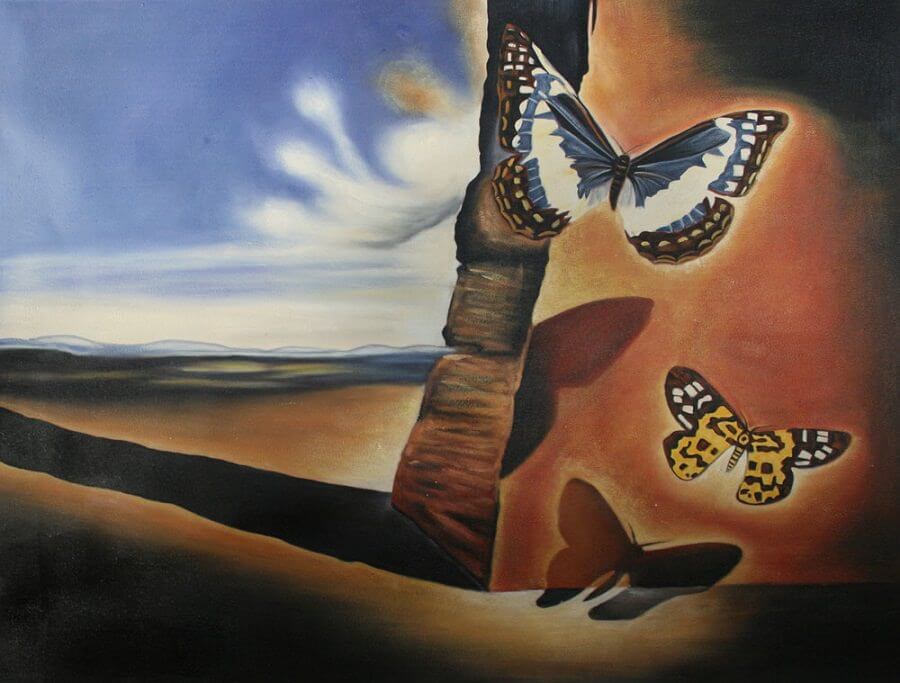
Salvador Dalí, Landscape with Butterflies, 1956. Salvador Dali Paintings.
Landscape with Butterflies illustrates Dalí’s late fascination with science, nature, and transformation. The composition features a vast, luminous landscape scattered with oversized, delicate butterflies. Dalí combined precise realism with dreamlike elements, making each butterfly appear both fragile and monumental. In the distance, mountains and cliffs rise with soft, glowing light, adding depth and serenity. The butterflies seem to float in midair, suggesting movement and metamorphosis.
Salvador Dalí often used insects as symbols of change, impermanence, and the passage of time. The work further reflects his interest in optical illusions, creating multiple layers of perception. By merging natural imagery with surreal distortion, he encourages viewers to reconsider reality. Landscape with Butterflies exemplifies Dalí’s late style, where scientific observation meets poetic imagination.
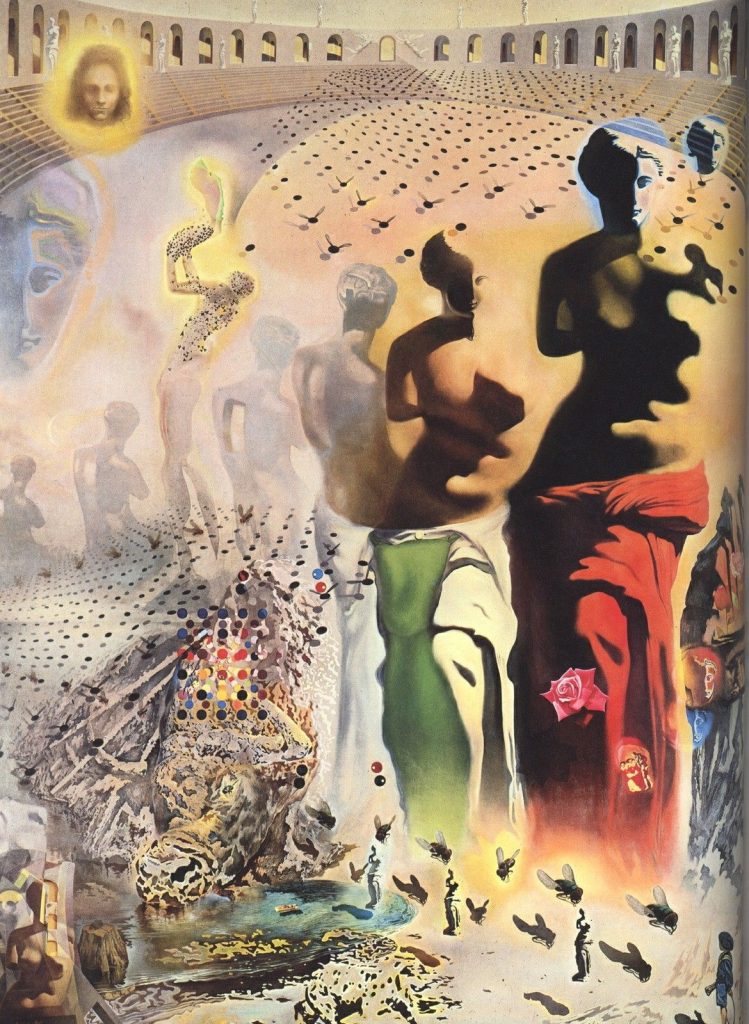
Salvador Dalí, The Hallucinogenic Toreador, 1968–1970, Salvador Dalí Museum, St. Petersburg, FL, USA.
The Hallucinogenic Toreador remains one of the most intricate Dalí artworks, completed in 1970. Dalí combined multiple layers of imagery, creating a complex visual puzzle. At first glance, the painting depicts a bullfighter in a traditional arena. Upon closer inspection, numerous hidden faces and shapes emerge throughout the composition. The artist employed his paranoiac-critical method once more to generate these optical illusions. Venus de Milo figures and other classical references appear among the crowd and background.
Each element interacts with the others, forming dual images that challenge perception. Bright colors contrast with shadowed areas, guiding the viewer’s eye across the canvas. Dalí’s precision makes the surreal elements appear plausible and tangible. The painting reflects his fascination with Spanish culture, bullfighting, and human form. Moreover, it demonstrates his enduring interest in visual tricks and subconscious symbolism.
DailyArt Magazine needs your support. Every contribution, however big or small, is very valuable for our future. Thanks to it, we will be able to sustain and grow the Magazine. Thank you for your help!

I'm Errika Gerakiti, an art writer and curator based in Athens. I write about modern and contemporary art, fashion, and cinema — with a particular interest in the overlooked, the uncomfortable, and the underrepresented. When I'm not writing, I'm curating exhibitions, reading, painting, sculpting, or reading. For longer reads, personal essays, and an occasional science-fiction or horror story, find me on Substack.

As an educator, writer, and neurodivergent creative, I enjoy learning and sharing through nature, the arts and novel experiences.
Gertrude Abercrombie’s barren landscapes, cats, female figures in long dresses, and other repeated imagery built a complex body of haunting...
Theodore Carter 5 June 2025
Edward James saw himself as more than just a patron of Surrealism—he considered himself intimately connected with the movement and the ideas it...
Nikolina Konjevod 28 January 2026
Exploring five works by female Surrealist Meret Oppenheim
Candy Bedworth 16 December 2025
At the outbreak of World War II, Varian Fry, a US journalist, volunteered to travel to Marseille to assist in the repatriation of Europe’s...
Javier Abel Miguel 4 February 2026


