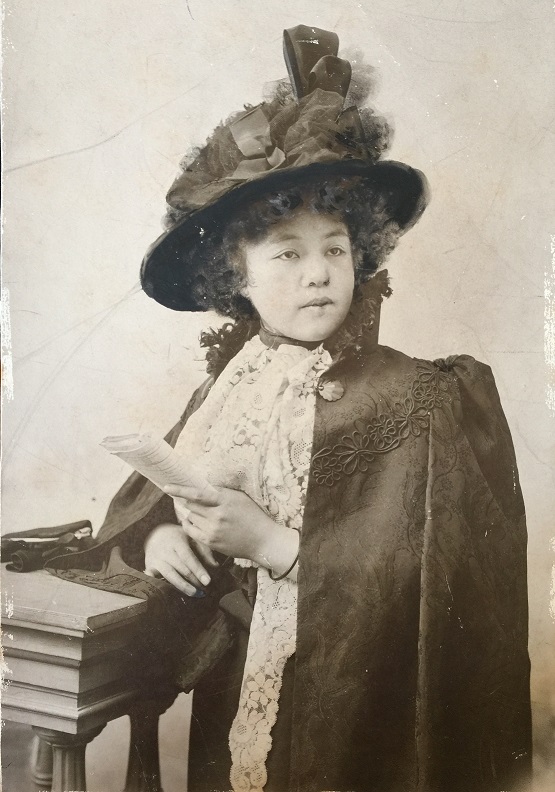
When tracing Japanese art stories in Europe, we found out about this exquisite female painter. Kiyohara Tama or Otama (later known as Eleonora Ragusa) was a woman so brave to leave the homeland for her husband and so ambitious to found a Japanese art school in Sicily.
After centuries of closure, Japan opened to foreign influence and trade in 1853. In his efforts to catch up with the global developments in technology, military, agriculture, and science, Emperor Meiji, or Meiji the Great, invited European scientists and experts to Japan. In the invited group, there were also three Italian artists who received a task to find an art school that would train young artists who would later equate Japanese art to European modern styles. Quickly did the new Kobu Bijutsu Gekko school in Tokyo open its doors to students trained in painting by Antonio Fontanesi, sculpture by Vincenzo Ragusa, and architecture by Vincenzo Cappelletti.
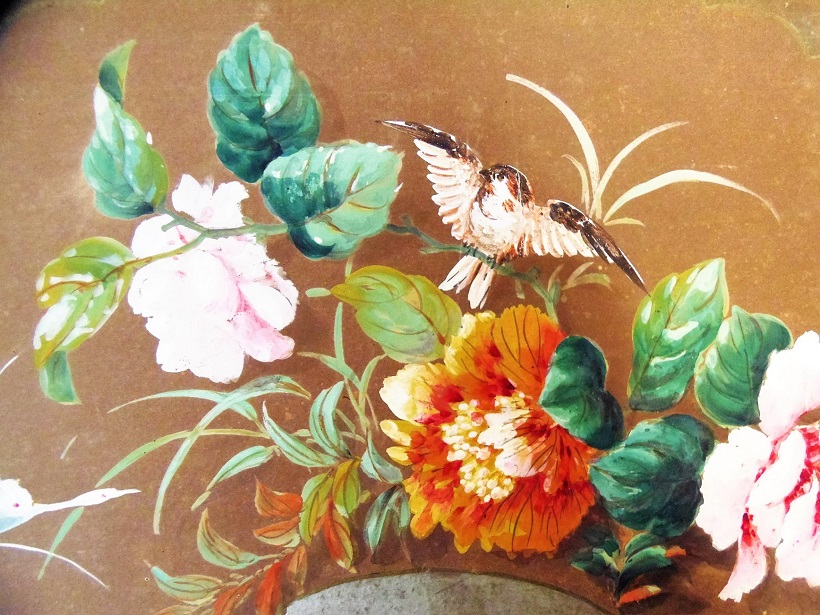
Kiyohara Tama, A sketch for a fan, 1887. Blog Sicilia.
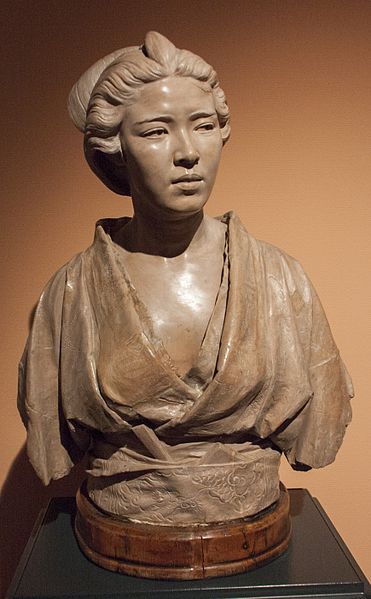
Vincenzo Ragusa, who originated from Palermo, met Kiyohara Tama in a garden where she was painting fans. He fell for her straight away and asked her to pose for a sculpture. Despite an age difference of 20 years, they quickly became lovers.
Photo by Davide Mauro, Vincenzo Ragusa, Bust of Otama Ragusa, 1883. Wikimedia Commons (public domain).
Tama was a real pioneer. Not only she was the first Japanese woman in history who married a European artist, but Kyohara Tama was also a skilled painter with enough courage to paint differently. Aged 21, she left her beloved Japan to follow her husband to Sicily, thankfully together with her sister and brother-in-law. They moved into a house in Palermo, where Otama lived until 1933.
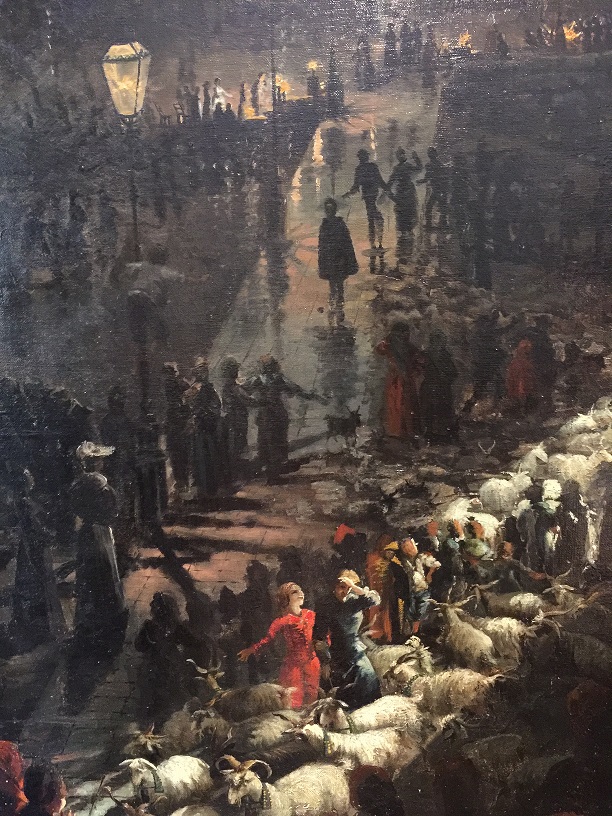
Kiyohara Tama, The blessing of the animals, 1891. Blog Sicilia. Detail.
The Japanologist and art historian Maria Antonietta Spadaro says:
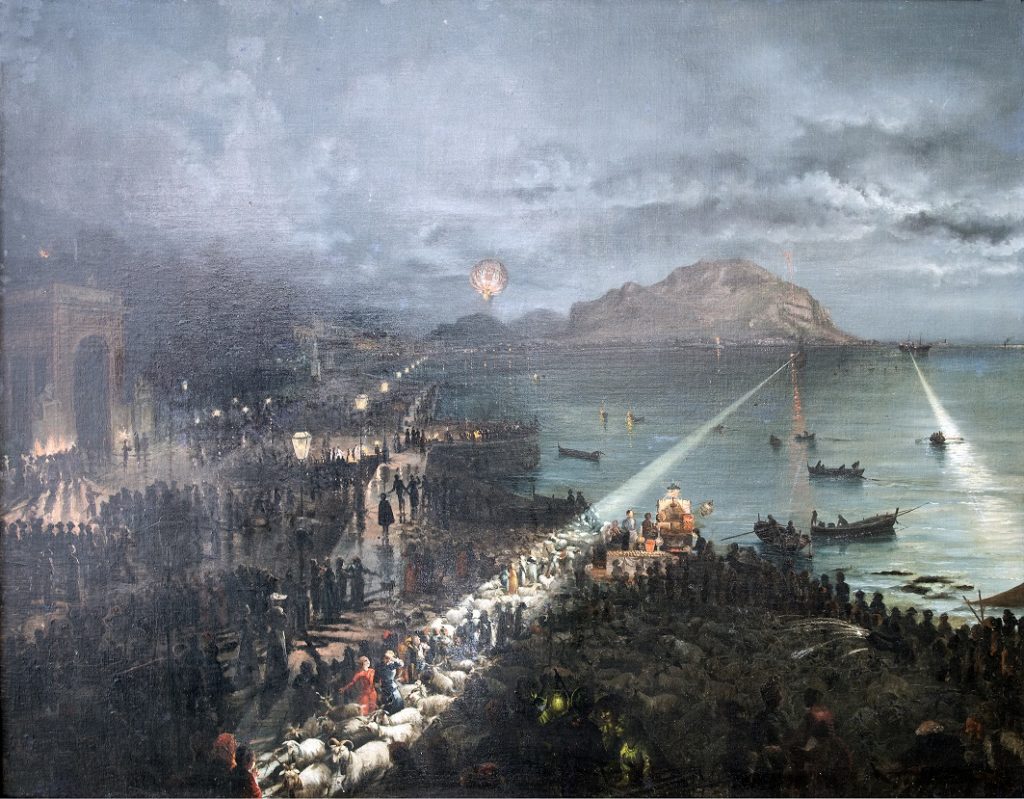
When arrived to Palermo, Otama found herself facing the entirety of Italian art. Her painting was instead variable and eclectic, ahead of its times since she chose to use techniques which did not yet exist in Japan. Let’s take The Night of the Feast of Ascension (Notte dell’ascensione): although all contemporary painters had depicted Mount Pellegrino, she was the first one to do it as a nocturnal scene. She showed the mount from above with a nebulous sky and lanterns which nobody had ever painted before, since the electric lamp posts were a complete novelty for Palermo and other Italian cities. Only the Futurists would have focused on them some time after that.
Maria Antonietta Spadaro
Kiyohara Tama, The Night of the Feast of Ascension (La Notte dell’Ascensione), 1891. Blog Sicilia.
Kiyohara Tama undoubtedly brought innovation to the hermetic Italian art world which had been fearing that art from the Far East would contaminate its pure artistic expression. Instead, it enriched it.
O’Tama. Migrazione di Stili, produced by Salvatore Militello accompanying the exhibition on Kiyohara Tama (December 2019-April 2020) in Fondazione Federico II Palermo, Palermo, Italy.
Tama’s husband died in 1927 but she remained in Palermo. Not long after her husband’s death, her extraordinary story was unearthed by two Japanese magazines which started writing a cover story on her life. Her Japanese relatives sent for her to Europe and, in 1933, she returned to Japan after 51 years away. Soon after, she opened a painting workshop in Shiba where she taught Italian art and culture until her death in 1937.
We love art history and writing about it. Your support helps us to sustain DailyArt Magazine and keep it running.
DailyArt Magazine needs your support. Every contribution, however big or small, is very valuable for our future. Thanks to it, we will be able to sustain and grow the Magazine. Thank you for your help!
Magda, art historian and Italianist, she writes about art because she cannot make it herself. She loves committed and political artists like Ai Weiwei or the Futurists; like Joseph Beuys she believes that art can change us and we can change the world.
'Painting the Light: The Story of Berthe Morisot, First Woman Impressionist' is written by Natalia Iacobelli and illustrated by Rosanna Tasker. Read about this inspiring new children's book from Reycraft Books.
Rolinda Sharples painted the world of Jane Austen, and the political turmoil unfolding beyond the ballroom. Her paintings capture Regency society as...
Bologna, in northern Italy, fostered more women artists in the early modern period than any other European city. Nowhere else matched the number, the...