Advertisement
Women Artists

Kiki Smith’s Bodies as Instruments of Perception and Travel

Magda Michalska 6 April 2019 min Read

It seems Kiki Smith didn’t have much choice when deciding on who to become in the future because art just flows in her veins: her father Tony Smith was a sculptor, her mother, Jane Lawrence Smith, was an opera singer and actor, and her sister Seton is also an artist… Although she was born in Nuremberg, Germany, she moved with her family to South Orange, NJ and quickly became a star of American contemporary art scene.
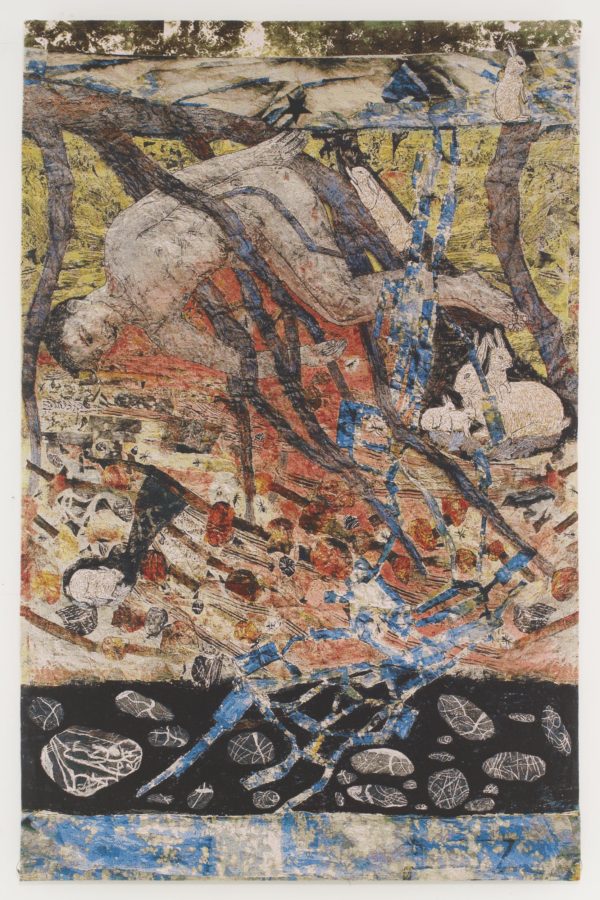
Kiki Smith, Tapestry Underground, 2012, Courtesy of the artist and Pace Gallery, Oakland, California, kiki smith's bodies
Kiki Smith, Tapestry Underground, 2012, Courtesy of the artist and Pace Gallery, Oakland, California

Kiki’s main artistic focus until the 1990s was the construct of the body, in particular that of the woman in all its fragile balancing on the verge of life and death. “I always think the whole history of the world is in your body,” Smith has said and hence treated it not only as a corporeal identity which is often torn and at times even dismembered, but also as an independent entity capable of rebellion or redemption. In her artistic exploration Kiki used a variety of media, such as drawing, sculpture, printmaking, photography, and textiles.
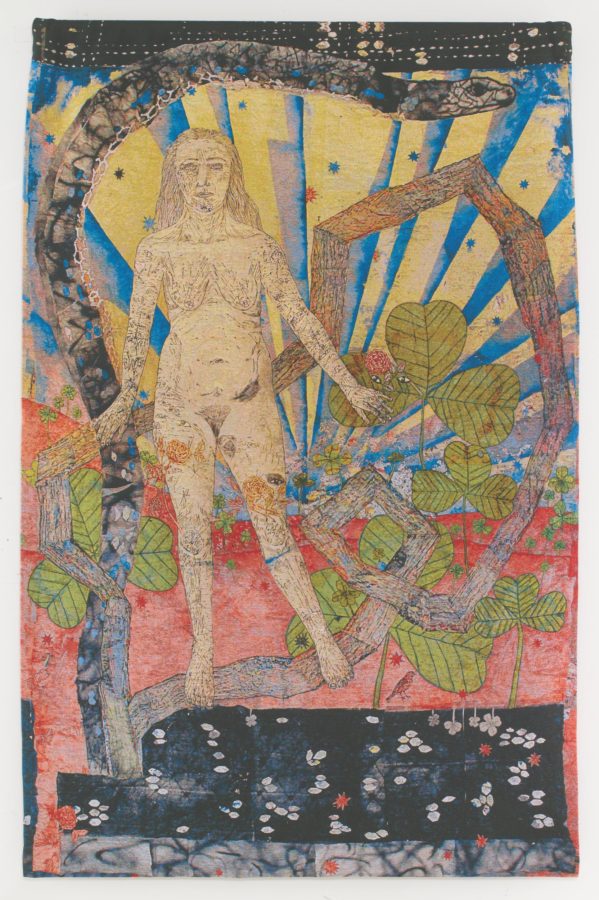
Kiki Smith, Tapestry earth, 2012, Courtesy of the artist and Pace Gallery, Oakland, California, kiki smith's bodies
Kiki Smith, Tapestry Earth, 2012, Courtesy of the artist and Pace Gallery, Oakland, California

Her new show What I saw on the road that you can see in Uffizi in Italy, features tapestries and sculptures which portray how the body is a lens and an instrument through which we can experience: Kiki explores the relationship between the body and the world, between man and the cosmos. Eike Schmidt, director of the Uffizi Galleries, noted that “the extremely elegant grace of Kiki’s latest works, whose often fragile and precious matter is an effective metaphor of the human – especially the female – condition, has the loftily ethical aim of recreating unity and harmony in what is so often a world of brutality and discord, unleashing a deeply revolutionary energy: hers is the vocabulary of a new, unexpected and disconcerting pietas.”
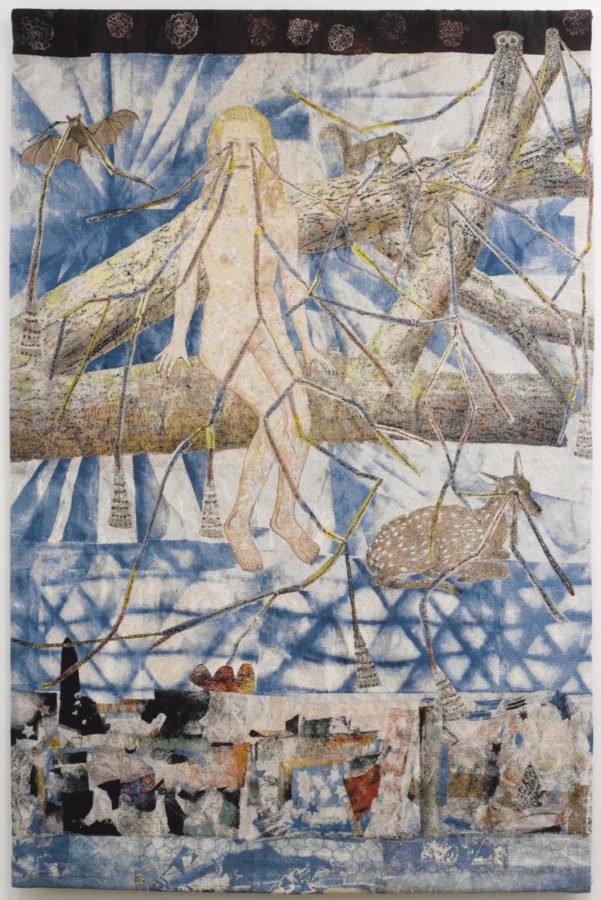
Kiki Smith, Tapestry Congregation, 2014, Courtesy of the artist and Pace Gallery, Oakland, California, kiki smith's bodies
Kiki Smith, Tapestry Congregation, 2014, Courtesy of the artist and Pace Gallery, Oakland, California

You can see the exhibition at Palazzo Pitti until June, 2nd.

Advertisement

Recommended

Women Artists

How a Curious Girl Became a World-Class Painter—New Children’s Book About Berthe Morisot

'Painting the Light: The Story of Berthe Morisot, First Woman Impressionist' is written by Natalia Iacobelli and illustrated by Rosanna Tasker. Read about this inspiring new children's book from Reycraft Books.

Candy Bedworth 7 September 2026

Women Artists

Rolinda Sharples—Jane Austen’s Contemporary Who Painted Britain’s Changing Society

Rolinda Sharples painted the world of Jane Austen, and the political turmoil unfolding beyond the ballroom. Her paintings capture Regency society as...

Guest Author 31 August 2026

Women Artists

Blanche Hoschedé-Monet: The Successful Painter History Remembered as Monet’s Stepdaughter

She was photographed beside Claude Monet in his garden at Giverny. She was called “the blue angel” by Georges Clemenceau. She is remembered as...

Guest Author 30 July 2026

Women Artists

Hidden Places to See Celebrating Women Artists in Bologna

Bologna, in northern Italy, fostered more women artists in the early modern period than any other European city. Nowhere else matched the number, the...

Kitty Perring 10 August 2026

Advertisement