1. A Self-Portrait in Allegory
Ginevra Cantofoli was a woman persistent in her pursuit of developing artistic skills. In this study, she depicts a young woman holding a compass in her right hand, suggesting that this may not be a portrait of a specific person, but rather an allegorical figure representing geometry, science, or intellectual virtue.
The figure, rendered in red, black, and white chalk, possesses a striking resemblance with a painting from the Pinacoteca di Brera in Milan, considered to be a self-portrait of the artist. This raises the intriguing possibility that the present study, too, may be a self-portrait of Cantofoli in allegorical character—presenting herself as the embodiment of artistic intellect and learning.
2. Tenderness and Tragedy
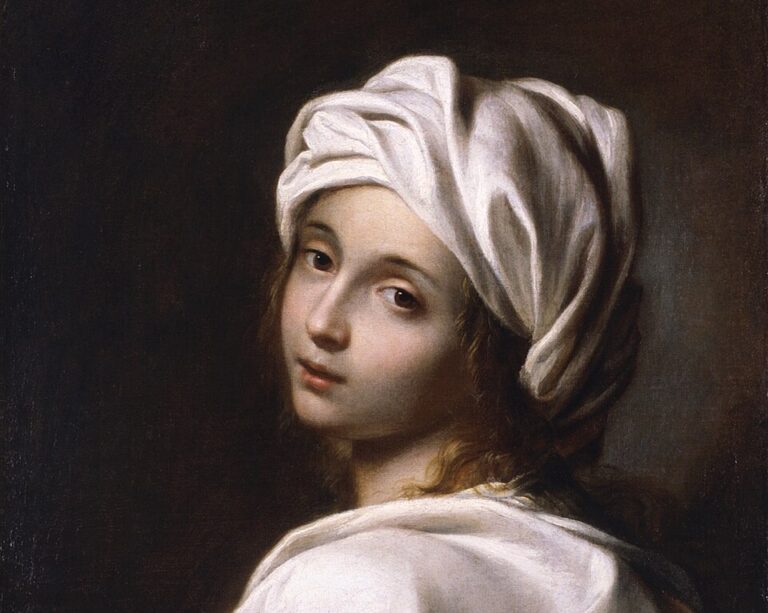
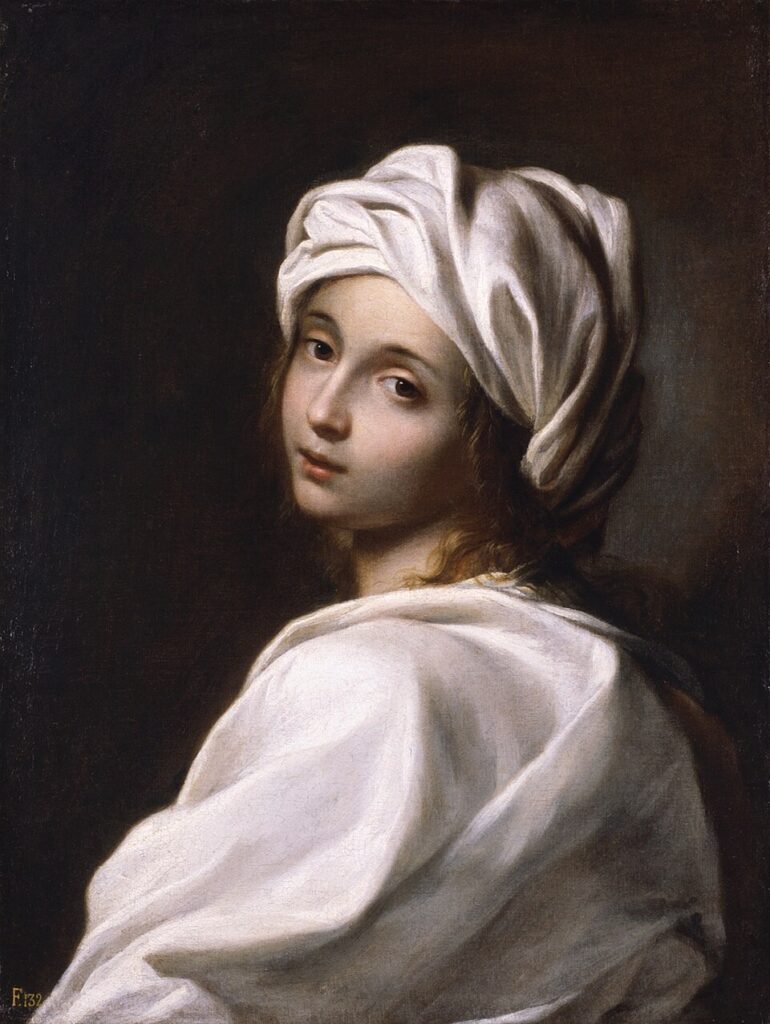
This work truly explains why Ginevra Cantofoli deserves more attention. The greatest writers and poets of the 19th century venerated this portrait. At first, this portrait of Beatrice Cenci was attributed to the Italian Baroque painter Guido Reni, however, today, critics generally agree that this painting is by Cantofoli.
The artwork takes up the controversial story of Beatrice Cenci, the Italian noblewoman executed under papal authority during the pontificate of Pope Clement VIII. Cenci was heavily abused by her father, whom she ultimately killed. She was then tried for murder and, despite widespread public sympathy, beheaded in Rome in 1599. Cantofoli conveys the cruel and unjust fate of this young girl through a sense of innocence and quiet tenderness. The stillness of the captured moment transforms the violence of her story, turning it into a moment of calm introspection.
3. Between Truth and Illusion
This work was previously called An Allegory of Vanity, which reflects a complex interpretation of its subject. A young woman in a flowing silver gown holds a pair of scales beside a mirror set upon a stack of books. Mirrors, skulls, and balances usually symbolize the fleeting nature of life, leading some to interpret the image as an allegory of Vanity.
Cantofoli’s version, however, departs from this convention: the scales are unbalanced, no skull appears, and the mirror reflects the woman’s own profile—though not quite accurately. Such details reveal a more subtle idea. It suggests that truth may be uncertain or constructed, that what we see does not fully coincide with what is real, and that art, in turn, plays with and reshapes that illusion.
4. Cantofoli’s Allegorical Figures
Working under the influence of Bolognese painters Elisabetta Sirani and Guido Reni, Cantofoli adopted the motif of the female half-length figure as saint or allegory—one of Reni’s most popular and enduring inventions. The figure of Temperance follows the description given in the famous book Iconologia by Cesare Ripa. Temperance is mostly shown with a bridle and a palm frond, a symbol of the reward for mastering one’s passions. It is also believed that many faces of Cantofoli’s figures are actually very similar to her own, if compared to her self-portraits.
5. A Sea-Nymph
This painting of a sea-nymph is one of Cantofoli’s most recognizable masterpieces. It depicts a woman crowned with mollusk shells, holding a red coral. She has her back turned to the viewer as she casts a mysterious glance over her shoulder. The figure is believed to represent Galatea, though she was typically portrayed riding a shell chariot drawn by dolphins. Galatea was a very popular subject in the 17th-century painting, known from the Ovid’s Metamorphoses. She transformed her mortal lover Acis into a river spirit after he was killed by the jealous Cyclops.
6. A Recurring Facial Type
At the first glance, this painting draws the viewer’s attention with the woman’s calm and introspective expression. Her gaze is soft and reserved, giving her a sense of quiet self-awareness. The blue turban is rendered with careful attention to folds and volume. It also draws our view upward, framing the face and emphasizing her soft and oval features. The woman’s face, small mouth, and slightly receding chin align closely with the facial type often associated with Cantofoli’s figures.
7. An Intimate Allegory
In this intimate scene, two softly lit figures emerge from a shadowed background, with their interaction unfolding with quiet intensity. The gentle modeling of figure’s faces recall Cantofoli’s usual style seen in the rest of her works. The atmosphere is contemplative, inviting the viewer into a moment that feels both personal and symbolic. The painting is ultimately leaving us to ponder the meaning of its allegory.
These works show an artist with a quiet but distinct voice. Through subtle allegory and a careful, refined technique, Ginevra Cantofoli creates images that feel both personal and thoughtful. Her paintings invite reflection, leaving a lasting impression that continues to unfold.
P.S. If you enjoy art created by women, don’t miss our two editions of Women Artists Postcards, showcasing masterpieces by remarkable painters across different periods and styles!