10 Famous Artists You Wouldn’t Think Were Self-Taught
Think art school is the only path to greatness? Think again. These 10 artists defied convention through persistence, originality, and vision, without...
Wen Gu 22 January 2026

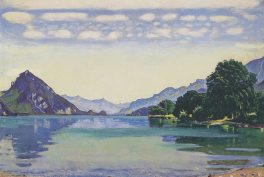
Ferdinand Hodler, The View on Lake Thun from Leissigen, Museum of Fine Arts Bern, Bern, Switzerland.
Ferdinand Hodler was one of the principal figures of 19th-century Swiss painting. Hodler worked in many styles during his life. Over the course of his career, he painted picturesque landscapes, realist portraits, genre paintings, and invented a style of his own called Parallelism that was inspired by Symbolism. His work had a significant impact on the Swiss artistic sensibility. Let’s take a closer look at this multifaceted painter and his creative life.

Ferdinand Hodler, The Student (Self-Portrait), 1874, Kunsthaus Zürich, Zurich, Switzerland.
Born in 1853 in Bern, Ferdinand Hodler’s childhood was humble and marked by tragedy. Hodler lost his father and two of his siblings at a young age. When his mother remarried, Hodler began to assist his stepfather, a sign painter, and this was the beginning of his formal training. Hodler was later apprenticed to another local artist who taught him the quintessentially Swiss tradition of the Alpine landscape, a tradition he would go on to upend.

Ferdinand Hodler, Self-Portrait with Roses, 1914, Museum zu Allerheiligen, Schaffhausen, Switzerland.
When Hodler was 18, he moved to Geneva pursuing his artistic career. He followed the traditional route, going to lectures and copying art in museums. From 1872-1877 he studied under Barthélemy Menn who had trained with Jean-Auguste-Dominique Ingres and was a contemporary and friend of Jean-Baptiste-Camille Corot. Studying with Menn introduced Hodler to French avant-garde painting, especially Gustave Courbet. Hodler began to push his picturesque style towards a form of realism influenced by Courbet.

Ferdinand Hodler, The Reader, c. 1885, Thyssen-Bornemisza Museum, Madrid, Spain.
Ferdinand Hodler frequently exhibited in Geneva and his new realist style became a subject for local art critics. Their reactions were varied – some dismissed his work outright for being “ugly”, while others found it original and boundary-breaking, a style that could push Swiss paining forward. But despite the recognition which these debates created, Hodler was still struggling financially.

Ferdinand Hodler, Portrait of Hélène Weiglé, 1888, Städel, Frankfurt, Germany.

Ferdinand Hodler, The Feeling, 1901, private collection.
In the 1880s Hodler’s style began to evolve once again. In Geneva, he frequented a variety of artistic circles. He became drawn to Idealism and Symbolism, artistic and intellectual movements that went on to influence his paintings. Modern dance, philosophy, and music began to have a profound impact on the artist, and he slowly left behind his realist style. Hodler also began exhibiting internationally during this period, at the Paris Salon as well as in London. He became an ambassador for Swiss art abroad, which only made him more beloved at home.

Ferdinand Hodler, Unemployed, 1891, private collection.
Hodler combined his interest in Idealism and Symbolism, as well as his appreciation for the Art Nouveau style, to create Parallelism, an aesthetic of his own. The style was based on symmetry and repetition. In his Parallelist works, Hodler strove to create perfectly balanced compositions. It was both an aesthetic and a philosophical goal. The artist endeavored to recreate in his paintings the sense of order which, as he believed, could already be found in nature. This new style was embodied by his painting Night. The provocative work caused a scandal at the 1891 Geneva Salon for its perceived obscenity.

Ferdinand Hodler, Night, 1889-1890, Museum of Fine Arts Bern, Bern, Switzerland.
.

Ferdinand Hodler, Retreat from Marignano, 1900, fresco on the west side of the Armory Hall, Swiss National Museum Zurich, Switzerland.
At the turn of the century, Hodler had a well-established reputation in Switzerland. He started receiving public commissions and became a sought-after history painter. He created a large-scale painting for the Palais des Beaux-Arts in Geneva for the 1896 Swiss National Exhibition, and another for the Swiss National Museum in Zurich. It was during this period that Hodler solidified his reputation as both a Swiss painter and a painter of Switzerland – its past as well as its present.

Ferdinand Hodler, Forest Brook at Leissigen, 1904, Kunsthaus Zürich, Zurich, Switzerland.
Today Hodler is perhaps best known for his landscapes. Influenced by his Parallelist style, they impart a feeling of calm, harmony, and majesty. The composition is simplified, with an emphasis on rhythm that prefigures the abstract style that would soon take over the art world. There are seldom figures in Hodler’s landscapes, instead, he invites the viewer to stand alone and take in the splendor of the natural world.

Ferdinand Hodler, Landscape on Lake Geneva, c. 1906, Bayerische Staatsgemäldesammlungen – Neue Pinakothek, Munich, Germany.
Get your daily dose of art
Click and follow us on Google News to stay updated all the time

DailyArt Magazine needs your support. Every contribution, however big or small, is very valuable for our future. Thanks to it, we will be able to sustain and grow the Magazine. Thank you for your help!

Louisa is a master's student in Art History at Sorbonne Université.

Think art school is the only path to greatness? Think again. These 10 artists defied convention through persistence, originality, and vision, without...
Wen Gu 22 January 2026
Bronzino was of the generation of artists who had to find a way of following the perfection of the High Renaissance. They pushed the conventions of...
Catriona Miller, 17 November 2025
From early roots in rural Ontario, Canada, to New York City and back again, David Milne was an artist who rarely settled for long. His works span a...
Bec Brownstone 20 November 2025
Edvard Munch is defined by The Scream as an artist of angst, alienation, and agony. Yet he had a long, prolific, and varied career, producing...
Catriona Miller 12 December 2025