Have you ever found one of those old brown British pennies? In an antique shop or in one of Grandma’s old handbags? Just a small, flat copper disc? Let’s take a closer look at one of those coins – the Suffragette Penny.
You pick it up and hold it, and it warms gently in your palm. Lift it to your nose, it smells coppery, metallic. Rub your fingers over the surface, it’s smooth, worn from passing through who knows how many hands over so many years.
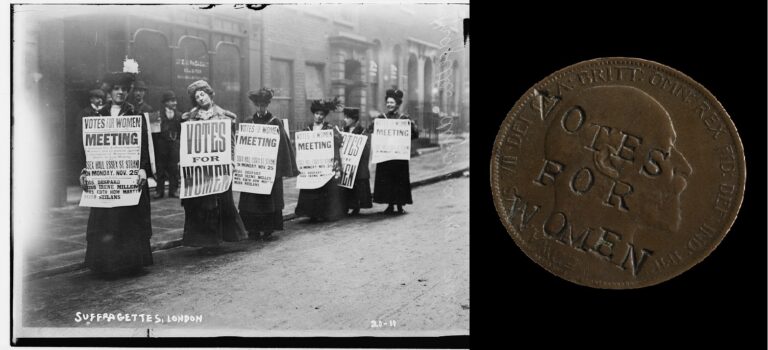
Suffragettes on a London street, Bain News Service, 1900. George Grantham Bain Collection, Library of Congress.
Who might have held that coin back in 1903 when it was first minted? A child perhaps, hoping for a mouthful of sweet licorice. Or a factory worker, buying a ha’penny stick of butter and a candle to light the meager breakfast table? Someone pausing on a busy London street corner perhaps, who would need three pennies to buy their copy of the Times newspaper. And, if you fancy something a little stronger, a quart of gin would cost you one penny.
The truth is that anyone and everyone handled those small brown coins. And that, of course, was the beauty of the Suffragette Penny. A message hammered onto a penny was seen by hundreds, thousands of people.
Suffragette Penny, 1903. British Museum, London, England, UK.
Let’s take a closer look. On one side we have Britannia in all her glory. She has been popular as a goddess figure since the first century and appeared on coins in the Roman era, but here she is the personification of the British Isles. Her spear becomes a trident, to emphasize British maritime power, but in this case, does her proud strength also remind us of the Suffragette?
Turn the coin over and we see a balding, bearded male – King Edward VII. But stamped over his face and neck, in crude letters, we see the words ‘Votes For Women’. This is a literal defacement of the King of England, individual letters hammered into the metal, one by one, with considerable force. It was a criminal act, subtle and subversive, with real shock value. It was a stroke of genius in the long battle for women’s rights. Pennies were of such low value and were produced in such high numbers, that recalling them would have been impossible.
Can you imagine women meeting secretly, bent over a table or bench, with hammers and metal stamps, bashing out their message to the world? What else did the Suffragettes do?
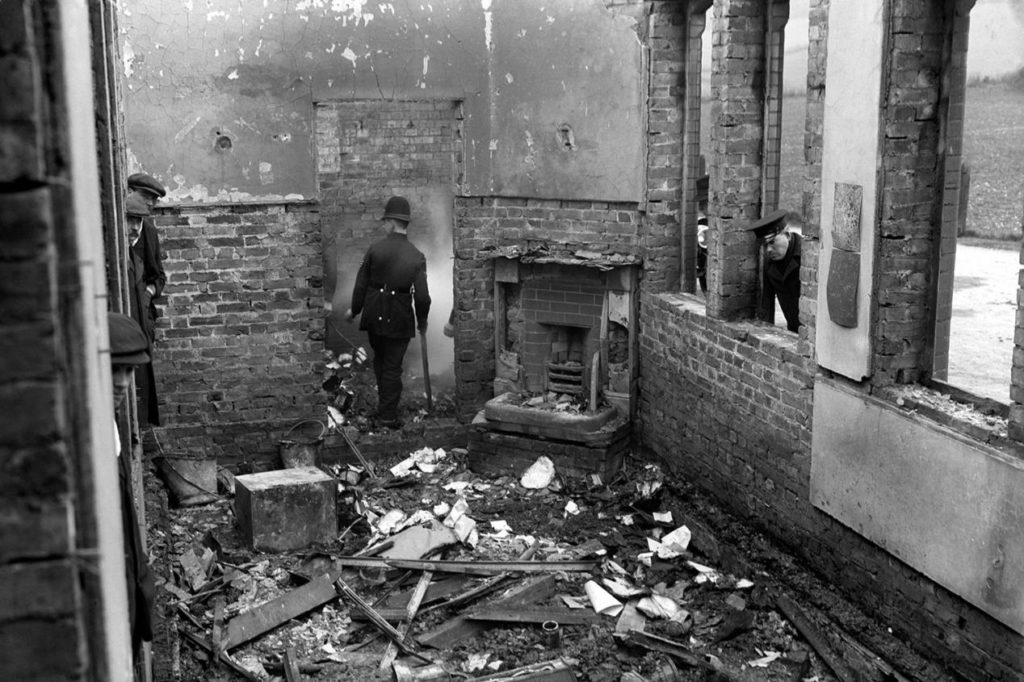
Saunderton Railway Station after a suffragette arson attack in 1913. LibCom.
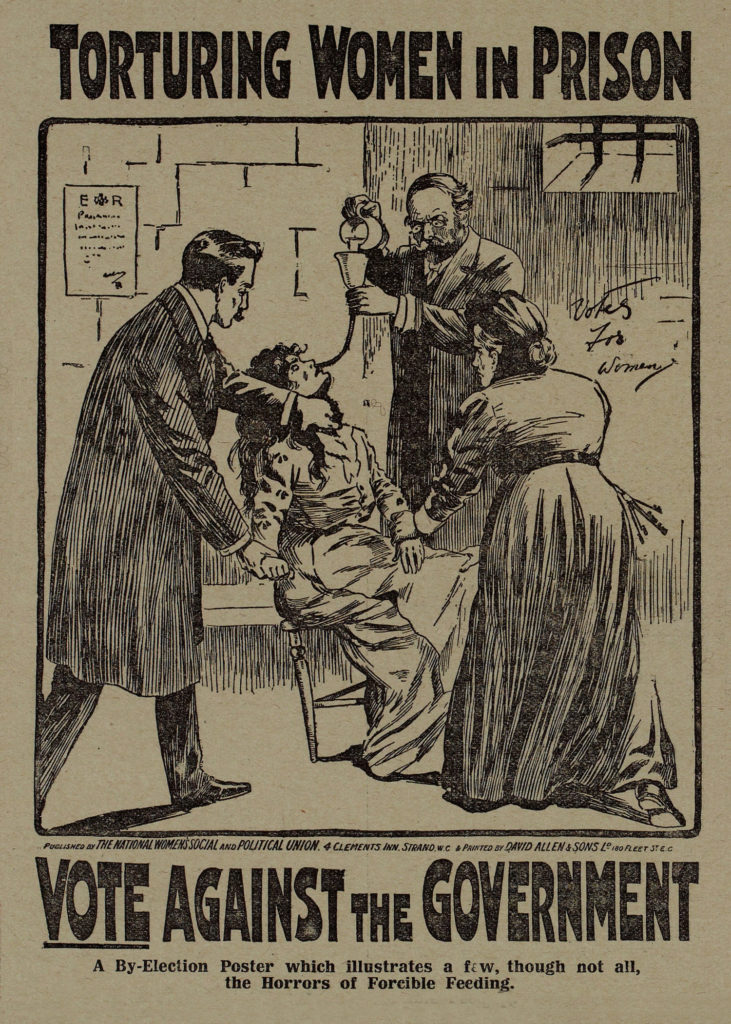
A mass campaign of window smashing. Arson attacks. Marching on Parliament in 1913. Many of these women were arrested and violently force-fed in prison. They lost their homes, their families, some lost their lives. ‘Deeds Not Words’ as they said themselves.
Vote Against the Government By-Election poster, 1909, National Library of Scotland, Glasgow, Scotland, UK.
The slashing of the Rokeby Venus painting by Suffragette Mary Richardson has been covered by Zuzanna Stanska here.
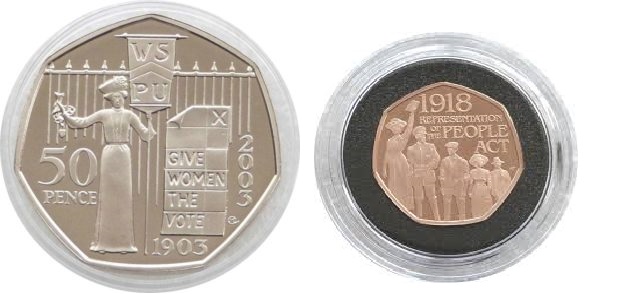
Move forward 100 years and take a look at this modern Suffragette British 50 pence coin. This was issued in 2003, marking the centenary of the WSPU – the Women’s Social and Political Union. One one side, the Queen of England, and on the other a suffragette, chained to a railing, next to a placard that reads ‘Give Women the Vote’. This time, 100 years on, it was legal to put that on a British coin. These 50p pieces are still in circulation if you are lucky enough to get one in your loose change.
Left: 50 pence coin commemorating the 100th anniversary of the Women’s Social and Political Union, 2003. Right: 50 pence coin commemorating the 1918 Representation of the People Act, 2018. London Coin Company.
The 2018 coin was struck at the Royal Mint in Llantrisant in Wales, by Helen, the great-granddaughter of Emmeline Pankhurst. The 1918 Representation of the People Act gave voting rights to women over 30 who owned property. Helen Pankhurst said:
“There is so much to be said about coins and their value in society. I think Emmeline would be very amused and proud for how things have changed and she would be remembering those defaced coins.”
Helen Pankhurst in Emmeline Pankhurst’s great-granddaughter hails coin marking vote centenary, 2018. The Argus.
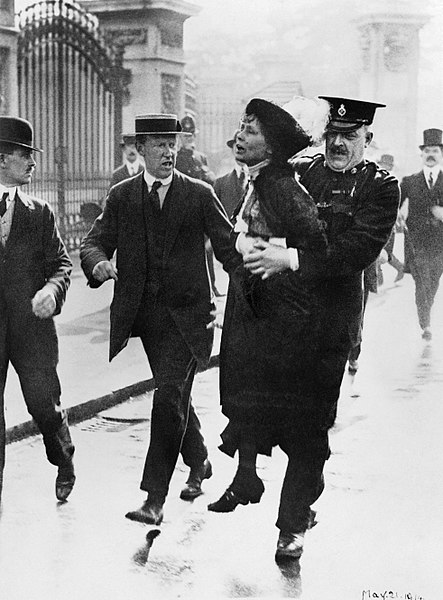
Emmeline Pankhurst arrested outside Buckingham Palace, 1914. Imperial War Museum.
We must wait another 10 years, until 2028, to celebrate the centenary of all UK women getting the vote. And of course, across the globe, so many women still fight for equal rights. As the Suffragette song goes:
“Rise up women, for the fight is long and hard”
Sometimes that fight means civil disobedience. What do you think? Is it ethical to break the law? How far would you go?
Click and follow us on Google News to stay updated all the time
We love art history and writing about it. Your support helps us to sustain DailyArt Magazine and keep it running.
DailyArt Magazine needs your support. Every contribution, however big or small, is very valuable for our future. Thanks to it, we will be able to sustain and grow the Magazine. Thank you for your help!
Candy's remote, rain soaked farmhouse clings to a steep-sided valley in rural Wales. She raises cats, chickens and children with varying degrees of success. Art, literature and Lakrids licorice save her sanity on a daily basis.
The Mona Lisa by Leonardo da Vinci is probably the most famous painting in the world. But is she famous for her beauty? Or for being stolen? Read our crime caper and decide for yourself.