
The Seams of Royalty: Justine Picardie’s Fashioning the Crown
Fashioning the Crown: A Story of Power, Conflict, and Couture is Justine Picardie’s latest book. She explores all the ways haute couture and...
Errika Gerakiti 23 February 2026
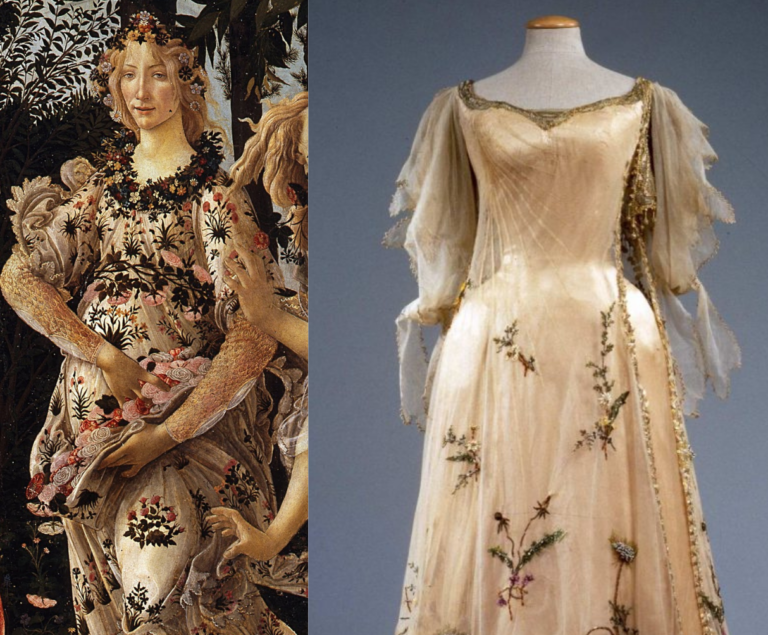
Left: Sandro Botticelli, Primavera (Allegory of Spring), detail, c. 1480, The Uffizi Gallery, Florence, Italy. Right: Rosa Genoni, La Primavera dress (Evening gown), 1906, Pitti Palace, Florence, Italy.
An Italian artist-designer at the turn of the 20th century, Rosa Genoni is described as a founder of Italian fashion, a dressmaker, a teacher, a feminist, and a peace activist. However, despite her significant contributions, Genoni is often overlooked in academic accounts of fashion history. Having the title of artist-designer, she intertwined a modern fashionable style with artistic expression and technical accuracy. Let’s explore how Genoni plays with an intricate long-standing relationship between fashion and art, using both mediums as expressions of creativity and Italian cultural identity.
Rosa Genoni, originally from the town of Tirano in Lombardy, moved to Milan at the age of 10 to work in a relative’s dressmaker shop. By 18, she became a master seamstress and started mingling in Milan’s socialist circles. Moreover, she was the sole female delegate, representing the Italian Workers’ Party in Paris, between 1884 and 1885. Genoni honed her tailoring skills during her stay in Paris, while working in an Italian seamstress shop and later at renowned fashion houses. Consequently, upon returning to Milan, she was committed to emphasizing the creative talent in her homeland and elevating the Italian sartorial production.
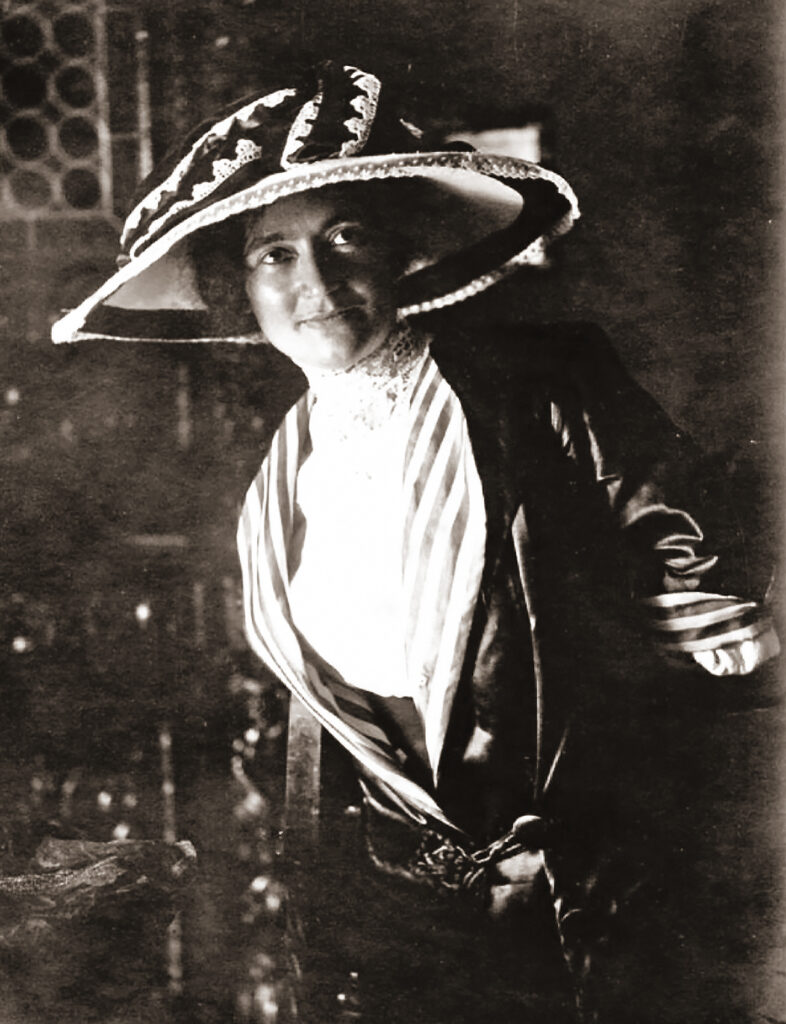
Photograph of Rosa Genoni, 1903. In the collection of Eugenia Paulicelli.
Rosa Genoni was also renowned for her socialist political activism. She was involved in humanitarian, pacifist, and feminist movements, alongside her revolutionary innovations in the fashion industry. Notably, she strongly advocated for women’s right to education and emancipation, and represented Italy at the International Congress of Women in Hague in 1915. Genoni was engaging in a range of activities across different domains until the outbreak of World War I and the rise of fascism, which she strongly opposed.
Genoni saw fashion as an art form. Her commitment to merge expertise, skill, and a deep understanding of the past and art, led her to create innovative and sophisticated designs. However, in the early 20th century, Italian fashion faced challenges in gaining international recognition due to the dominance of Parisian Haute Couture. Italy needed to recognize its own potential and break free from Paris’s cultural influence to establish its fashion identity. Signs of this shift began at the turn of the 20th century, as Italy started to re-evaluate and embrace its own distinctive creativity. One of the prominent figures to encourage this was Rosa Genoni.
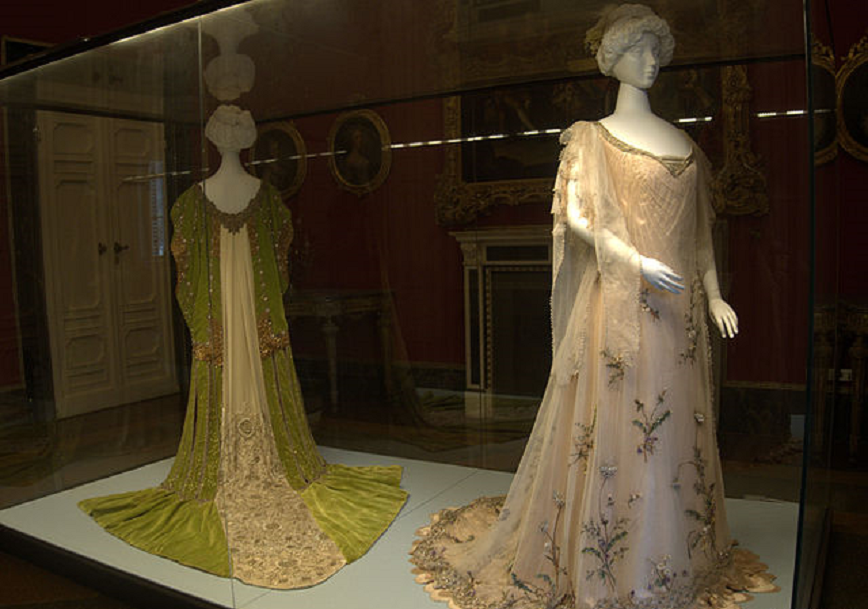
Rosa Genoni, Mantello di Corte (left) and La Primavera dress (Evening gown) (right), 1906. Photograph of the display in the Pitti Palace, Florence, Italy.
Genoni’s dedication to exploring new styles was evident in her exhibition of eight dresses, strongly referencing Italian art and culture, specifically from the Renaissance period. Genoni received the highest prize, as well as praise from important art critics and contemporaries. Notable among these was the Primavera dress inspired by Botticelli’s Flora from his painting Primavera. Alongside the other seven, this dress was exhibited in the Pavilion dedicated to the decorative arts at Milan’s 1906 International Exhibition.
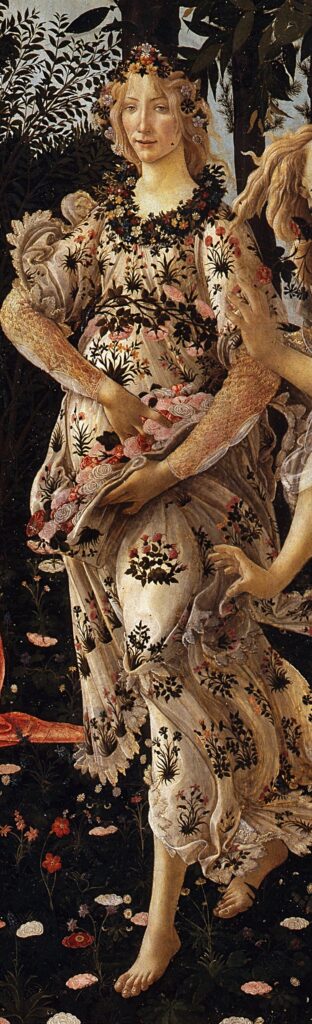
Sandro Botticelli, Primavera (Allegory of Spring), c. 1480, Uffizi Gallery, Florence, Italy. Detail.

Rosa Genoni, La Primavera dress (Evening gown), 1906, Pitti Palace, Florence, Italy.


Genoni’s dedication to exploring new styles was evident in her exhibition of eight dresses, strongly referencing Italian art and culture, specifically from the Renaissance period. Genoni received the highest prize, as well as praise from important art critics and contemporaries.
Notable among these was the Primavera dress inspired by Botticelli’s Flora from his painting Primavera. Alongside the other seven, this dress was exhibited in the Pavilion dedicated to the decorative arts at Milan’s 1906 International Exhibition.
Allegory of Spring stands as an exquisite masterpiece, renowned for its intricate naturalistic portrayal of a meadow teeming with diverse flora, vibrant color palette, graceful figures, and overall poetic essence. This celebrated work has captivated audiences globally with its profound elegance and artistic allure. Backed by the influential Medici family, Botticelli secured numerous prestigious commissions, producing some of Italy’s most iconic Renaissance masterpieces. Accordingly, his works have been widely reproduced, with his motifs frequently borrowed and reinterpreted, often in various contexts.
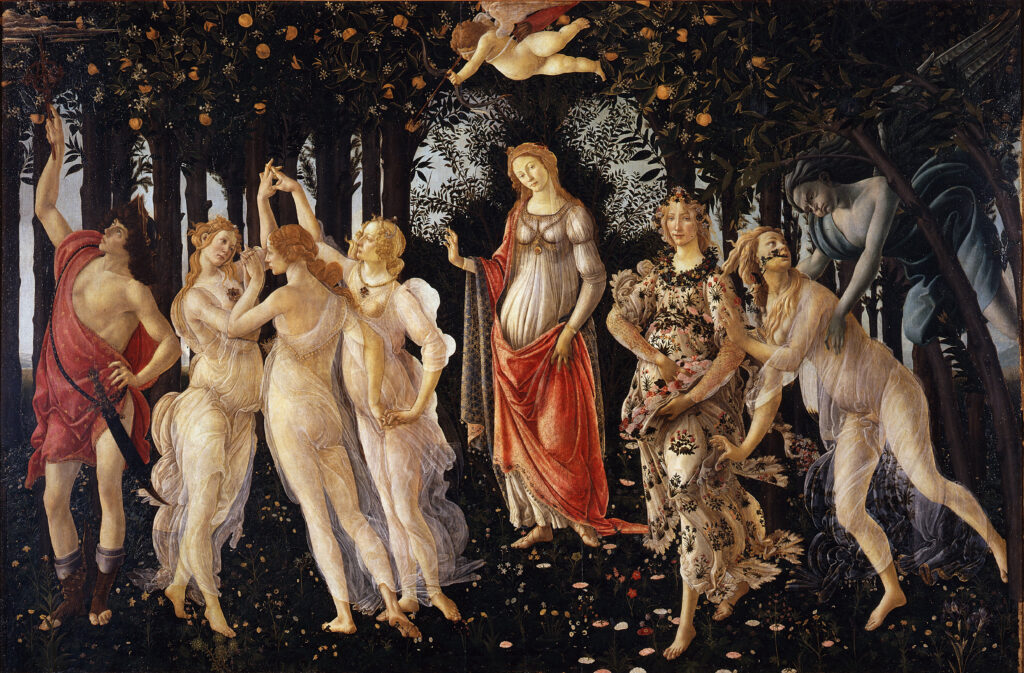
Sandro Botticelli, Primavera (Allegory of Spring), c. 1480, Uffizi Gallery, Florence, Italy.
Similarly, Genoni reconceptualized this seminal work of Italian art in Primavera dress. Inspired by Flora’s dress, Genoni designs a silk gown in the color of ivory with a trumpet bell skirt. A special feature of the dress is its draping with the ecru tulle arranged loosely around the underlying gown. The tulle is embroidered with plant and floral designs, such as primroses, country daisies, and violets, in multicolored threads and glass tube beads. Additionally, the prominence of this elaborate embroidered pattern is rendered with the contrast between the colorful and tridimensional materials of embroidery and the light and thin tulle.
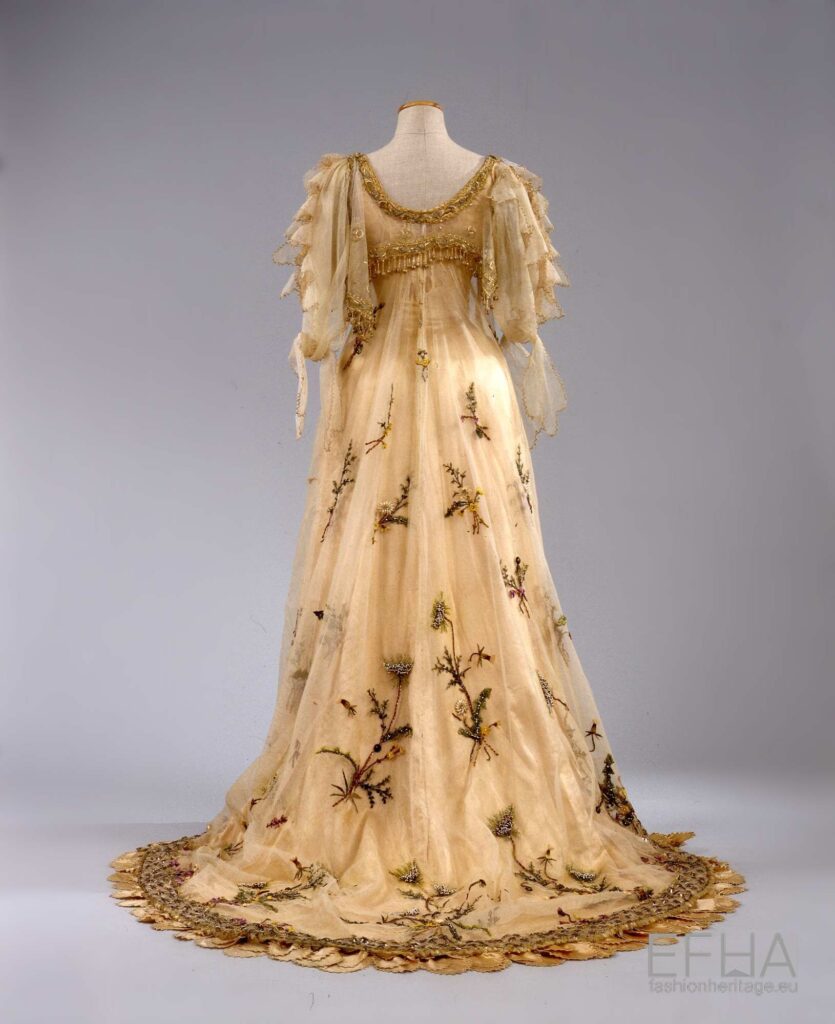
Rosa Genoni, La Primavera dress (Evening gown), 1906, Pitti Palace, Florence, Italy.
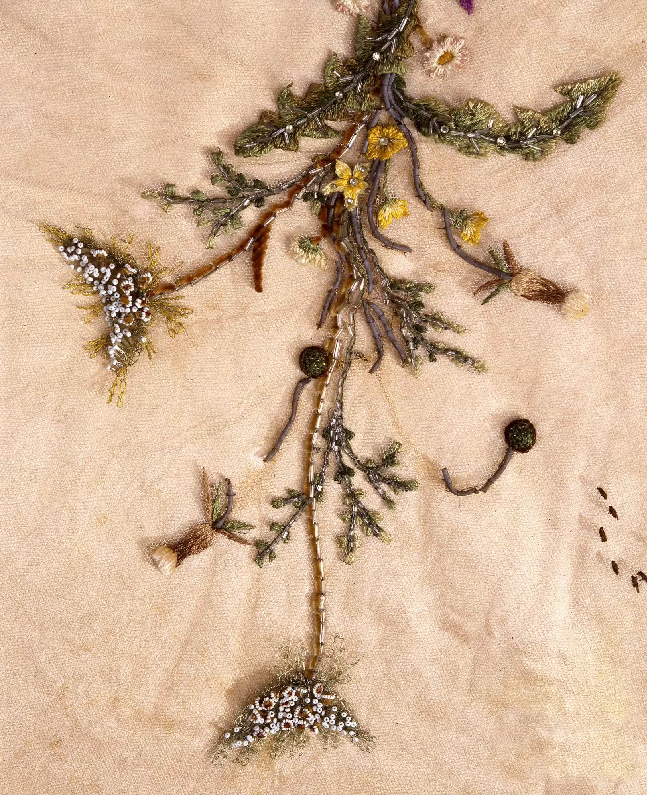
Rosa Genoni, La Primavera dress (Evening gown), 1906, Pitti Palace, Florence, Italy. Detail of floral design in multicolored threads and glass tube beads.
Inspired by Flora’s dress, Genoni designs a silk gown in the color of ivory with a trumpet bell skirt. A special feature of the dress is its draping with the ecru tulle arranged loosely around the underlying gown.
The tulle is embroidered with plant and floral designs, such as primroses, country daisies, and violets, in multicolored threads and glass tube beads. Additionally, the prominence of this elaborate embroidered pattern is rendered with the contrast between the colorful and tridimensional materials of embroidery and the light and thin tulle.
Genoni’s integration of fashion and art was intended to re-interpret Italian artistic tradition and develop a new concept of style and beauty that reflected the current conditions of the time. Strongly advocating women’s rights through various means, her sartorial re-interpretation of Botticelli’s masterpiece intended to demonstrate the complexity of the female identity. Evoking the artistic idealized beauty of the Renaissance period through women’s attire, Genoni highlighted how traditional views of femininity are constructed concepts. Also, Genoni realizes how through a merge of fashion and art, she can encourage Italian sartorial production by referencing the already rich Italian artistic tradition.
Eugenia Paulicelli, Rosa Genoni: Fashion is a serious business. The Milan world fair 1906 and the great war. Milan: Milan Deleyva, 2015.
Giovanna Ginex, “Rosa Genoni: La Moda è Un Cosa Seria. Milano Expo 1906 e La Grande Guerra.” Journal of Modern Italian Studies 22, no. 1 (2017): 115–117. Abingdon: Routledge, 2017.
Chesne Dauphiné Griffo, Catalogue. Museum of Costume and Fashion, edited by K.Aschengreen Piacenti, 94–95. Florence, Palazzo Pitti, 1983.
Eugenia Paulicelli, “Fashion, Culture and National Identity: Rosa Genoni and the Futurist.” Fashion under Fascism: Beyond the Black Shirt, 27–36. Oxford: Berg, 2004.
Eugenia Paulicelli,”Italian Fashion and Film in the 1910s: From the Futurists to Rosa Genoni.” Italian Style: Fashion & Film from Early Cinema to the Digital Age, 19–26. London: Bloomsbury, 2016.
Eugenia Paulicelli, “Italian fashion: yesterday, today and tomorrow.” Journal of Modern Italian Studies, 20:1(2015): 1–9. DOI: 10.1080/1354571X.2014.973150
Get your daily dose of art
Click and follow us on Google News to stay updated all the time

DailyArt Magazine needs your support. Every contribution, however big or small, is very valuable for our future. Thanks to it, we will be able to sustain and grow the Magazine. Thank you for your help!

History of art graduate and enthusiastic appreciator of anything art and culture-related. Currently very interested in Catalan Modernism and Postmodernism, Surrealist artist-designer Elsa Schiaparelli, and 15th-century Florentine art.

Amelia is a mom, wife, and college instructor who loves to curl up with a cup of tea, a good book, and her fluffy cat Bonky. She loves writing, studying French, spending time with her family, and creating and viewing art.
Fashioning the Crown: A Story of Power, Conflict, and Couture is Justine Picardie’s latest book. She explores all the ways haute couture and...
Errika Gerakiti 23 February 2026
Renowned photographer Annie Leibovitz once again proves to us that when art and fashion meet, the result is always striking. Together, they can...
Nikolina Konjevod 15 September 2025
Turbans are one of the most enduring forms of headwear in human history. Though associated today with Sikh and Muslim communities, turban and...
Maya M. Tola 3 July 2025
Thierry Mugler’s art redefined the boundaries of fashion, blending creativity, drama, and innovation. His bold silhouettes and futuristic...
Errika Gerakiti 30 December 2024


