

Must-See Exhibitions Fall 2026
Wherever you are in Europe or the United States this fall 2026, there are great exhibitions to visit. From anniversary blockbusters to intimate focus...
Catriona Miller 7 September 2026
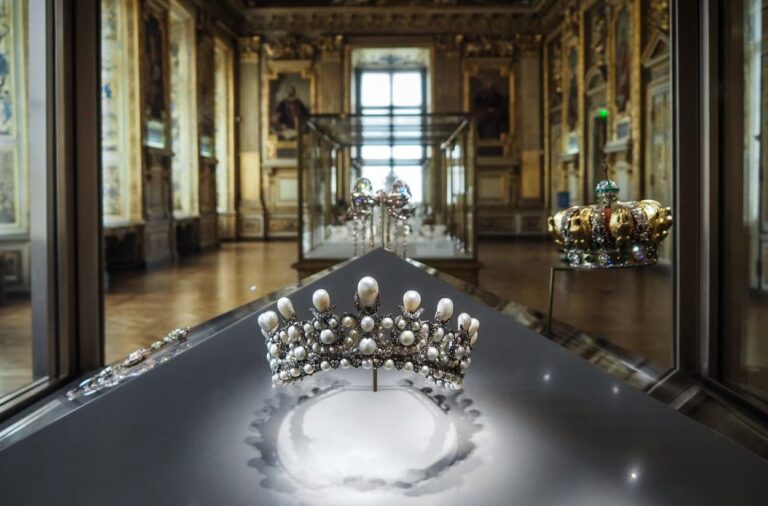
The stolen French crown jewels on display in the Louvre. CNN.
Recently, Paris woke up to find its crown missing a sparkle. One crisp October morning, eight dazzling jewels vanished from the Louvre. Not just any jewels, but the kind that once shimmered on the necks and brows of empresses. While the headlines buzzed with talk of ladders, scooters, and a seven-minute getaway, the real stars of this drama are the French crown jewels themselves. Each has lived a long, glittering life, passing through royal courts, world’s fairs, and museum vitrines before disappearing into mystery once again. Let’s meet these lost treasures—the emeralds, sapphires, and diamonds that once defined the very idea of imperial glamour.
When Napoleon Bonaparte wed the Austrian Archduchess Marie Louise of Austria in 1810, he commissioned a fine emerald-and-diamond jewelry set to mark the union. The surviving pieces, a necklace and matching earrings, ended up in the Louvre, a glittering testament to the empire’s reach. The emeralds, mined in Colombia’s Muzo region, shimmer with a rare green intensity, while the diamonds offer crisp brilliance. The museum acquired them in the early 2000s.
Wearing them, Marie Louise embodied the link between Napoleon’s France and Habsburg Austria. Today, their loss is far more than financial—it’s a break in the chain of history. It’s the kind of jewel-set that becomes a mirror of the nation and empire.
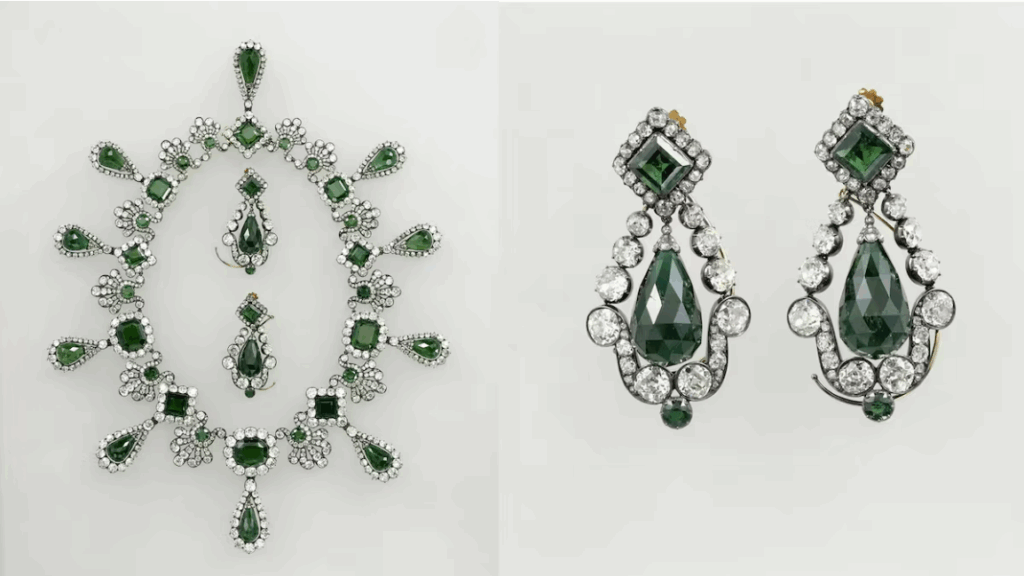
Emerald necklace and earrings of Empress Marie Louise, ca. 1810, Louvre, Paris, France. EFE/El Pais.
The sapphire parure linked two remarkable women across changing regimes: Marie-Amélie (Maria Amalia of Naples and Sicily), the last queen of the French, and Hortense de Beauharnais, Napoleon’s stepdaughter, Queen of Holland, and mother of Napoleon III. The set was acquired by the Louvre in 1985. The tiara alone features 24 deep-blue Ceylon sapphires and over 1,000 diamonds. Accompanying the tiara was a matching necklace, eight large sapphires alternating with diamonds, designed to sit high on the neckline for formal evening wear.
This piece encapsulates mid-19th-century taste: the sober elegance of blue gems paired with dynamic sparkle. Its removal in the heist again severs a historical thread: royal women photographed wearing it, social seasons marked by its appearance, the quiet shift from monarchies to modern states. One of the earrings from this parure was left behind by the thieves.
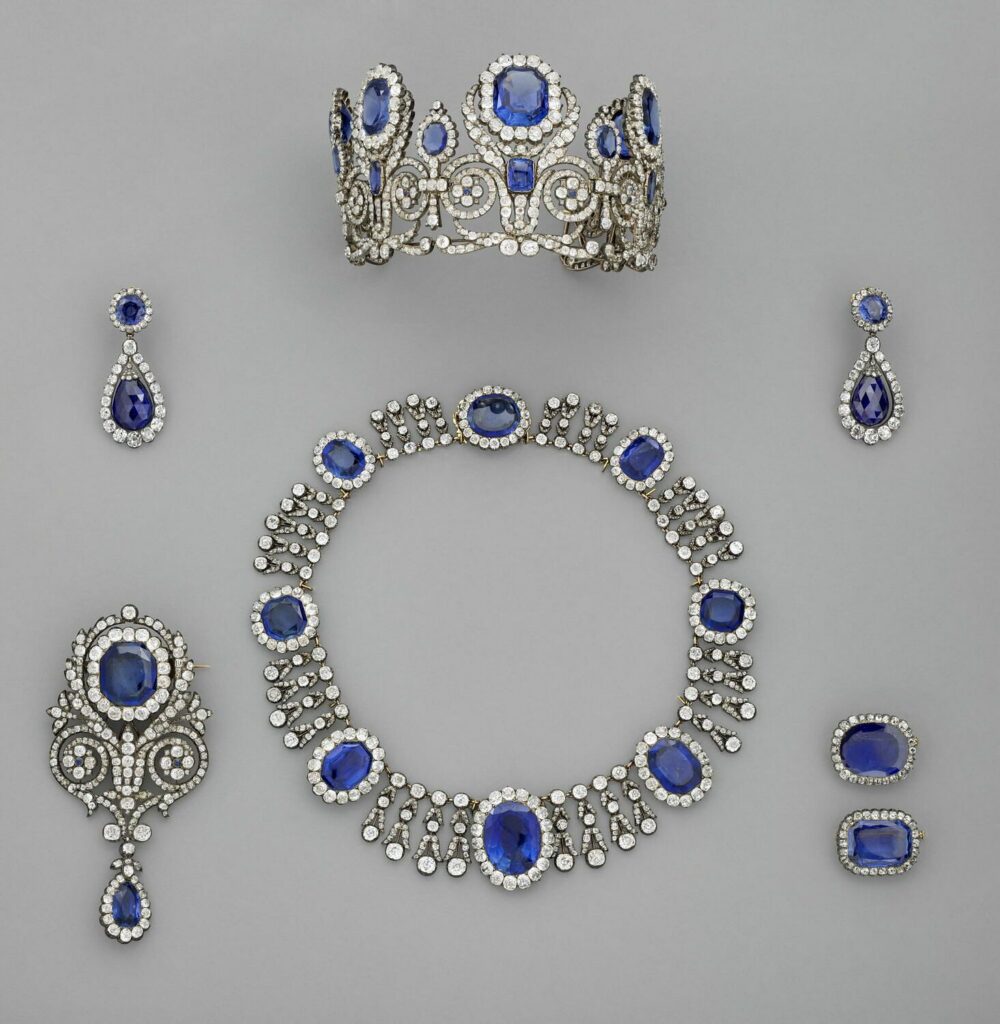
Sapphire parure of Queen Marie-Amélie and Queen Hortense, ca. 1830–1840, Louvre, Paris, France. Photograph by GrandPalaisRmn (Louvre Museum)/ Stéphane Maréchalle. Town & Country Magazine.
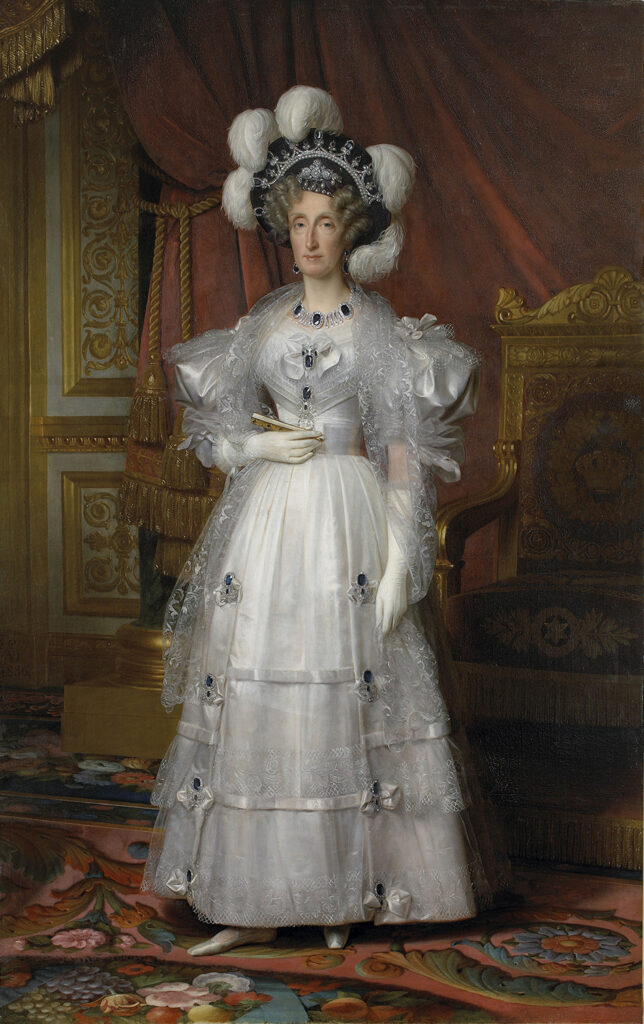
Louis Hersent, Marie-Amélie of Bourbon, Princess of the Two Sicilies, Queen of the French, 1836, Palace of Versailles, Versailles, France. Museum’s website.
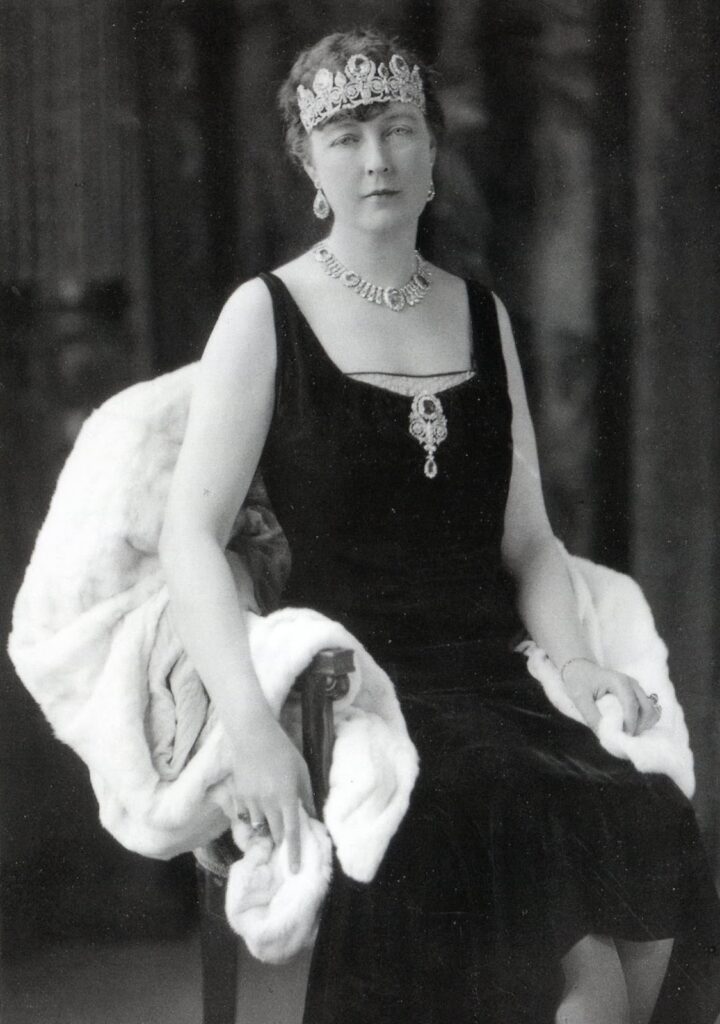
Princess Isabelle of Orléans, Duchess of Guise, wearing the tiara, necklace, and brooch, 1920s. Wikimedia Commons (public domain).
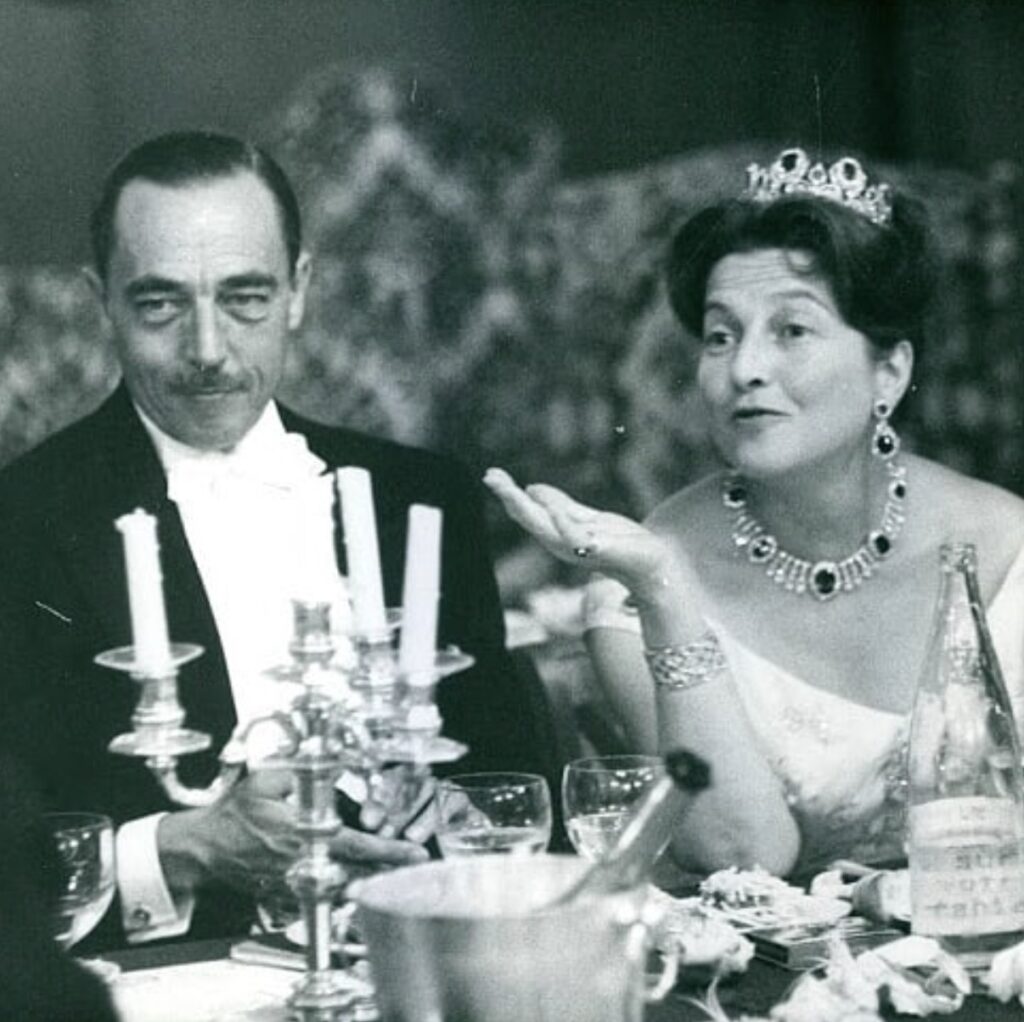
Princess Isabelle of Orléans-Braganza wearing the tiara, necklace, and earrings. The Royal Watcher.


A parure is a set of matching jewelry designed to be worn together.
This painting shows that the original parure had more items than those exhibited in the Louvre.
The flexibility of mixing and matching the parts of the parure makes it adaptable for many occasions.
It is amazing to see the French crown jewels being worn through the centuries.
Empress Eugénie de Montijo, wife of Napoleon III, was a paragon of Second Empire elegance. One of the stolen items is her diadem, set with nearly 2,000 diamonds and hundreds of pearls. The grandeur of the piece matched the imperial ambition of its time.
Eugénie wore this tiara at state balls and international exhibitions; it reflects not only jewelry artistry but diplomatic theatre. The loss of the diadem, therefore, is the loss of multiple narratives: design, gender, power, and diplomacy.
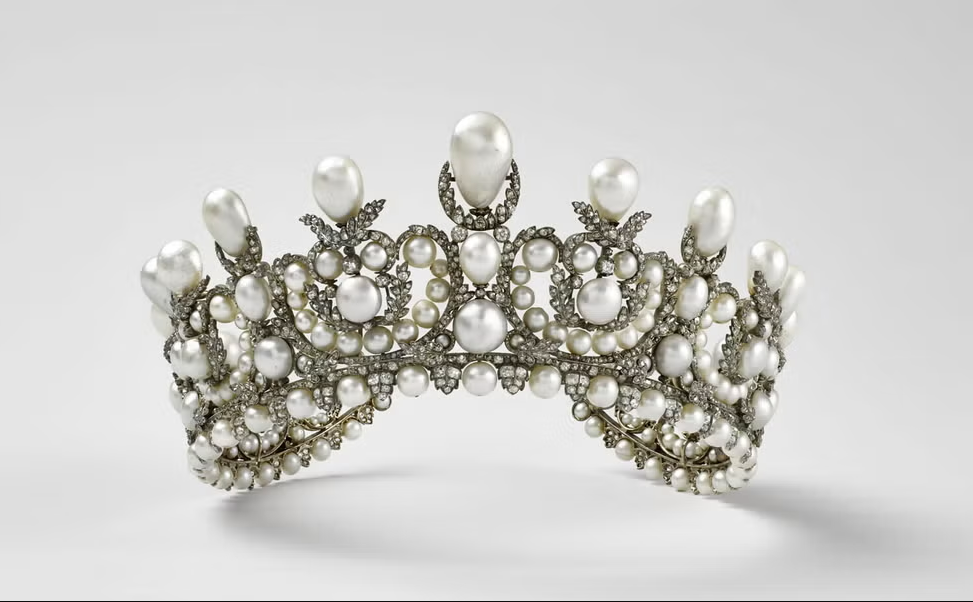
Diadem of Empress Eugénie de Montijo, ca. 1855, Louvre, Paris, France. Photograph by GrandPalaisRmn (Louvre Museum)/Stéphane Maréchalle. Town & Country Magazine.
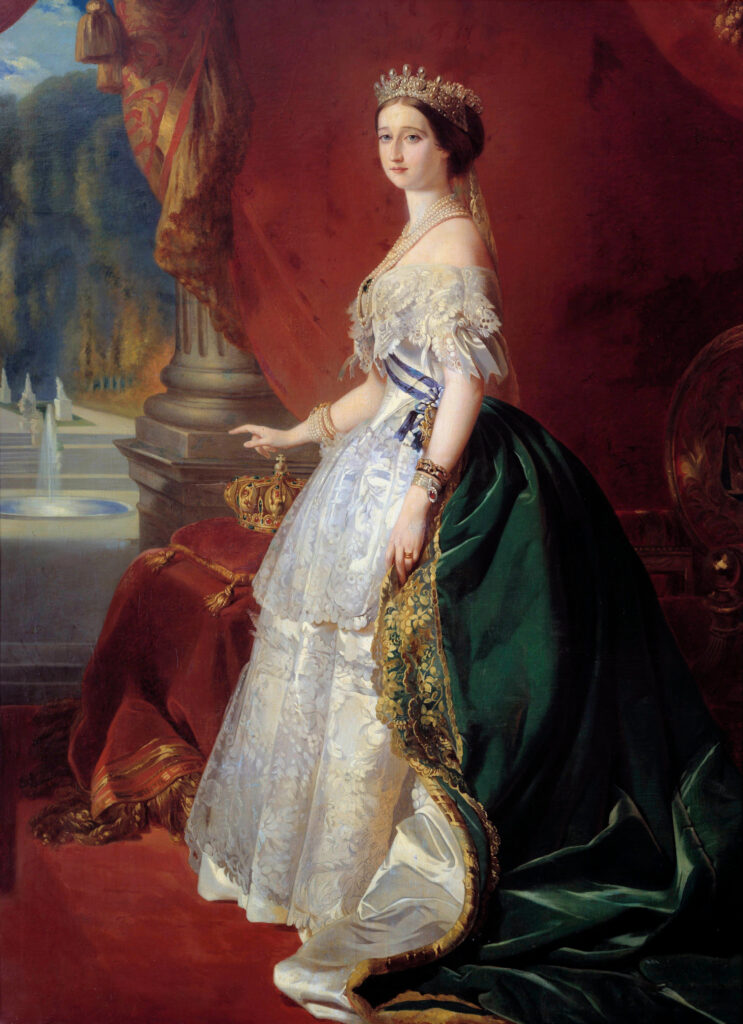
Copy of Franz Xaver Winterhalter, Portrait of Empress Eugénie, 1855–1870, Château de Compiègne, Compiègne, France. Wikimedia Commons (public domain).
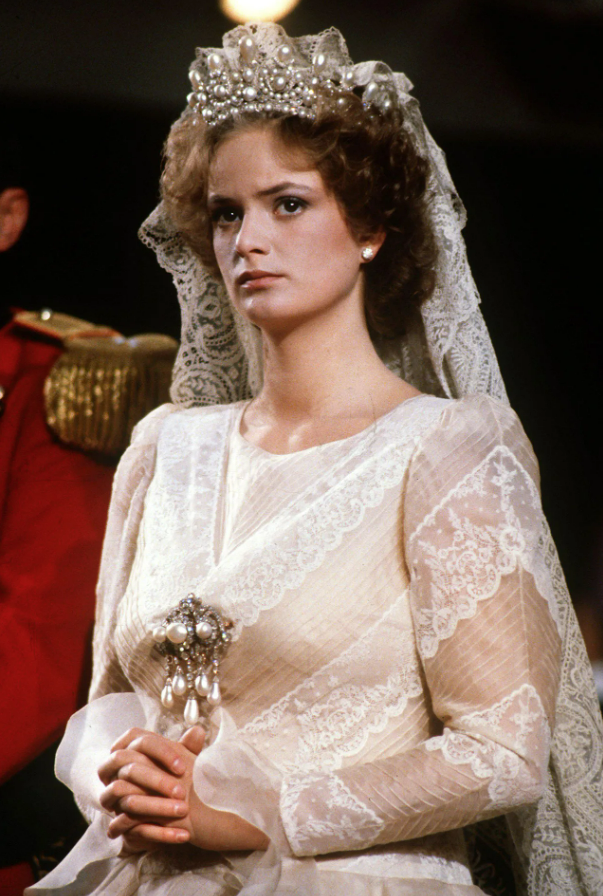
Gloria von Thurn und Taxis wearing the pearl tiara on her wedding, 1980. Tatler.
This pearl diadem is full of timeless elegance.
The original painting was kept in the Palace of Tuileries and was probably lost during the fire of 1871.
Opulent pearls for a special occasion.
Another piece from Eugénie’s ensemble is a large brooch shaped like a bow, designed by Francois Kramer. Originally part of a belt shown at the 1855 Paris Exposition and later reworked into a corsage ornament.
Its transformation, from belt to brooch, mirrors changes in fashion. Shortly after this transformation, the brooch was purchased by the jeweler Emile Schlesinger for Caroline Astor. From then on, it changed hands several times, and it took more than 100 years for the Empress’s bow brooch to make its way back to the Louvre in 2008.
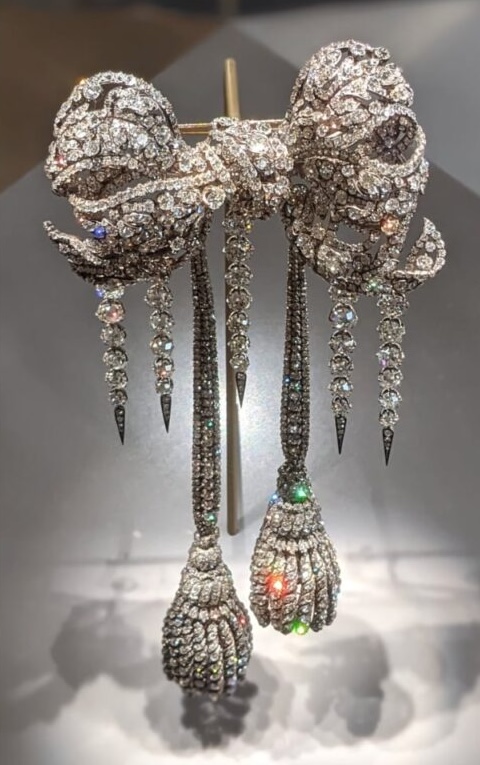
Bodice-Bow Brooch of Empress Eugénie, ca. 1855, Louvre, Paris, France. Yanko Design.
Finally, the so-called “reliquary” brooch: chandelier-like, diamond-laden, was made for Eugénie by Paul-Alfred Bapst in 1855. Perhaps a vestige of piety or a clever marketing flourish in empire-era jewelry design, especially since it is not clear where the relic could be stored in the brooch.
The brooch evokes religion, display, and political identity: an empress’s adornment, a museum’s trophy. Its disappearance is symbolic—the smaller, less flamboyant piece may attract less attention than a tiara, but its cultural importance is equally rich.
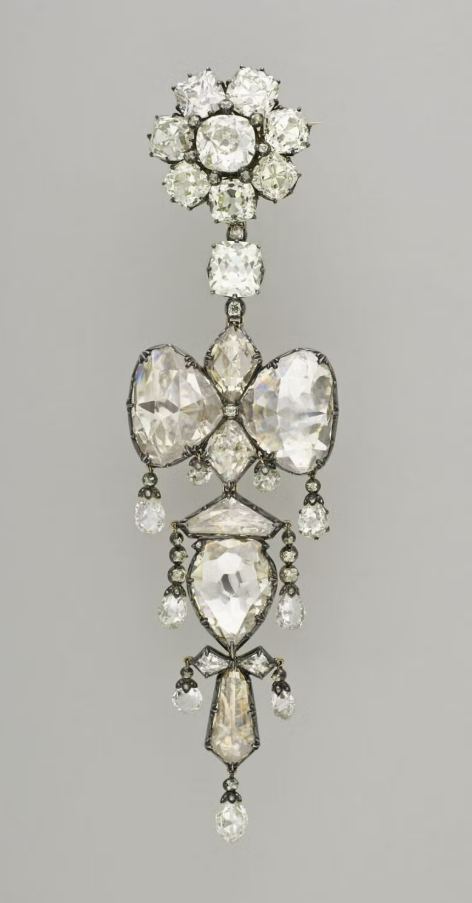
Reliquary brooch of Empress Eugénie, mid-19th century, Louvre, Paris, France. Photography by GrandPalaisRmn (Louvre Museum)/Stéphane Maréchalle. Town & Country Magazine.
While the thieves originally grabbed this piece as well, they lost it during their flight. It was damaged, but has been returned to the Louvre. The Crown of Empress Eugénie was the glittering centerpiece of France’s Second Empire. Commissioned for the 1855 Paris Exposition, it dazzled with over 1,000 diamonds and over 50 luminous emeralds set in delicate gold leaves and laurel motifs.
Though Eugénie never wore it for a coronation, she famously donned it at state occasions, where it symbolized both imperial power and the refined femininity she embodied. The crown was designed by Alexandre-Gabriel Lemonnier, her favored jeweler, whose craftsmanship balanced opulence with grace.
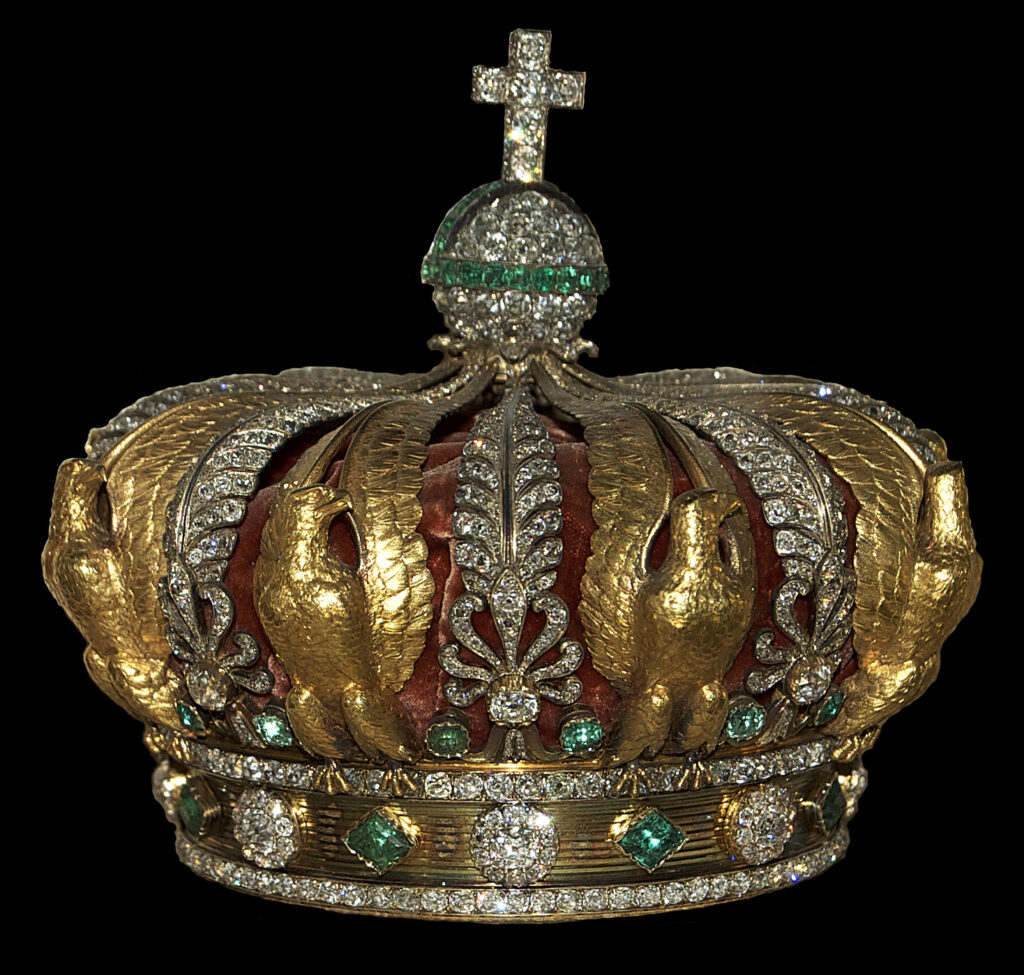
The Crown of Empress Eugénie, 1855, Louvre, Paris, France. Photograph by Wouter Engler via Wikimedia Commons (CC BY-SA 4.0).
It’s easy to get caught up in the cinematic suspense of the Louvre heist—the speed, the stealth, the astonishment. But perhaps it’s more satisfying to linger on the French crown jewels themselves: creations that once embodied love, ambition, and sheer splendor. Whether they resurface in an attic, a private vault, or a detective’s lucky find, they’ve already secured their place in history’s sparkle file. And until they return, we can imagine them glittering still, somewhere out there, telling their royal stories in whispers of emerald green and sapphire blue.
DailyArt Magazine needs your support. Every contribution, however big or small, is very valuable for our future. Thanks to it, we will be able to sustain and grow the Magazine. Thank you for your help!

Art historian by education, data geek by trade, art and book lover by passion, based in London in love with Europe and traveling around it. You can visit my book blog here: https://bookskeptic.com/

Univ. of New Orleans, Fine Arts and History; Fine Artist, Professional Graphic Designer, Art Historian, Historian, Musician, worked at the New Orleans Museum of Art and MS Museum of Art; learning enthusiast!
Wherever you are in Europe or the United States this fall 2026, there are great exhibitions to visit. From anniversary blockbusters to intimate focus...
Catriona Miller 7 September 2026
How well do you know art from around the world? Anthropeum turns exploring the Met’s digital collection into a daily guessing game, where players...
Bec Brownstone 24 August 2026
At DailyArt Magazine, we have assembled a carefully curated list of 10 must-see exhibitions across Europe and the United States this spring, from...
MJ Rivera 9 April 2026
As the art world turns the page on a new year, museums and galleries are unveiling a lineup that invites us into a season of bold visions, unexpected...
Natalia Iacobelli 15 January 2026