Summary
- In Wilhelm Trübner’s Dog with Sausages, a dog, with sausages hung around his nose, is related to the person who will go to any length to impress.
- Edwin Henry Landseer’s A Jack In Office features a dog related to a political official. The artist reflects on government, both canine and homo sapiens.
- William Strutt’s A Warm Response explores the urge to seek dangerous thrills and reflects on what causes both dogs and humans to seek danger for no profound benefit.
- Giovanni Boldini’s The Amazon compares the canine and human need for adventure and the willingness to face the world. It reflects on how dogs and humans often mirror each other’s behaviors.
- In Rapp and Johan, Bruno Liljefors explores unlikely friendships between dogs and cats, as well as between human rivals.
- In The Hunter’s Present, Gabriël Metsu offers a reflection on the eternal will of dogs and people to be out of doors and enjoying themselves.
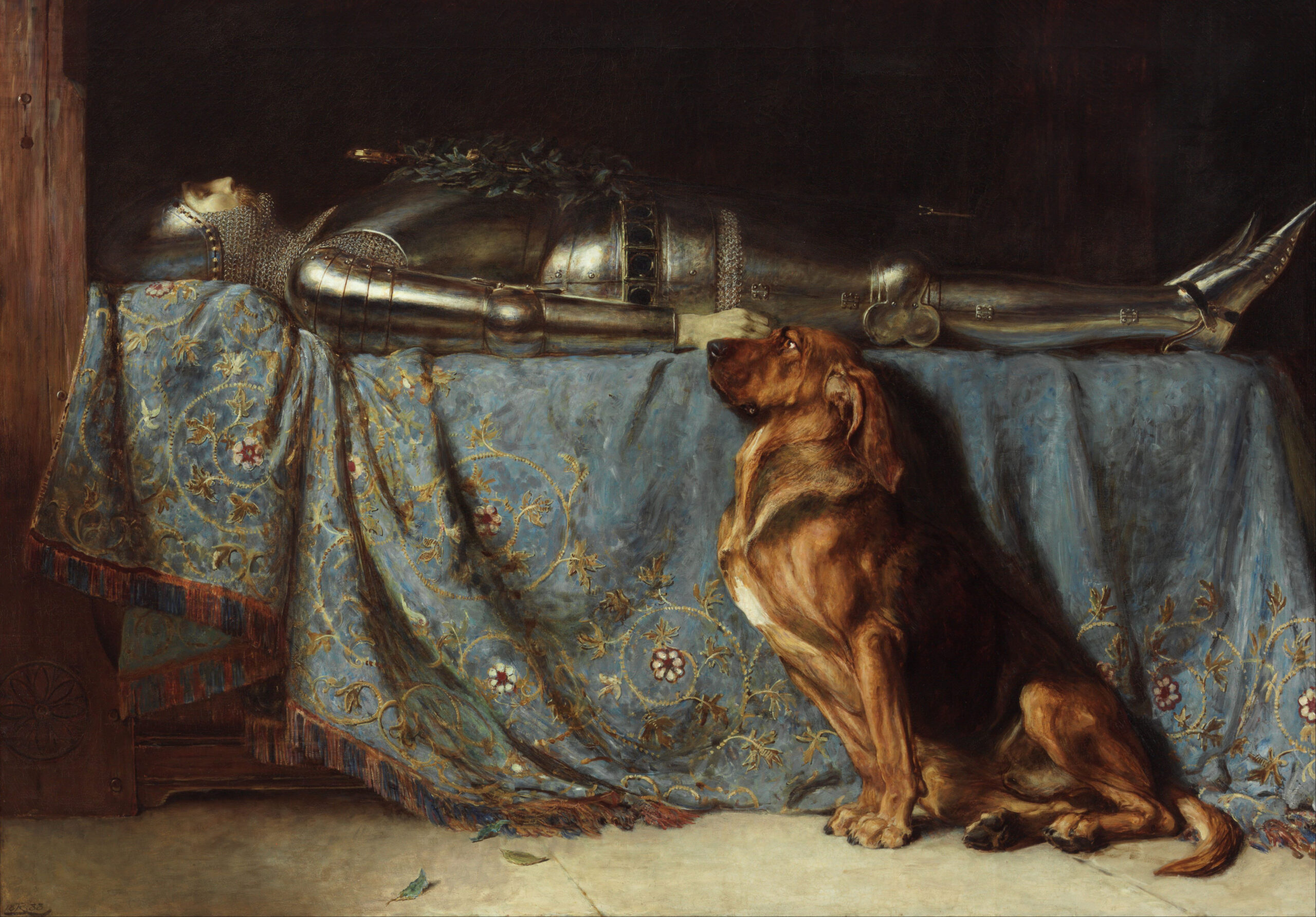
- Briton Rivière’s Requiescat is a classic illustration of dogs’ total loyalty to humans, both in life and death.
- In Olof Hermelin’s Avenue at Strömsholm, we find one of the classic behaviors of both dogs and humans: innocent attention-seeking.
- Edwin Henry Landseer’s Queen Victoria at Osborne reminds us of the need to cherish moments we are given in the company of all we love.
- In Walter Hunt’s In from the Cold, we find a reminder that in times of trouble, we often come together. The artist reflects that if we came together before trouble arrived, perhaps it would never come.
1. Dog with Sausages
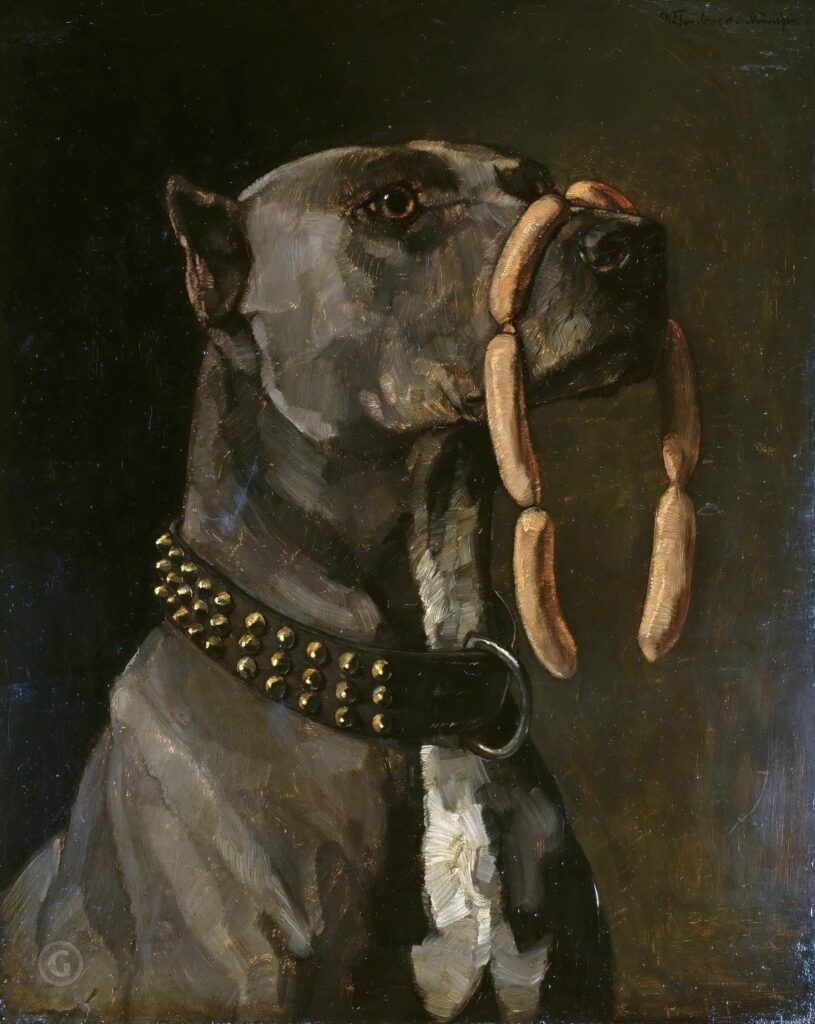
Wilhelm Trübner, Dog with Sausages (Ave, Caesar, morituri te salutant), 1877, Alte Nationalgalerie, Berlin, Germany.
We have here what one might imagine as the canine equivalent of a Prussian soldier, desperate to appear exemplary before none other than Bismarck himself; and how impressively the dog carries himself with such martial composure.
Despite being weighed down by what is, without a doubt, an extremely appetizing lunch, he remains focused, chin up, unbothered. Of course, we can say he is rather overdoing it, not unlike the Prussian soldier whose eyes grow wet as Bismarck marches by him. Our dog’s wet eyes and the slight descent of his ears both seem to say to us that he is second- guessing his commitment to modelling his ability to be a good soldier. We all, in our pride, embark upon such adventures to impress, and almost always do so needlessly.
2. A Jack in Office
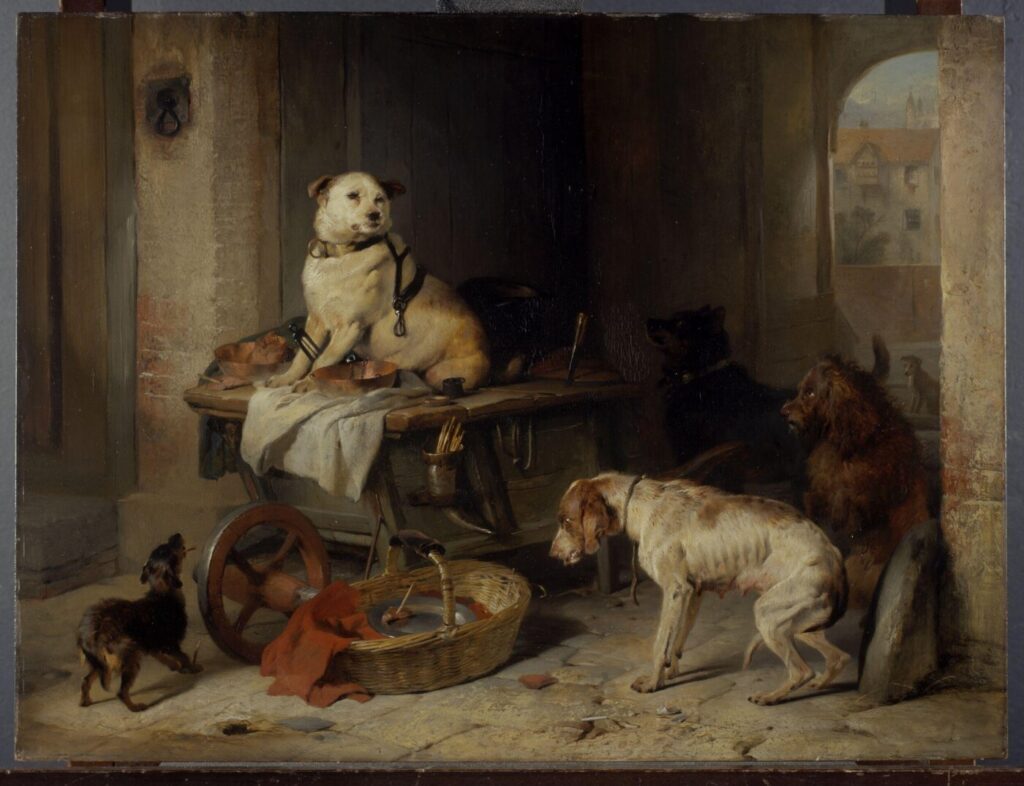
Edwin Landseer, A Jack in Office, c. 1833, Victoria and Albert Museum, London, UK.
We find a strange title for what is close to an anarchic scene, but we cannot suppose the artist did not mean for this. Jack stands on his own sort of stage: a butcher’s cart whose edible contents would have been long ago knocked over if he, the Jack, hadn’t been guarding it. He is anything but a graceful leader, although he is one who, by some means, just keeps the order.
The painter, Edwin Landseer, had meant for this: in his day, a Jack had been, as explained in the Penguin Dictionary of Historical Slang, “an imperious petty official” (with “petty” meaning half-important rather than grudging). Because Jack considerably inflates his importance by separating himself from the crowd below, he keeps things together: his imperiousness seems almost necessary, unfortunate as it is.
All around him, the crowd of fellow dogs goes wild with varied passions. One barks, another tries to sneak up, another lingers back somewhat and seems to be planning an attack on the meat, while another wets their eyes and begs. The dog that stands out the most is the white dog below Jack. She is seemingly pregnant or has just given birth to pups, and the tail between her legs suggests she is frightened, either by Jack or by the greedy crowd of dogs around her. While she seems to lament that Jack has not delivered her nearly as much food as he perhaps ought to have, we are reminded why Jack keeps the order as he does. If he allowed the other dogs to have their way, there would be no food remaining for the vulnerable dogs of the world.
Of course, we also have a classic dog behavior put on canvas: absolute duty to the task he has been left with. Jack, assigned to guard the cart by his owner, does just that and would be swayed to step aside by none but the person who appointed him.
3. A Warm Response
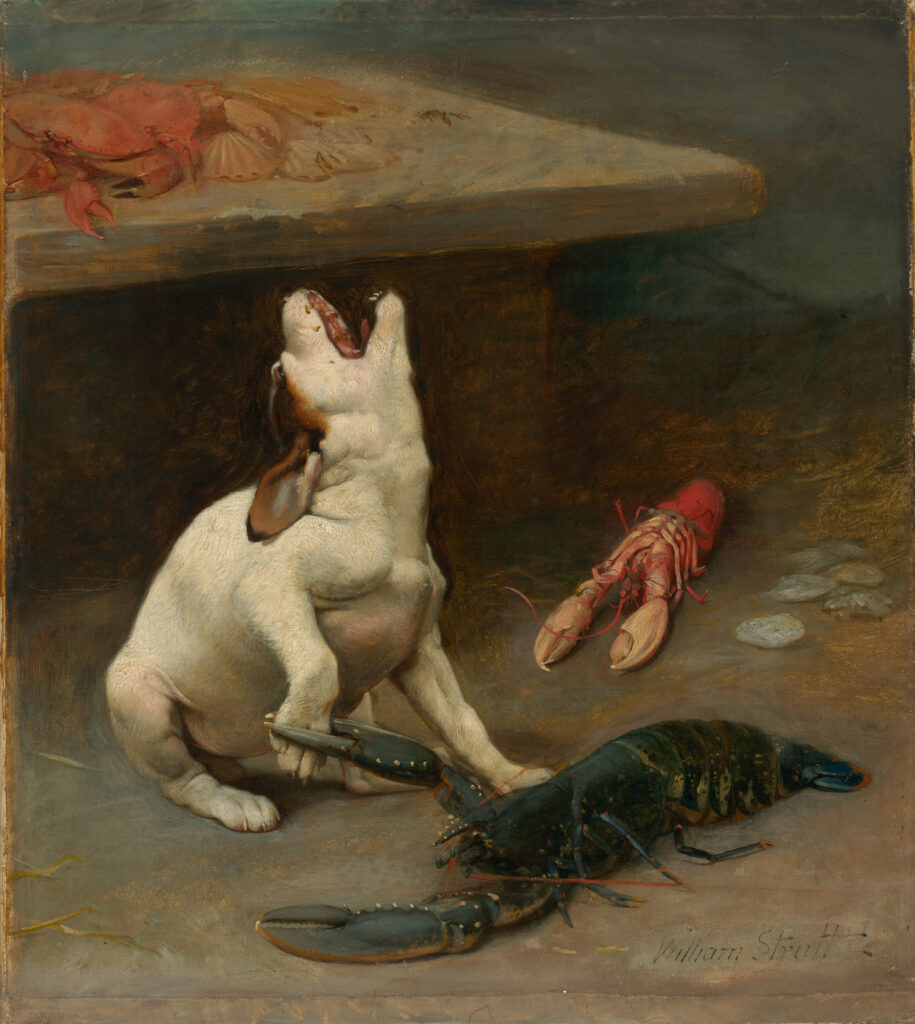
William Strutt, A Warm Response, 1889, National Gallery of Australia, Canberra, Australia.
It is unfortunately not very seldom that we, or our dogs, do something we really ought not do, whether out of a spirit of adventure or for some other reason, and suffer harm as a result. Perhaps we do it because we can’t say for certain that doing it would bring us harm, or perhaps because it is an entertaining, if very fleeting, thing to do.
We have a representation of this laid out in a painting by William Strutt, called A Warm Response. A boundless temptation to play with the lobster, it must have appeared to the poor pup whose paw has become one with that of the vicious crustacean causing him harm. One wonders what motivation dogs have to go playing under such dangerous conditions. For us, it is usually either a desire to look impressive or to be genuinely playful. A friend of dogs, having spent some time around them, could not deny that dogs often mirror these two instincts in us, as well as many others.
Which of them inspired the above dog, we cannot say, for we do not know whether he was all alone, or whether a human or fellow dog was standing behind him, impressed by his intrepid playing. But we do know him, for he is us.
4. The Amazon
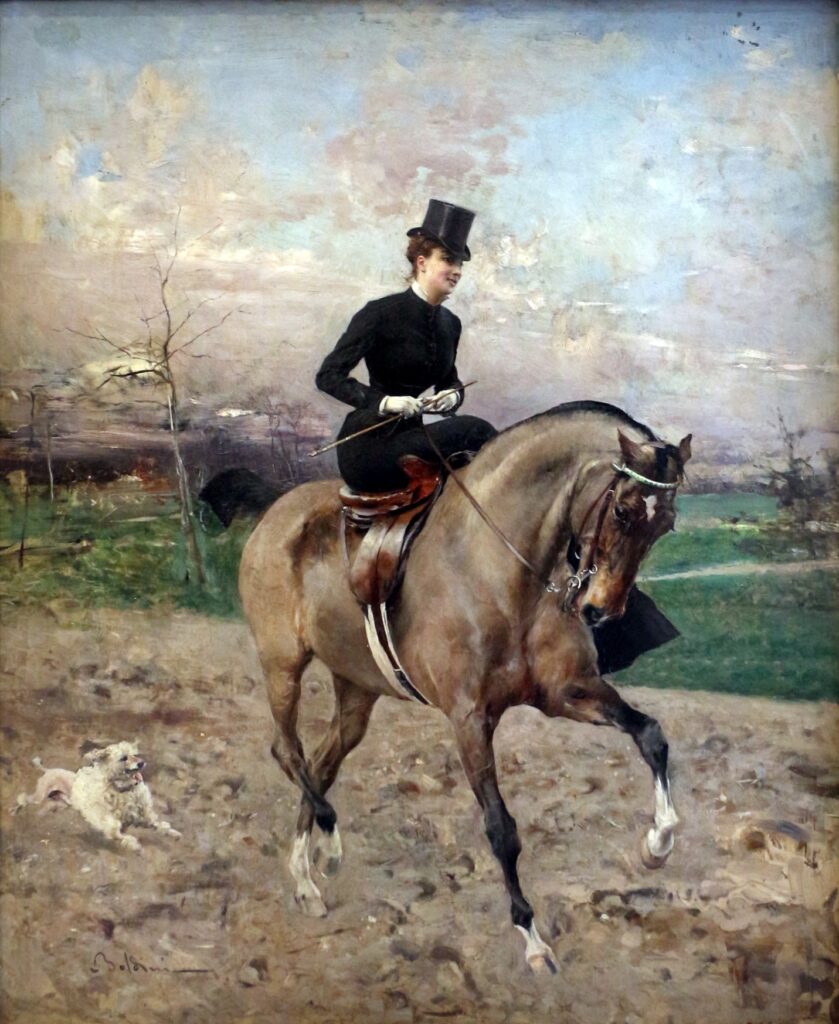
Giovanni Boldini, The Amazon (Alice Regnault on Horseback), c. 1879–1880, Galleria d’Arte Moderna, Milan, Italy.
Here we have a dog who, despite his Lilliputian occupation of the canvas, grabs almost all of our attention and keeps it once we see him or her.
It has been said that dogs take after their owners. This means not that dogs take care of their owners (although they often do this!), but that they adopt the same character, look, and beliefs—if dogs have such strange things—as their owners. At best, that is but a hypothesis. Naturally, not all dogs do, indeed, take after their owners.
But this painting by Giovanni Boldini, depicting the French actress and novelist Alice Regnault and her happy dog, almost makes a theory of this hypothesis. For how alike the dog and the owner are on this brilliantly colored canvas. Despite its size compared to the things of the world, the dog is as excited as ever to throw itself forward and carry on in adventuring. In much the same way, Miss Regnault is quite prepared to travel all across the world with nothing but a horse to carry her where she goes. They wear the same smile. They seem not only the best of friends, but twin souls.
5. Rapp and Johan
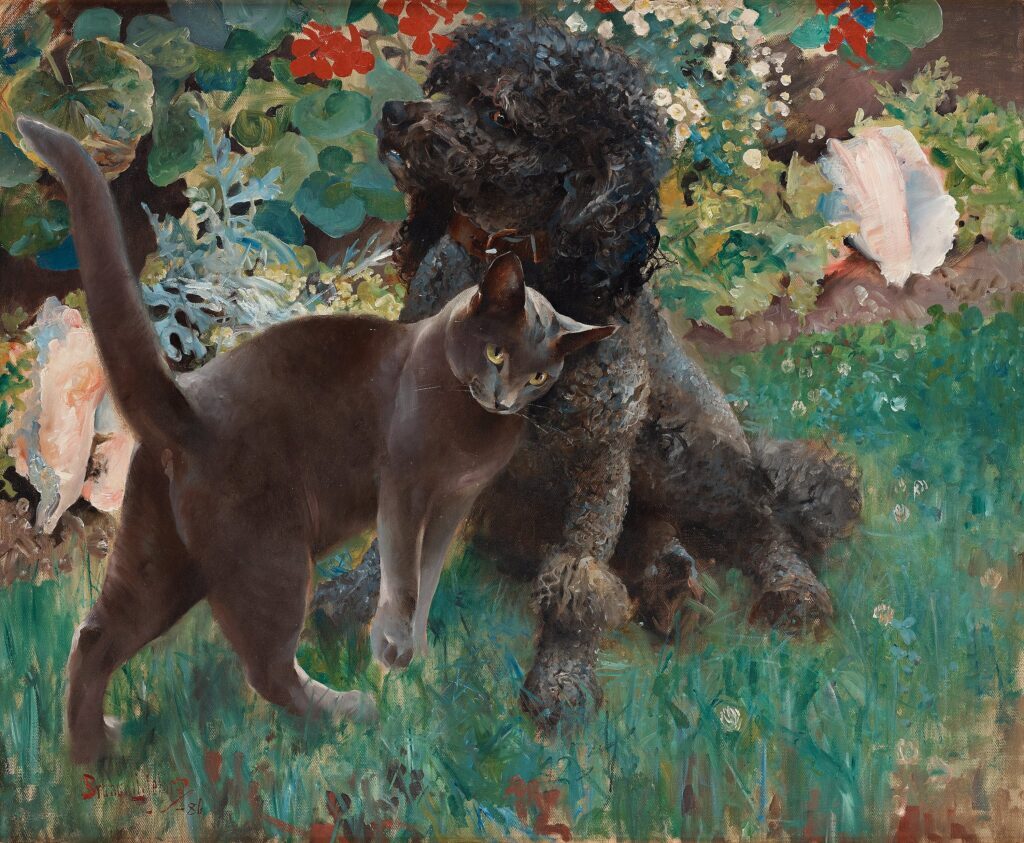
Bruno Liljefors, Rapp and Johan, 1886, private collection. Bukowskis.
The cat is not the traditional friend of the dog, we probably all know. Often, they are put up beside one another as examples of classic rivals. On Liljefors’ canvas, however, we find something a bit different than the traditional relationship of two rivals. Instead, we find one rival and one friend. Or, at least, we find two friends—one skeptical of friendship’s merits and the other not so skeptical.
Of course, the cat—who openly rubs himself against the dog and swings his tail wildly about as he does, signalling openness and repose—is not at all skeptical that he has a friend in the curly-haired pooch. No, he has a friend, as all assertive but ultimately good-hearted cats manage to eventually make. Meanwhile, the dog seems, while letting the rubbing go on, to wonder how much of the friendship is based upon mutual agreement! A relationship that exists amongst dogs and cats as much as it does between humans.
6. The Hunter’s Present
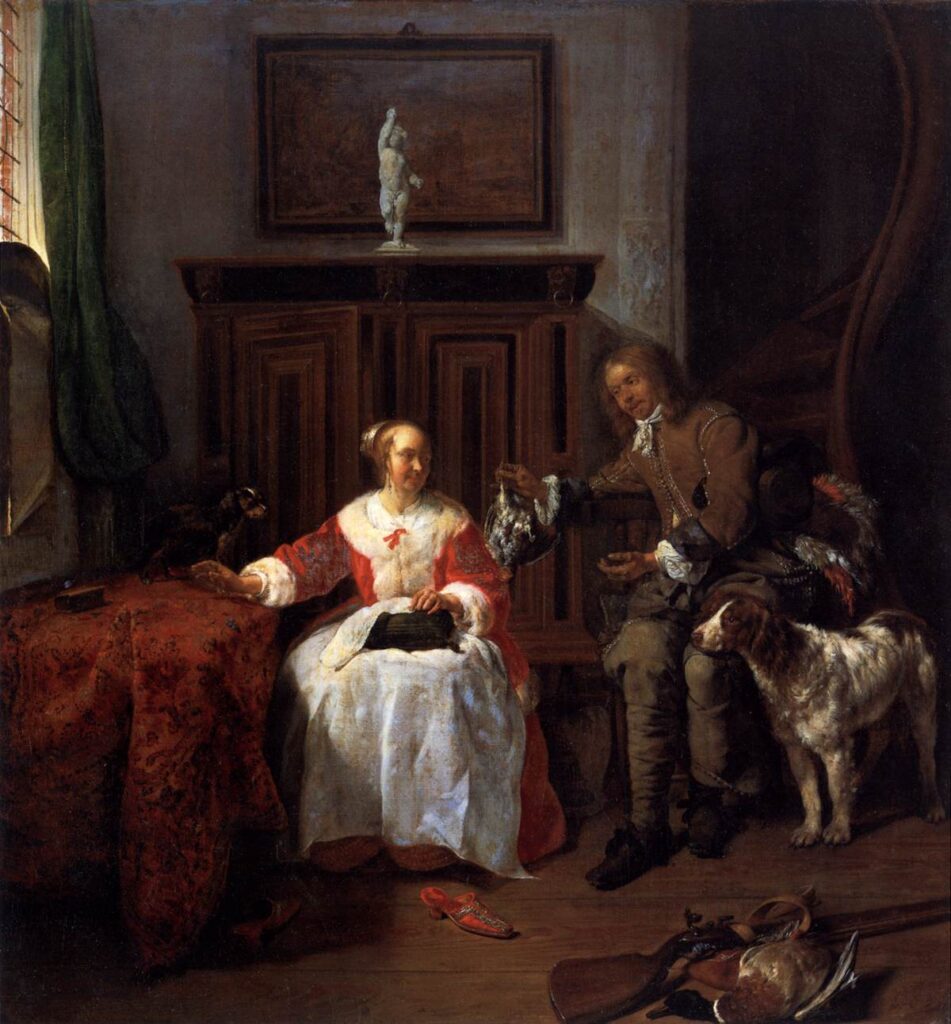
Gabriël Metsu, The Hunter’s Present, c. 1658–1661, Rijksmuseum, Amsterdam, Netherlands.
“Father, do you suppose we can soon go back out and play a little while longer?” the dramatic dog seems to ask of his owner, a hunter who presents his quarry to his wife. Her somewhat less imposing pup evidently stayed indoors during the hunt. We recall both in ourselves and our dogs the desire to be both out of doors and out of doors joyfully. Whether it is a remnant of the earliest, childish will inside us—which might be fixed permanently into innocent, fun-loving hounds—matters little: the fact is that we, as much as our dogs, love being in nature and playing.
For the dog, there is probably no better play than running about and helping his owner hunt food for their family. It is evident by the gaze he longingly sets upon the source of light in the painting—a window above the hunter’s wife—that he is beginning to be beset by boredom. Anyone who has had a dog, or has been around one during a walk, can surely recall this: after some time out, a dog begins to slow down and wander off on little excursions. This happens as soon as it senses that a return home is approaching. Further, one surely knows that the dog feels it could repeat the walk just then, no matter their tiredness or the weather, and be perfectly pleased doing so. On his canvas, Metsu perfectly captures the will to play, so memorable and alive in dogs as well, though increasingly rare, in humanity.
7. Requiescat
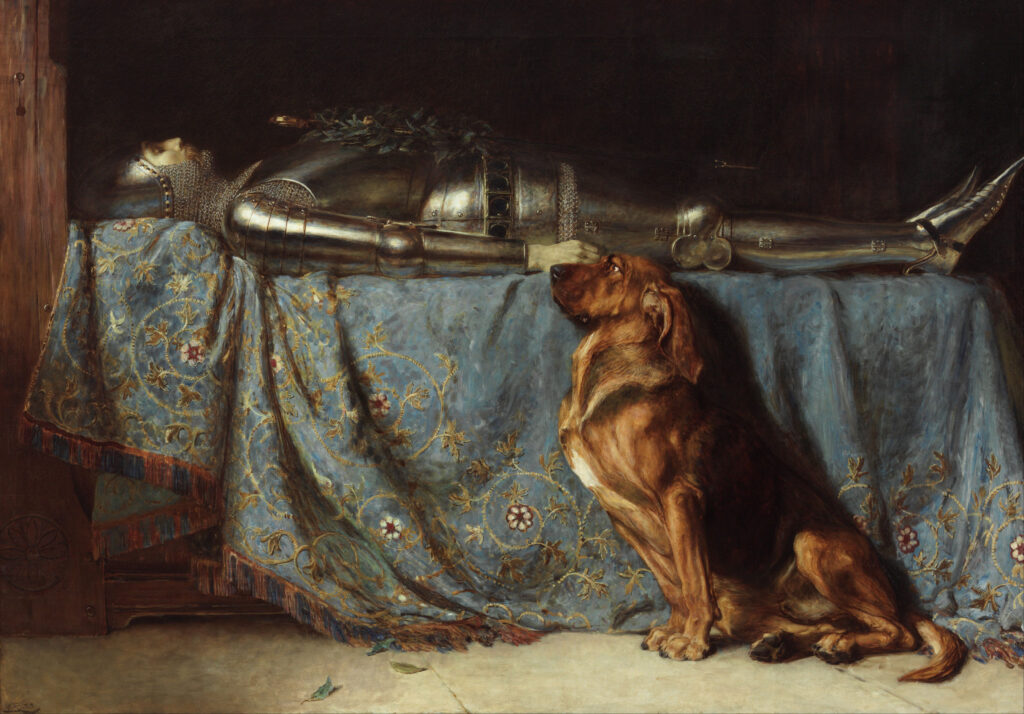
Briton Rivière, Requiescat, 1888, Art Gallery of New South Wales, Sydney, Australia.
Requiescat in pace—or, rest in peace—is the theme of this very beautiful work by Briton Rivière. As in Strutt’s A Warm Reply, we see a dog in pain, though of a very different, much more spiritual manner. All have heard that a dog would rather starve beside its fallen owner than step anything like a distance away from them. But it is not idle talk—dogs who love their owners, whom they were loved by, really will choose to die beside their departed owner if they can. Otherwise, fearing the worst but not knowing, they will do all they can to return to their lost owner.
The dog in this painting is dramatic, though not in a pejorative sense. He represents the very best of morality, both canine and human. His scene is a dramatic one, and he sits in it very gracefully. May he and his noble owner, now both long passed from the earth, requiescat in pace.
8. Avenue at Strömsholm
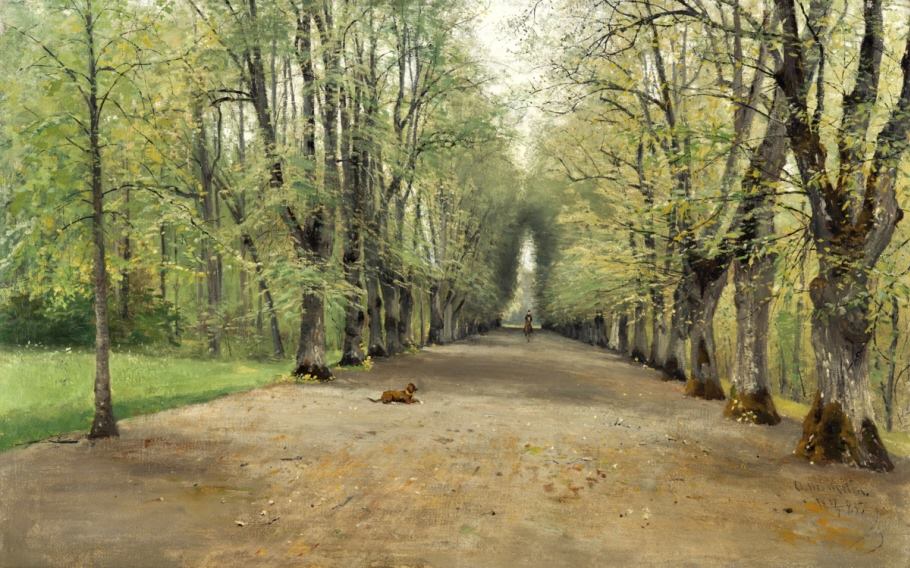
Olof Hermelin, Avenue at Strömsholm, 1885, Gothenburg Museum of Art, Gothenburg, Sweden.
Our dog subject takes up a very small span of the canvas on this occasion. Nevertheless, he fills our imagination with 100 or more remembrances of warm, attention-seeking dogs we have encountered. Out of all the nature surrounding the path, which the animal could have happily sojourned in, he has chosen to plant himself almost right in the middle of the path. We can very easily imagine how he would have pretended to have merely happened upon the path as someone passed him by and considered giving him a pat or a treat. “Look here, if you please, Sir; I’ve just lost my way a little. Might you help me? . . . I’m a little hungry, too!”
9. Queen Victoria at Osborne
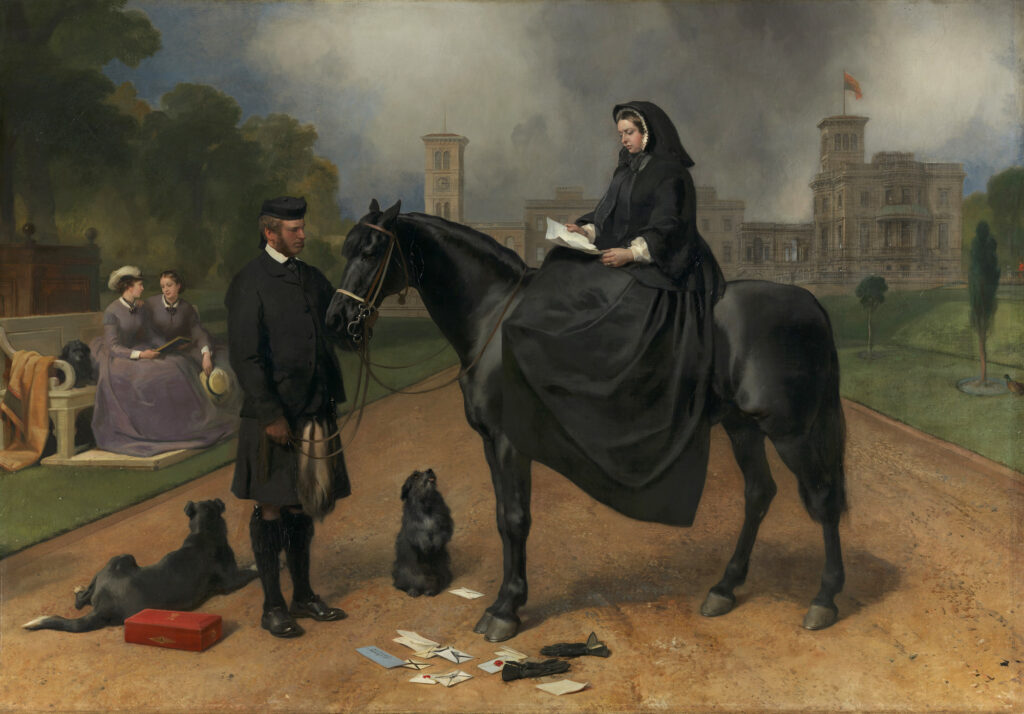
Edwin Landseer, Queen Victoria at Osborne, 1865, Osborne House, East Cowes, Isle of Wight, UK.
Though we have three dogs in this painting, I would like to focus on the small one at the bottom center of the canvas.
“Mum… Down here, mummy! O, is that the last letter, mum? Might we go running after, mummy—I promise I’ll keep up!” One can almost hear the desperate pleas that Queen Victoria’s little dog wishes it could make as Her Majesty remains mounted, reading correspondence.
Unlike Metsu’s painting of the active dog, here we have a dog with a certainly different temperament. Whereas the hunting dog is happy to run about all day, half-accompanied by their owner and half not, the dog of the world’s most powerful monarch, like probably one thousand others on any given day, desires nothing more than an extra minute of Her Majesty’s attention. It is a greatly endearing scene. It neither turns us cold to Victoria nor her dog, but fills us only with the feeling that we ought to cherish every moment with our dogs as well as all else we love. These moments often come sparingly, but are always the fullest of joy.
10. In from the Cold
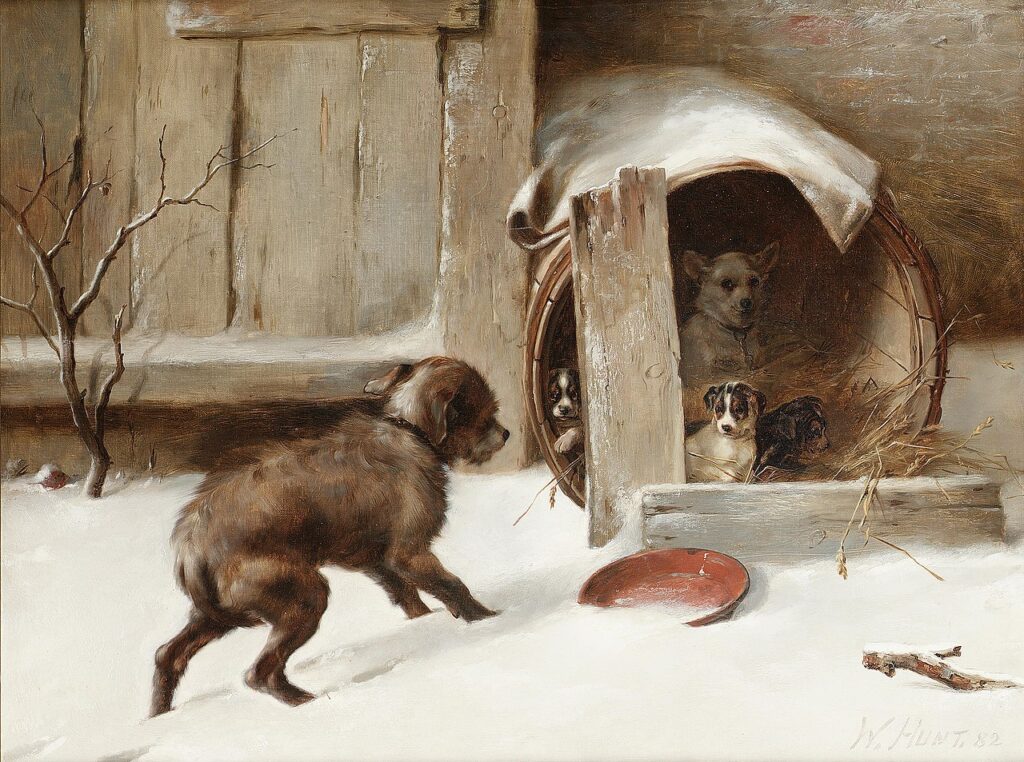
Walter Hunt, In from the Cold, 1882, private collection. Bonhams.
Here we have a painting of great dramatism and realism. It gives us an example of dog and human behavior, which is eternal so far as humanity’s history is concerned. Just like us, dogs have their own superiorities and feelings and emotions. We can all recall the proud poodle that prances down the beach with a large stick in its mouth and its tail held high, as well as the meek, lonely dog who stays right by their owner’s leg as they walk on the boardwalk. But, just like us, dogs are quite willing to surrender possession of their feelings, emotions, and superiorities in times of peril. No matter how we feel about our neighbour, many of us will care for them in times of trouble. This is something that has long been commanded, yet in everyday life is too often little observed and long neglected.
If there is a storm, we often come together and survive under the grand roof of a relief building. If a beloved building catches alight, we will not carry on in our normal manner, since the building is not, after all, our own, but will do what we can to help, even if it’s a little. In times of trouble, it cannot be denied, we come together. Alas, it is not very often in common times that we come together, and this often brings times of trouble. The case, as Hunt would like us to know, is just the same for our dog friends.
P.S. If you love dogs and their depictions in art, be sure to check out our Animals Postcards, featuring timeless animal paintings!
Author’s bio:
Trygve Rasmussen is a Canadian/Australian author who writes about art and philosophy. He writes on Substack. He is the editor in chief of Peremen Press, which publishes classic literature in pocket format. He has just finished his newest book covering nihilism.