



The Cost of Devotion in Caravaggio’s Saint Jerome
Caravaggio, one of the most striking painters of the Baroque era, uses the figure of Saint Jerome to explore themes of devotion and mortality. In...
Frank Schildiner 13 September 2026
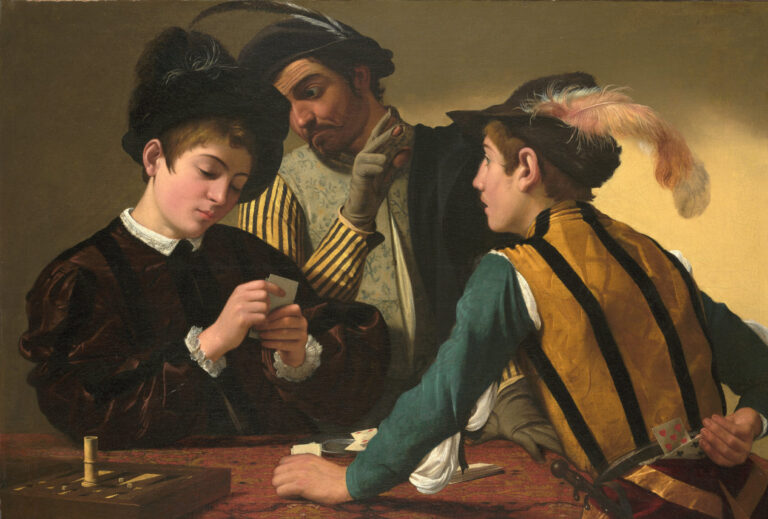
Caravaggio, The Cardsharps, c. 1594, Kimbell Art Museum, Fort Worth, TX, USA. Wikimedia Commons (public domain). Detail.
In Caravaggio’s work, desire requires payment. The great baroque artist illuminates that impulses such as greed, desire, and sensual longing are transactions with apparent consequences. This is not a new notion, but one he explored over his career. Using darkness and subtle movement, Caravaggio presents the hidden cost yearning has over the life of the individual. This view proved insightful and educational once examined.
Based on his work, Caravaggio abandoned idealized beauty in favor of a stark, human reality. His paintings introduce us to scenes in which, as viewers, we often feel not as observers but as participants, implicated in the cost that desire exacts on those who tempt fate. The details presented provide an implied pattern: vulnerability leads to temptation, which results in a price to be paid. Sometimes the fee is a material loss, other times the costs are moral or possibly existential.
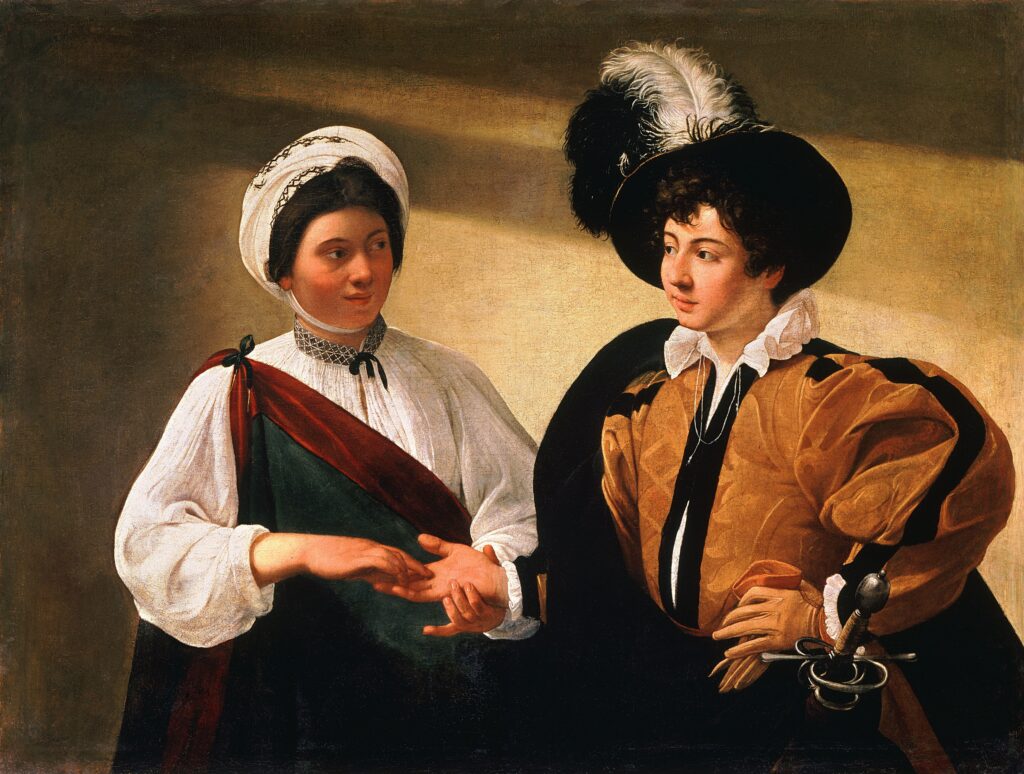
Caravaggio, The Fortune Teller, c. 1595, Louvre, Paris, France. Wikimedia Commons (public domain).
Beginning with The Fortune Teller, Caravaggio presents a scene that provides the clearest intentions of this notion. A well-dressed boy stands with a Romani girl who holds his hand, tracing lines that tell his fortune. Their eyes are upon each other, and her gaze holds an almost coquettish intensity. Desire appears present, based on the young man’s pose and locked gaze.
What Caravaggio places near the bottom of the painting is the cost of the youth’s desire for the fortune teller. As their eyes remain connected, she carefully removes the ring from his finger. This hidden price is almost forgotten, lost in the bright plume of the nobleman’s feathered hat and the unspoken desire he holds for the Romani girl.
This scene is universal, a hidden truth that Caravaggio places in plain sight. The boy’s desire for the girl is real; the cost is the ring on his finger and possibly his innocence. A commonality in life that was otherwise hidden from art in that period of history. This demonstration of the cost of desire was, in many ways, revolutionary.
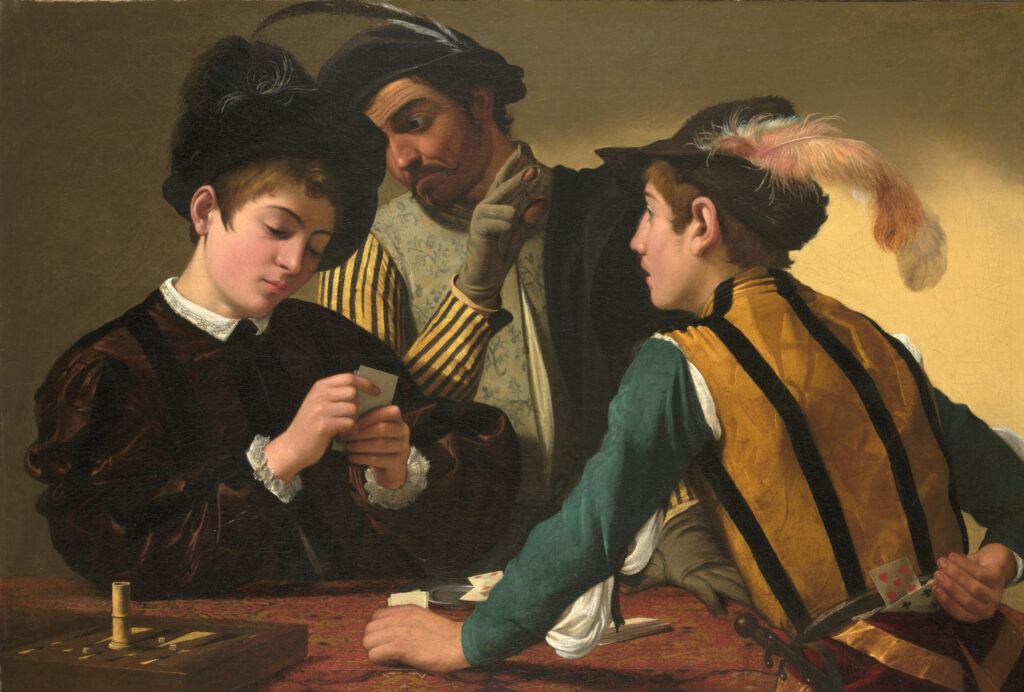
Caravaggio, The Cardsharps, c. 1594, Kimbell Art Museum, Fort Worth, TX, USA. Wikimedia Commons (public domain).
The Cardsharps provides an evident demonstration of the cost of desire. A well-dressed young man plays cards with a flashily dressed youth. The young man’s eyes are upon his card, and Caravaggio shows us that his opponent holds several cards behind his back and a knife in his belt. A third man, older than the card-playing pair, stands behind the well-dressed young man, looking at the cards while holding up three fingers. This action is a signal, a method of cheating that transforms this encounter from a game of chance to a crime.
The sequence is clear: the well-dressed young man joined a game with a pair of criminals, cardsharps if you will. They will either rob him of his money or, based on the blade present in the flashily dressed youth’s belt, his life. Caravaggio exposes both sides of this situation: a desire for money or pleasure, money or life.
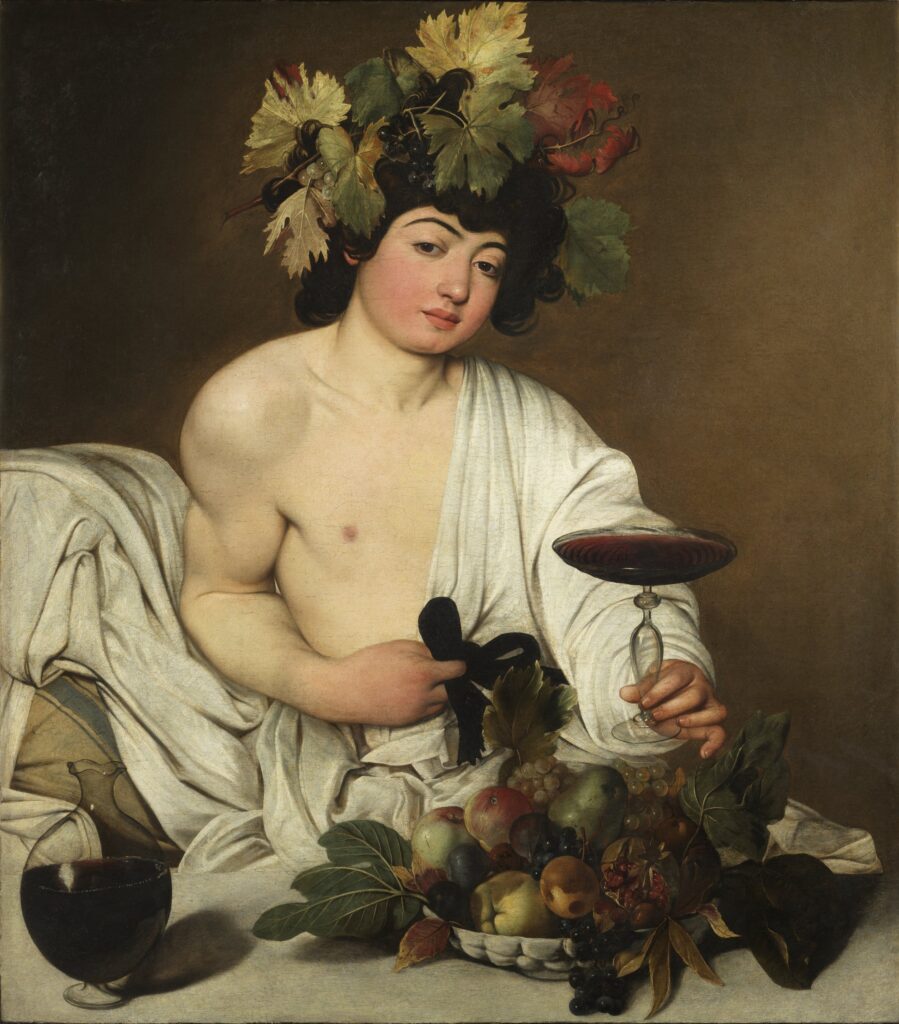
Caravaggio, Bacchus, 1598, Uffizi, Florence, Italy.
Caravaggio’s Bacchus presents desire in a different manner, one of sensual invitation and decay. Caravaggio presents a round-faced youth with hooded eyes, a muscular body covered by an open toga, while extending a glass of wine towards the viewer; before him lay a basket of fruit with a bursting pomegranate and a rotting apple.
The implication is clear. By embracing the sensuality of the youth, you risk succumbing to corruption. There is also a hint that youth and pleasure are fleeting, and when indulged, they will rot and die like the fruit before the boy. Caravaggio’s homoerotic suggestions may have also alluded to his patron, Cardinal Francesco Maria del Monte’s purported sexuality and his preference for youthful male lovers. This inclination may have damaged the cardinal’s chance at assuming the papacy in the 1621 papal conclave.
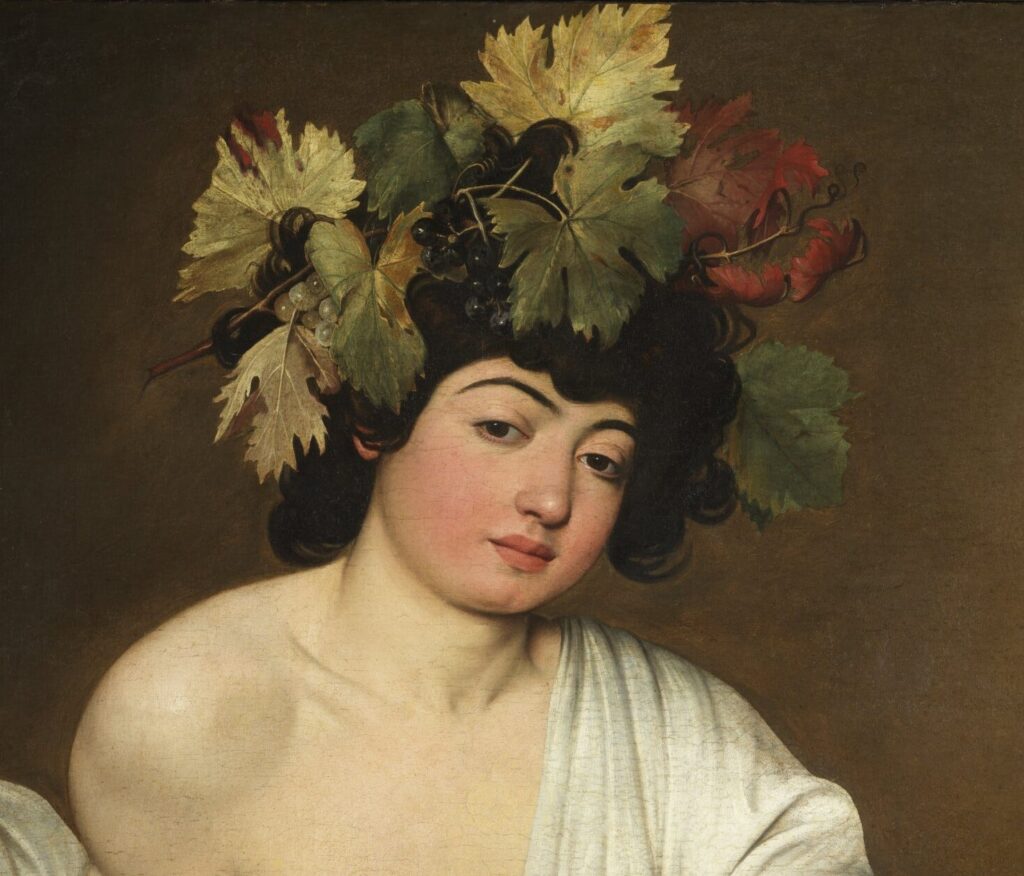
Caravaggio, Bacchus, 1598, Uffizi, Florence, Italy. Detail.
Caravaggio presents desire as exacting a payment from its participants. In The Fortune Teller, a young man feels desire for the Romani girl as she steals a ring from his finger. The Cardsharps presents an innocent nobleman as he plays a game of cards with a cheater, while a third man helps the cardshark win. Caravaggio suggests the risk for avarice is either the loss of money or life. Finally, in Bacchus, a youth suggests sensual pleasure, with the possible consequence of corruption. In each painting, Caravaggio presents desire and its cost either openly or through implication.
DailyArt Magazine needs your support. Every contribution, however big or small, is very valuable for our future. Thanks to it, we will be able to sustain and grow the Magazine. Thank you for your help!

An admirer of antiquity, art, and architecture. An avid reader and amateur photographer. Always curious, always on an adventure.
Caravaggio, one of the most striking painters of the Baroque era, uses the figure of Saint Jerome to explore themes of devotion and mortality. In...
Frank Schildiner 13 September 2026
Mount Olympus, Homeric Troy, Renaissance Venice, Golden Age Delft. At the outset, Western art history hardly bears any connections with its Eastern...
Guest Author 15 May 2025
Anthony van Dyck, a Flemish Baroque painter of remarkable skill, left an indelible mark on art history. His signature style of refined portraits and...
Jimena Aullet 17 August 2026
Many things could be said about Peter Paul Rubens, the most important and influential Flemish painter of the 17th century. The genius of the Baroque,...
Andra Patricia Ritisan 5 October 2026