
Mirrors in Art: Reflections of Femininity
The mirror has functioned as a recurring symbol throughout art, particularly in representations of women. Historically, its presence in art has often...
Martha Teverson 24 August 2026
23 March 2026 min Read
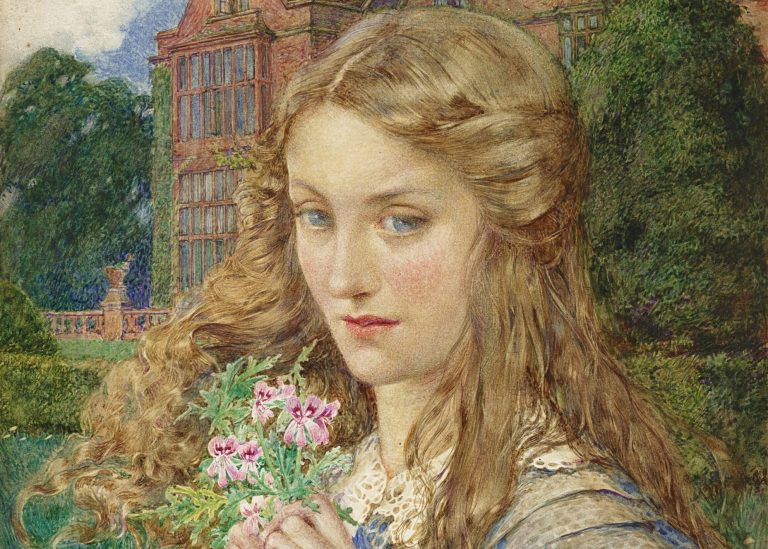
Eleanor Fortescue-Brickdale, Evelyn Hope, 1908, private collection. Wikimedia Commons (public domain). Detail.
Eleanor Fortescue-Brickdale’s paintings are full of rich, opulent color and detail, and her subjects range from Arthurian legends to fairies to the rise of aviation. Considered the last of the Pre-Raphaelites, she showed the splendor of an imagined European courtly life and illustrated folklore and poetry at a time when many artists were moving towards modernism.
Although born in 1872, 24 years after the formation of the Pre-Raphaelite Brotherhood, Fortescue-Brickdale’s art lineage can be traced to the movement’s founders. She trained and exhibited at London’s Royal Academy of Arts. There, Byam Shaw became a mentor. Shaw was trained by John Everett Millais, one of the founders of the Pre-Raphaelite movement. Millais and his brethren believed in paintings grounded in nature, realism, keen detail, and a return to a style of painting preceding Raphael.
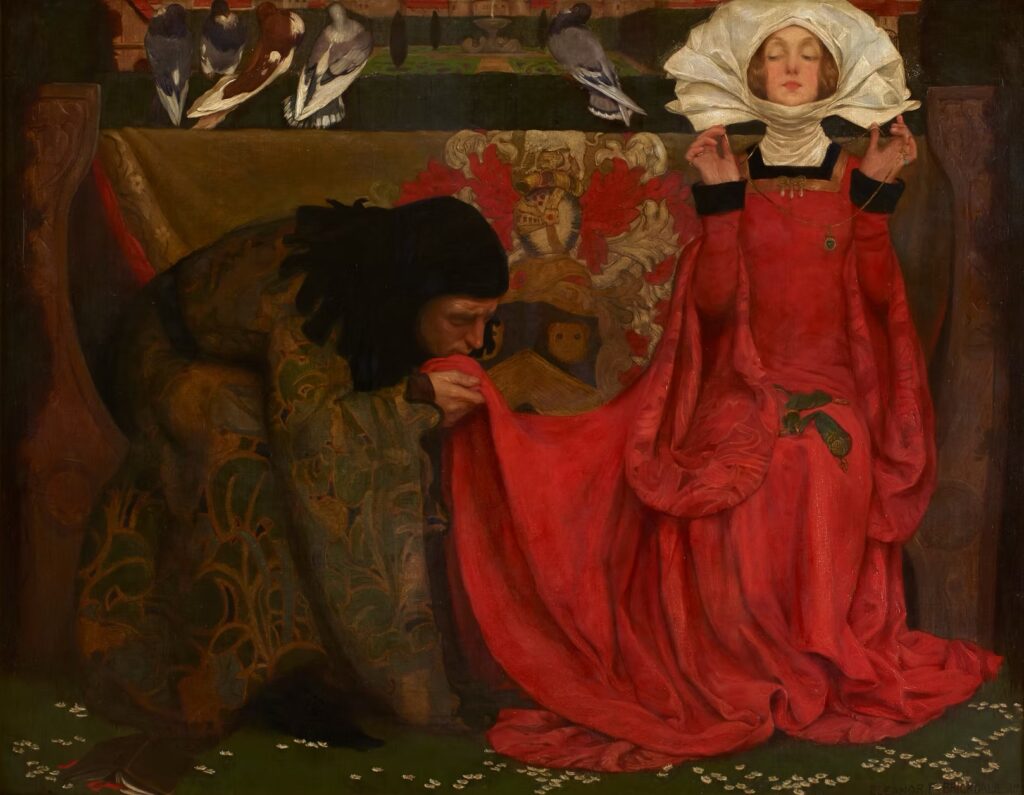
Eleanor Fortescue-Brickdale, The Pale Complexion of True Love, 1899, Musée d’Orsay, Paris, France.
As a young artist, Fortescue-Brickdale won several awards and secured employment as a pen and ink illustrator. Dowdeswell and Dowdeswell’s Gallery in London commissioned her to create 45 watercolors. Often considered her first major work, this painting is based on Shakespeare’s As You Like It, and was first shown at the Royal Academy of Arts in 1899. The striking colors and details in the folds and design of the fabric and tapestry are hallmarks of Fortescue-Brickdale and the Pre-Raphaelites more generally.
Also, Fortescue-Brickdale portrays her female subject in a position of power, the recipient of attention, perhaps relishing in her opportunity and choice to refuse it. The same is true of her painting, The Cunning Skill to Break a Heart, painted in 1900. In this way, Fortescue-Brickdale is setting her work apart from so many Pre-Raphaelite works showing women as more passive subjects of adoration.
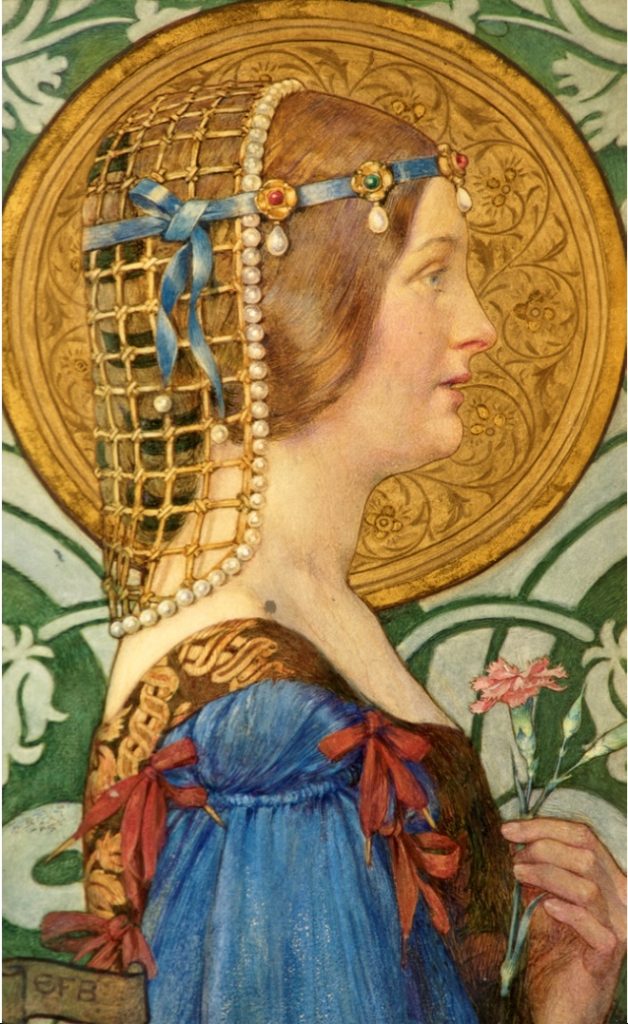
Eleanor Fortescue-Brickdale, If One Could Have that Little Head of Hers, 1900–1909, Russell-Cotes Art Gallery and Museum, Bournemouth, UK.
Fortescue-Brickdale exhibited 32 illustrations of Robert Browning’s poetry at the Dowdeswell and Dowdeswell Gallery in 1909. One Could Have that Little Head of Hers was painted for Robert Browning’s A Face, a poem about a Renaissance portrait. The poem begins: “If one could have that little head of hers; Painted upon a background of pale gold, Such as the Tuscan’s early art prefers!”
The Russell-Cotes Art Gallery and Museum, which owns the paintings, suggests that the Browning poem is referencing Ritratto di dama by Giovanni Ambrogio de Predis, and certainly the two paintings bear a strong resemblance. Fortescue-Brickdale employs the symbolism of the solid circular background as a golden halo, a common medieval and early Renaissance symbol referenced in the Browning poem as well.
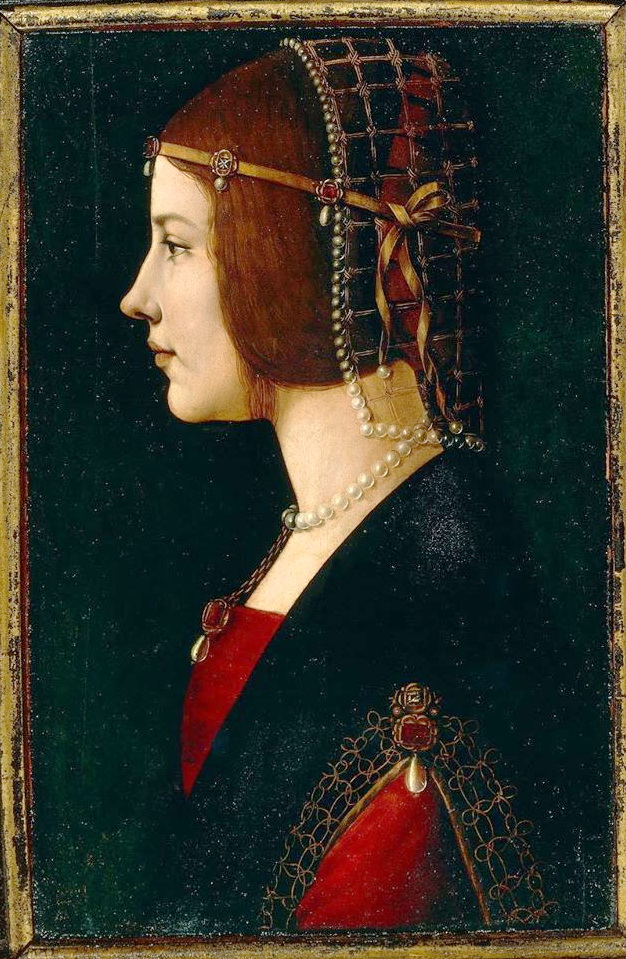
Giovanni Ambrogio de Predis, Portrait of a Lady, 1490, Veneranda Biblioteca Ambrosiana, Milan, Italy.
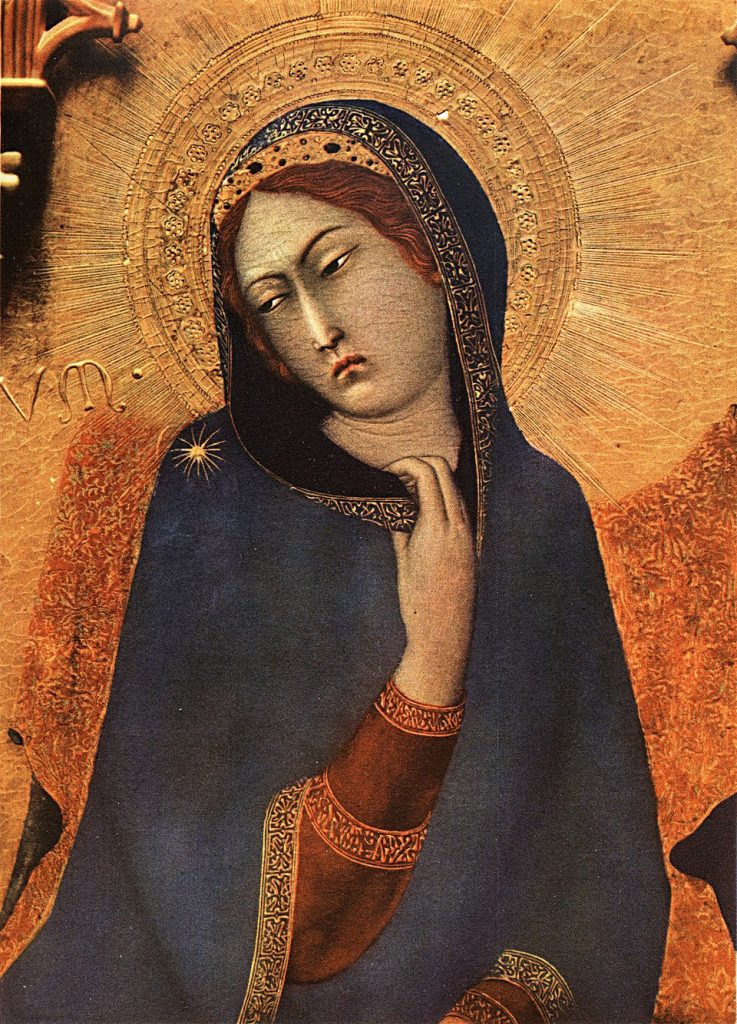
Simone Martini and Lippo Memmi, Annunciation with St. Maxima and St. Ansanus, 1333, Uffizi Gallery, Florence, Italy. Detail.


The Russell-Cotes Art Gallery and Museum suggests that the Robert Browning’s A Face is referencing this painting by Giovanni Ambrogio de Predis.
This painting shows an example of how halos were painted in the early Renaissance period.
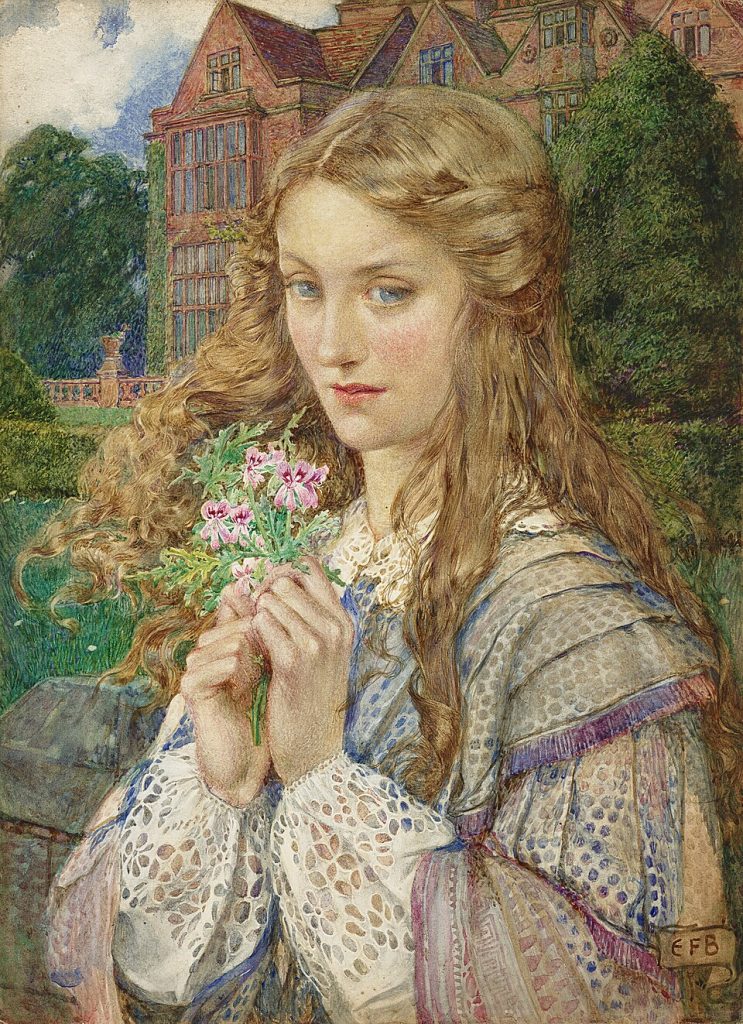
Eleanor Fortescue-Brickdale, Evelyn Hope, 1908, private collection. Wikimedia Commons (public domain).
In Robert Browning’s poem Evelyn Hope, a man opines about the beauty and virtue of a 16-year-old girl who has died and a relationship that never was. It’s an uncomfortable read from a modern lens, the narrator being “thrice as old” as the dead young girl about whom he speaks. In this painting, Fortescue-Brickdale shows Evelyn Hope on her own, the expansive background suggesting a full life. In fairness, the poem imagines a full life for Evelyn Hope, too, only filtered through the gaze of a much older man. In the Fortescue-Brickdale painting, she is presented on her own.
Despite the evident skill of Fortescue-Brickdale’s work, at least one critic objected to Fortescue-Brickdale having the audacity to try to add to Browning’s brilliance. A critic in The Guardian wrote “…a finely done poem can not want your art, and is apt to land you with nothing but a girl against the backdrop of an old manor house to do the duty for Evelyn Hope…”
Several reviews at the time criticized Fortescue-Brickdale’s work and minimized the artistic value of illustration in general. Still, Fortescue-Brickdale remained as successful in gallery settings as she was within the pages of a book.
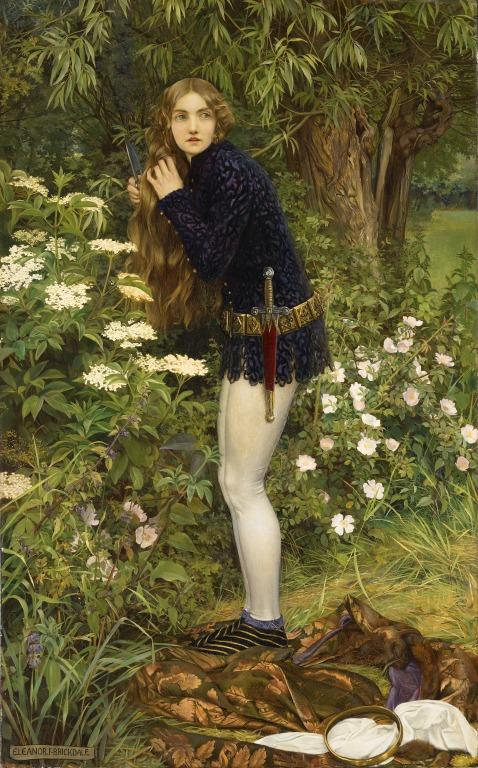
Eleanor Fortescue-Brickdale, Little Foot Page, 1905, Walker Art Gallery, National Museums Liverpool, Liverpool, UK.
Little Foot Page was inspired by the folk song Child Waters which tells the story of a pregnant woman whose lover is leaving. To be with him, she disguises herself as his foot page. There are several versions of this story, each uncovering various depths of cruelty and devotion. The subject of the painting is preparing to cut off her hair to disguise herself as a male page. The details of the lush forest background give the painting its visual abundance, a hallmark of the Pre-Raphaelites and of Fortescue-Brickdale.
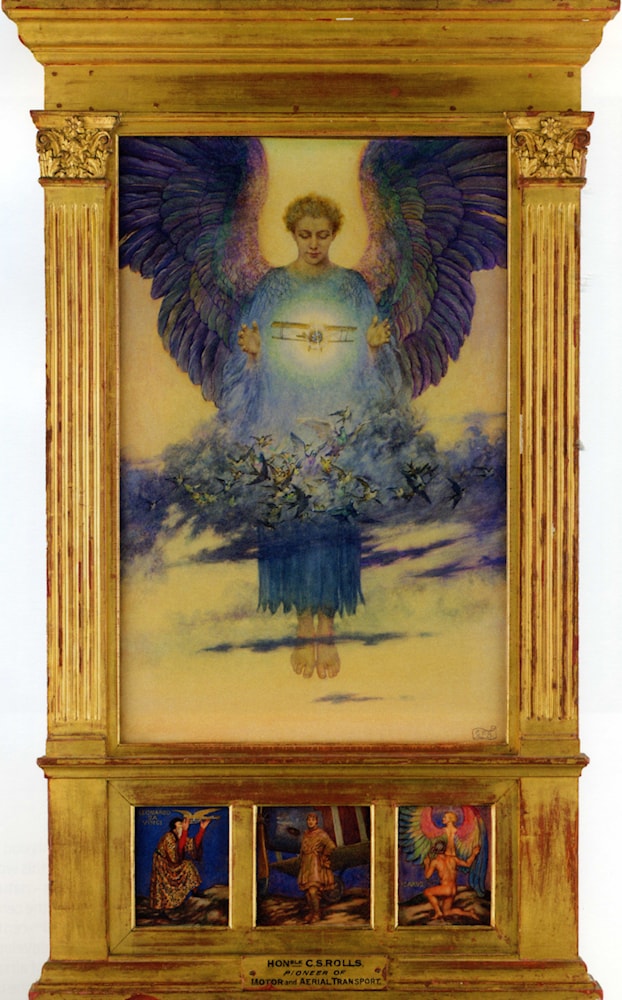
Eleanor Fortescue-Brickdale, Guardian Angel or In Honor of C.S Rolls, Pioneer of Motor and Aerial Transport, 1910. Art Renewal Center.
This piece honors C.S. Rolls, co-founder of the Rolls-Royce Company, who died after his Wright Flyer crashed during an aviation demonstration. Rolls was just 32 at the time, and aside from starting the now-famous company, he also set a land speed record in a car in 1903, made 170 ascents in hot air balloons, and was the first airplane pilot to make a double crossing across the English Channel.
Here, an angel appears, guiding an airplane. The bottom left portion of the painting depicts Leonardo da Vinci studying flight. In the middle stands a uniformed pilot. The last panel shows the doomed Icarus. Text at the bottom of the frame reads, “In Honor of C.S Rolls, Pioneer of Motor and Aerial Transport.”
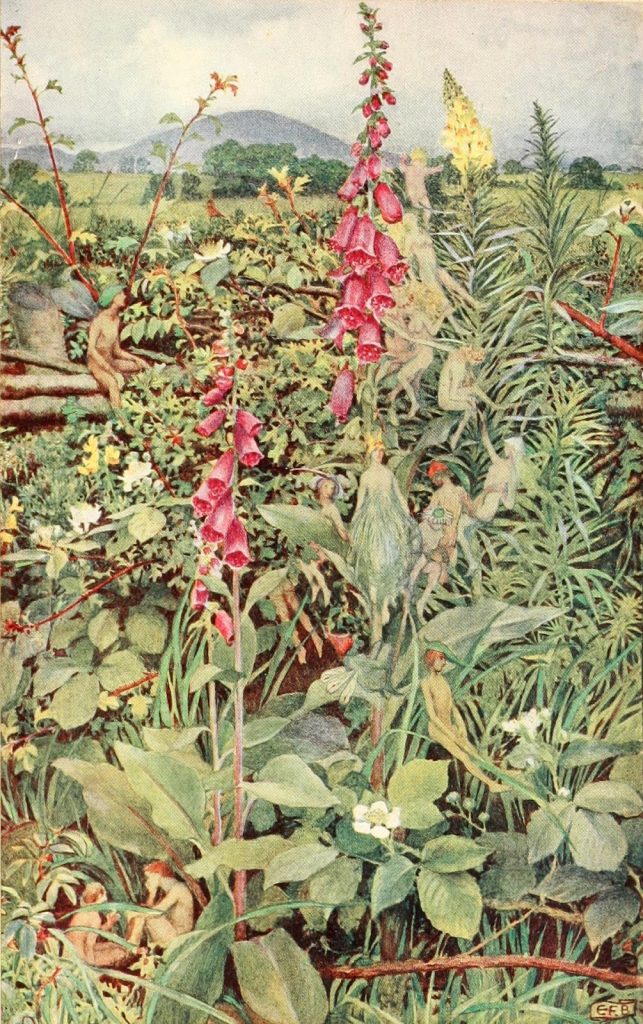
Eleanor Fortescue-Brickdale, Before the Coming of the Sinful Queen, 1913. Wikimedia Commons (public domain).
This is one of 21 illustrations appearing in the 1911 publication of Alfred, Lord Tennyson’s Idylls of the King, a book of narrative poems about King Arthur and the Knights of the Round Table. Fortescue-Brickdale previously contributed black and white illustrations to a 1905 edition of Tennyson’s poems. However, the full-color work produced for this book endures as some of her most stunning work.
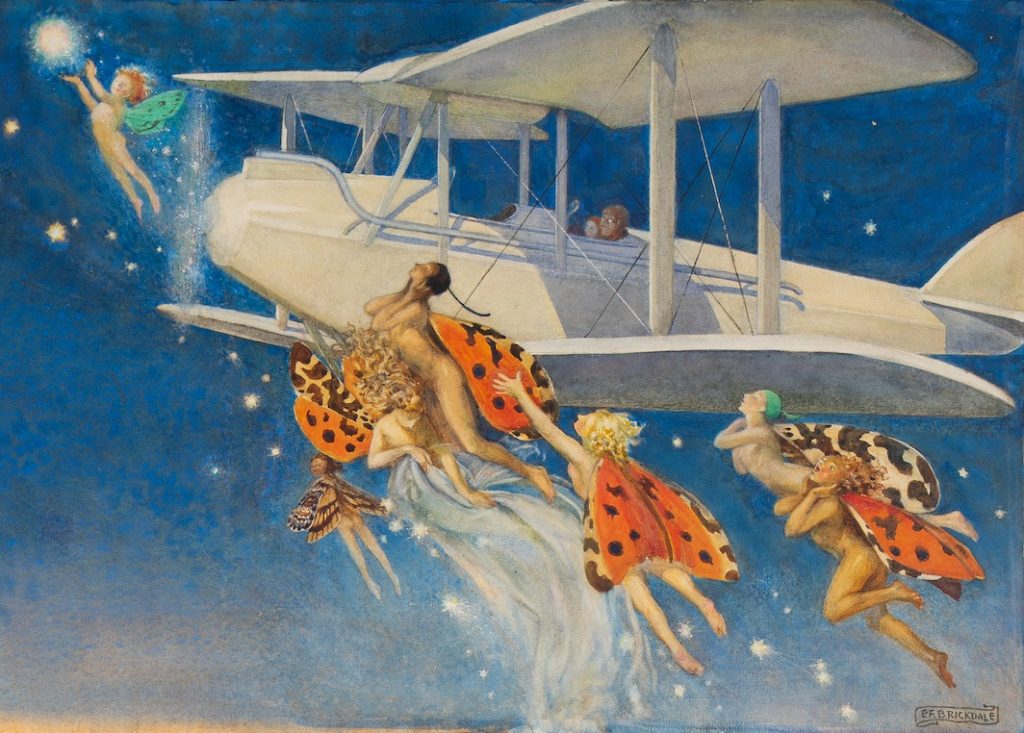
Eleanor Fortescue-Brickdale, The Moth, 1917, Korshak Collection. Backus Museum.
More than any other painting by Fortescue-Brickdale, The Moth clearly shows her position as the last of the Pre-Raphaelites, the one carrying the romanticism of the movement far into the 20th century. At a time when World War I spurred the aviation boom, Fortescue-Brickdale mixes in frolicking fairies popular during the Victorian era.
Steve Korshak has lent this and other paintings in his Korshak Collection of Illustrations of Imaginative Literature to 20 museums in the United States, Japan, and Spain. On the collection’s website, Korshak highlights Fortescue-Brickdale’s contributions to fantasy art, most notably in her paintings for Idylls of the King. He writes, “Her illustrations were highly sought after for their evocative beauty and emotional depth, earning her a reputation as one of the leading fantasy illustrators of her time.”
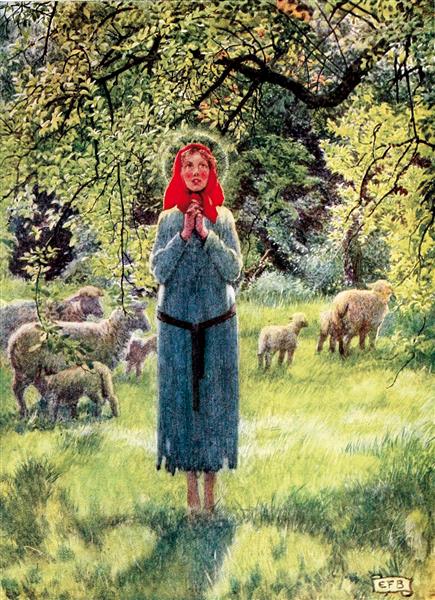
Eleanor Fortescue-Brickdale, Joan of Arc, 1919. WikiArt (public domain).
Eleanor Fortescue-Brickdale’s Golden Book of Famous Women, published in 1919, includes excerpts from 52 works of fiction and poetry featuring prominent women in history and literature. Fortescue-Brickdale illustrated 15 of these works, including an excerpt from Robert Southey’s epic poem Joan of Arc. Here, Joan of Arc is depicted by Fortescue-Brickdale as a humble peasant, yet with a halo that both portrays the divine touch Joan of Arc claims to have guided her, and which harkens back to Pre-Raphaelite artistic tradition. The illustration is accompanied by a quote from the text reading: “I have heard Strange voices in the evening wind; strange forms, Dimly discovered, thronged the twilight air.”
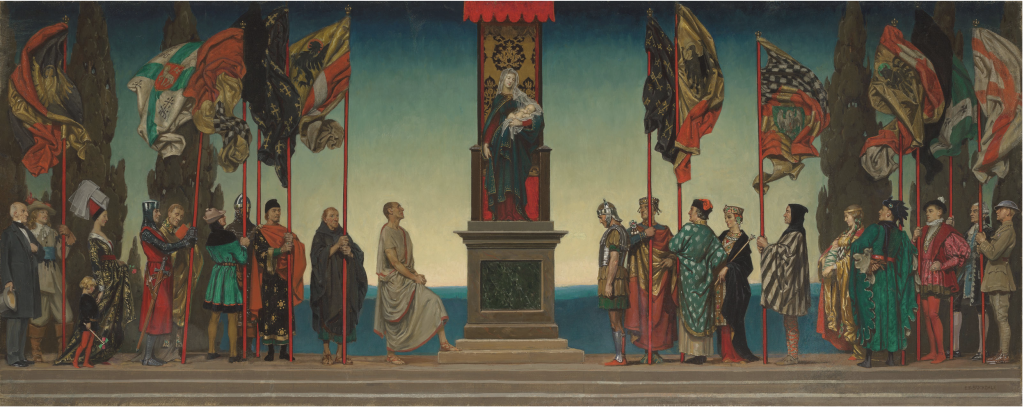
Eleanor Fortescue-Brickdale, Unknown title, 1910–1920, private collection. Christie’s.
This painting is a sacra conversazione, a motif developed during the Renaissance featuring Mary holding an infant Jesus as saints and admirers look on. St. George’s Church, Campden Hill, Kensington, owned this painting for years, and a spokesperson for the church thinks it was likely donated by a parishioner sometime in the 1930s. The church stands just blocks away from Byam Shaw’s art school, where Fortescue-Brickdale was a teacher.
“…St George’s had never been a particularly high church; it [the painting] was never actually displayed at the church…” said spokesperson Daniel Gable. The church loaned the painting to the council of the Royal Borough of Kensington and Chelsea, where Gable says it hung in the mayor’s office for a time. “Ultimately, because it was an asset of the church and wasn’t part of the fabric, they came to the decision that it should be sold,” said Gable. The painting was purchased by the knighted British rocker Sir Rod Stewart in 1999.
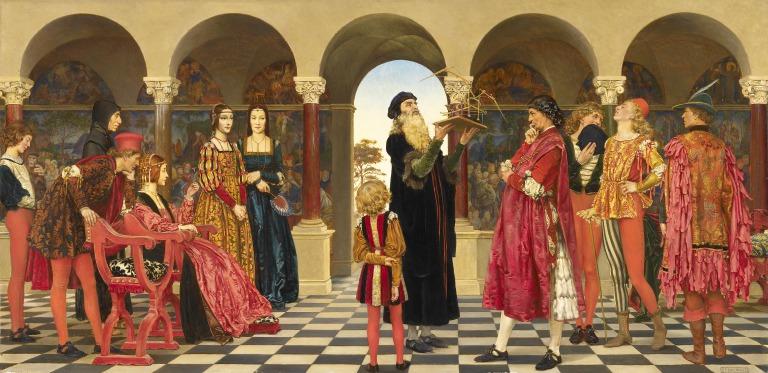
Eleanor Fortescue-Brickdale, The Forerunner, 1920, Lady Lever Art Gallery, National Museums Liverpool, Bebington, UK.
Again, Fortescue-Brickdale shows her fascination with flight and depicts Leonardo da Vinci as the father of modern aviation, showing his patrons a model of his flying machine. Here, Fortescue-Brickdale shows a masterful execution of perspective, particularly in the tiles and architecture. The same can be found in her painting Romeo and Juliet Farewell and Botticelli’s Studio. This, along with the composition of her numerous subjects, each in an expressive pose, harkens back to the art of the High Renaissance. In this ambitious work, Fortescue-Brickdale is again affirming herself as an artist of the Pre-Raphaelite movement.
Fortescue-Brickdale suffered a stroke in 1938 and ultimately died in 1945. As modern art and modern industry proliferated, Fortescue-Brickdale used the style and techniques of the early Renaissance to hang on to the Victorian Pre-Raphaelite movement well into the 20th century. She was the last of the Pre-Raphaelites and one of the most impactful.
DailyArt Magazine needs your support. Every contribution, however big or small, is very valuable for our future. Thanks to it, we will be able to sustain and grow the Magazine. Thank you for your help!

Theodore Carter is the author of several books including "Stealing The Scream" and "Frida Sex Dreams and Other Unnerving Disruptions". You can see his art out in the streets of Washington, DC, and on his website: https://theodorecarter.com.

Elizabeth Provost is a visual arts journalist, editor, and scholar of the Italian Renaissance based in New York City and Toronto. She is a PhD student at the Bard Graduate Center. Learn more about her on her website: www.elizabethprovost.com
The mirror has functioned as a recurring symbol throughout art, particularly in representations of women. Historically, its presence in art has often...
Martha Teverson 24 August 2026
Explore the stigma of syphilis in Victorian art and society. Science was advancing in this transformative era, but societal attitudes lagged behind. How did the art world respond?
Candy Bedworth 15 June 2026
Rosita Mauri was one of the most talented dancers of her generation, and her mastery on stage drew the attention of countless artists. They created...
Jimena Escoto 11 June 2026
Explore the world of Tove Jansson's Moomins, where adventure, friendship and a love of nature create a delightful narrative for readers of all ages.
Candy Bedworth 2 April 2026