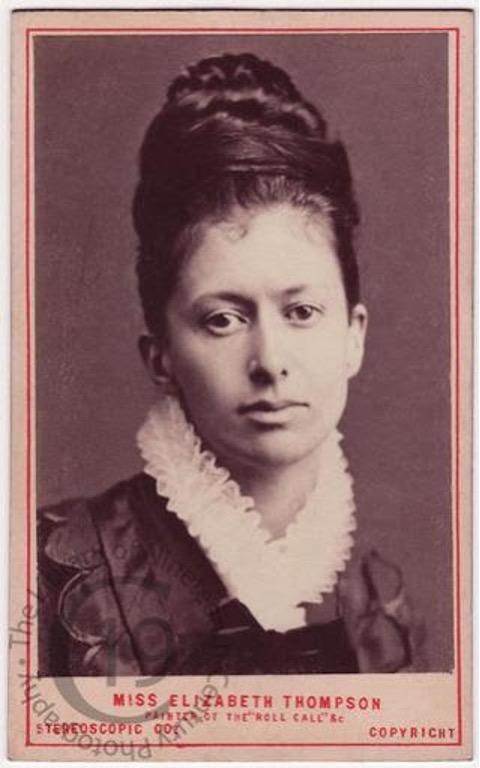
Elizabeth Thompson was born in 1846 in Switzerland, 31 years after the country began its now two-century-long policy of military neutrality. In 1922 she would die as one of the greatest battle painters to have ever lived. While some would call her preferred subject matter peculiar, nothing could be more appropriate for this woman who had to fight during the entirety of her artistic career.
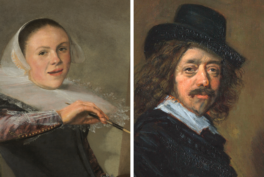
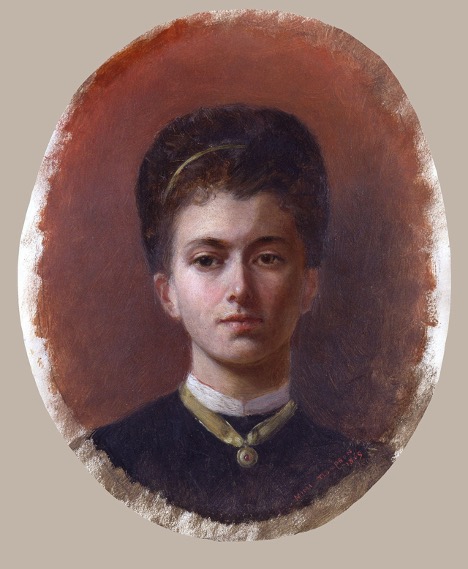
Elizabeth Thompson, Self-Portrait, 1869, National Portrait Gallery, London, UK.
Thompson’s talent was fostered at a young age by her parents. They were both connoisseurs of the arts themselves, both in the visual and literary arts. Their preference was more than likely for literature as they were friends with Charles Dickens, of all people; however, they were committed to developing their daughter’s budding talent.
Thompson’s first formal training came in her teens, while she was living in England, and this is where she saw some of her first obstacles. At the time, women were not allowed to use nude models to study anatomy, so Elizabeth was barred from taking the real art classes offered at South Kensington Art School. However, by the time she applied, her talent was already more than prevalent, so with a sketchbook full of specimens and a lot of optimism, young Elizabeth was able to talk her way into attending. While the policy on the painting of nudes remained, the headmaster at the time appreciated Elizabeth’s skill, admitting her and immediately placing her in the advanced classes.
Before she had finished her first term, Elizabeth began submitting her work to exhibitions. Of course, in classic Victorian era fashion, her first salvo was rejected likely for no other reason than her sex. So, for the second attempt, she decided to try something particular; she sent in a sketch called Bavarian Artillery Going into Action, which caught the attention of critics. England, despite having a number of solid artists, had little to no presence in the world of military art. Thus, while they may have had a problem with her sex, the Londoners were motivated to look past that on the grounds that they had finally found someone who could compete with French military artists.
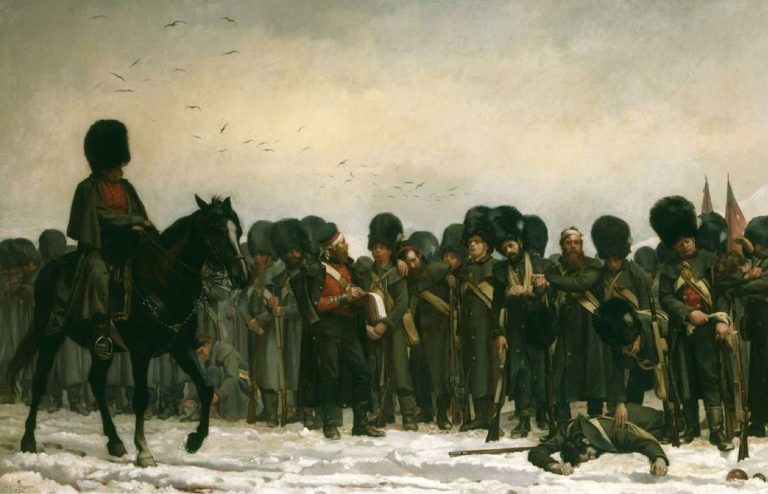
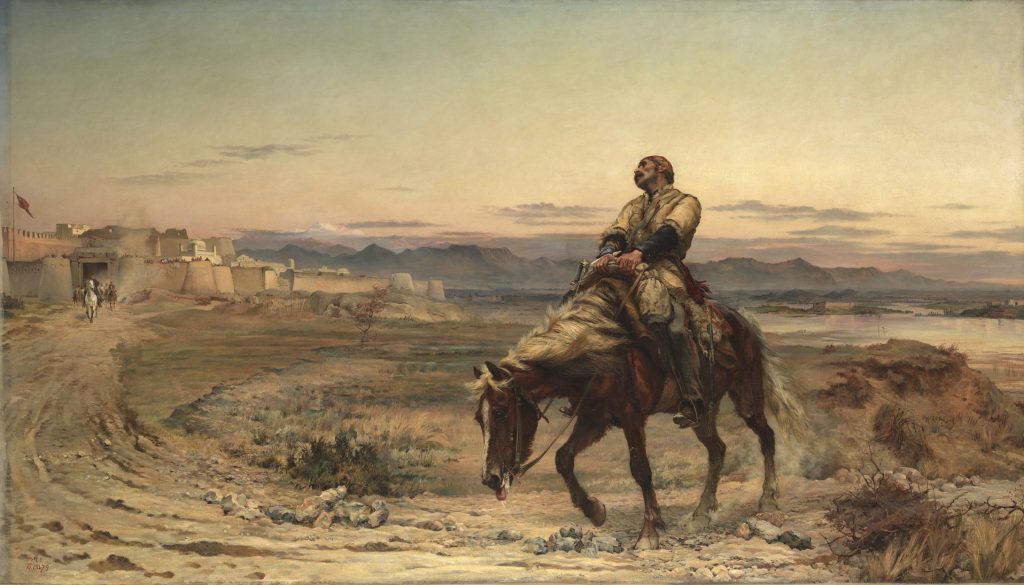
Elizabeth Thompson, Remnants of an Army, 1842, Tate, London, UK.
After a period of study in Florence, Elizabeth once again began submitting to prestigious galleries. This time, her ambitions were set on being exhibited at the Royal Art Academy. As with her schooling, she knew there would be challenges, but would have had no idea exactly the level of disrespect she would receive for her efforts.
Elizabeth would have to submit three works to the Royal Academy over the course of three years before someone finally responded positively to her work. Her first submission, a painting named The Visitation, would be returned to her with a hole in the canvas, the second rejected completely, and the third, which was finally accepted, would be hung somewhere well out of sight in the gallery.
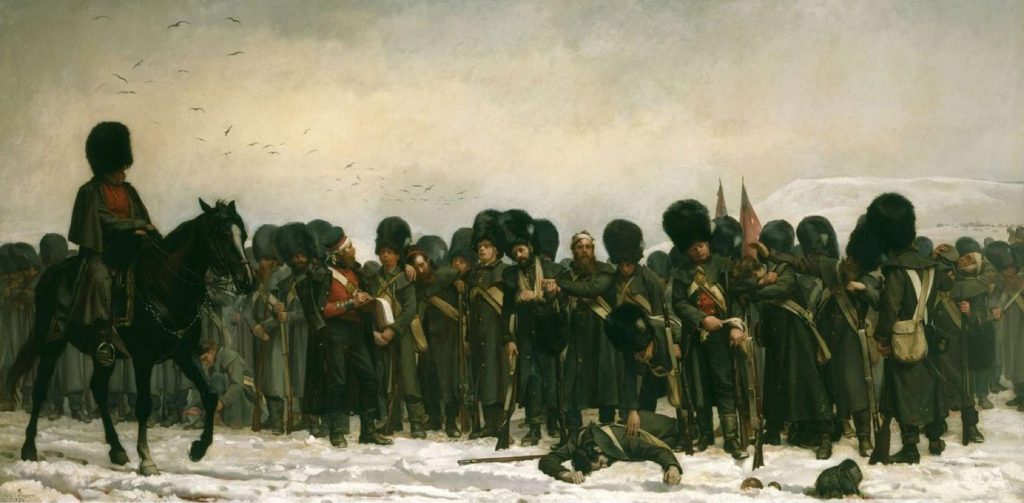
Elizabeth Thompson, The Roll Call (Calling the Roll After Engagement in Crimea), 1874, Royal Collection Trust, London, UK.
However, that same year, she was be commissioned to paint a piece that would eventually catch the attention of the world—a piece that showcased war in a dramatically different light than what people were used to. She named the piece Calling the Roll After Engagement in Crimea, now simply known as Roll Call.
The image showed a battered battalion standing before their commander, taking stock of who has survived a recent battle. The painting would be hung in the Royal Academy in a place of honor, drawing literal crowds of people, and it did so well that the work received a private viewing from both the Prince of Wales and the Duke the Cambridge, who both praised its depiction of the war. This was significant because the Duke of Cambridge had actually fought in the Crimean War, so when he said that he was “astonished,” by the painting, people (particularly men) knew that it was something worth seeing.
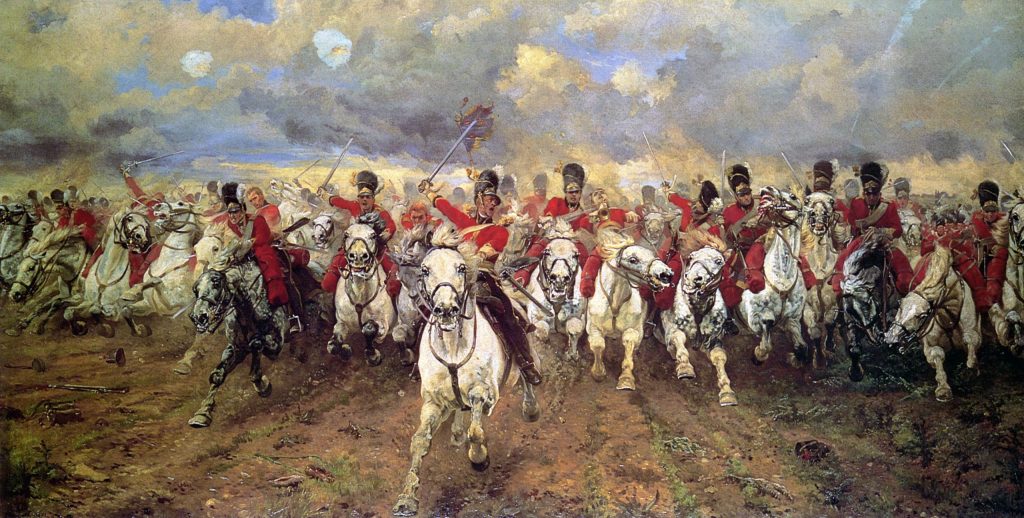
Elizabeth Thompson, Scotland Forever!, 1881, Leeds Art Gallery, Leeds, UK.
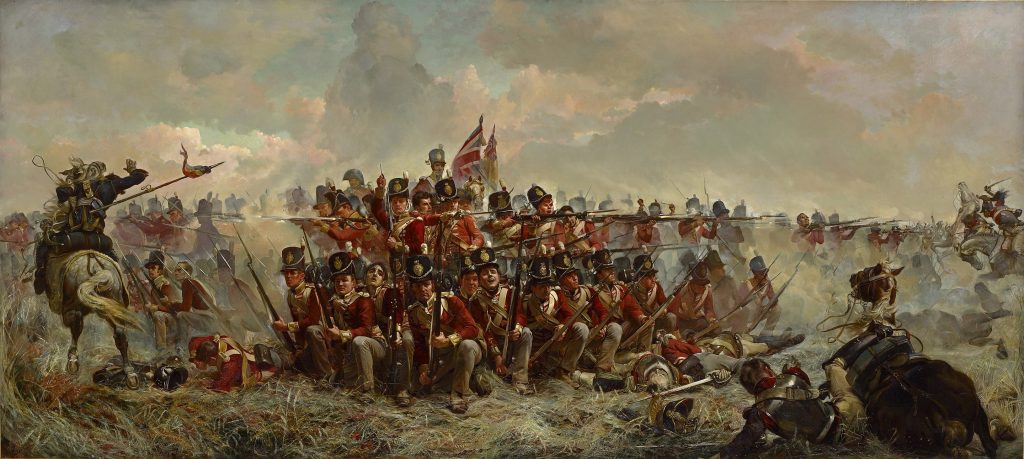
Unfortunately, this awe would not last. Elizabeth would have a number of other paintings admitted to the Royal Academy with some success. But by 1875, fragile masculine egos would once again start working against Elizabeth, and she started seeing her paintings hung in less and less prestigious locations. One, called Quatre Bras, was hung in a particularly inconspicuous corner of the gallery, nicknamed the “the black hole.”
Elizabeth Thompson, The 28th Regiment at Quatre Bras, 1875, National Gallery of Victoria, Melbourne, Australia.
In 1877, Elizabeth married Sir William Francis Butler, an Irish General. With him, she would have six children and travel the breadth of the Commonwealth. Her marriage also marked the end of her time in the lime-light. She continued to paint, but the public responded incredibly harshly to a number of stylistic choices she brought to her art.
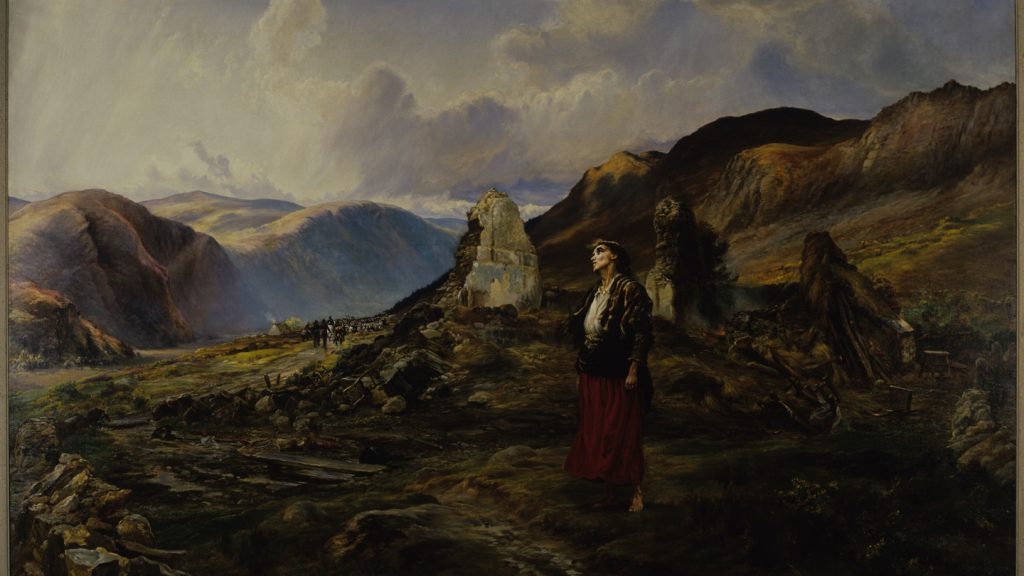
First, her focus shifted from military images to depictions of how Catholics were treated in the British world. This very much did not interest her audience, as demonstrated by how her painting Evicted was so unpopular in Britain and even failed to find a buyer.
The final blow would come during the Boer war. The conflict had sparked Britain’s patriotism, and Thompson’s depictions of the realities of warfare became counterintuitive to the efforts of the nation, resulting in her being labeled as “distasteful.”
Elizabeth Thompson, Evicted, 1890, Department of Irish Folklore, University College Dublin, Dublin, Ireland.
Still, in 1879 she would come within two votes of becoming the first female member of the Royal Academy, something that would not actually happen for another 40 years. Despite this, and the numerous other petty individuals who had strived to get in her way, Elizabeth Thompson’s legacy lasts. She was the first English artist to frame the ordinary British soldier in a sympathetic light and winning them over, in turn, not only through the nature of her own skill, but also the capacity of her heart.
Author’s bio:
Wyatt Billingsley has a BA in English from the University of Iowa and has been researching the world of Art History for the past two years. He is a particular fan of obscure contemporary artists such as Ivan Albright and Hung Liu.
We love art history and writing about it. Your support helps us to sustain DailyArt Magazine and keep it running.
DailyArt Magazine needs your support. Every contribution, however big or small, is very valuable for our future. Thanks to it, we will be able to sustain and grow the Magazine. Thank you for your help!
This is our guest profile for occasional authors. If you have an interesting story about art to tell, send it to our Editor-in-chief Kate at [email protected]. You might be the next here!
'Painting the Light: The Story of Berthe Morisot, First Woman Impressionist' is written by Natalia Iacobelli and illustrated by Rosanna Tasker. Read about this inspiring new children's book from Reycraft Books.
Rolinda Sharples painted the world of Jane Austen, and the political turmoil unfolding beyond the ballroom. Her paintings capture Regency society as...
Bologna, in northern Italy, fostered more women artists in the early modern period than any other European city. Nowhere else matched the number, the...