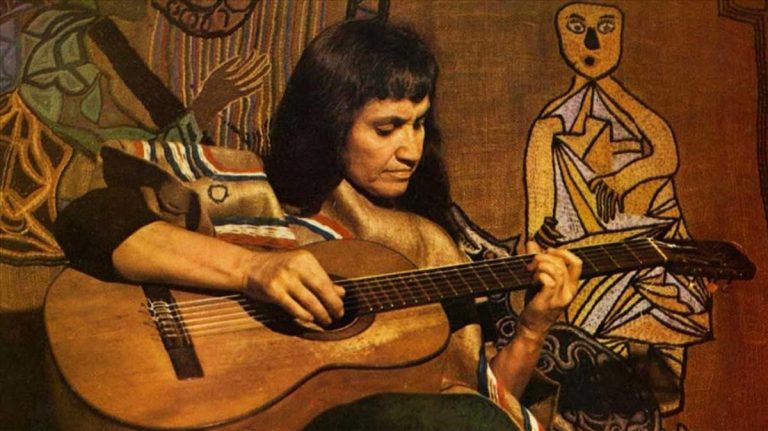
In April 1964 the Musée des Arts décoratifsin the north-western wing of the Louvre Palace hosted an extraordinary exhibition that went down in history as the first solo show of a Latin American artist in the museum. The artist, Violeta Parra, was a woman and a Chilean who wove legendary songs and tapestries.
Gracias a La Vida
Violeta Parra, Against the War (Contra la guerra), 1962, Museo Violeta Parra, Santiago, Chile.
Parra started her career as a musician and composer who, in the 1950s, greatly popularized folk music in Chile. She died by suicide in 1967. Her moving song Gracias a la Vida (Thanks to Life), created that same year, became a leading anthem. It was also an inspiration for the protest music genre nueva canción chilena. This turned out to be hugely influential in the revolutionary movements in Chile in the 1960s and 1970s.
Parra’s Exhibition
Violeta Parra, Poster, 1964, Museo Violeta Parra, Santiago, Chile.
The 1964 exhibition Chilean Tapestries by Violeta Parra. Sculpture and Painting was a multi-sensory experience. During the five weeks of the show, one could easily stumble upon the artist who came to the museum every day to chat with visitors. While there, she continued working on her tapestries, playing the guitar, singing, and even serving empanadas! Moreover, the display included arpilleras (patchwork stitches), wire sculptures, and paintings.
Violeta Parra, The tree of Life (Árbol de la vida), 1960, Museo Violeta Parra, Santiago, Chile.
As art critic P. M. Grand described in his review for Le Monde:
Violeta is present […] to play the guitar, to sing sad and expressive music, to invent as she embroiders […]. Petite and brunette […] simple and complex like a figure from Lorca, or like one of her sculptures, where the tangle of metallic wires make golden flowers burst from a black tree.
P. M. Grand, Trois variations sur themes populaires, Le Monde, (April 17, 1964), p. 12.
Doubts and Uncertainties
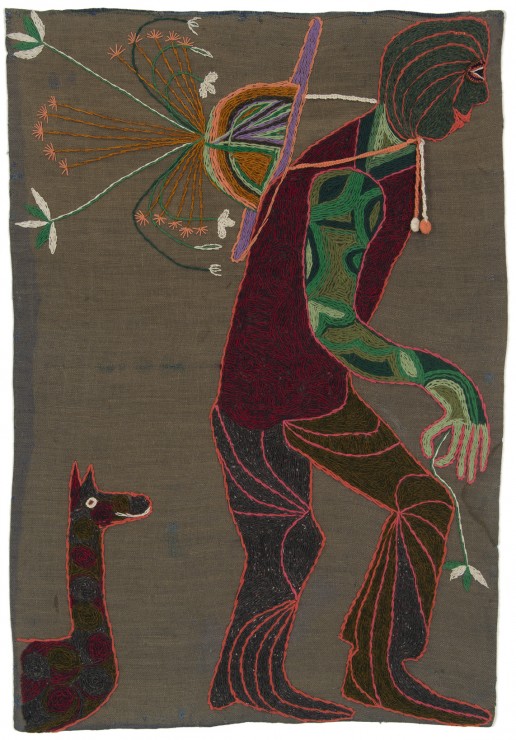
Violeta Parra, A man (El hombre), 1962, Museo Violeta Parra, Santiago, Chile.
However, the show might not have taken place at all. Initially, the selection committee rejected Parra’s application. Only when one of the museum officials asked them to reconsider their decision did the committee agree and the show went ahead. Amid these uncertainties, Parra lost faith and at one point even doubted herself. In a letter to Amparo Claro she wrote:
How could I have an exhibit at the Louvre, I, the ugliest woman on the planet, who comes from a tiny country, from Chillán, the end of the world?
Patricia M. Stambuk and Patricia Bravo, Violeta Parra: el canto de todos (Santiago: Pehuén Editores, 2011), p. 126.
Despite doubts about her appearance (her skin was marked by childhood smallpox), she was strong and aware of her own talent. Once, when strolling close to the Louvre Palace with her friend Alejandro Jodorowsky (yes, the Jodorowsky), she told him:
I’m just a tiny woman, but this edifice doesn’t impress me. Mark my words: before long, you’ll see my works exhibited here.
Alejandro Jodorowsky, The Spiritual Journey of Alejandro Jodorowsky: The Creator of El Topo (Rochester, Vt.: Park Street Press, 2008), pp. 15–16.
The Documentary
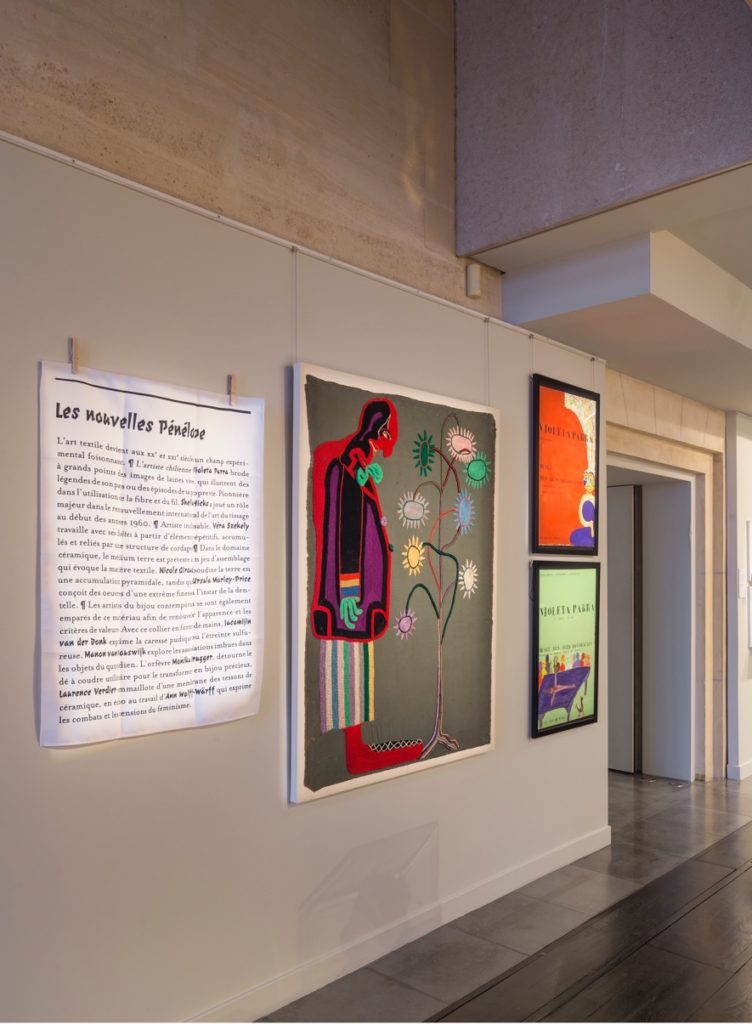
Installation view: The Clown, 1960 on exhibition Travaux de Dames?, 2017, Musée des Arts Décoratifs, París, France. Photograph by Luc Boegly.
Parra’s tapestries were seen by Swiss art critic and filmmaker Marie-Magdeleine Brumagne. In a review for Tribune de Lausanne, she revealed that Parra had only started making them six years before and considered that she had turned her life into art without realizing it. A year later, Brumagne made a documentary about Parra called Violeta Parra, Chilean Embroiderer. In this film, the artist asserted that she didn’t even know how to draw or make embroidery correctly.
We love art history and writing about it. Your support helps us to sustain DailyArt Magazine and keep it running.
DailyArt Magazine needs your support. Every contribution, however big or small, is very valuable for our future. Thanks to it, we will be able to sustain and grow the Magazine. Thank you for your help!
Magda, art historian and Italianist, she writes about art because she cannot make it herself. She loves committed and political artists like Ai Weiwei or the Futurists; like Joseph Beuys she believes that art can change us and we can change the world.
'Painting the Light: The Story of Berthe Morisot, First Woman Impressionist' is written by Natalia Iacobelli and illustrated by Rosanna Tasker. Read about this inspiring new children's book from Reycraft Books.
Rolinda Sharples painted the world of Jane Austen, and the political turmoil unfolding beyond the ballroom. Her paintings capture Regency society as...
Bologna, in northern Italy, fostered more women artists in the early modern period than any other European city. Nowhere else matched the number, the...