

Halloween Monsters: What Our Fears Reveal About Society
Halloween monsters have long served as mirrors of human fear and imagination. From vampires and witches to zombies and digital phantoms, they reveal...
Errika Gerakiti 30 October 2025

Portrait of Sabina Haza Radlic, c. 1676, National Museum, Poznań, Poland. Detail.
In the 17th and 18th centuries, Poland was a much bigger and more important country than it is today, as it encompassed some parts of the territories of today’s Poland, Lithuania, Belarus, and Ukraine. The Poles, however, were a relatively young nation. But they didn’t want to admit that… So they came up with this theory which derived the origins of the Polish nobility from an ancient nomadic barbarian tribe from Iran – the Sarmatians. They also developed a unique style of coffin portraiture which was both fascinating and creepy.

According to the Polish geographers, the Sarmatians had arrived by the Danube in the first century BCE, had settled down in the land of Ukraine, and gave the beginning to the heroic Polish nation. In 1633 a theologian and priest, Wojciech Dębołecki, wrote: “The Poles inherit power over the whole world since they are the oldest nation in the world in the straight line.”
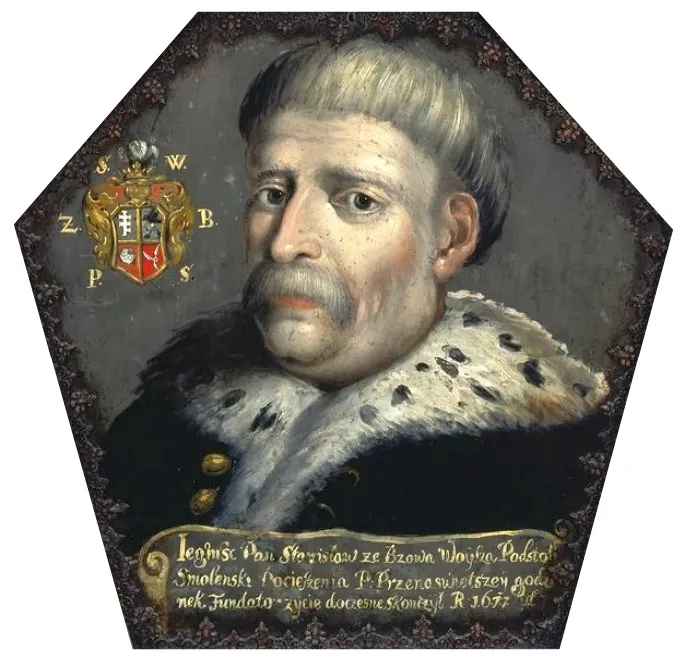
Since the Polish nobility believed in their ancient ancestry and their special status, they tried to include some of the ancient practices into their own culture. One of the examples are the coffin portraits, which had been manufactured in Egypt, and then adapted by the Polish nobility. The Polish-Lithuanian Commonwealth was the only country in Europe where such portraits were produced (and were so on a massive scale as everybody had to have their portrait painted: men, women, children, and even babies).

The coffin portraits were meant to represent the deceased at their own funeral and thus the painters always tried to portray the dead as if they had still been alive. The portraits stared directly at the viewer, checking whether all the gathered relatives cried well enough and praised the dead sufficiently. Painters didn’t hesitate to depict any detail of the model’s face, even if it was a shameful falling eyelid or an attractive wart. With time, this extreme realism became so popular that painters often exaggerated the characteristics of the face in order to impress the viewers.

The production of coffin portraits slowed down with time to eventually stop at the beginning of the 19th century. At the time, Poland was no longer a great empire but a partitioned country erased from the map of Europe for over a century. However, the unique aesthetic of Polish coffin portraits fascinates the viewers till today.
DailyArt Magazine needs your support. Every contribution, however big or small, is very valuable for our future. Thanks to it, we will be able to sustain and grow the Magazine. Thank you for your help!

Magda, art historian and Italianist, she writes about art because she cannot make it herself. She loves committed and political artists like Ai Weiwei or the Futurists; like Joseph Beuys she believes that art can change us and we can change the world.

Antonia Chela is an avid art history fan, always seeking to know more about the wonderful world of art! She is a student of museum studies, and she is interested in learning about all aspects of the art world, current, past and future.
Halloween monsters have long served as mirrors of human fear and imagination. From vampires and witches to zombies and digital phantoms, they reveal...
Errika Gerakiti 30 October 2025
When you picture Halloween, a flood of familiar images rushes in: glowing jack-o’-lanterns, fluttering bats, skeletons, and black cats. But the...
Errika Gerakiti 31 October 2025
Marian Henel’s tapestries are huge. The largest one measures over 6 m in length and 3 m in width (19 ft. 8 in. by 9 ft. 10 in.). Created in the...
Zuzanna Stańska 22 May 2026
Los Caprichos are some of the most disturbing of Francisco Goya’s works. A sharp critique of society and its values, there are plenty of monsters...
Edoardo Cesarino 31 October 2024