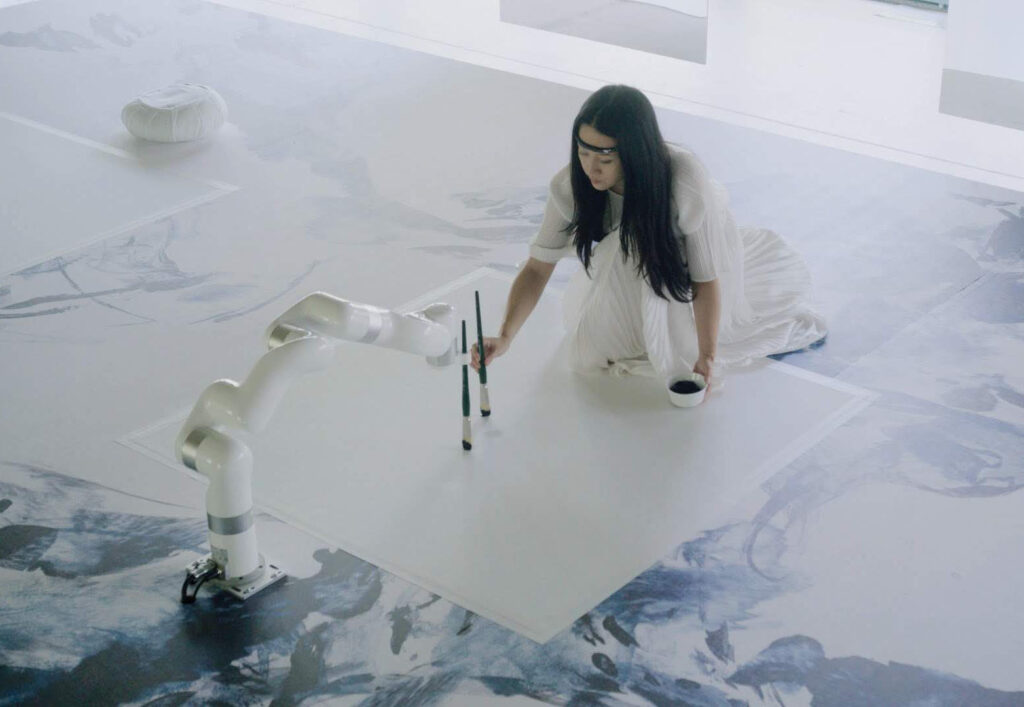
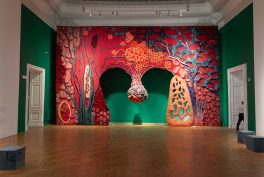
Assembly Lines is a performative installation by artist Sougwen Chun featuring the artist herself and a custom multi-robotic system. The robotic system is a large-scale technological configuration exploring instinctive and collaborative painting through humans and machines. During the performance, the robots respond to signals from the artist’s brainwaves through the use of a headset measuring brain activity. By synchronizing the artist’s neural activity with robotic gestures, the robots become the actors that reflect the artist’s internal state on the canvas, essentially extending their expressive capabilities. The piece highlights a dynamic exchange between human and machine, where expression arises through co-creation. The piece underscores the artistic value of robots as companions and invites reflection on how technology may expand the medium of expression in contemporary art.
What happens when humans and robots create together? Sougwen Chung explores the artistic entanglements of humans and machines in more than 30 artworks spanning drawing, sculpture, performance, and installation. In her work, she integrates AI, biomaterials, and cybernetic systems. She has been recognized as a TIME100 Impact Award recipient and Cultural Leader at the World Economic Forum.
2. Building with Robots
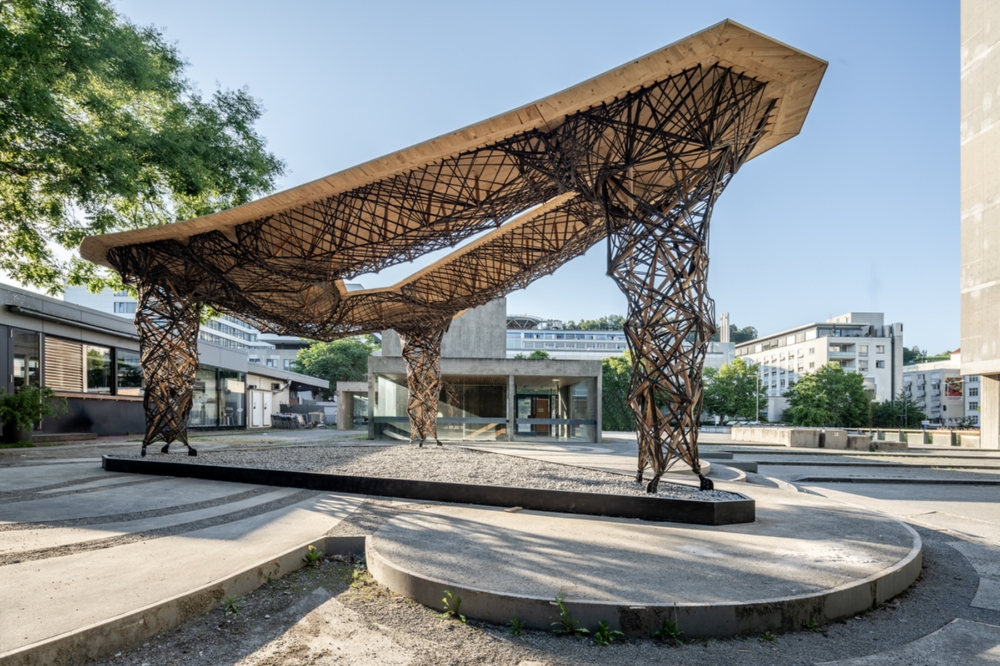
The ICD/ITKE Research Pavilions are experimental installations that explore robotic fabrication as an artistic practice. Using industrial robot arms guided by computational models, the pavilions are constructed from unconventional materials such as bent timber strips or carbon and glass fibers, with the robots placing or shaping elements according to principles drawn from biological systems. This process produces lightweight, intricate forms that would be impossible to achieve by hand alone. What makes the pavilions compelling for the arts is the way they reveal how novel materials, biologically inspired design, and robotic fabrication can together shape new possibilities for architectural design of the future.
Co-created by the Institute for Computational Design and Construction (ICD) and the Institute of Building Structures and Structural Design (ITKE) at the University of Stuttgart, the Research Pavilions have shaped our understanding of architectural design since 2010. Together, ICD and ITKE are internationally acclaimed for experimental installations that merge design, material science, and robotic construction to explore new forms of architectural expression.
3. Talking with Robots
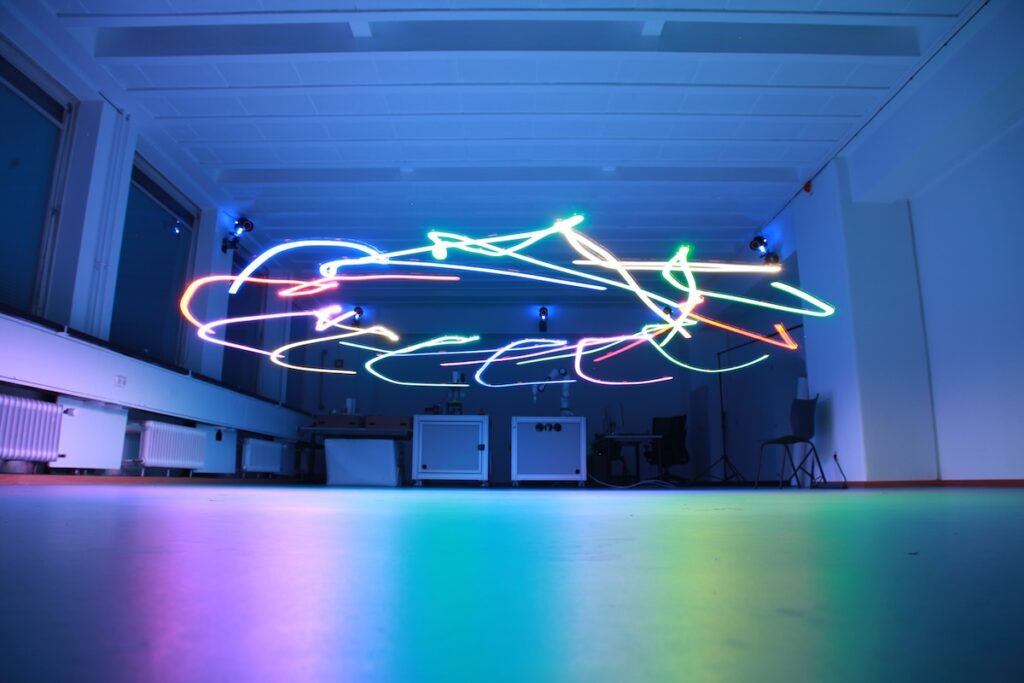
The interactive art piece SwarmGPT transforms conversations into performance. In this project, the performers are a swarm of drones that execute choreographies shaped collaboratively by human and machine interpretations of music. Participants are invited to describe the intended behaviors for the drones in text form and thereby co-design the choreography with an AI-based agent. For instance, a participant might suggest that a part of the performance take the form of a “helix formation.” SwarmGPT iterates on these ideas in simulation, refining the design until a compelling choreography is reached, which is finally shown on flying robots.
By translating human words into robot movements grounded in music, the project explores intuitive communicative exchange between humans and machines as a harmonic thought process for joint creation. The experience is shared by the audience, the artist, and the machine alike, where expression emerges through collective participation.
SwarmGPT was created by Angela Schoellig, a roboticist pioneering drone dancing. Together with artist Hallie Siegel, she presented one of the first drone performances synchronized to music. Since then, she has advanced aerial swarms capable of interacting with human counterparts and has been recognized in MIT Technology Review’s Innovators Under 35.
4. Choreographing with Robots
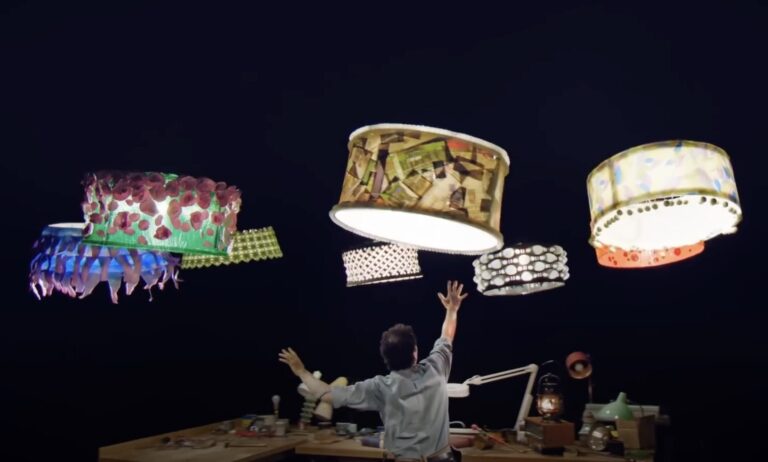
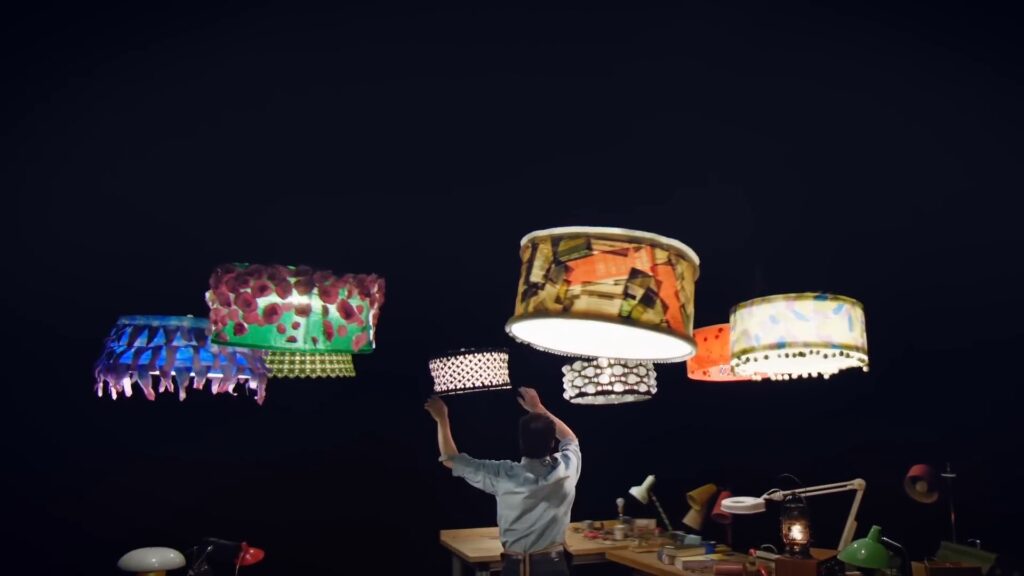
The pivotal collaboration Sparked between Raffaello D’Andrea, Verity Studios, and the creative minds at Cirque du Soleil introduced autonomous drones as a new medium in live entertainment. The short film features ten quadcopters disguised as lampshades performing a synchronized dance with a human actor.
By concealing the robots as expressive, whimsical characters (flying lampshades), the project dramatically shifts the public perception of drones from technological pieces to graceful, expressive performers. The work demonstrates how human–robot interaction can transcend pure utility, embracing choreography, emotion, and narrative as artistic elements in their own right. As such, Sparked had a lasting impact on the entertainment industry and fundamentally established autonomous drones as a new medium in live performances.
Raffaello D’Andrea is a roboticist, artist, and entrepreneur whose research and ventures pioneer autonomous drone technologies for both art and industry. Verity Studios, founded by D’Andrea, is a leading company for autonomous drone shows, supporting large-scale productions from Cirque du Soleil, Metallica, Celine Dion, and others.
5. Dancing with a Robot
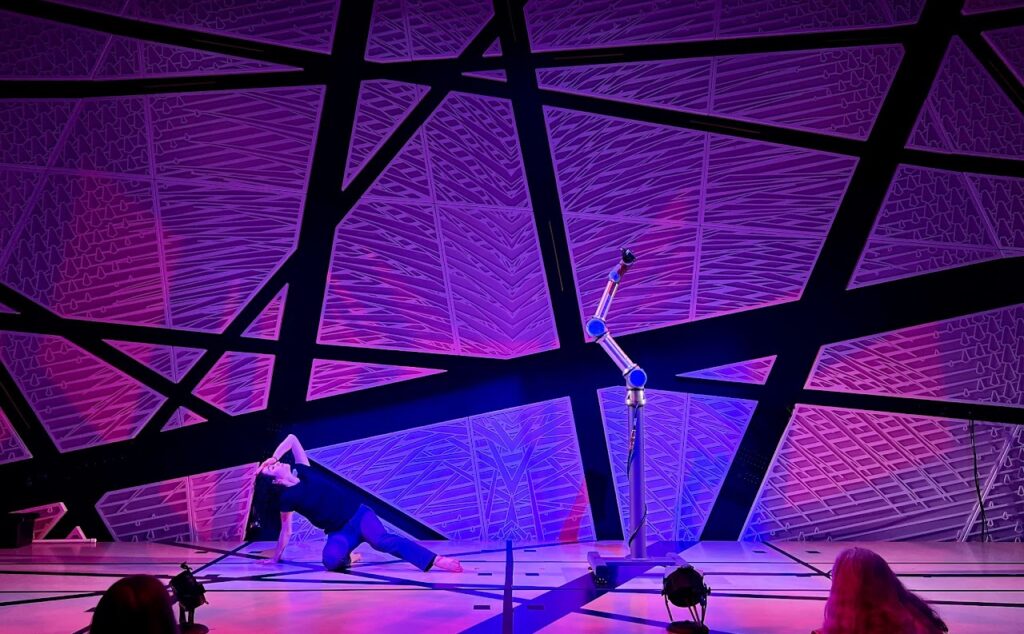
Breathless: Catie and the Robot is a captivating duet between the dancer Cuan and an industrial robot arm in a 21st-century pas de deux created by dancer and choreographer Catie Cuan and artist and roboticist Ken Goldberg. The performance unfolds over the duration of a typical American workday (eight hours) and features pre-programmed motions of the robot, as well as parts where the dancer can interact with the robot using touch, leading to live improvisations and a reflection of the artist’s internal state on the machine’s behavior. It contrasts the beauty, naturalness, and frailty of the human body with the relentless precision of machinery, and reflects the significant technical gaps between science fiction and contemporary robotics.
Catie Cuan is an engineer and artist recognized for her work bridging AI, human-robot interaction, and performance art, with award-winning choreographies created for nearly a dozen different robots. Ken Goldberg is well-known for his various artistic installations since 1989, many of which combine human factors and machines, including Telegarden (2004), Tele-Actor (2001), and Natural Frequencies (2015).
6. Moving with Robots
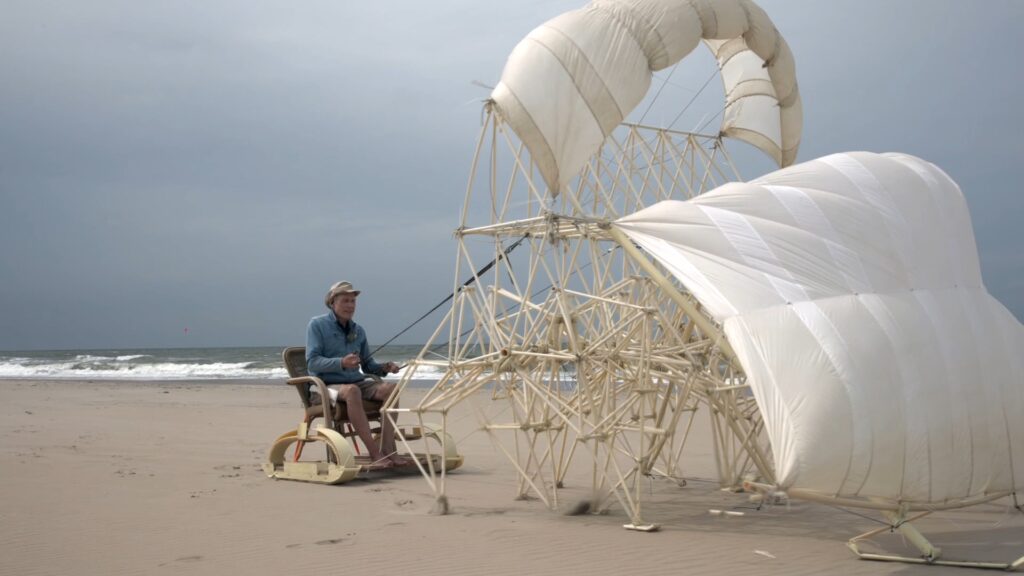
Strandbeests (Dutch for “beach beasts”) exist at the intersection of art, engineering, biology, and philosophy. The Strandbeests walk using a delicate mechanical system powered by wind through a complex system of linkages and joints based on its own mathematical algorithms. A central element of the Strandbeests—developed over more than three decades—is their evolutionary nature. Each Strandbeest is treated as a species within a lineage, evolving over time, with desirable locomotion traits passed down to the next generations. Through this ongoing process, the Strandbeests become a compelling vision of human-made evolution.
Jansen says, “I wanted to observe the phenomenon of evolution with my own eyes”—and you can too, at one of the live demonstrations or in the video above. While obviously not alive in the biological sense, the Strandbeests raise philosophical provocations. How can machines be alive in their own way? Can evolution be simulated?
Beyond live demonstrations at the beach, Jansen’s Strandbeests have been showcased in recognized exhibitions around the world, such as the Dubai World Expo (2021) and the Reina Sofía Museum (2007).
7. Making Music With a Robot
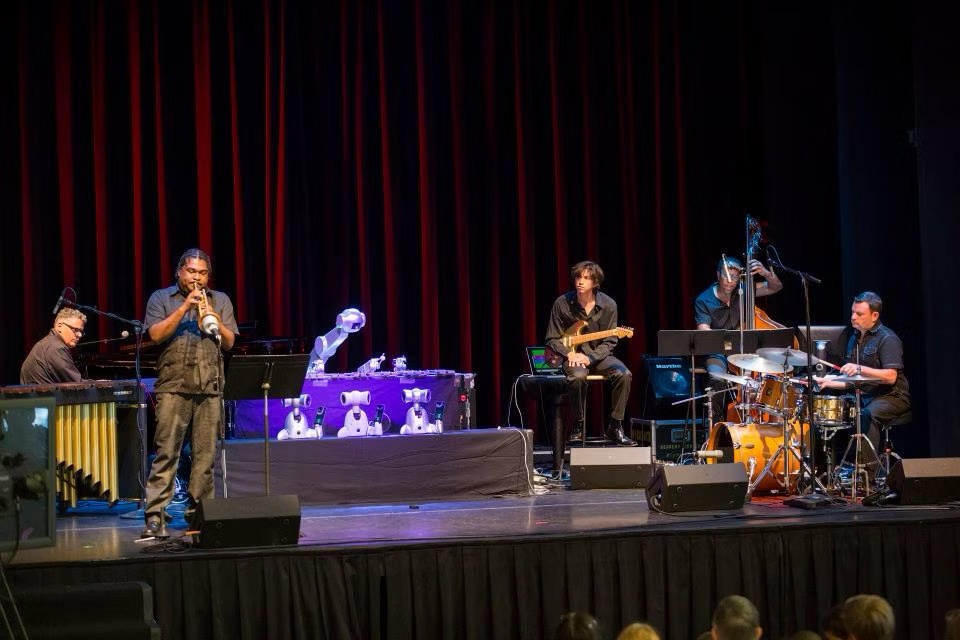
The final project explores the creative potential of artificial intelligence and robotics through an interactive jazz performance between humans and the robotic musician Shimon. Developed at Georgia Tech, Shimon is a robotic marimba player, equipped with an AI trained on thousands of hours of jazz, classical, and popular music. The result is a creative machine improvising in real time with human musicians—generating original melodies, rhythms, and harmonies that respond meaningfully to live input.
A central focus is co-creativity: Shimon is not simply following or replicating commands, but participating as a collaborator with its own musical voice. The performance blurs the boundaries between compositions, improvisations, and machine autonomy. Shimon has performed on stages around the world—from concert halls to TEDx events—and provokes questions about authorship, creativity, and the evolving role of AI in music and art in a world shaped by increasingly capable machines.
Do You Find These Art Projects Insightful?
As roboticists, we love seeing robots in works of beauty and imagination. Art offers a unique space to explore how people want to interact with robots and to envision how technology and AI might be integrated into everyday life. As technological interfaces grow simpler and more intuitive, interactions become more natural, enabling a broader public to participate in shaping the relationship between humans and machines. Ultimately, art—our most fundamental expression of human imagination—offers both a pathway for integrating technology into society and a mirror that reflects the limitations of our current tools, challenging us to keep pushing the boundaries of what is possible.
Authors’ bio:
Oliver Hausdörfer is a robotics researcher working on intuitive human-robot interfaces and learning-based methods.
SiQi Zhou is a robotics researcher and designer focusing on how robots can understand our world and act alongside humans. Both are enthusiastic about art and using technology to explore new forms of artistic expression.