The Present of Ceramics: 5 Highlights from Kikuchi Biennale XI
Clay, first soft beneath the hands or hardened in the kiln, in all its forms, retains the mark of every gesture that shaped it—be it modeling,...
Ania Kaczynska 26 February 2026
30 March 2026 min Read

Adrien Lucca (art), Prof. Dr. Ing. Colas Schretter, Dr. Marko Ilić, Dr. Aiman Raza (sci), Parallel Worlds: Moth Vision, 2026, exhibition view of Studiotopia 2.0. Sensitive Data of the Anthropocene, CCA Łaźnia, Gdańsk, Poland. Photo by Robert Wolak. Courtesy of CCA Łaźnia.
Can storing digital information in DNA help the environment? What can we learn from the world seen from the perspective of a moth? These and other questions are part of the international European project Studiotopia 2. Enter the Symbiocene with Arts and Science that connects two seemingly opposite worlds of science and contemporary art. We had a chance to talk with Agnieszka Kulazińska from the Centre for Contemporary Art Łaźnia in Gdańsk, Poland, about the project and the latest presentation of its works, Studiotopia 2.0. Sensitive Data of the Anthropocene, which is on view until May 24, 2026.
Studiotopia 2 is an international project coordinated by 11 European institutions. As in the first edition, which focused on the Anthropocene, the aim is to encourage scientists and artists to collaborate, developing a shared language to address reality and explore contemporary problems. As Agnieszka Kulazińska, the curator of the latest exhibition of the project, puts it, “usually, it is artists who visit scientific laboratories; here, the direction is reversed, with scientists visiting artists’ studios. It is a laboratory of thinking and investigation, where we look at the same issues from different perspectives and try to develop an interdisciplinary language.”
In this edition of Studiotopia, we explore the Symbiocene—finding other ways of being in the world, alternative ways of communicating with other species, and how our activity can become more sustainable. We aim to encourage people to question our place in a world that was never made for us.
Curator of Studiotopia 2.0. Sensitive Data of the Anthropocene, CCA Łaźnia, Gdańsk, Poland.
This edition focuses on the Symbiocene—a concept introduced by eco-philosopher Glenn Albrecht, envisioning a future in which humans coexist in balance with the Earth and all living beings, grounded in mutual understanding and deep interconnection.
Studiotopia is unique in its parallel open call process—one for artists’ projects and one for scientists’ proposals. According to Agnieszka Kulazińska, for many researchers, it was an opportunity to work on something different, shift their perspective, and communicate in new ways. Scientists often focus on specific procedures and sometimes overlook the simple questions that can reveal another layer of a problem or new ideas for how we can use this knowledge.
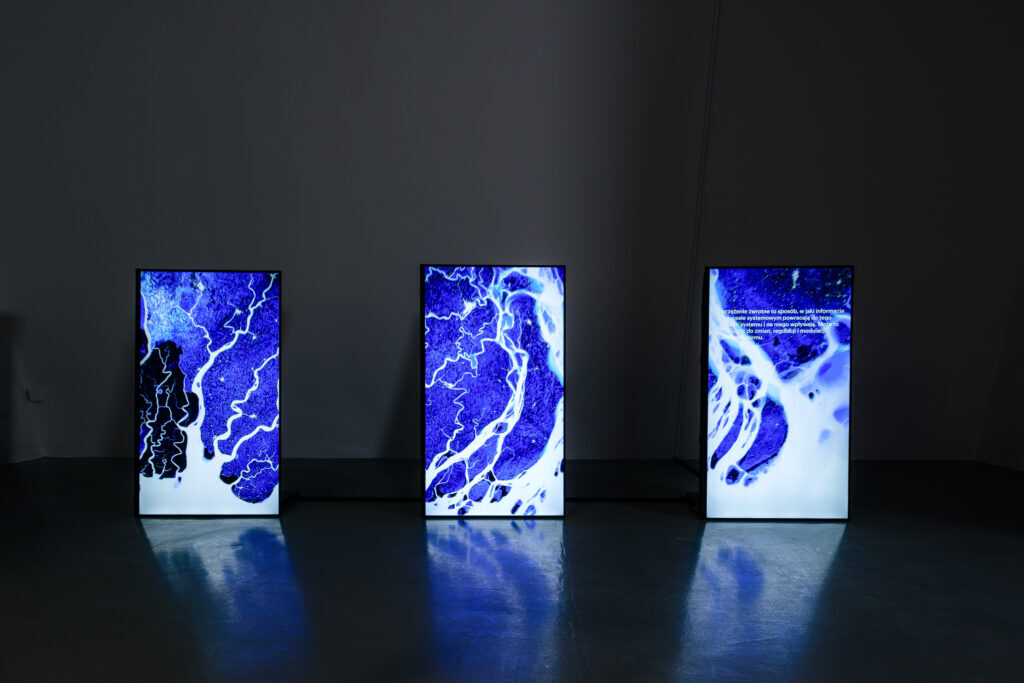
Territorial Agency (art), Dr. Alexander Damianos (sci), Anthropocene Great Acceleration, exhibition view of Studiotopia 2.0. Sensitive Data of the Anthropocene, CCA Łaźnia, Gdańsk, Poland. Photo by Robert Wolak. Courtesy of CCA Łaźnia.
The exhibition at the CCA Łaźnia is the first group presentation of works from this edition of Studiotopia. One can say that merging art and science is something that Łaźnia specializes in, as it has done a number of projects in this field in the past. The show curated by Agnieszka Kulazińska, titled Sensitive Data of the Anthropocene, focuses on scientific data and its impact on ourselves. Can we look at them from a different perspective (like in Adrien Lucca’s work)? Can they trigger something in us? After all, most of them forecast an impending climate catastrophe.
The question behind many of Studiotopia 2’s projects is how we can look at scientific data differently, how we can connect with it on a more human level. For us, they are just numbers, words, or charts. But can we look at them with empathy and emotion? Can they evoke a feeling of responsibility for the planet? They speak of terrible things, of catastrophe, so I feel it should somehow be emotional for us.
Curator of Studiotopia 2.0. Sensitive Data of the Anthropocene, CCA Łaźnia, Gdańsk, Poland.
And the works created during Studiotopia 2 are doing precisely that. They make us feel uneasy, they intrigue us, but also encourage us to pause and reflect on our place in today’s world, and how we consume and use data around us. Below, we present five of the most surprising projects from the exhibition.
Justyna Górowska (art), Thomas Heinis (sci), commissioned by: CCA Łaźnia, Poland

Justyna Górowska (art), Thomas Heinis (sci), BhA—Digital Art Archive in DNA, 2026, exhibition view of Studiotopia 2.0. Sensitive Data of the Anthropocene, CCA Łaźnia, Gdańsk, Poland. Photo by Robert Wolak. Courtesy of CCA Łaźnia.
One of the growing issues of today’s world is the overproduction of digital data. Our lives are highly dependent on the Internet, which we often treat as something abstract. But the “digital cloud” is in fact a large number of big computer centers, producing a very real environmental footprint. During her residency in CCA Łaźnia, Justyna Górowska explored new, organic ways of storing her digital art archive—the Blue Humanities Archive. The artist proposes information preserved in DNA that could be e.g. stored in a drop of water.
Collaborating with Imperial College London, Górowska encoded her archive into DNA sequences enclosed within a capsule shaped like the logo of her project. This way of storing information is not only more ecological but also strangely poetic, emphasized by the “hydrological footprint” visible in the tubes connecting the whole installation.
Fanny Sariano (art), Kalliopi Ioumpa (sci), commissioned by: Hexagone, France
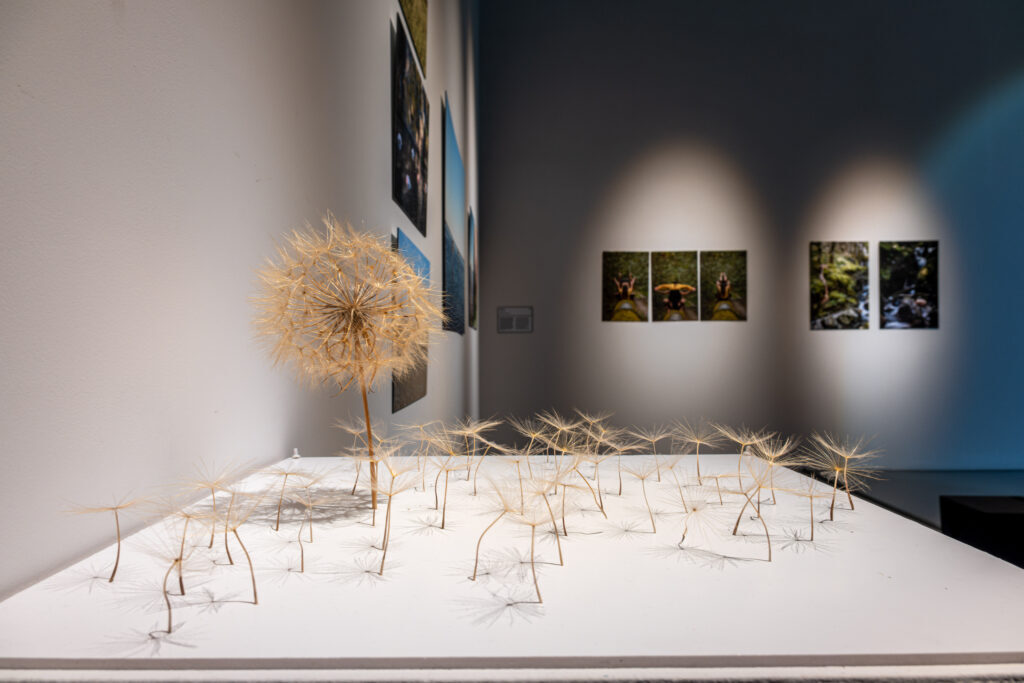
Fanny Sariano (art), Kalliopi Ioumpa (sci), MU, 2026, exhibition view of Studiotopia 2.0. Sensitive Data of the Anthropocene, CCA Łaźnia, Gdańsk, Poland. Photo by Robert Wolak. Courtesy of CCA Łaźnia.
The exhibition in Łaźnia presents two projects by Fanny Sariano, highlighting the need to restore humans’ relationship with nature, which we lost through technology and digitalization of our lives. The artist collaborated with neuropsychologist Kalliopi Ioumpa to investigate if this can be achieved through the body’s innate intelligence and perception, the concept described as embodied experience. Can we find a place in our body responsible for empathy, and how can we use it to connect with the world?
In her interactive project MU, the visitors are invited to complete simple tasks using elements of nature—deer antlers, fern leaves, stones, or dandelion seeds. The work is engaging, but most importantly, through our senses, in particular touch, it subconsciously reconnects us with the natural world. This feeling is emphasized by Sariano’s beautiful collaborative photographic project Apparitions. The images feature micro-performances in nature, in which the artist uses her circus experience to blend human figures with landscape, once again reconnecting us with the planet. This embodied experience curated by Sariano leaves the visitors with different emotions (as evidenced in one of MU’s sections)—mystical, serene, loving, but also sad and anxious.
Adrien Lucca (art), Prof. Dr. Ing. Colas Schretter, Dr. Marko Ilić, Dr. Aiman RAZA (sci), commissioned by GLUON, Belgium
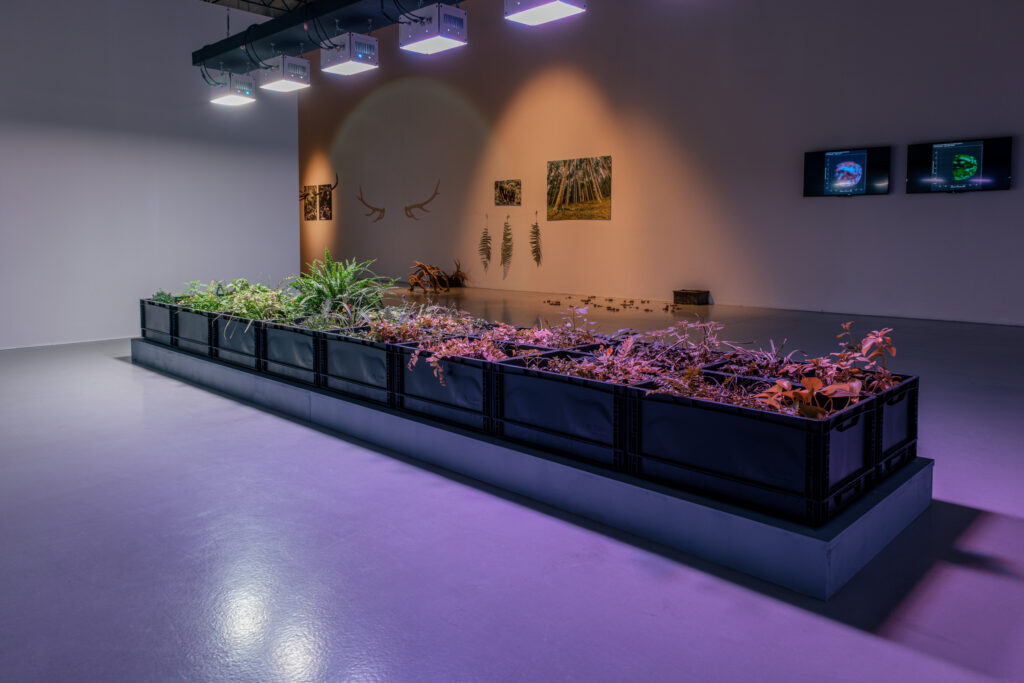
Adrien Lucca (art), Prof. Dr. Ing. Colas Schretter, Dr. Marko Ilić, Dr. Aiman Raza (sci), Parallel Worlds: Moth Vision, 2026, exhibition view of Studiotopia 2.0. Sensitive Data of the Anthropocene, CCA Łaźnia, Gdańsk, Poland. Photo by Robert Wolak. Courtesy of CCA Łaźnia.
Adrien Lucca is a Belgium-based artist whose work centers around color, light, and different ways of perceiving the world—how we see it and how other species see it, how our vision is limited compared to theirs. In his installation Parallel Worlds: Moth Vision, he presents plants in a changing light that provides a perspective different from human. Suddenly, the color range diminishes and we can’t perceive the colors of the flowers or leaves as we normally would. It creates a parallel world, normally invisible to us. Lucca asks a fundamental question: who are the plants made for? Humans or pollinators and other animals?
The work is accompanied by a video, developed as a part of the project Dawn of Twilight, that focuses on the elephant hawk moth (Deilephila elpenor). A result of his collaboration with biologists and a computer scientist, it explores how artificial light impacts the insect’s vision. The elephant hawk moth is often treated as an indicator of light pollution, as even some of the LED light—generally perceived as eco-friendly—can significantly interfere with the visual communication between moth and plant, changing the contrast between foliage.
Karolina Sobecka (art), Michał Piasecki, Agnieszka Szostok (sci), commissioned by CCA Łaźnia, Poland

Karolina Sobecka (art), Michał Piasecki, Agnieszka Szostok (sci), Thermolab, 2025, exhibition view of Studiotopia 2.0. Sensitive Data of the Anthropocene, CCA Łaźnia, Gdańsk, Poland. Photo by Robert Wolak. Courtesy of CCA Łaźnia.
Karolina Sobecka’s multilayered ongoing project Thermal Thinking focuses on the heat. In scientific research, heat often becomes abstract data—part of charts and diagrams. Sobecka emphasizes an alternative take, which sees heat as a phenomenon that can impact life, matter, social interactions, politics, and so on.
She traces moments in which people separated themselves from naturally experienced temperature. Drawing on historical ways people used the heat in rituals, medicine, industry, and even colonization and punishment, Sobecka also shows how its role and perception can change. For example, incubators, originally designed for livestock and maximizing the exploitation of nature, were later used for saving human infants, and today are often the only way to preserve endangered wildlife.
The main part of the project is Thermolab—a repurposed sauna designed as a space for learning from our bodies’ reactions and regulation. Through workshops, small rituals, and experiments, the team centered around Thermal Thinking explored how we can organize life differently in a shared climate.
Sikau/Pubalova (Dr. Lea Luka Sikau & Denisa Pubalova) (art), Felipe Lombó (sci), commissioned by LABoral, Spain

Sikau/Pubalova (art), Felipe Lombó (sci), as we synch, 2026, exhibition view of Studiotopia 2.0. Sensitive Data of the Anthropocene, CCA Łaźnia, Gdańsk, Poland. Photo by Robert Wolak. Courtesy of CCA Łaźnia.
Artistic duo Sikau/Pubalova tackled the importance of looking at ourselves and our health as a result of the cohabitation of diverse species. Drawing from recent scientific research promoting seeing human bodies as complex ecosystems, the artists proposed a multisensory installation, somewhat evoking the process of fermentation.
Developed in Asturias, Spain, a biodiverse region rich in fungi and microorganisms with a long tradition of fermented dairy, as we synch offers a sensory experience, exploring fermentation as a way to feel our connection with the living world. The process of fermentation is based on many microorganisms. When we consume the products of fermentation, we accept new life into our bodies. They become part of our ecosystem. As Agnieszka Kulazińska explains:
As we synch is about our place in the world. We shouldn’t see it as a hierarchy of species. We’re all living in this symbiotic world, we depend on each other, we influence each other, and we’re influenced by other species. We’re part of the living planet.
Curator of Studiotopia 2.0. Sensitive Data of the Anthropocene, CCA Łaźnia, Gdańsk, Poland.
This is, of course, only a selection of projects presented in CCA Łaźnia. Other interesting collaborations include Anthropocene Great Acceleration by Territorial Agency (art) and Dr. Alexander Damianos (sci)—a powerful installation that gathers data on the rapid impact of human activity on the natural environment and combines it with a scientific commentary from various research centers. Through this, the Territorial Agency proposes a new, polyphonic way of visualizing contemporary knowledge. Ground Truth by Miguel Teodoro (art), George Zittis (sci) focuses on the problem of desertification on Cyprus, while Cezar Mocan’s End of Signal tackles the complex issue of the reliability of scientific observation through modern technology—questioning how much of what we see reflects objective truth and how much is shaped by human interpretation.
Works created during Studiotopia 2 are a result of in-depth reflections and discussions between artists and scientists. They do not offer easy solutions but are meant to help shift the perspective and shed light on issues and mechanisms that might be overlooked in the mainstream discourse. Perhaps through dialogue and exchange, we can better navigate the future. If you want to get a taste of this creative ferment, be sure to visit the exhibition in CCA Łaźnia.
Other presentations of projects created during Studiotopia 2 will take place in museums and galleries across Europe in 2026 and 2027, among them Bozar (Brussels, Belgium), Ars Electronica Festival (Linz, Austria), Meet (Milan, Italy), and Hexagone (Grenoble, France).
Studiotopia 2.0. Sensitive Data of the Anthropocene is on view at the CCA Łaźnia in Gdańsk, Poland, through May 24, 2026. You can follow future Studiotopia 2 events on the project’s website.
Get your daily dose of art
Click and follow us on Google News to stay updated all the time

DailyArt Magazine needs your support. Every contribution, however big or small, is very valuable for our future. Thanks to it, we will be able to sustain and grow the Magazine. Thank you for your help!

Architecture nerd, art historian, museum professional, fascinated by pre- and post-WWII modernism in Central/Eastern Europe.

Univ. of New Orleans, Fine Arts and History; Fine Artist, Professional Graphic Designer, Art Historian, Historian, Musician, worked at the New Orleans Museum of Art and MS Museum of Art; learning enthusiast!
Clay, first soft beneath the hands or hardened in the kiln, in all its forms, retains the mark of every gesture that shaped it—be it modeling,...
Ania Kaczynska 26 February 2026
Explore the Faras Gallery at the National Museum in Warsaw. Discover Nubia, an ancient civilization rich in art and culture.
Candy Bedworth 23 December 2025