


The Temple of Dendur: Roman Egypt Preserved in Manhattan
Built around 15 BCE, the Temple of Dendur honored both Roman authority in Egypt and local Nubian traditions, blending imperial politics with regional...
Maya M. Tola 2 October 2025
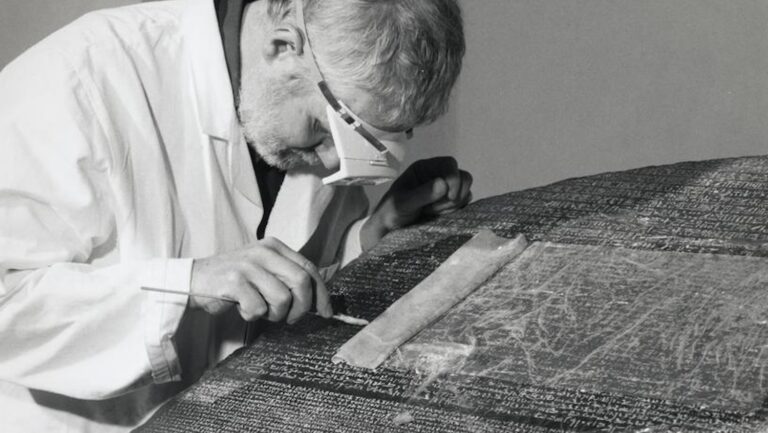
British Museum conservator cleaning the inscription on the Rosetta Stone. British Musuem. Detail.
The ancient monuments of Egypt remained an enigma for centuries, their intricate hieroglyphs silent and undeciphered. The language of the pharaohs had been lost to history, leaving the modern world unable to fully understand the civilization that created them. Then, everything changed with one remarkable discovery. The Rosetta Stone became a monumental bridge between ancient and modern worlds, unlocking the secrets of Egyptian writing and sparking a new era of scholarship that revealed thousands of years of previously silent history.
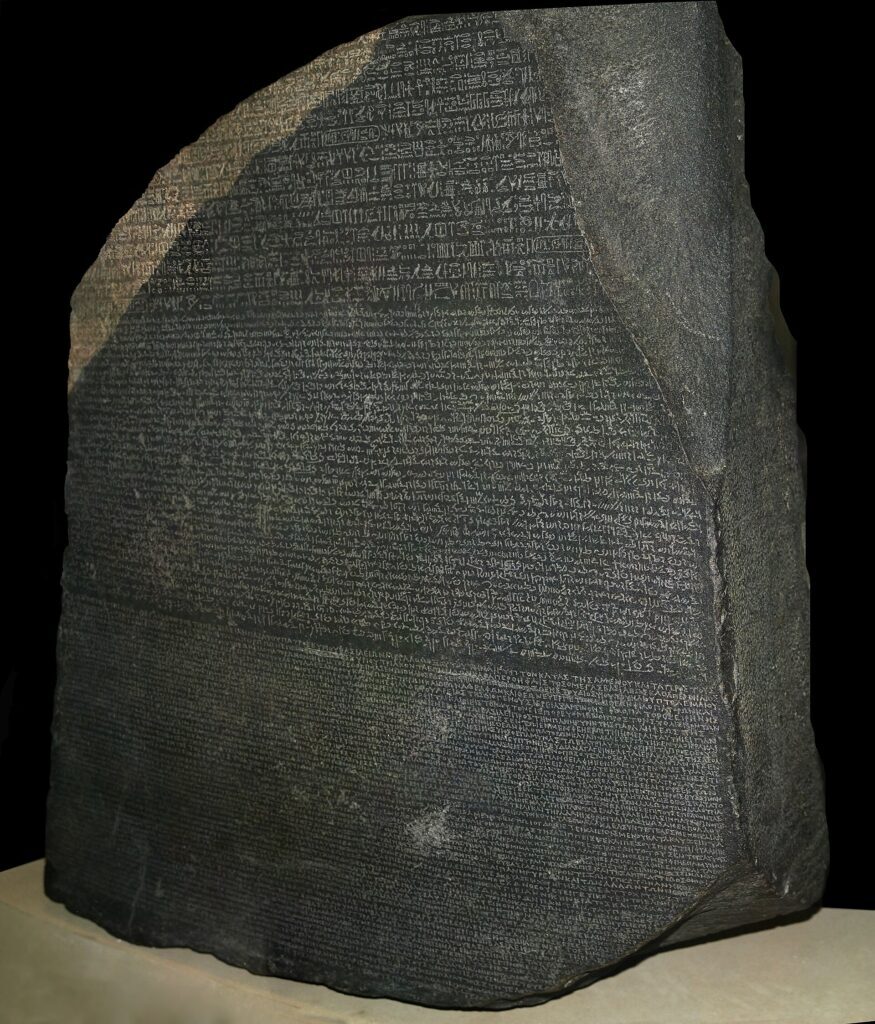
Rosetta Stone, 196 BCE, British Museum, London, UK. Photograph Hans Hillewaert via Wikimedia Commons (CC BY-SA 4.0).
When Napoleon Bonaparte invaded Egypt in 1798, he brought more than 160 scholars, scientists, and artists to study and document the country’s history and culture. On July 15, 1799, French soldiers repairing Fort Julien near the town of Rosetta (Rashid) uncovered a large inscribed stone that had been reused as building material after being removed from an ancient temple centuries earlier.
France’s occupation of Egypt was short-lived. After British and Ottoman forces defeated and expelled the French in 1801, the Rosetta Stone was transferred to Britain under the terms of the Capitulation of Alexandria.
The stone and other ancient artifacts arrived at the British Museum in 1802, where they quickly garnered public interest and curiosity. Aside from being moved to protected underground storage during the First World War and a temporary loan to the Louvre in 1972, it has remained on display at the British Museum ever since.
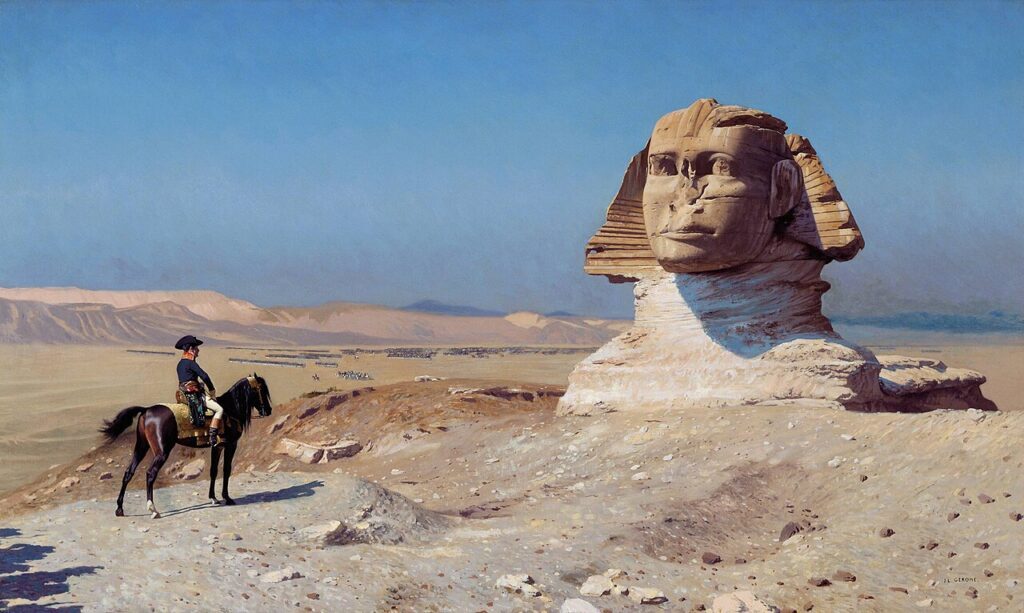
Jean-Léon Gérôme, Bonaparte Before the Sphinx, 1886, Hearst Castle, San Simeon, CA, USA.
Although the artifact may not seem spectacular at first glance, it changed the course of art history. Carved in 196 BCE to mark the first anniversary of King Ptolemy V’s coronation, the 2,200-year-old Rosetta Stone features a bureaucratic decree from a council of priests affirming the royal cult. So why did this ancient document prove to be so important? Despite its dry, administrative nature, the stone became the key to deciphering ancient Egyptian by repeating the same message in three different writing systems.
The first two scripts—hieroglyphic and Demotic—record the ancient Egyptian language. Hieroglyphs were used for monumental and religious inscriptions, while Demotic was the script of government records, business, and everyday writing. The third text is Ancient Greek, the language of Egypt’s ruling Ptolemaic court. Because scholars could already read Greek, the stone provided the crucial comparison that eventually allowed them to decipher the long-lost Egyptian language.
The Rosetta Stone was originally intended as royal propaganda, with copies of the decree ordered for temples across Egypt. While it was the first such stela discovered in modern times, 29 similar priestly decrees from the reigns of Ptolemy III through Ptolemy VI have since been found. Three surviving copies of the same decree have even helped scholars reconstruct portions of the Rosetta Stone’s missing hieroglyphic text.
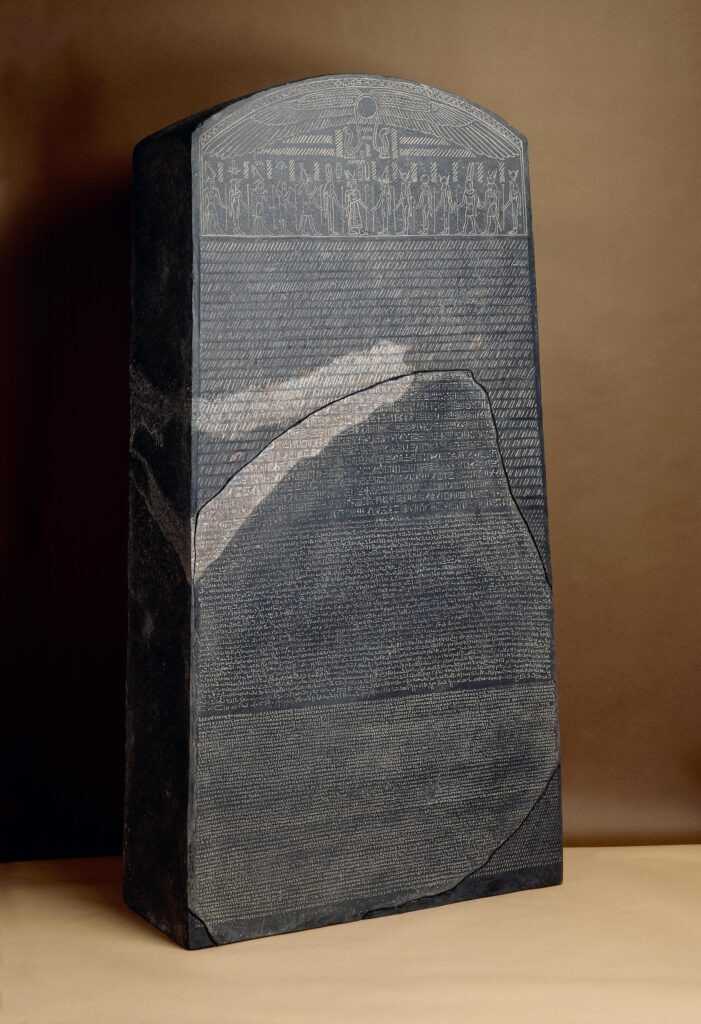
Possible reconstruction of the original stele. British Museum.
While many scholars had attempted to solve the mystery of Egyptian writing, the decisive breakthrough came from the French linguist Jean-François Champollion. Fascinated by ancient languages from childhood, he studied a remarkable range of texts, including Greek, Hebrew, Arabic, and Coptic, which later became essential to his work on Egyptian.
In 1822, Champollion announced his breakthrough in deciphering Egyptian hieroglyphs, using the Rosetta Stone and other inscriptions as his evidence. By studying royal names such as Ptolemy and Cleopatra and comparing different forms of Egyptian writing, he demonstrated that hieroglyphs were not merely symbolic images but a complex writing system that included phonetic signs.
His discovery transformed the study of ancient Egypt, allowing scholars to finally read royal inscriptions, religious texts, funerary writings, and countless other records that had remained unread for more than a millennium!
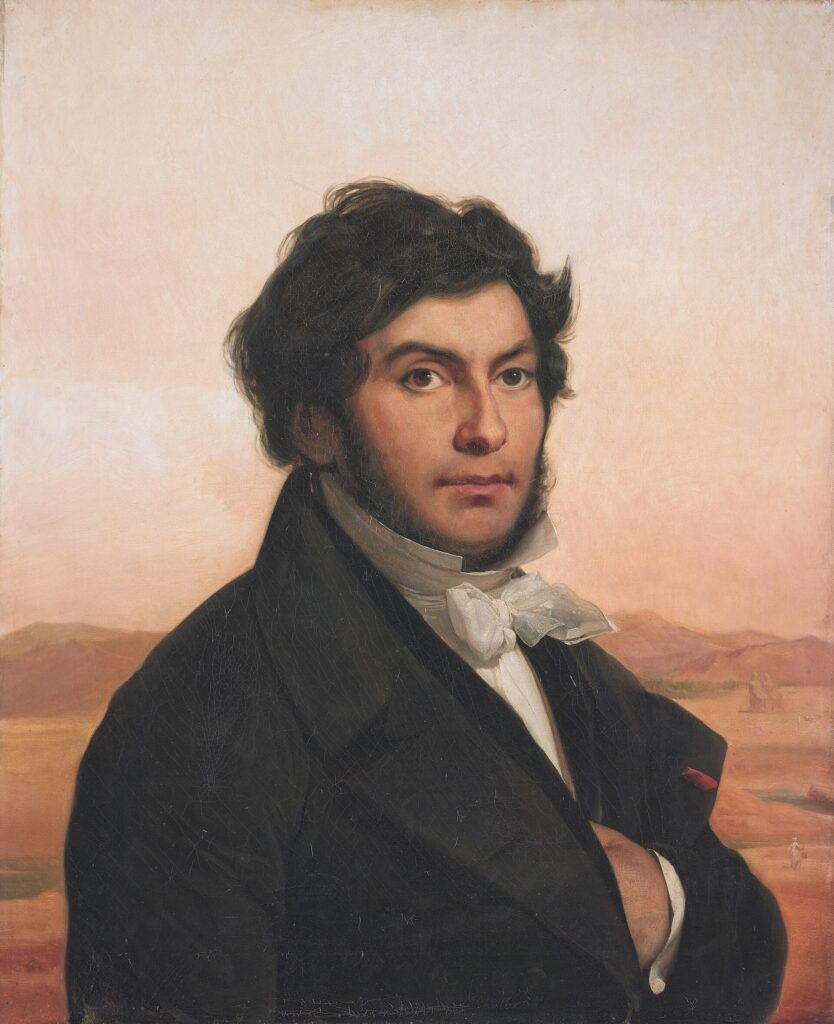
Léon Cogniet, Portrait of Champollion, ca. 1834, Louvre, Paris, France.
While Jean-François Champollion is credited with the final breakthrough in deciphering Egyptian hieroglyphs, his British contemporary Thomas Young made several important discoveries that helped pave the way. A brilliant polymath, Young was among the first scholars to make significant progress in understanding the Egyptian portions of the Rosetta Stone.
Young’s major contribution was recognizing that the oval frames known as cartouches contained royal names and identifying the phonetic spelling of names such as Ptolemy. His research showed that hieroglyphs could represent sounds, not just ideas or symbols. Although Champollion ultimately unlocked the full writing system, he built upon earlier discoveries, including Young’s careful analysis of phonetic signs and royal names.
Young’s work provided crucial clues in the long process of deciphering ancient Egyptian, helping transform the Rosetta Stone from an archaeological curiosity into the key to recovering a lost language and eventually a big portion of ancient history.
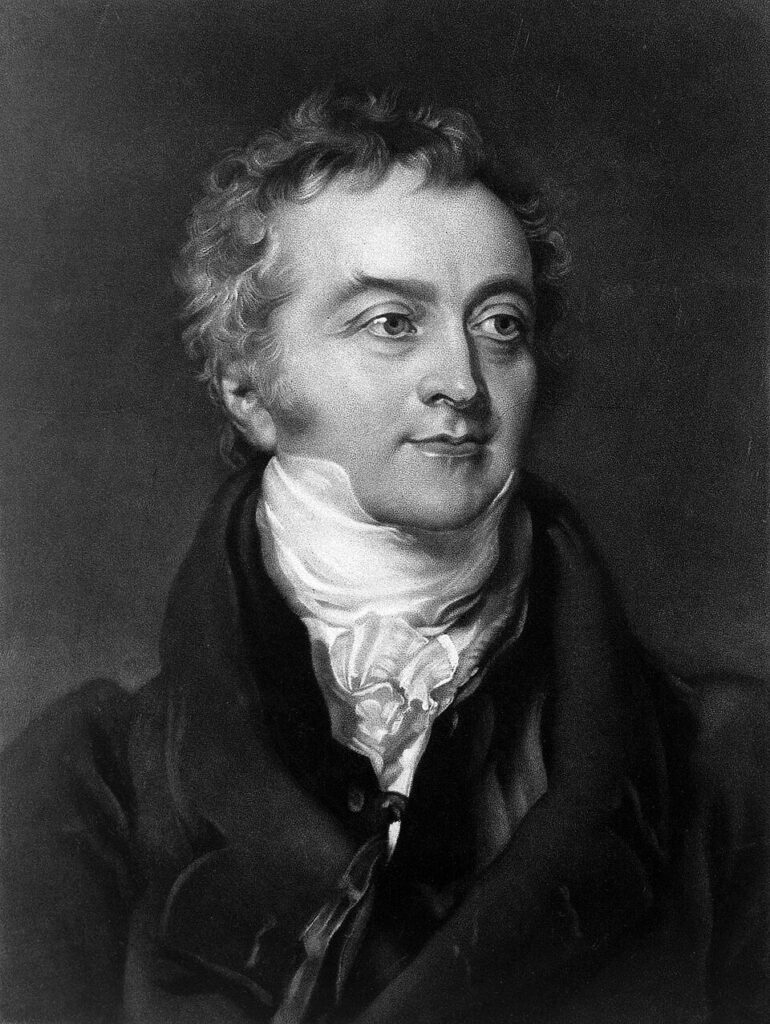
George Raphael Ward (after James Thomson), Portrait of Thomas Young, 1855, Wellcome Collection, London, UK.
Deciphering the Rosetta Stone did far more than reveal the words of ancient Egypt; it transformed our understanding of one of the world’s oldest civilizations. By unlocking Egyptian hieroglyphs, scholars could read thousands of temple inscriptions, papyri, and monuments, revealing new details about Egyptian history, religion, government, and daily life. The ability to understand royal records and historical texts also helped scholars refine Egypt’s chronology, which became an important reference point for dating civilizations throughout the Eastern Mediterranean and Near East.
Ultimately, the Rosetta Stone’s journey is one of history’s great transformations. What began as a royal decree created to reinforce political authority became a universal symbol of human curiosity, scholarship, and communication. Its discovery continues to inspire researchers studying undeciphered scripts around the world, including the mysterious writing system of the Indus Valley Civilization. For the IVC script, scholars still search for their own “Rosetta Stone” to unlock the secrets of one of the world’s earliest urban civilizations.
DailyArt Magazine needs your support. Every contribution, however big or small, is very valuable for our future. Thanks to it, we will be able to sustain and grow the Magazine. Thank you for your help!

Maya Tola is a Dallas-based attorney, with a zest for art history. A time traveler at heart, Maya often finds herself consumed in the contemplation of life in antiquity. She has been sharing her infectious enthusiasm for art and history since 2018 through her posts and articles for the DailyArt App and DailyArt Magazine. When she's not working or writing, you'll find Maya obsessing over plants, animals, and food (in no particular order).

An admirer of antiquity, art, and architecture. An avid reader and amateur photographer. Always curious, always on an adventure.
Built around 15 BCE, the Temple of Dendur honored both Roman authority in Egypt and local Nubian traditions, blending imperial politics with regional...
Maya M. Tola 2 October 2025
Amenhotep IV, widely recognized as the notorious Akhenaten, was the enigmatic “heretic” pharaoh who ruled during the Eighteenth Dynasty.
Maya M. Tola 13 May 2026
The ancient African civilization of Nubia thrived along the banks of the Nile, encompassing present-day Sudan and southern Egypt. Nubia gained renown...
Maya M. Tola 16 September 2026
After the United States, and before Australia, France has been, since April 7, the only European country to host a large-scale exhibition around the...
Montaine Dumont 25 May 2023