Masterpiece Story: The Descent from the Cross by Rogier van der Weyden
The Descent from the Cross by Rogier van der Weyden is a masterpiece of Northern Renaissance art that captures a crucial moment in the Passion of...
James W Singer 5 April 2026
19 March 2026 min Read
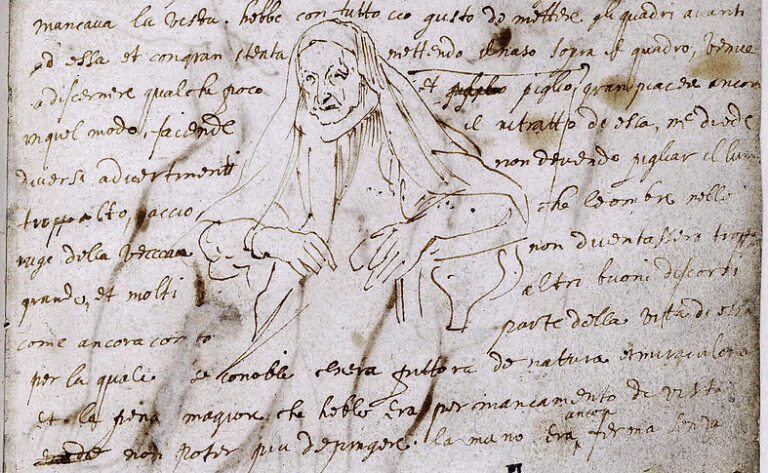
Anthony van Dyck, The painter Sofonisba Anguissola, leaf from Van Dyck’s Italian sketchbook, 1624, British Museum, London, UK. © The Trustees of the British Museum. Detail.
Anthony van Dyck (1599–1641) was a Flemish painter from Antwerp. Between 1621 and 1627, he worked in Italy, mainly in Genoa, studying the great masters—especially the Venetian painter Titian—and completing commissions. He also visited Rome, Venice, Padua, Mantua, Milan, Turin, and Palermo, where in 1624 he sketched what may have been a study for a portrait of the Italian painter Sofonisba Anguissola. Here, we explore the story of that portrait.
Sofonisba Anguissola (c. 1532–1625) was a late Renaissance Italian painter born in Cremona. She worked in the court of Philip II of Spain and established an international reputation for her ability to paint portraits. At a time when women were not accepted as apprentices in the workshops of artists, most female painters came from families where the father was a painter. Sofonisba Anguissola was an exception to this rule.
She studied with painters Bernardino Campi and Bernardino Gatti and, according to a letter from her father, now found at the Buonarroti Archives in Florence, she was held in high esteem by Michelangelo. Giorgio Vasari, known for his biographies of many Renaissance artists, wrote in his Lives of the Most Excellent Painters, Sculptors, and Architects that she had not only learned to draw, paint, and copy from nature and from the works of other artists but also produced beautiful paintings of her own.
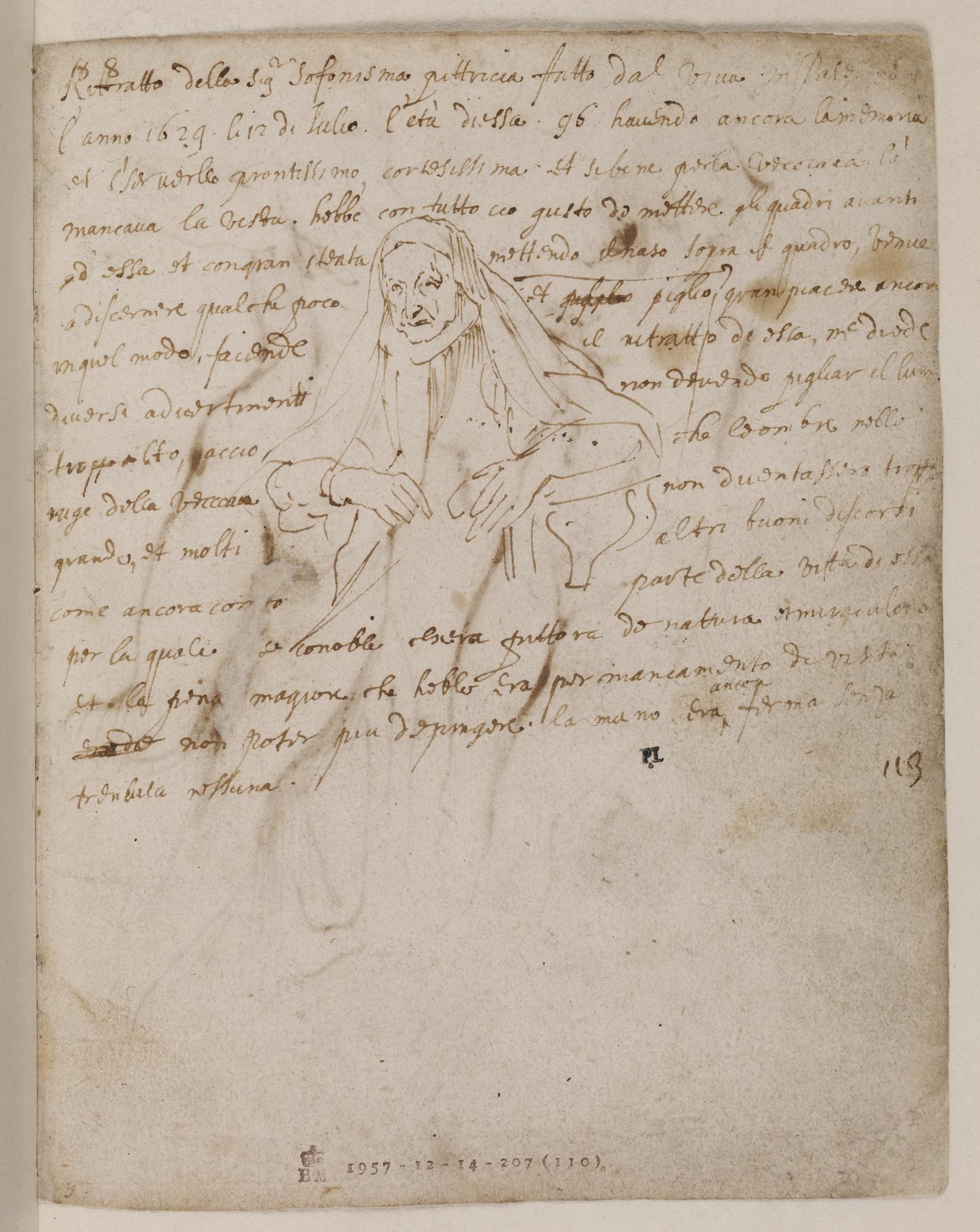
Such was the fame of the woman that the 25-year-old Anthony van Dyck visited her in Palermo on the July 12, 1624. His notes on the visit and the sketch that he made of her are to be found in his Italian sketchbook, now at the British Museum. By the time of the visit, Sofonisba Anguissola was an aged woman. Van Dyck believed her to be 96 years old. Now we know that she was 92 and died the following year. Therefore, this portrait is one of her last ones, along with Sofonisba Anguissola on Her Deathbed, painted around 1625.
Despite her old age, she was still lucid and her hands did not tremble. However, she could no longer paint due to loss of sight, which must have been a pity for her and her visitor. Nonetheless, the visit proved to be useful for the young Flemish painter. As he notes, she was courteous and had a good memory. She told him about her life and, as he was drawing her portrait, gave him some advice on the use of light. A feeling of admiration is evident in Van Dyck’s text.
More details on the sketchbook, including an image of the sketch itself as well as the full text of the notes in Italian and an English translation, can be found in Lionel Cust’s A Description of the Sketch-Book by Sir Anthony Van Dyck, used by him in Italy, 1621-1627, preserved in the collection of the Duke of Devonshire, K. G. at Chatsworth.
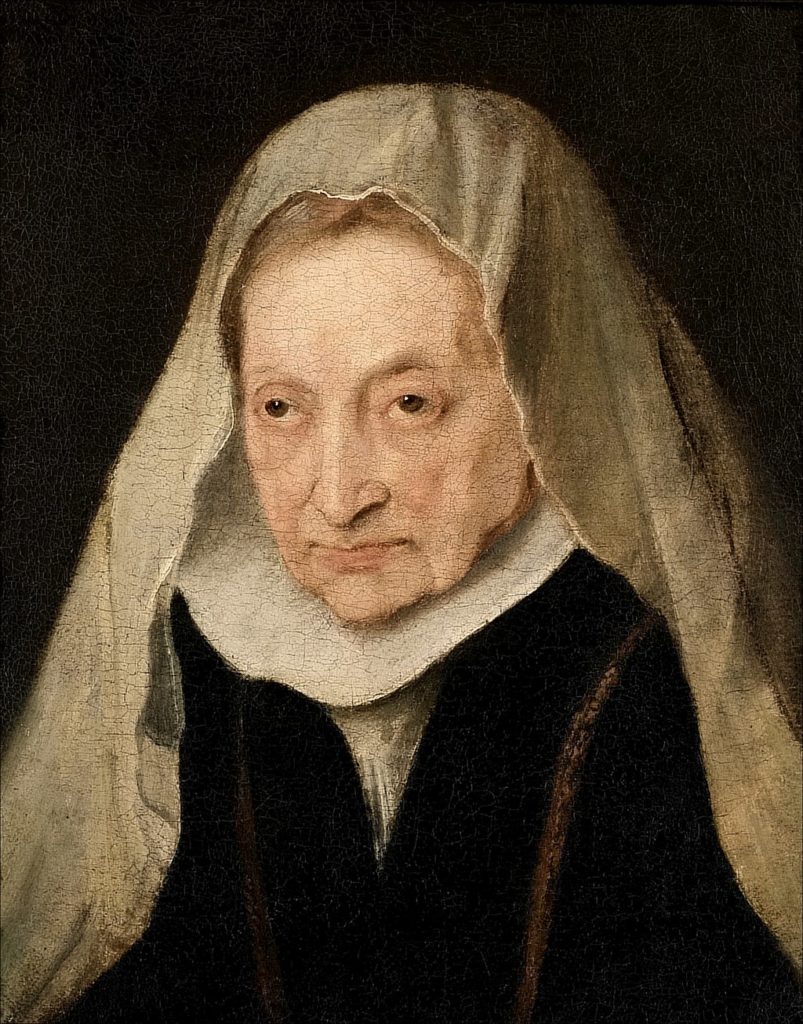
The painted portrait closely resembles the drawing in Van Dyck’s Italian sketchbook. It is an oil painting on panel measuring 42 x 33, 5 cm. Sofonisba Anguissola is represented wearing a black dress and a white veil over her head.
The painting is found at Knole, a country house and former archiepiscopal palace located in Kent, England. Knole was a property of the Sackville family since 1603. In 1946, it was gifted to the National Trust and is now open to the public. How the painting arrived there remains somewhat mysterious. According to the information recorded by the National Trust and the Netherlands Institute for Art History, it was possibly brought by Arabella Diana Cope (1767–1825), wife of John Sackville and 3rd Duchess of Dorset. However, it was initially mistaken for a portrait of Catherine Fitzgerald, Countess of Desmond.
In 2012, the portrait of Sofonisba Anguissola was accepted by the British government in lieu of the Inheritance Tax and allocated to the National Trust. It is now on display in the billiard room of the house, where it can be admired along with a portrait of Caterina Cornaro painted in the manner of Titian.
Get your daily dose of art
Click and follow us on Google News to stay updated all the time

DailyArt Magazine needs your support. Every contribution, however big or small, is very valuable for our future. Thanks to it, we will be able to sustain and grow the Magazine. Thank you for your help!

Political scientist with a strong passion for Art History. Great admirer of Vermeer and Velázquez. Researcher and amateur painter of still lifes.
The Descent from the Cross by Rogier van der Weyden is a masterpiece of Northern Renaissance art that captures a crucial moment in the Passion of...
James W Singer 5 April 2026
The girl leans out of the painting as if she intends to cross the boundary between art and reality—she touches the frame and looks directly at the...
The Royal Castle in Warsaw 26 March 2026
With sweet putti, handsome gods, beautiful nymphs, vibrant colors, and elaborate compositions, The Setting of the Sun is a testimony to François...
James W Singer 8 February 2026
Among the Sierra Nevada, California, by Albert Bierstadt, is a majestic mountainous landscape filled with wild beauty and blissful idealism. Its...
James W Singer 25 January 2026