

Masterpiece Story: The Setting of the Sun by François Boucher
With sweet putti, handsome gods, beautiful nymphs, vibrant colors, and elaborate compositions, The Setting of the Sun is a testimony to François...
James W Singer 8 February 2026
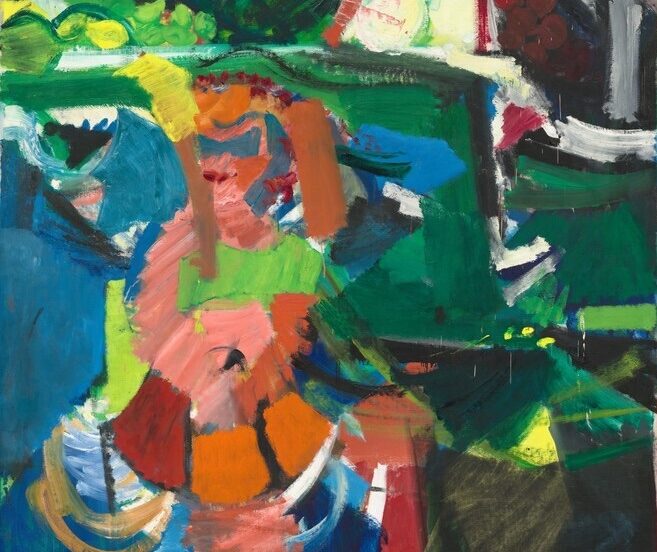
Grace Hartigan, Summer Street, 1956, National Gallery of Art, Washington, DC, USA. Museum’s website. Detail.
Grace Hartigan’s Summer Street (1956) is like stepping into a whirlwind of city light and sound. Painted in bold strokes and radiant colors, it captures the rhythm of an American summer—a blur of bicycles, people, and watermelons where abstraction and life meet.
Grace Hartigan (1922–2008) was one of the most original painters of postwar America. Though often placed among the Abstract Expressionists, she never fit neatly into any single category. Her art was both emotional and structured, both expressive and grounded in the real world.
Two dominant trends defined Abstract Expressionism:
Hartigan borrowed something from each, but her voice was distinct. Her paintings often contain recognizable forms—faces, streets, fruit, or figures—that float between the abstract and the figurative.
Her influences were many: Henri Matisse—for his joyous use of color and flat space; Willem de Kooning—for his lively, tangled brushwork; Jackson Pollock—for his sense of motion and daring; and her poet friends—especially Frank O’Hara, who encouraged her to paint life as she lived it—vibrant, fast, and full of feeling.
Unlike other women of her generation, such as Joan Mitchell or Lee Krasner, Hartigan mixed abstraction with imagery drawn from daily life—city streets, magazines, and myth. She believed emotion and observation could coexist.
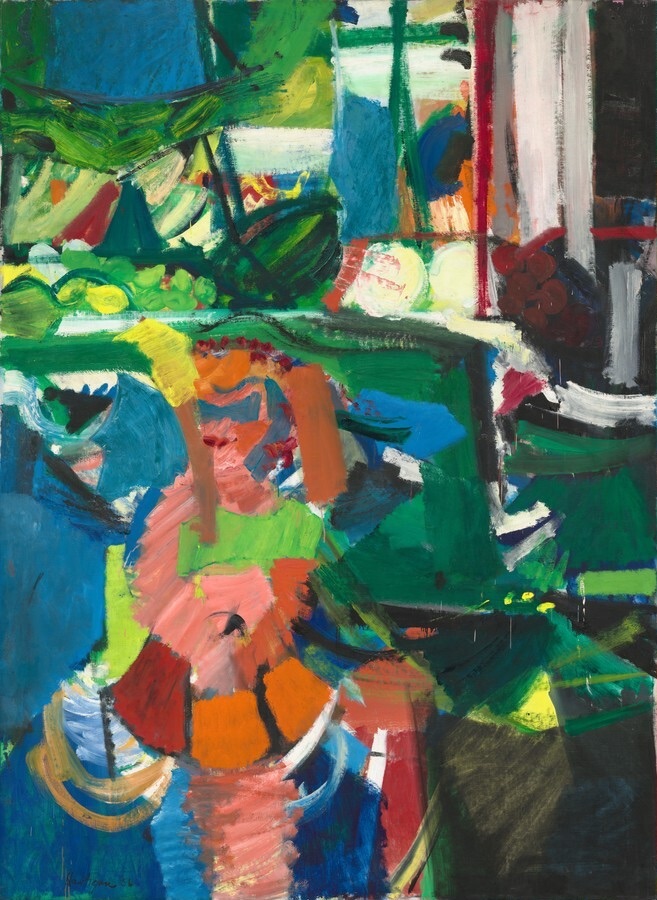
Grace Hartigan, Summer Street, 1956, National Gallery of Art, Washington, DC, USA. Museum’s website.
Painted in 1956, Summer Street seems to shimmer and move before your eyes. Large strokes of green, coral, yellow, blue, and orange collide and overlap. The paint feels alive, almost musical. Hartigan doesn’t describe a scene in a traditional way—she suggests it.
As you look closer, shapes begin to appear. In the lower half of the canvas, a seated woman with blue sunglasses becomes visible. Her legs blend into the round forms of a bicycle’s wheels, so figure and object become one. Around her, color fields vibrate like reflections on hot pavement.
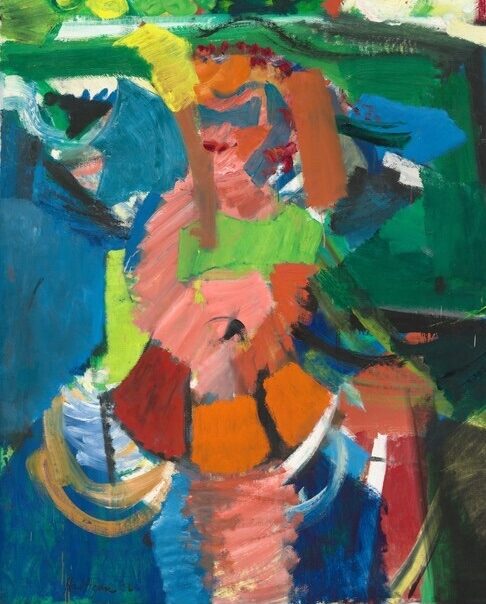
Grace Hartigan, Summer Street, 1956, National Gallery of Art, Washington, DC, USA. Detail.
There is no real three-dimensional space in Summer Street. Hartigan doesn’t use perspective or shadow. Instead, every part of the surface competes for attention—like sounds in a busy street. We recognize shapes only because our brains find patterns: the curve of a circle becomes a wheel; a pink area becomes skin. But these things are not outlined or modeled—they are built from color and rhythm.
This is what makes the painting so exciting: it feels alive but unconfined. The foreground and background blend together. The city, the bicycle, the figure, and even the watermelon exist in the same energetic plane.

Grace Hartigan, Summer Street, 1956, National Gallery of Art, Washington, DC, USA. Detail.
Hartigan’s color choices show her love of Matisse. The reds and greens, blues and oranges, balance perfectly but still vibrate with tension. There are no outlines, color itself builds the form. Warm hues (peach, coral, yellow) are paired with cool tones (blue, teal, emerald) to create a sense of light and motion. The result is balanced yet unpredictable, just like the city in summer, full of noise and surprise. Hartigan varies her brushstrokes constantly: thick impasto beside thin washes, quick dashes next to calm slabs of paint. This variation keeps the viewer’s eye moving, adding texture and energy.

Grace Hartigan, Summer Street (detail), 1956, National Gallery of Art, Washington, DC.
By 1956, Hartigan was gaining recognition but still pushing against boundaries. Summer Street shows her confidence—and her rebellion. The artist refused to choose between abstraction and representation, between emotion and structure. Instead, she painted the world as she felt it: crowded, bright, human, alive.
Today, Summer Street feels timeless. It reminds us that painting doesn’t need clear lines or perspective to tell a story. It can speak through color, motion, and intuition—the same way we experience the world when we walk through a sunlit street on a hot summer afternoon.
Summer Street, National Gallery of Art Online Collection. Accessed: Nov 14, 2025.
Grace Hartigan, The Art Story. Accessed: Nov 14, 2025.
Get your daily dose of art
Click and follow us on Google News to stay updated all the time

DailyArt Magazine needs your support. Every contribution, however big or small, is very valuable for our future. Thanks to it, we will be able to sustain and grow the Magazine. Thank you for your help!

I am a Publishing Editor with a PhD in Physics. During my free time, I enjoy reading art articles, attending exhibitions, and nurturing my curiosity and interest in painting, photography, literature, and music.

With sweet putti, handsome gods, beautiful nymphs, vibrant colors, and elaborate compositions, The Setting of the Sun is a testimony to François...
James W Singer 8 February 2026
Among the Sierra Nevada, California, by Albert Bierstadt, is a majestic mountainous landscape filled with wild beauty and blissful idealism. Its...
James W Singer 25 January 2026
The Cardsharps is an early masterpiece of Baroque art by Caravaggio that explores the revolutionary theme of crooked card playing. Let’s delve...
James W Singer 11 January 2026
As Europe burned during WWII, Wassily Kandinsky, who had fled Nazi Germany in 1933, lived as a recluse in his Neuilly-sur-Seine apartment. In that...
Javier Abel Miguel 8 January 2026