Nakedness or Nudity? To Be a Woman Is to Perform
Throughout the centuries, women’s bodies have consistently been staged for display rather than simply allowed to exist. John Berger’s...
Guest Author 12 March 2026
12 March 2026 min Read
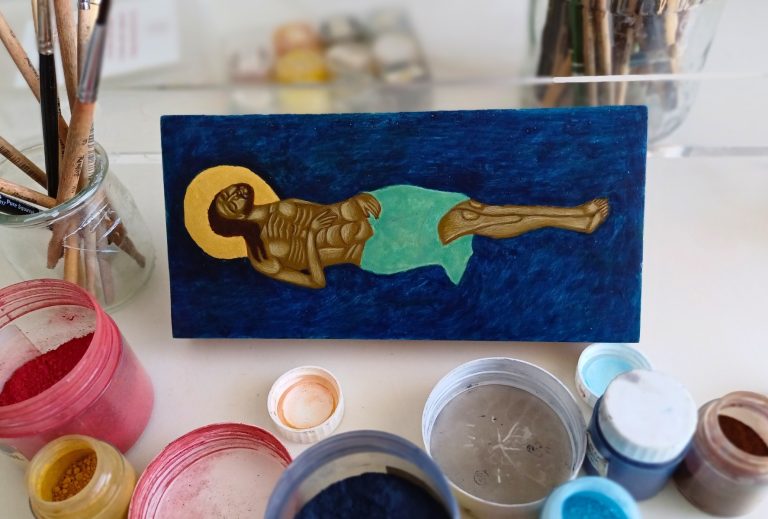
Monika Bartosiak, Epitaphios, 2025, egg tempera and gold leaf on linden wood, Iconoria Studio, Warsaw, Poland. Photograph by the author. Detail.
As we are in the middle of the season of Great Lent, sacred imagery becomes a bridge between the material world and spiritual reflection. Even today, the ancient Byzantine tradition of icon writing is kept alive through the meticulous use of egg tempera, natural pigments, and genuine gold leaf. This exploration of the Crucifixion and Epitaphios icons reveals how medieval techniques continue to transform raw linden wood into the “Gospel painted on wood”.
To understand the significance of the contemporary icon, one must look back at the era before oil paints dominated the artist’s palette. For centuries, egg tempera was the primary medium for the greatest masterpieces of European art. Long before the Van Eyck brothers popularized oils in the 15th century, masters such as Giotto di Bondone (c. 1267–1337) and Duccio di Buoninsegna (c. 1255–1319) relied on the luminous quality of tempera to create their altarpieces.
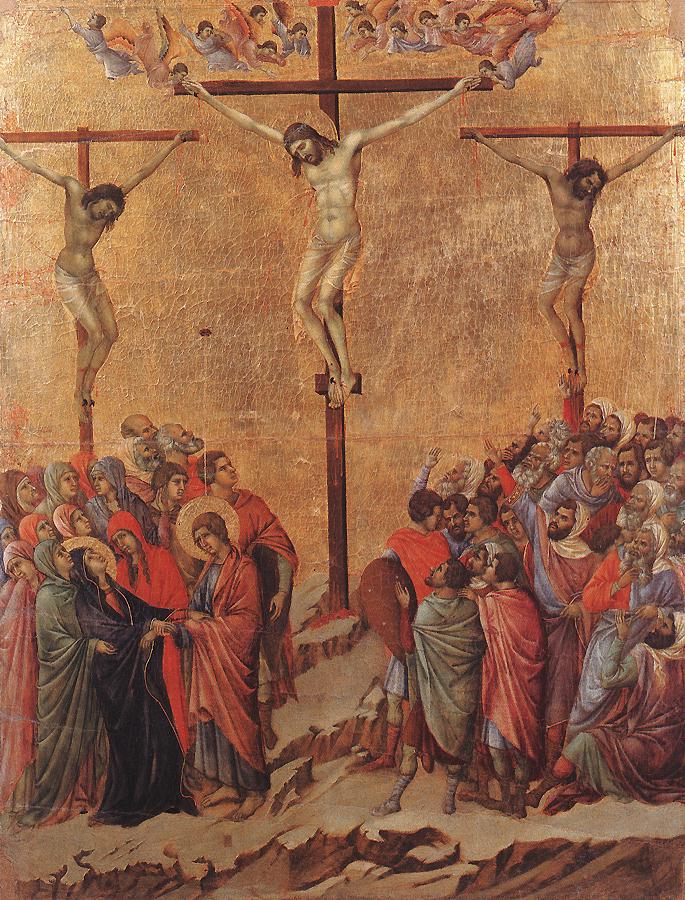
Duccio, Crucifixion, 1308–1311, Museo dell’Opera del Duomo, Siena, Italy.
Duccio’s Maestà, created for the Siena Cathedral in the early 14th century, remains one of the most complex examples of tempera on wood, with the central panel measuring 213 × 396 cm (84 × 156 in.). The back of the altarpiece contains a series of Passion scenes, including The Crucifixion, which share a common “DNA” with the Byzantine icons. The fast-drying nature of the egg-yolk medium required these masters to use precise, hatched brushstrokes—a technique still employed in professional studios to build depth and form.
Even Sandro Botticelli (1445–1510) used egg tempera for his most famous works, such as The Birth of Venus, demonstrating that this medium possesses an eternal durability and a unique, soft glow that oil can rarely replicate.
In the Eastern Christian tradition, an icon is not merely a religious painting; it is a “window to the divine.” Unlike Western art, which often emphasizes the physical agony and anatomical realism of the Passion, Byzantine iconography presents the Crucifixion as a moment of cosmic triumph. This spiritual perspective is achieved through a specific canonical language in which every color, gesture, and material carries theological weight.
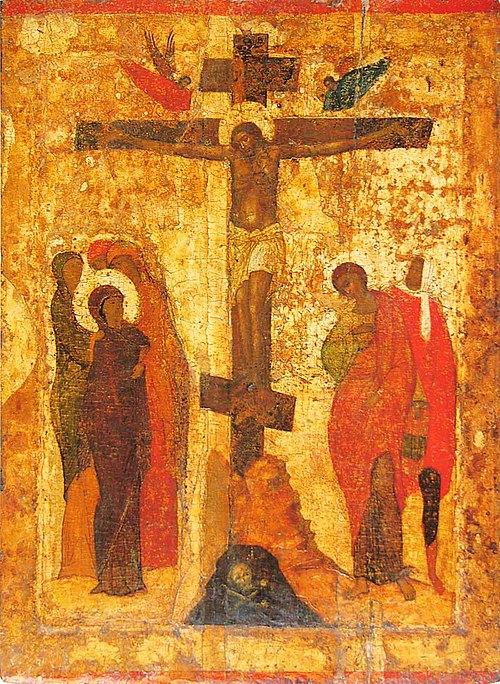
Workshop of Daniel Chorny and Andrey Rublev, Crucifixion, 1420, Sergiev Posad, Russia. Wikimedia Commons (public domain).
In the Crucifixion icon, Christ’s figure remains central, yet his presence transcends human suffering. His outstretched arms are not merely hanging from nails—they symbolize a divine embrace of the entire world. The body is not depicted as a defeated corpse, but as the Lord of Glory resting in the “sleep of the flesh.” Beneath the cross, a black abyss reveals a skull—the skull of Adam. This detail represents the Orthodox truth of “conquering death by death,” as the blood of the Savior reaches the first man, offering redemption to all of humanity.
This compositional rigor has been preserved for centuries, most famously by Andrei Rublev (c. 1360–1430). While Rublev is best known for his Trinity, his school’s approach to the Passion scenes emphasized peace over gore, and spiritual light over darkness. Rublev’s influence reminds us that the iconographer does not seek personal expression, but rather to reveal the “uncreated light” that has guided the Church for a millennium.
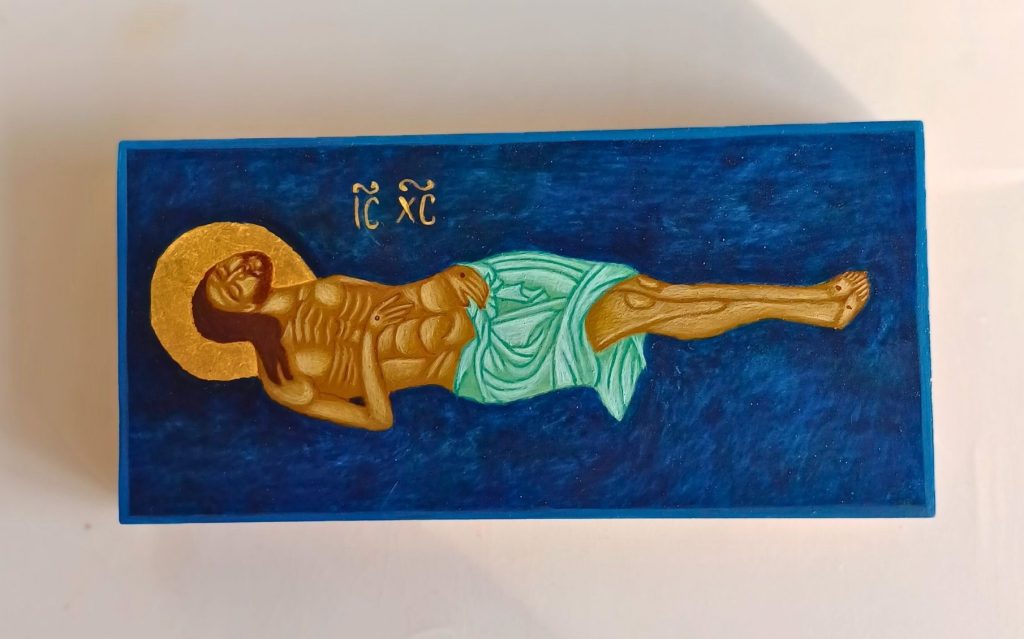
Monika Bartosiak, Epitaphios, 2025, egg tempera and gold leaf on linden wood, Iconoria Studio, Warsaw, Poland. Photograph by the author.
The Epitaphios icon—from the Greek meaning “on the tomb”—depicts Christ laid out for burial. It is a central element of Good Friday and Holy Saturday liturgies, where it serves as a focal point for the faithful to contemplate the mystery of the Holy Sepulchre. In contemporary practice, such as in the Iconoria workshop, the use of color in this scene is deeply symbolic. For instance, the choice of Prussian blue for shadows creates a deep, contemplative atmosphere, while a light green cloth symbolizes the subtle hope of the coming Resurrection.

Jerzy Nowosielski, Epitaphios, 1960s, Monastery of Basilian Order of Saint Josaphat, Warsaw, Poland. UM Warszawa.
This tradition remained remarkably vibrant in Poland, a country where Eastern and Western influences have historically met. A modern master of this dialogue was Jerzy Nowosielski (1923–2011). Nowosielski, both a theologian and a painter, revolutionized the icon by stripping it to its most essential, almost abstract forms, while maintaining the rigorous technique of the masters. His works, found in churches from Kraków to Lourdes, show that the iconographic language is not a relic of the past, but a living form of sacred art that continues to challenge the modern viewer.
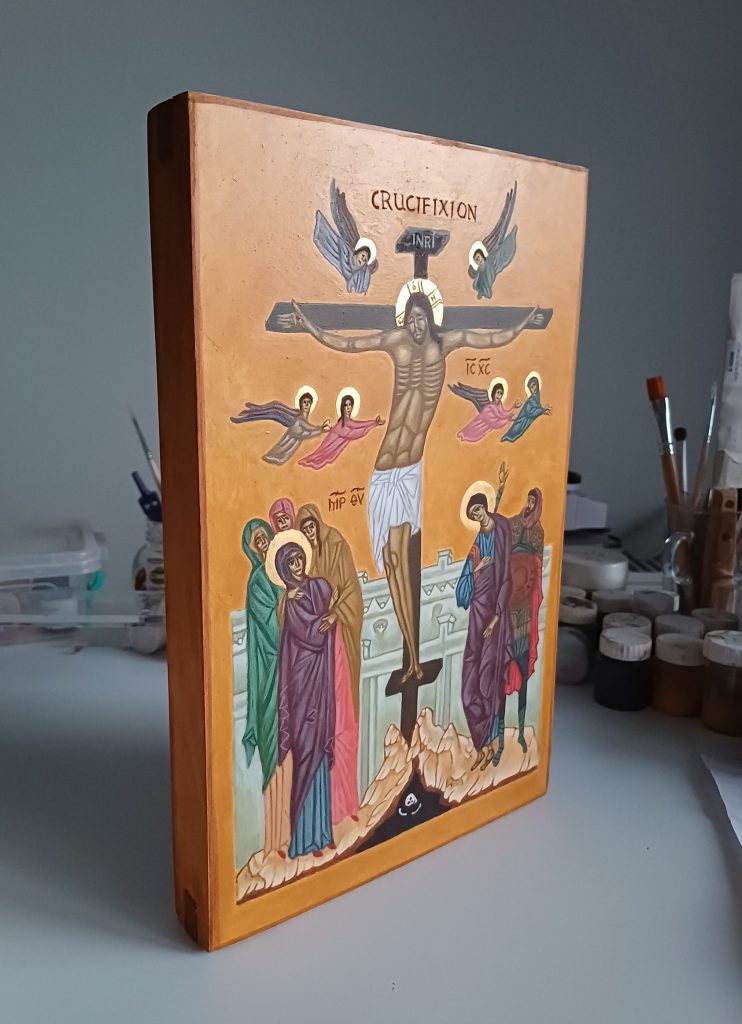
Monika Bartosiak, Crucifixion, 2025, egg tempera and gold leaf on wood, Warsaw, Poland. The image showcases the reflective 24K gold leaf on the halos of Jesus, the Angels, and the Saints. Photograph by the author.
The creation of an icon is as much physical labor as it is spiritual. It begins with the selection of the wood—typically linden (limewood), which is chosen for its fine grain and stability. The board represents the Tree of the Cross. To prepare it, the iconographer applies multiple layers of levkas—a traditional mixture of chalk and rabbit-skin glue (gesso). This mixture must be applied warm and then sanded until it is as smooth as ivory.
Once the surface is ready, the gilding process begins. Studios often follow the ancient poliment (bole) method, which involves applying a base of natural red clay (bole) mixed with glue. This clay serves as a cushion for the genuine 24K gold leaf. After the gold is applied, it is burnished with a precious agate stone. This burnishing compresses the gold into the clay, creating a mirror-like surface that reflects light in a way that modern “gold” paints never could. In iconographic theology, this gold represents “uncreated light”—the eternal, unchanging presence of the Divine. To preserve this sanctity, traditional iconographers avoid modern shortcuts like drilling holes for metal hangers, treating the wood with the same reverence as the sacred image itself.
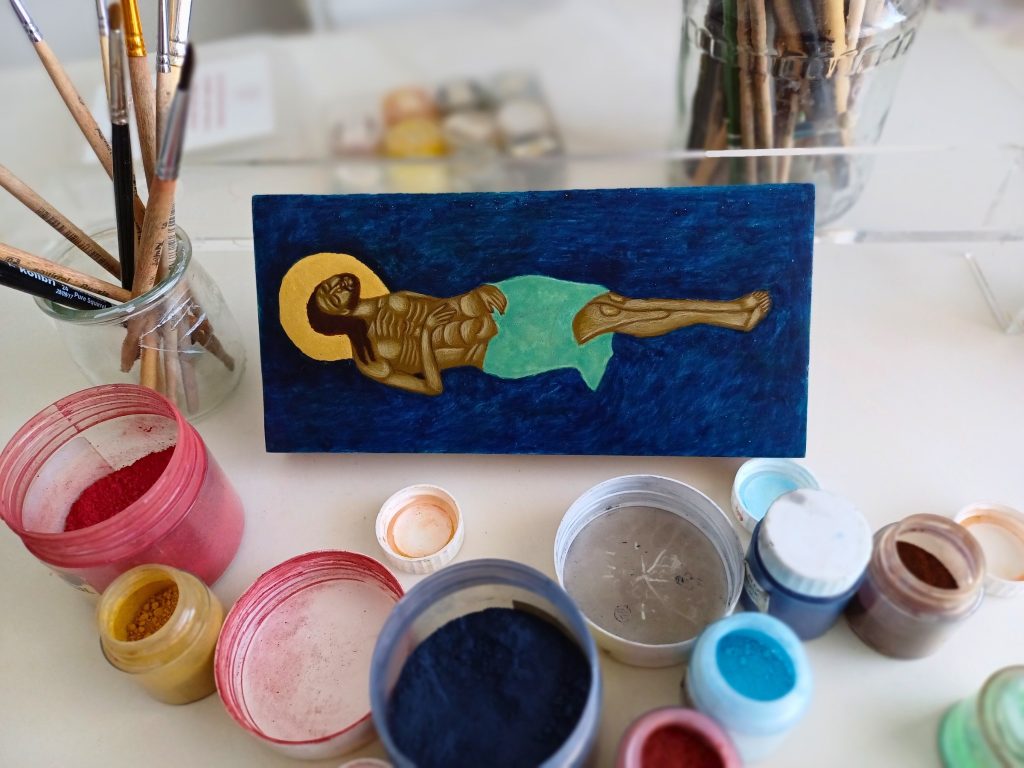
Traditional workshop scene: hand-grinding natural pigments in the Iconoria studio in Warsaw for the Epitaphios icon. Photograph by the author.
The heart of the icon lies in its colors. In the studio, iconographers maintain a collection of over 80 natural pigments derived from earth, crushed minerals, and plants. These include Greek indigo, lapis lazuli, and various ochers sourced from the hills of Italy and Cyprus. The process of grinding these minerals by hand connects the artist to the geological history of the Earth, turning stones into prayer.
The binder is a simple yet perfect emulsion: fresh egg yolk mixed with dry white wine and a drop of clove oil for preservation. This “alchemy” allows for the layering of colors from darkness to light—a technique known as sankir. The process starts with dark, earthy tones and gradually builds up to the brightest highlights, known as ozhivki. This process mirrors the spiritual journey of the soul from the darkness of sin to the radiance of grace. Unlike modern synthetic paints, natural pigments in egg tempera do not yellow or crack with age; they actually become harder and more luminous over the centuries.
Maintaining these hand-painted icon traditions in a contemporary setting like Warsaw is not about nostalgia; it is about providing a space for silence and beauty in a loud, digital world. The slow rhythm of the workshop, the weeks spent waiting for glue to dry, the hours of polishing gold, and the thousands of tiny brushstrokes—is an act of resistance against the ephemeral nature of modern life. When a viewer stands before a Crucifixion or an Epitaphios, they are not just looking at a historical artifact. They are engaging with a tradition that has survived empires and revolutions—a tradition that still speaks of hope, sacrifice, and the eternal victory over death.
Author’s bio:
Monika Bartosiak is a professional iconographer and the founder of Iconoria. Based in Warsaw, she specializes in traditional Byzantine iconography, using medieval techniques of egg tempera and 24K gold leaf. Her work focuses on preserving ancient methods while engaging with the spiritual depth of sacred imagery.
Get your daily dose of art
Click and follow us on Google News to stay updated all the time

DailyArt Magazine needs your support. Every contribution, however big or small, is very valuable for our future. Thanks to it, we will be able to sustain and grow the Magazine. Thank you for your help!

This is our guest profile for occasional authors. If you have an interesting story about art to tell, send it to our Editor-in-chief Kate at [email protected]. You might be the next here!

An admirer of antiquity, art, and architecture. An avid reader and amateur photographer. Always curious, always on an adventure.
Throughout the centuries, women’s bodies have consistently been staged for display rather than simply allowed to exist. John Berger’s...
Guest Author 12 March 2026
Fanny Eaton was a regular model for the Pre-Raphaelites during the 1860s and features in a number of famous works. Yet for most of the last century,...
Catriona Miller 19 February 2026
From van Gogh’s sunflowers, through golden dresses, to tranquil landscapes—yellow lights up the scene. It is the color of the sun, associated...
Kinga Dobosz 26 February 2026
For centuries, artists interpreted the biblical story of Salome and turned it into a lasting theme in art. But where did this fascination come from?...
Edoardo Cesarino 22 January 2026