
Sliman Mansour, Painter of Palestinian Resistance, Dies at 79
Sliman Mansour, one of the leading figures in Palestinian art, died yesterday at the age of 79. Mansour’s practice was profoundly intertwined...
Martha Teverson 25 August 2026
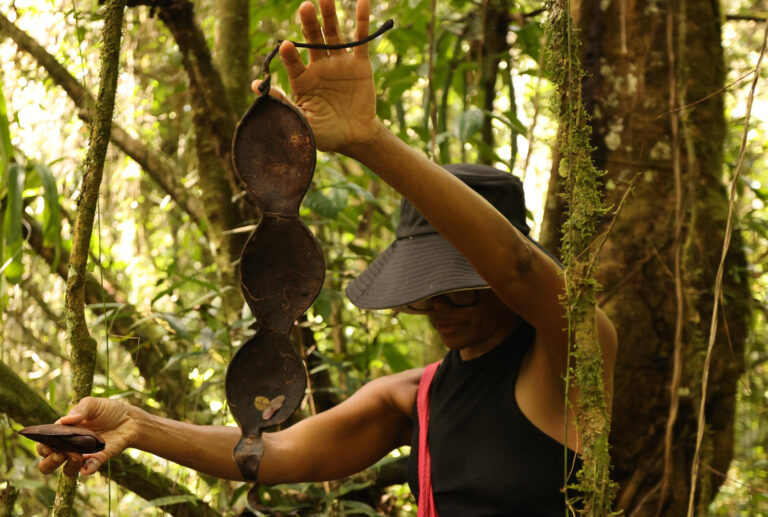
Photograph of Jasmine Thomas-Girvan making a sculpture in a forest, date unknown, Photo Courtesy Rhonda Chan Soo.
What stories do materials hold? For Jamaican artist Jasmine Thomas-Girvan, each seed pod, feather, and shard of metal carries traces of memory, resistance, and belonging. Her sculptural practice uses these fragments to explore Caribbean history as both a site of survival and a space for transformation.
Jasmine Thomas-Girvan (b. 1961) is a Jamaican artist whose sculptural practice explores the entanglement of ancestral memory, material histories, and creative resistance. Working with organic and found materials, coconut shell, cow horn, charred wood, seed pods, and precious metals, her delicate yet complex forms merge the human, animal, and plant worlds. Through her work, Thomas-Girvan draws from the Caribbean oral traditions, nature as a site of refuge, and the survival strategies of the Maroons. This offers viewers a tactile encounter with histories that persist beneath the surface.
Her recent works, including Cosmic Whispers (His Master’s Voice) (2019) and The Forestine Soul, Wisdom That Surround Us (2024), embody this approach. Combining traditional techniques with unexpected materials, she crafts sculptural narratives that ask us to linger—to hold complexity, to remember, and to find healing through material engagement.
We talked with Thomas-Girvan about her evolution from jewelry-making to sculpture, her relationship with nature, and how ancestral knowledge shapes her vision of art as both refuge and act of resistance.
Tedecia Bromfield: You’ve had a fascinating evolution in your practice, from creating utilitarian objects to sculptural works of art. I know you began making jewelry. How did your experience in jewelry-making influence your approach to sculpture? Do you still carry aspects of working with smaller, functional objects into your larger, more abstract pieces?
Jasmine Thomas-Girvan: Jewelry making requires tremendous patience and attention to detail because you are working on a small scale. Understanding the importance of the minutiae becomes second nature, so when creating larger works, that sensitivity is always present.
I can’t say it is a conscious approach, but without a doubt, the idea of zooming in, requiring viewers to look more closely for the obvious and sometimes not so obvious, challenges the viewer to become more engaged. I think people appreciate the trust invested in them to find the surprise.
TB: Given your focus on ancestral memory and materials tied to the Caribbean landscape, do you feel there’s an intimate relationship with the materials you work with, almost like working with memory itself?
JTG: I often say that materials choose me.
While working on several of the projects, new materials appeared serendipitously at the right time. This happened with glass and feathers, for instance.
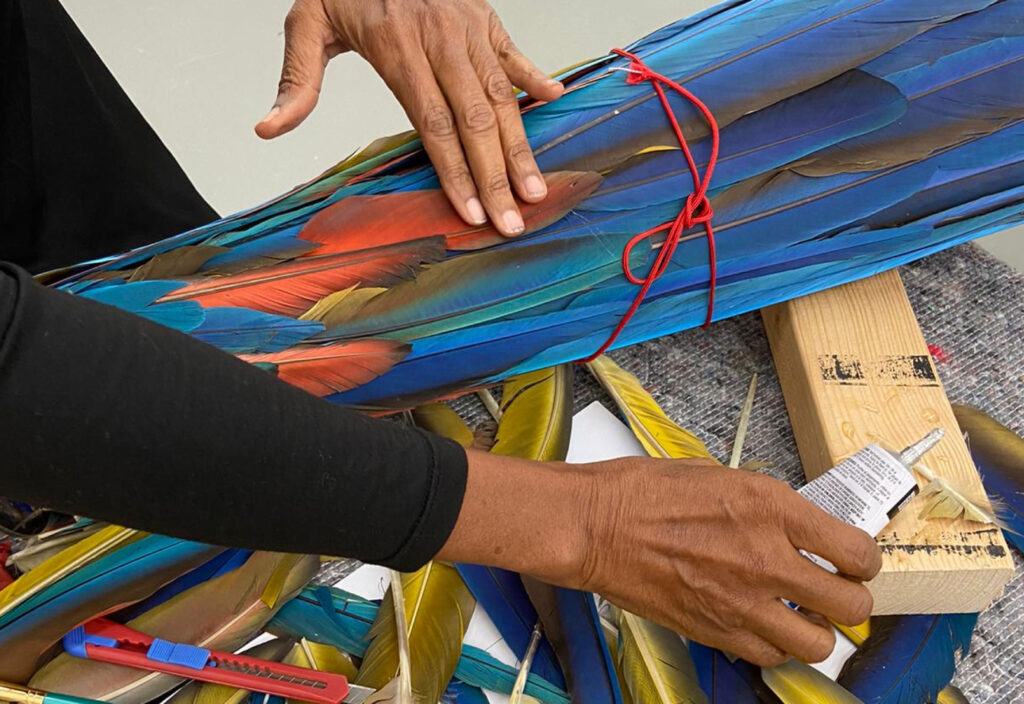
Jasmine Thomas-Girvan working with macaw feathers during the creation process. Photograph by Rhonda Chan Soo.
Some may say this is a coincidence, but maybe the explanation is that when you are contemplating an idea, you are locked into all aspects of that idea and therefore are attuned to a particular frequency, which then makes you a receptor on many different planes and levels related to that idea.
I think one of the most gratifying aspects of making is the unpredictability of it. We forget that materials are energy. There is a reciprocal exchange happening. It is not necessarily the final product that is the ultimate fulfillment, but who we become in the process of the investigation. I am not easily frustrated by making. If I am challenged, I simply give it some time and return when I am called.
When I work with materials that provoke destruction, I ponder the resoluteness of our ancestors as a point of inspiration. I imagine the travails of existing in a hostile system and the tenacity required to survive it. I do not wish to romanticize the struggle, but I respect the tenacity, indomitable spirit, and intelligence that defied the ugliness! So if a work is about the Caribbean, maybe it is best translated in materials which are present in that geography, even if it requires protracted experimentation.

Detail of Jasmine Thomas-Girvan’s sculpture incorporating cacoon seed pod. Photograph courtesy of NLS (New Local Space).
TB: How do you navigate the balance between function and artistic expression in your work? How do you decide when something is meant to be functional versus when it’s meant to purely evoke a response?
JTG: Our ancestors created beauty, which did not fall into categories of art as distinct from a functional object. They invested effort into making something meaningful. I think it is important for us to engage with objects. If the tactile engagement magnifies the message, then it is considered, but it depends on the context. I do believe that sensory connection is important to make us present.
TB: Your use of natural elements often feels like a form of storytelling, linking nature to spiritual and ancestral knowledge. How does this fusion of materials and meaning connect to broader Caribbean cultural beliefs?
JTG: I believe we have been tricked into accepting that things fit comfortably into silos—ethnography, archaeology, art, science, philosophy. It’s all connected. I regard nature as a teacher and guide. I spend a lot of time outside in my garden, sitting, observing, or just walking away from the noise of the world. I soak in the sights, smells, tastes, and sounds of nature. I believe an intimate connection with the land keeps us grounded physically and psychologically.
TB: Your work seems to blur physical and metaphysical realities, almost like you’re mapping fugitive or hidden histories through form. How do you see your sculptures inviting viewers into these layered spaces of memory and imagination?
JTG: I see my work as a trigger of experience. Our memories hold the key to understanding ourselves. The most impactful memories for me are those that surface in unexpected encounters; the memories that haunt us and escape categorization. It’s like arriving somewhere and being overcome by the sense that you’ve been there before. The beauty of such an encounter is allowing it to speak to you. There is a reservoir of deep knowing that we need to tap into. My practice involves uncovering subsumed histories and compiling inventories.
While my work considers positive knowledge, it suspends the earthly and mundane to imagined histories untold; to reference Wilson Harris’s idea, to “free” our stories and lay claim to our cosmic potential.
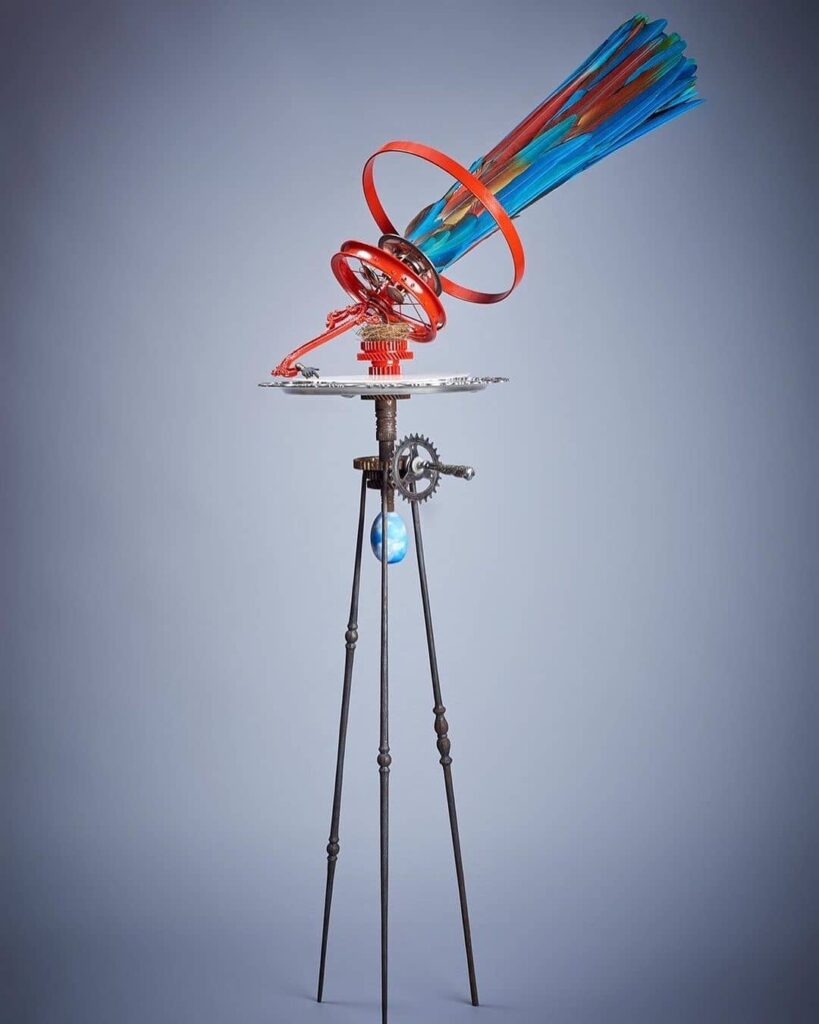
Jasmine Thomas-Girvan, Cosmic Whispers (His Master’s Voice), 2019, bicycle wheel, nest, watch parts, silver tray, etched plexiglass, macaw feathers, bronze, aluminium, steel, painted calabash. Photograph by Michele Jorsling.
Our memories can help us to redeem and redream our ancestral legacies. My hope is that my work will help reveal some of the fugitive narratives, subsumed histories, and therapeutic interventions that have sheathed us over time. I ask people to allow themselves to be led by the imagery and to simply absorb its provocations. May we leave with an earnest curiosity about our continued roles in, and proximity to, the many traumas of history that continue to plague humanity. And like generative modalities guarded by our ancestors, may it offer refuge and resource… ultimately a pathway to understanding and healing.
TB: I know you grew up in Jamaica, and now you live in Trinidad. I’m curious about how cultural attitudes towards nature and the environment differ between the two places. What role does this play in the way both societies engage with their surroundings and the materials they use?
JTG: Our cultural attitudes are shaped by history. We have similar colonial histories, so the material hierarchies are skewed in favor of European dictates. Thankfully, nature and geography outside of the influence of imperial control exert their influence on many choices. Trinidad is a breakaway from the Amazon, so there is a more diverse plant and animal life, and therefore more material options. Also, being immersed in a diverse cultural pool gifts us with the practice of different ways of seeing and being. There are many rich retentions evident in ceremonies and rituals still celebrated under the protection of nature.
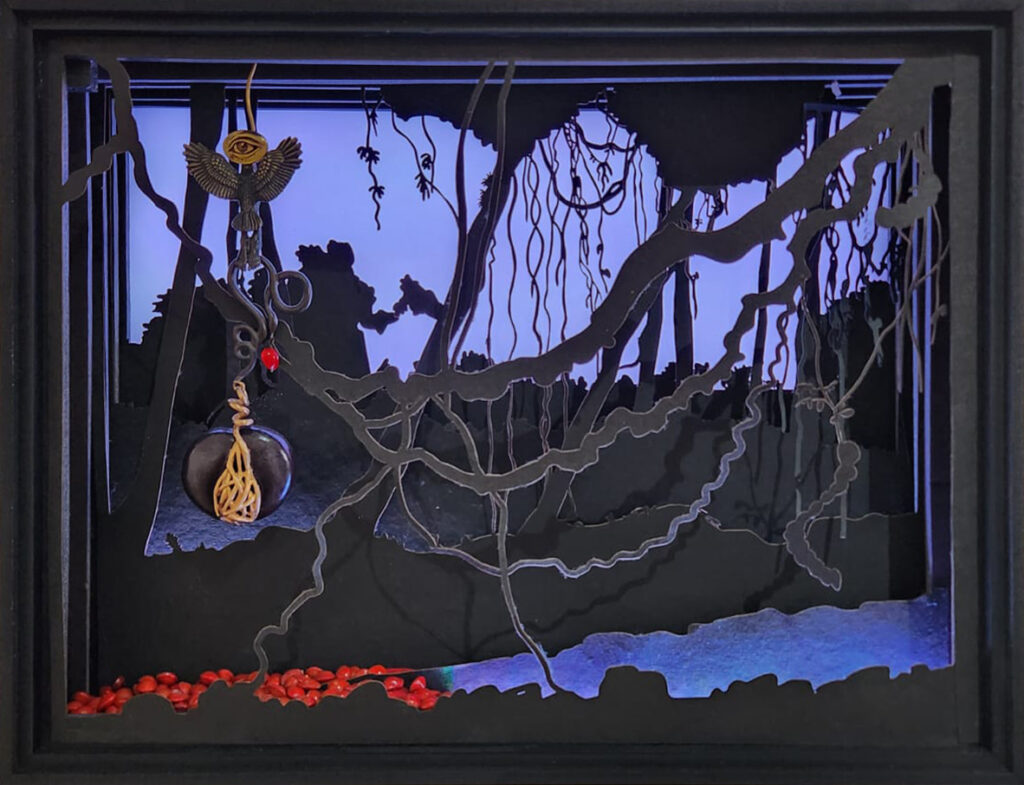
Jasmine Thomas-Girvan, The Forestine Soul, Wisdom That Surround Us, 2024. Courtesy of the artist.
Rituals like Carnival, particularly Traditional Masquerade, integrate participants, many seemingly disparate cultural heritages, into an act of communal joy. What strikes me most is how the costumes reflect passionate guardianship of Carnival traditions, both in concept and in crafting.
In Carnival, the street is the stage. In Traditional Mass, people craft their costumes, which are lovingly embedded with the history of the Masquerade. People across age groups—in their 70s, 80s, and even 90s—perform with tremendous pride characters that harken back to the genesis of Carnival—retaining the Spirit of resilience, rebellion, and marronage [Ed. note: extricating oneself from slavery].
This practice reinforces the subversive power of community through ritual and the renegade practice of making as a form of healing. The participants are invested in the power of the imagination. Right now, the world is all about beautifully polished consumer items that are transactional. Joy is tethered to commerce. Traditional Carnival is the opposite of that. In this restorative theater, the performers and audience recognize the mutual benefit of this therapeutic vibe. As we say in Jamaica, “one hand can’t clap”. We need each other to thrive.
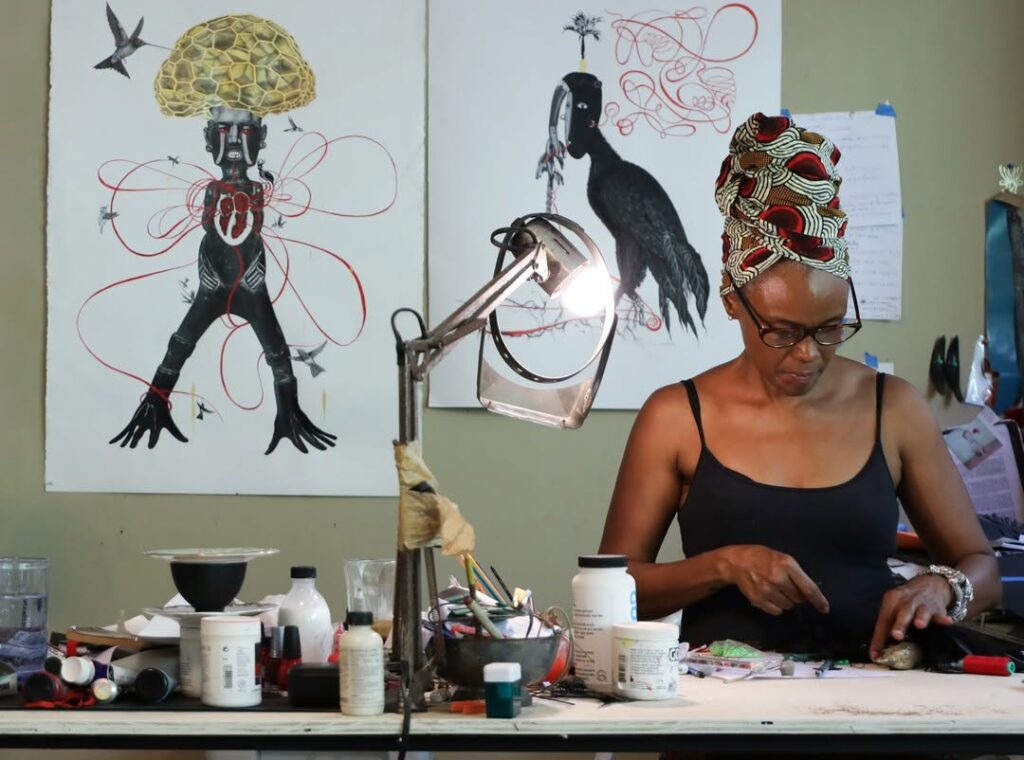
Jasmine Thomas-Girvan in her studio. Photograph by David Zwirner.
TB: The Maroons are an important part of Caribbean history and identity. How do the Maroon traditions and their resilience inspire your own creative work? Is there an ancestral connection you feel when exploring these histories through art?
JTG: If we look at the strategies of the Maroons, we will understand what an indomitable spirit looks like. The Maroons were in several wars with the British during the 18th century, lasting many years. This was an unequal battle based on armaments. They were at a “disadvantage,” having no guns or cannons. Regardless, ever resourceful, they used what they had. They converted the mountains and forests into natural fortresses of tremendous strength.
In consort with nature, they were able to protect and maintain their sovereignty until the British used imported hunting dogs to track them. This distinctive understanding of fugitive pathways—navigating the world by building alliances with nature… understanding the resonance between things, gives me hope.
Author’s bio:
Tedecia Bromfield (they/them) is a Jamaican writer, poet, and emerging archivist invested in reimagining Black queer histories through archival research, experimental poetry, and visual storytelling. They are the author of Field Notes from the Archive and work at the intersection of research, writing, and marketing with Wattle and Red Earth. Their work has been published in Burnaway, Tenement Yaad Media, and the Journal of Jamaican Art.
DailyArt Magazine needs your support. Every contribution, however big or small, is very valuable for our future. Thanks to it, we will be able to sustain and grow the Magazine. Thank you for your help!

This is our guest profile for occasional authors. If you have an interesting story about art to tell, send it to our Editor-in-chief Kate at [email protected]. You might be the next here!
Sliman Mansour, one of the leading figures in Palestinian art, died yesterday at the age of 79. Mansour’s practice was profoundly intertwined...
Martha Teverson 25 August 2026
There is a particular vertigo in crouching down to look at something the size of a fingernail. Since 2006, Slinkachu has built an entire career...
Errika Gerakiti 3 August 2026
Few would claim real shock at the loss of an artist a month shy of turning 89. And then David Hockney passed away on June 11. Born in 1937, the lad...
MJ Rivera 22 June 2026
Between marquee art fairs, auction-house madness, downtown openings, uptown previews, long-awaited gallery and museum exhibitions, and the artsy...
MJ Rivera 28 May 2026