


The Cost of Devotion in Caravaggio’s Saint Jerome
Caravaggio, one of the most striking painters of the Baroque era, uses the figure of Saint Jerome to explore themes of devotion and mortality. In...
Frank Schildiner 13 September 2026

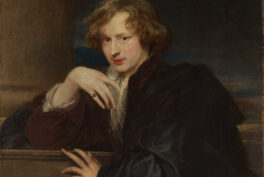
Anthony van Dyck, Self-portrait, ca. 1640. National Portrait Gallery, London, UK.
Anthony van Dyck, a Flemish Baroque painter of remarkable skill, left an indelible mark on art history. His signature style of refined portraits and dynamic compositions was widely admired and emulated. Here are 10 fascinating facts about Anthony van Dyck, his artistic journey and personal life, that might surprise you. They will, however, explain how his unique approach solidified his place among the Old Masters and inspired future generations of artists.
Anthony van Dyck was recognized as a prodigy from an early age, as his remarkable talent quickly set him apart. By the age of 14, he was already working independently, demonstrating skills that many seasoned artists took years to master. By the age of 19, his exceptional abilities led him to be accepted into the esteemed Antwerp Guild of Saint Luke as a master painter, an impressive achievement that solidified his reputation within the art world.

Anthony van Dyck, The Taking of Christ, 1618–1620, Museo del Prado, Madrid, Spain.
Van Dyck was a leading pupil in the studio of Peter Paul Rubens. This experience greatly influenced his style, especially in his use of color and composition. Rubens himself referred to Van Dyck as the best of his disciples. This recognition allowed him to attract influential patrons. As his career progressed, Van Dyck’s distinctive approach to portraiture, marked by elegance, dignity, and lifelike expression, reshaped how the European elite wished to be seen and remembered.

Anthony van Dyck, St Ambrose Barring Theodosius from Milan Cathedral, 1619–1620, National Gallery. London, UK.
After moving to England in 1632, Van Dyck was appointed the principal court painter to King Charles I. The king admired Van Dyck’s work so much that he not only knighted him but also granted him a pension and a house, enabling him to work and live in luxury. Van Dyck’s portraits of King Charles I are some of the most iconic images of the monarch.

Anthony van Dyck, Charles I in Three Positions, 1635–1636, The King’s Gallery, Buckingham Palace, Royal Collection, London, UK.
Van Dyck became famous for his portraits of the English aristocracy. His elegant style, characterized by his ability to flatter his subjects while still capturing their individual personalities, became the standard for portraiture in England and beyond.

Anthony van Dyck, Lady Mary Villiers, Duchess of Richmond and Lennox, 1622–1637, Royal Collection Trust, Queen’s Gallery, Windsor Castle, London, UK.
Van Dyck’s influence extended well beyond his lifetime. His style of portraiture became an exemple to follow for English artists for generations. The “swagger portrait,” a term used to describe the grand and imposing style of portraiture that became popular in the UK, owes much to Van Dyck’s influence.

Anthony van Dyck, Marchesa Geronima Spinola, ca. 1624, Gemäldegalerie, Berlin, Germany.
Van Dyck was known to live lavishly, and had a reputation as a charming and fashionable figure. As a result of his success, his personal life was marked by frequent travels and a series of romantic entanglements. He married Mary Ruthven, a lady-in-waiting to Queen Henrietta Maria, just a year before his death.
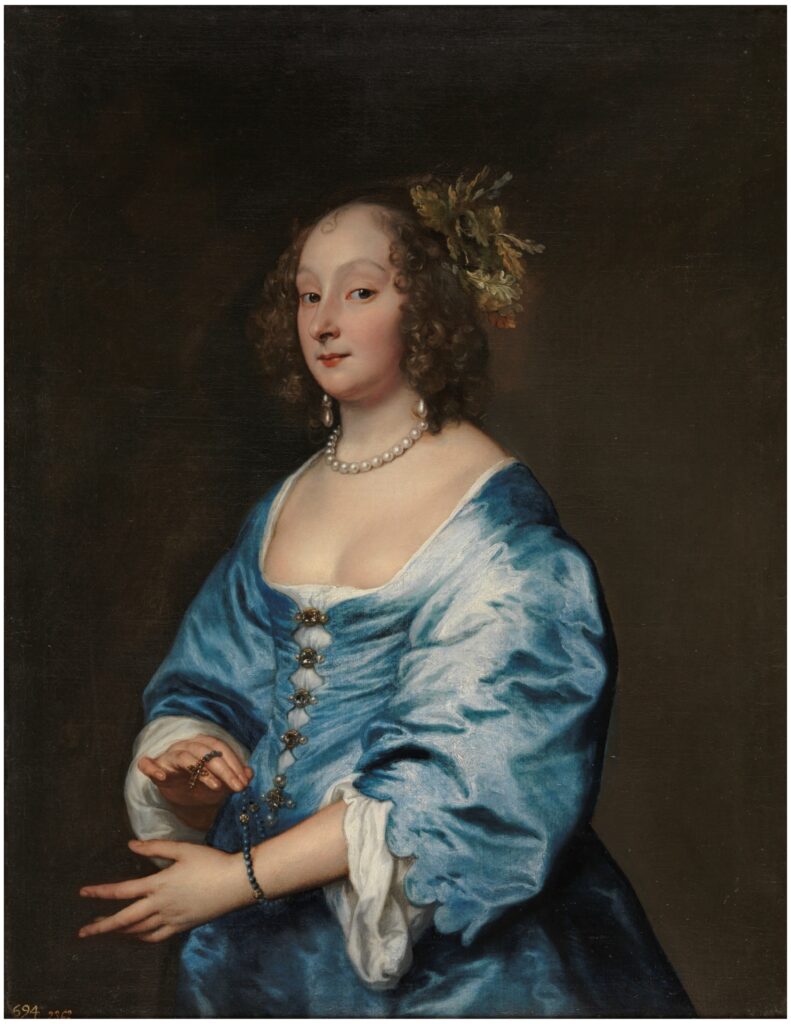
Anthony van Dyck, Mary Ruthven, Lady Van Dyck, 1640, Museo del Prado, Madrid, Spain.
Van Dyck died at the age of 42, likely from illness. His early death cut short a brilliant career. Despite his premature death, his legacy endured, not only through the works he left behind but also through his profound influence on both his contemporaries and future artists. His refined technique, characterized by elegant compositions and a unique ability to capture the character of his subjects, inspired generations to come and solidified his place as one of the greatest portraitists in the history of art.

Richard Cosway, Self-portrait in Masquerade Costume, 1770, Attingham Park, Shrewsbury, UK. National Trust.
Van Dyck’s portraits often highlight the sitters hands and eyes, a stylistic choice that distinguished his work. He believed that expressive eyes and hands could convey a person’s character, so he meticulously detailed them to create a sense of intimacy and depth. His attention to these features added a unique psychological insight to his portraits, bringing his subjects to life for viewers.

Anthony van Dyck, The Painter Martin Ryckaert, 1631, Museo del Prado, Madrid, Spain. Details.
Van Dyck had a remarkable ability to portray armor in his paintings with incredible precision and sheen. Many of his portraits feature sitters in elaborate armor, reflecting the European fascination with chivalric virtues. His skill in rendering reflective surfaces added a level of sophistication to his work, and he often contrasted the hard metal with the soft textures of clothing and skin, creating a striking visual effect.

Anthony van Dyck, Equestrian Portrait of Charles I, ca. 1637–1638, National Gallery, London, UK. Detail.
While Van Dyck is best known for his portraits, he also created compelling religious works, especially during his early years in Italy. His series on the Apostles was particularly admired for its emotional intensity and realism. Unlike traditional, more static religious representations, Van Dyck’s figures often appear thoughtful and deeply human, adding a level of relatability to these spiritual subjects that connected with viewers on a personal level.

Anthony van Dyck, The Apostle Philip, 1619–1621, Kunsthistorisches Museum, Vienna, Austria.
Una obra, un artista: El Prendimiento de Cristo, de Van Dyck, Museo Del Prado, 2021. Accessed: October 4, 2024.
Christopher Baker, “How Van Dyck made his mark on English portraiture,” Apollo Magazine, 2022. Accessed: October 4, 2024.
Michael John Partington, “Anthony van Dyck, Equestrian Portrait of Charles I,” Smarthistory, 2020. Accessed: October 4, 2024.
Andrew Wilton, The Swagger Portrait: Grand Manner Portraiture in Britain from Van Dyck to Augustus John, 1630–1930. Tate Publishing 1992.
DailyArt Magazine needs your support. Every contribution, however big or small, is very valuable for our future. Thanks to it, we will be able to sustain and grow the Magazine. Thank you for your help!

Jimena Aullet is a multidisciplinary professional born in Mexico City, with a solid academic background in Art History. She took part in research and production for audiovisual projects focused on the diffusion of art and culture, she has also participated in cultural heritage preservation projects.

Elizabeth Provost is a visual arts journalist, editor, and scholar of the Italian Renaissance based in New York City and Toronto. She is a PhD student at the Bard Graduate Center. Learn more about her on her website: www.elizabethprovost.com
Caravaggio, one of the most striking painters of the Baroque era, uses the figure of Saint Jerome to explore themes of devotion and mortality. In...
Frank Schildiner 13 September 2026
In Caravaggio’s work, desire requires payment. The great baroque artist illuminates that impulses such as greed, desire, and sensual longing are...
Frank Schildiner 6 April 2026
Mount Olympus, Homeric Troy, Renaissance Venice, Golden Age Delft. At the outset, Western art history hardly bears any connections with its Eastern...
Guest Author 15 May 2025
Many things could be said about Peter Paul Rubens, the most important and influential Flemish painter of the 17th century. The genius of the Baroque,...
Andra Patricia Ritisan 5 October 2026