Summary
- Little black dress—Gabrielle “Coco” Chanel’s simple, accessible creation turned black into a symbol of elegance and replaced ornate excess with timeless minimalism.
- Two-tone slingback shoes—an innovative design that was both ergonomic and beautiful, hugging the female foot in all the right ways.
- Jersey dress—Chanel turned a fabric once used for men’s underwear into fluid, easy-to-wear dresses that let women move freely.
- Long pearl necklace—the more pearls, the better, and they didn’t even have to be real. What mattered was how a woman wore them, not their price tag.
- Tweed suit—tweed turned into elegant, collarless jackets and skirts that moved with the woman wearing them instead of restricting her.
- Marinière—design borrowed directly from the fishermen of Normandy and turned into something timelessly chic.
- Wide-leg trousers—styled with the marinière on the French Riviera, these trousers created one of fashion’s first iconic resort looks.
- Cardigan jacket—the relaxed, softer cousin of the tweed suit, this ensemble let women look polished while moving freely.
- The 2.55 bag—the most iconic of Chanel designs, introduced a shoulder strap with thoughtful details, blending practicality and timeless style.
- Camellia—Chanel’s eternal signature flower, inspired by Alexandre Dumas’ The Lady of the Camellias, outlasted its creator by over half a century.
1. The Little Black Dress (1926)
Before Coco Chanel, black was the color of mourning. No self-respecting woman wore it for pleasure or elegance. Then, in 1926, Chanel published a simple, short black dress in Vogue. The magazine called it “Chanel’s Ford,” as democratic and essential as the Model T car. Her inspiration came from a place of genuine frustration. She looked around at women drowning in fussy, over-decorated clothes and felt contempt for the excess. The couturier wanted simplicity. So, she drew from menswear, borrowing its clean lines and no-nonsense attitude.
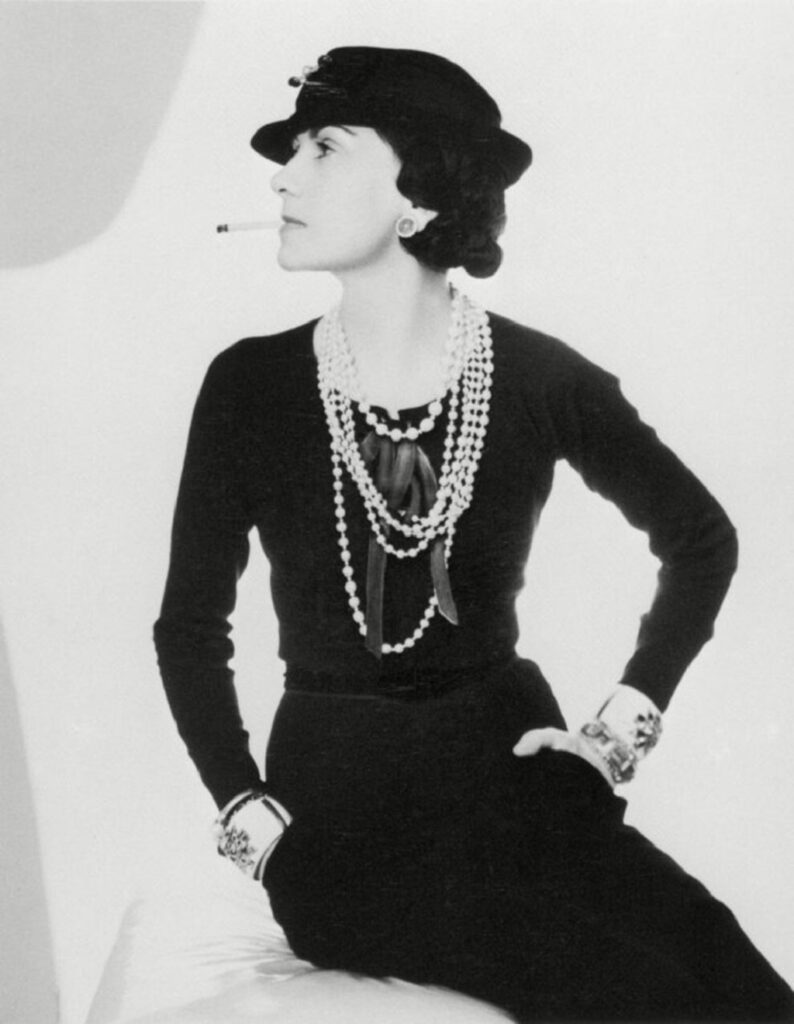
Gabrielle “Coco” Chanel in her little black dress. Fashion Illiteracy.
Furthermore, her own life shaped the design deeply. Chanel grew up in poverty and always gravitated toward restraint over extravagance. For her, less was never a compromise, but a choice. The result was revolutionary. The little black dress replaced ornate, corseted silhouettes with something clean, sharp, and quietly powerful. Every woman could wear it. Every woman could make it her own. Today, no wardrobe exists without one.
2. The Two-Tone Slingbacks (1957)
Among all the iconic Coco Chanel designs, this one has become one of the classiest in fashion history. Chanel introduced her two-tone slingbacks in 1957, and women never looked back. The design was characteristically clever. A beige body elongated the leg visually, while a dark, contrasting cap toe made the foot look smaller and more delicate. Together, the two elements created effortless elegance through pure logic. But the thinking went deeper than aesthetics. Chanel designed these shoes with movement in mind. She wanted women to walk freely and comfortably without sacrificing style.
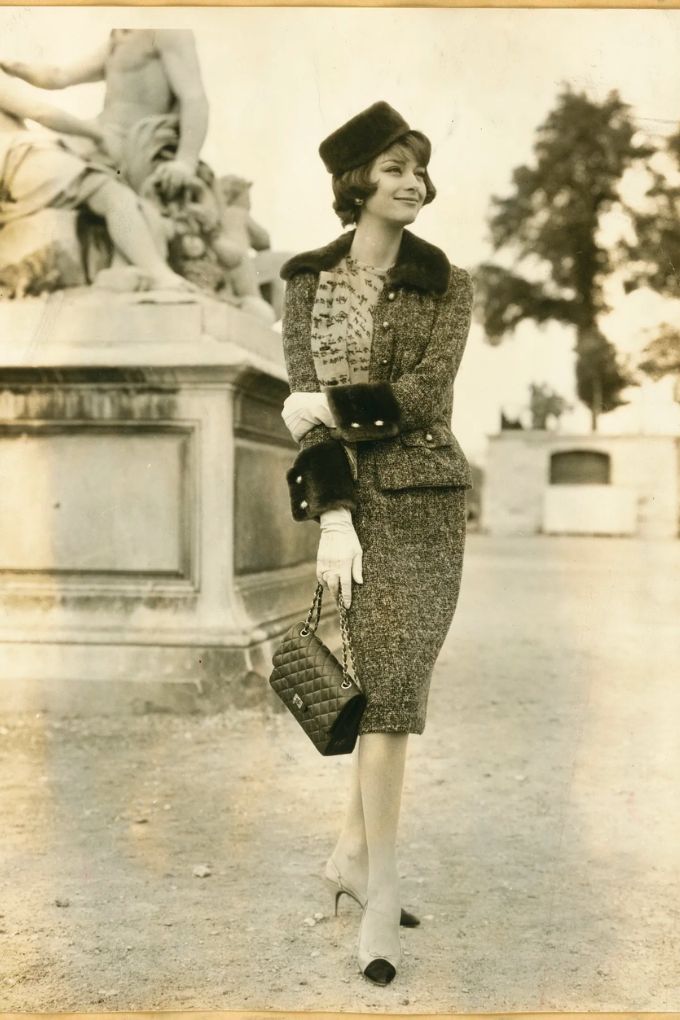
Marie-Hélène Arnaud wearing a tweed Chanel suit from the fall/winter 1959–1960 collection and the two-toned slingback shoes. Vogue Singapore.
At the time, this was a radical proposition. Most fashionable shoes prioritized appearance over function, leaving women teetering and uncomfortable. Chanel rejected that idea entirely. The slingback also solved a practical problem: the beige tone camouflaged scuffs and dirt far better than a solid dark shoe, while the dark toe cap disguised wear at the front. Form and function, as always with Chanel, worked hand in hand. Even today, the two-tone slingback remains one of the most recognizable and copied shoe designs in fashion history.
3. The Jersey Dress (1916)
In the 1910s, Chanel made a decision that shocked the fashion world. She picked up jersey fabric, a humble, stretchy knit previously reserved for men’s underwear and sportswear, and made it the foundation of women’s fashion. At the time, elegant women wore structured, stiff fabrics that shaped and constrained the body. Jersey did the opposite. It moved with the body and let it breathe. Chanel first experimented with jersey out of necessity, as wartime fabric shortages left her with limited options. Yet, she turned that limitation into a masterpiece.

Gabrielle “Coco” Chanel, Marinière blouse, 1916, Victoria and Albert Museum, London, UK.
In 1916, she presented a full jersey collection. The centerpiece was a simple, fluid jersey dress with a relaxed silhouette, easy to wear, and startlingly modern. The press was fascinated. Women finally felt liberated when it came to fashion. Suddenly, comfort and elegance were not opposites—they belonged together.
4. Costume Jewelery—The Long Pearl Necklace (1920s)
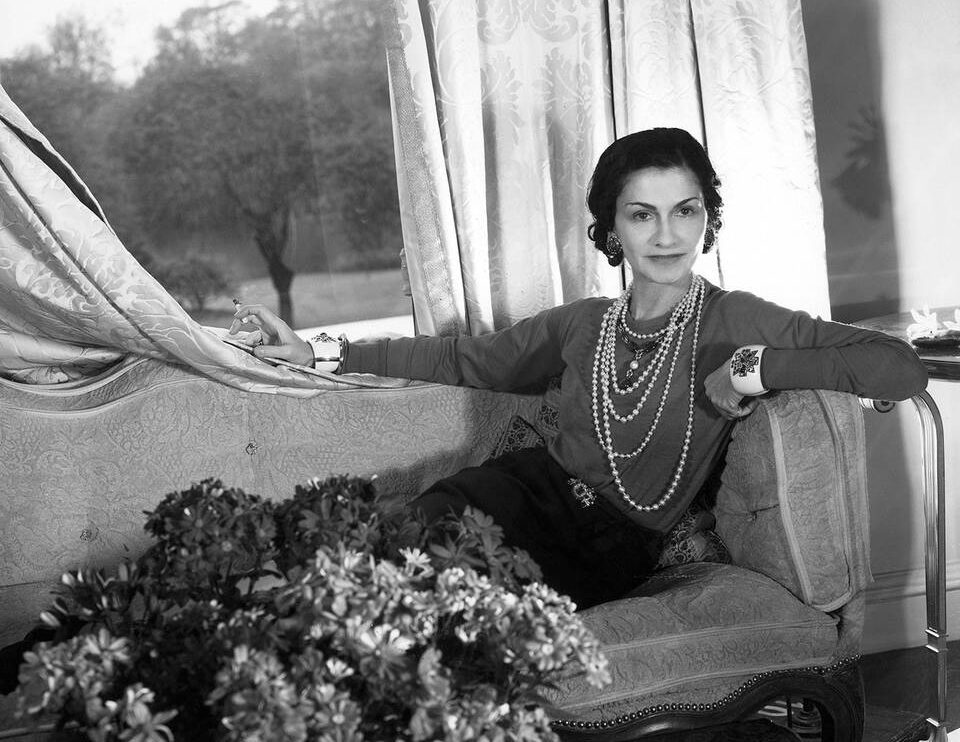
Coco Chanel wore pearls like other women breathe air; constantly, effortlessly, and in abundance. Her long, layered pearl necklaces became her signature look in the 1920s. But here was the scandal: they were fake. This was genuinely radical. At the time, a woman’s jewelry reflected her wealth and status. The gems and the gold had to be real, and anything less was shameful. Chanel disagreed completely. She found that jewelry should serve the outfit, not signal the bank account. Moreover, she believed that beautiful fakes worn with confidence outshone real gems worn out of obligation.
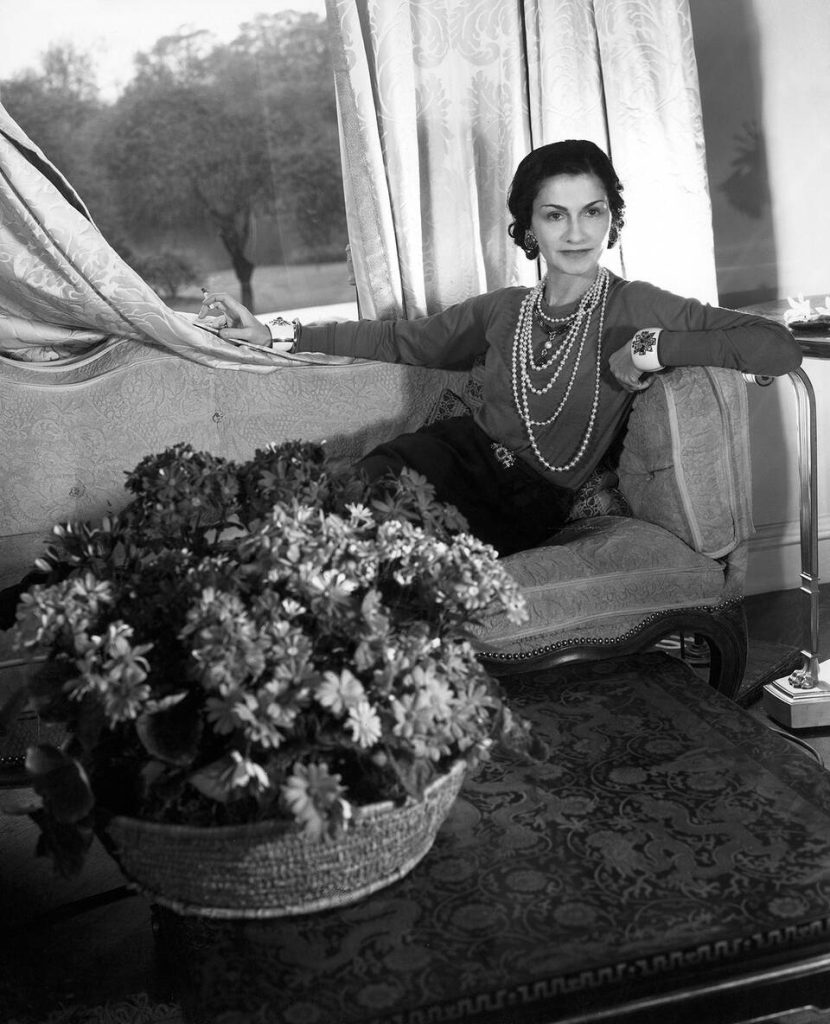
Gabrielle “Coco” Chanel wearing a string of pearl necklaces. Photograph by Cecil Beaton, 1937. V&A.
Her long pearl necklaces embodied this philosophy perfectly. Women could layer them, knot them, or let them fall loose. They worked with a jersey dress in the afternoon and a tweed suit in the evening. They were playful, versatile, and completely liberating. Soon, costume jewelry flooded the fashion world. Chunky chains, colored glass gems, and bold brooches all followed. Among all the iconic Coco Chanel designs, costume jewelry perhaps best captures her core belief: style was a state of mind, not a matter of money.
5. The Tweed Suit (1925, relaunched 1954)
Chanel borrowed tweed from the Scottish Highlands—and from men. She first encountered the fabric through her lover, Arthur Capel, a British polo player who wore it for sport and leisure. Chanel looked at that rough, practical fabric and was immediately inspired. Her first tweed suits appeared in the 1920s. However, it was her 1954 comeback collection that cemented the design as a true icon. Chanel returned to fashion after a 15-year absence, and the world was skeptical. Then she presented the tweed suit: a collarless jacket, clean lines, a slightly boxy silhouette, trimmed with braid, and paired with a matching skirt. While the haute couture world was divided, women were excited.
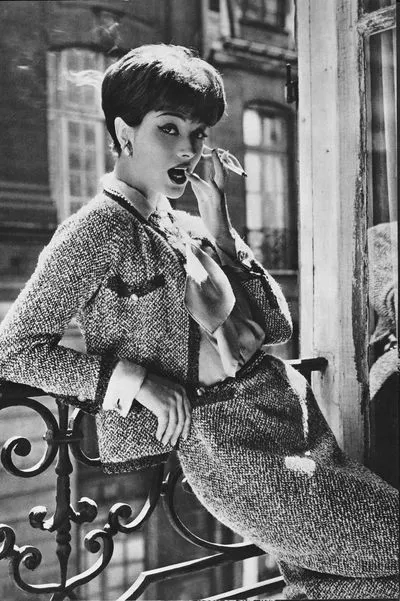
Marie-Hélène Arnaud wearing the revamped tweed suit, 1950s. Marie Claire.
The genius lay in the details. The jacket had no structure, no stiff interlining forcing the body into shape. Instead, it moved naturally with the wearer. Chanel even sewed a thin chain along the inside hem to keep it hanging perfectly. The pockets were real, a defining element for women’s fashion. Furthermore, the fabric itself told a story. Tweed was rugged, democratic, and unpretentious. In Chanel’s hands, it became the ultimate expression of effortless luxury.
6. The Marinière—The Blue and White Striped Shirt (1917)
In 1917, Coco Chanel introduced the marinière, a blue and white striped shirt borrowed directly from the uniforms of Normandy fishermen and naval workers. Nobody in women’s fashion had done anything like it before. Once again, Chanel raided the male wardrobe and came back with a timeless and iconic piece of clothing. However, she did not copy the design but, rather, she refined it. She softened the fabric, adjusted the proportions, and styled it with wide-leg trousers and espadrilles from the beaches of the French Riviera. The result felt effortlessly modern.
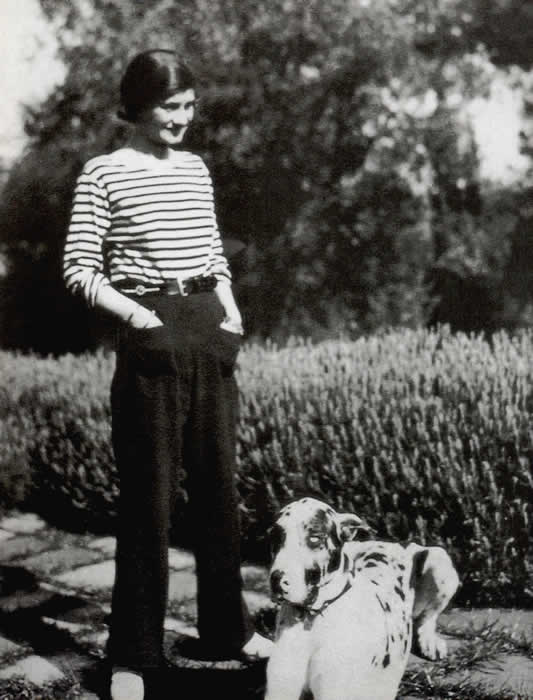
Gabrielle “Coco” Chanel poses in a sailor top in 1928. Wikimedia Commons (public domain).
Furthermore, the marinière arrived at a specific moment in history. World War I had upended everything, including fashion. Women needed practical, comfortable clothes. They had entered the workforce, moved through the world independently, and had no patience for fragile, ornate garments. The striped shirt answered all of those needs at once. It was sturdy, easy, and surprisingly chic. It also carried a deeper message, aligning with Chanel’s fashion philosophy: working-class clothes could be beautiful, and that true style had nothing to do with fussiness or expense.
7. Wide-Leg Trousers (1920s)
We already met them briefly—those wide-leg trousers Chanel paired with the marinière on the beaches of the French Riviera. That image was not accidental. Chanel spent her summers in Deauville and the Côte d’Azur, and the relaxed, sun-soaked atmosphere fed her creativity directly. The beach became her laboratory, and the wide-leg trouser was one of her boldest experiments.
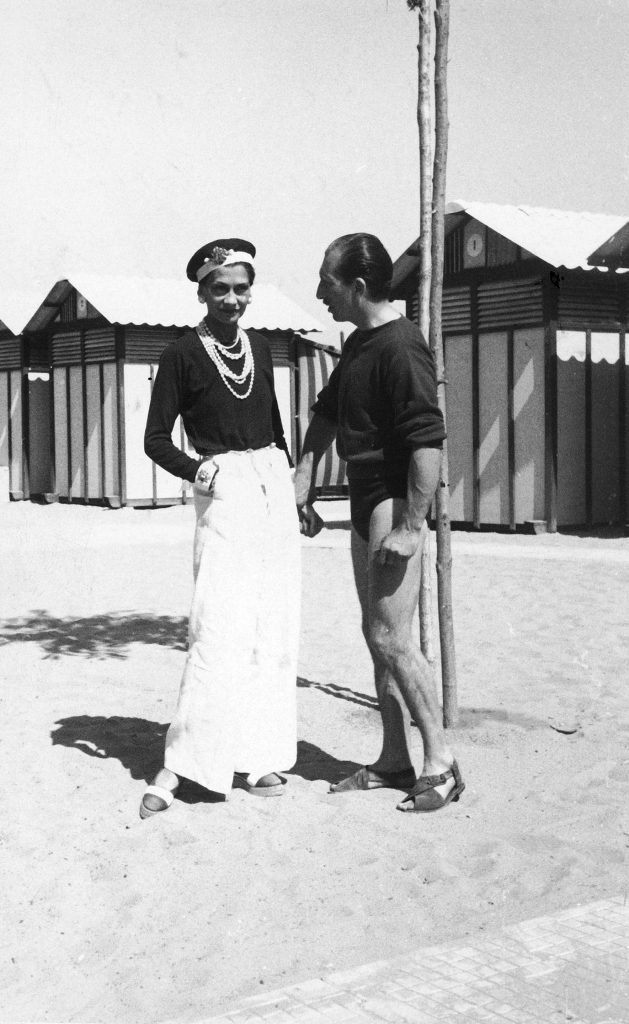
Gabrielle “Coco” Chanel wearing the wide-leg trousers while on vacation. CNN.
Putting women in trousers was a genuinely subversive act in the 1920s. Trousers belonged to men. A woman wearing them in a social setting risked ridicule, scandal, and being ignored by polite society entirely. Chanel ignored polite society right back. She wore her wide-leg palazzo-style trousers confidently and elegantly. Her circle of glamorous, modern friends followed.
What made the design so powerful was its attitude. These were not practical trousers borrowed out of necessity, as wartime women had done. These were a deliberate choice, a statement that women could dress for their own comfort and pleasure. The wide, flowing silhouette also played beautifully against the body. It was relaxed but refined, casual but deeply considered. Furthermore, paired with the marinière and espadrilles, it created one of fashion’s first truly modern resort looks, a uniform for the free, independent woman Chanel herself embodied.
8. The Cardigan Jacket Ensemble (1920s)
We already know that Chanel transformed jersey fabric into a legitimate fashion statement. Then, she took that philosophy one step further. From the same spirit of comfort and ease, she developed the cardigan jacket: a collarless, open-fronted knit jacket, often trimmed with braid, worn as part of a coordinated ensemble with a matching skirt.
Think of it as the softer, earlier cousin of the tweed suit. The instinct was the same: a jacket and skirt working together as a unified look. But where the tweed suit was structured and precise, the cardigan ensemble was relaxed and fluid. It borrowed openly from menswear knitwear, stripping away everything stiff and formal, and leaving only elegance behind.
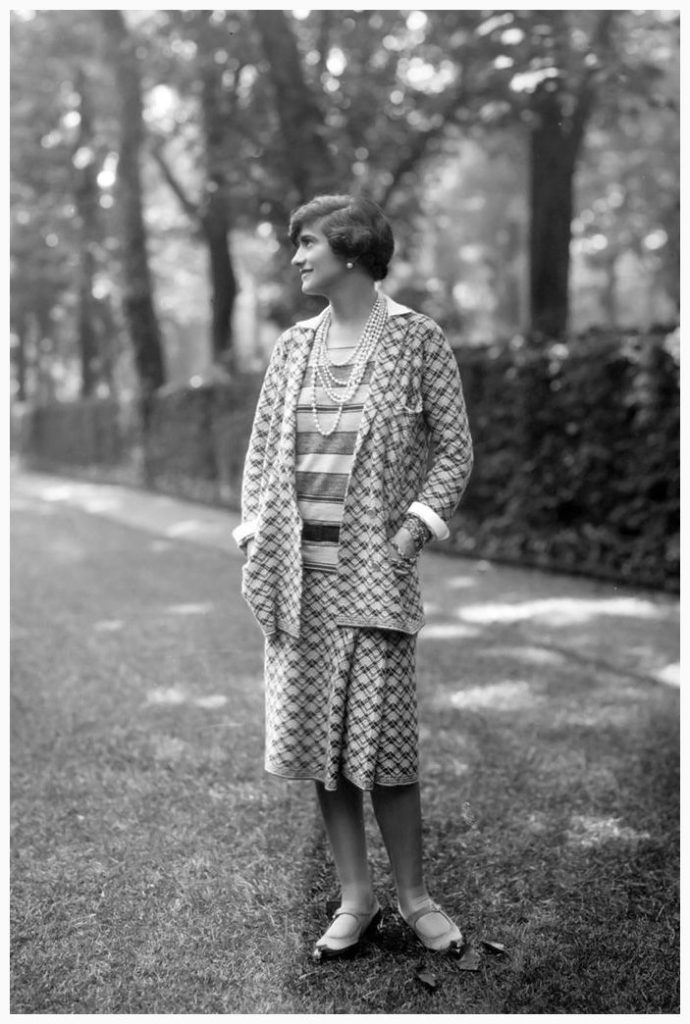
Gabrielle “Coco” Chanel wearing one of her suits in Paris, France. Elle.
The cardigan jacket solved a problem women did not yet know how to name. They wanted to look put-together without feeling imprisoned. They wanted clothes that moved with them through a full day, from morning errands to afternoon visits to evening gatherings. The cardigan ensemble did exactly that. Moreover, it introduced the idea of the coordinated knit set, a concept so enduring that it still dominates wardrobes today. Among all the iconic Coco Chanel designs, the cardigan ensemble is perhaps the least celebrated. Yet without it, the tweed suit might never have existed.
9. The 2.55 Bag (February 1955)
The name says everything. Chanel introduced this bag in February 1955, and so she called it the 2.55. The date alone tells you how deliberately she thought about this design. Nothing about the 2.55 was accidental.
Before this bag, women carried handbags in the crook of their arms or clutched them in their hands. Chanel found this absurd. Her hands were busy. She had things to do, places to go, and no patience for a bag that demanded to be held. So she added a chain strap, the first of its kind in luxury fashion, and slung it over her shoulder. A simple, logical, yet revolutionary change.
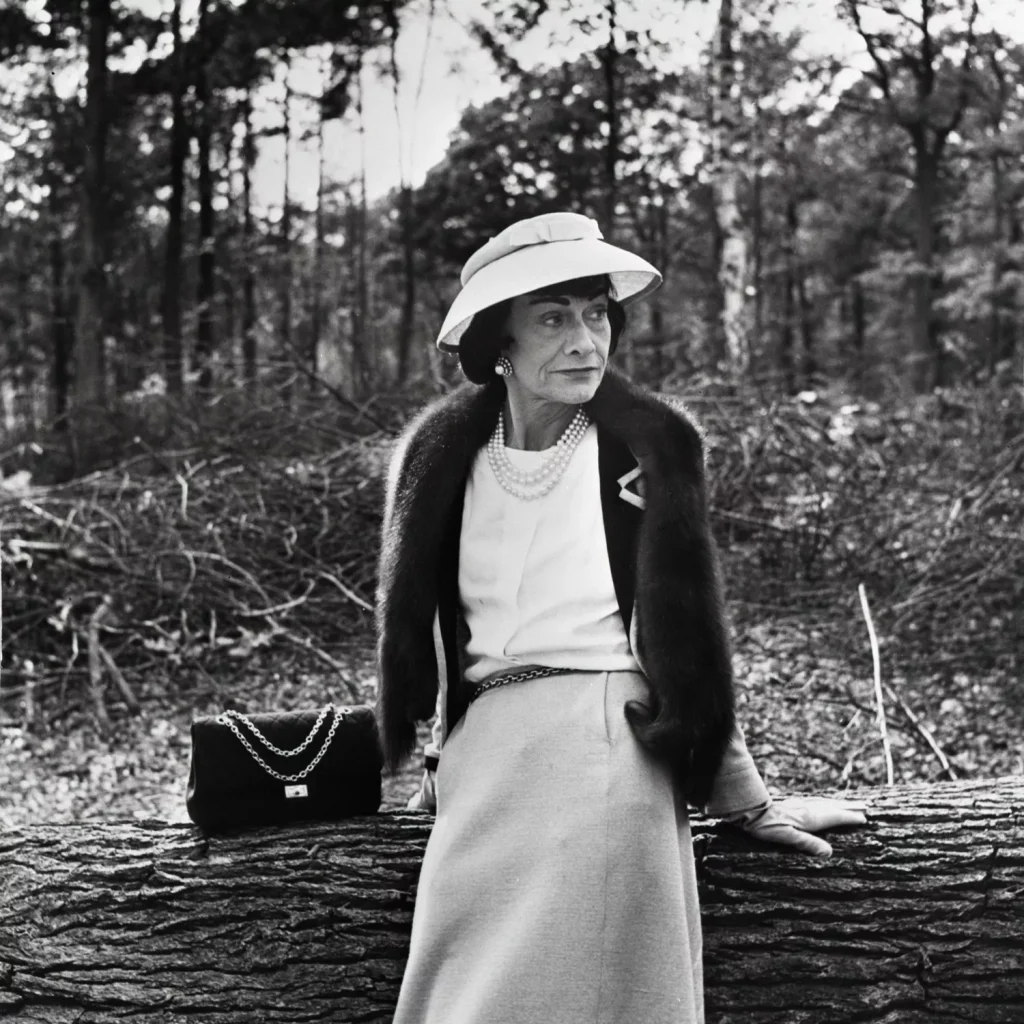
Gabrielle “Coco” Chanel with the 2.55 bag, 1957. Vogue Scandinavia.
But the genius of the 2.55 lived in its details. The burgundy interior lining referenced Chanel’s childhood at the Aubazine orphanage. The rectangular lipstick case tucked inside the back pocket reflected her practicality. The front pocket, meanwhile, kept her love letters (or so the story goes). The double-C logo lock was added later by Karl Lagerfeld. Chanel’s original closure was a simple rectangular clasp she called the Mademoiselle lock. Every detail of the 2.55 told a personal story. Together, they created one of the most iconic Coco Chanel designs ever made: a bag that transformed how women moved through the world, one shoulder strap at a time.
10. The Camellia (1920s)
Coco Chanel chose the camellia as her signature motif early in her career and never let it go. The flower first caught her attention through her love of Alexandre Dumas’ novel The Lady of the Camellias. Its heroine wore white camellias when she was available and red ones when she was not. Chanel loved that quiet, subversive symbolism. She made the white camellia her own.
From the 1920s onward, fabric camellias appeared everywhere in her work. She pinned them to jacket lapels, sewed them onto shoes, attached them to handbags, and wore them in her hair. Unlike real flowers, the fabric camellia never wilted. It was permanent, precise, and endlessly versatile. These three qualities perfectly described Chanel herself after all.
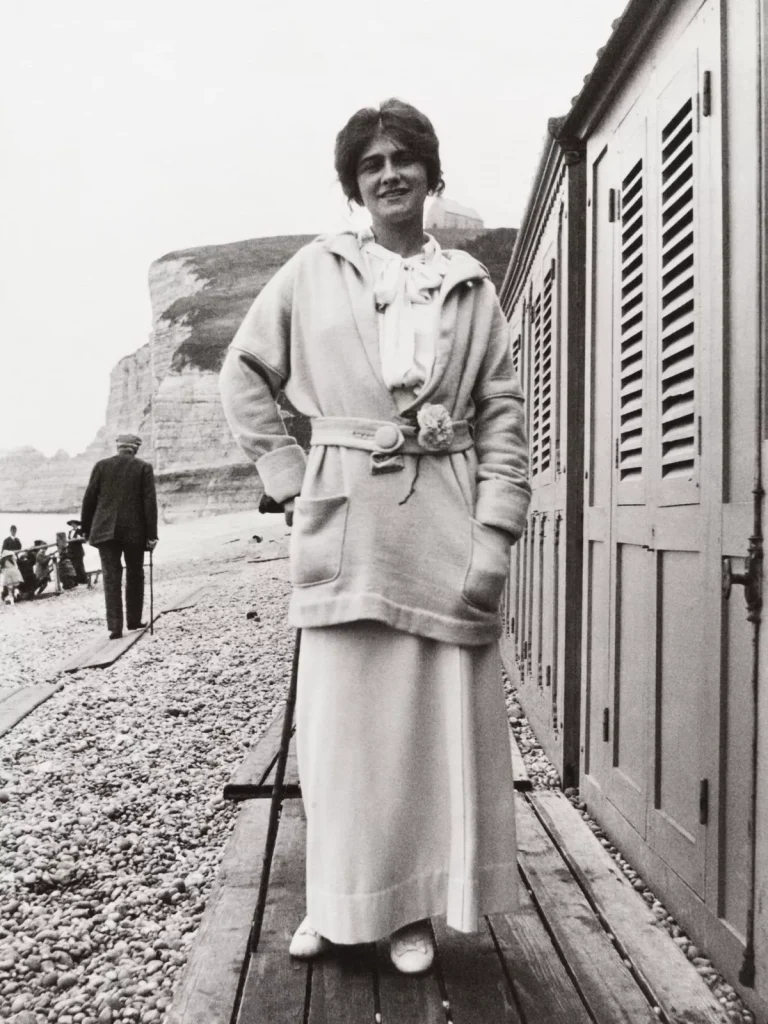
Gabrielle “Coco” Chanel wearing a camellia pin on the beach at Étretat, France, ca. 1913. Vogue Scandinavia.
The design of the camellia was characteristically restrained. No elaborate petals, no dramatic colors. Just clean, concentric layers of white fabric, folded and shaped into something quietly perfect. It asked for attention without demanding it. Furthermore, the camellia carried a deeper meaning in Chanel’s hands. She had always gravitated toward flowers without fragrance, such as the camellias, because she believed a woman’s perfume should come from her bottle, not her clothes. Today, the camellia remains the symbol of the House of Chanel.