Masterpiece Story: The Setting of the Sun by François Boucher
With sweet putti, handsome gods, beautiful nymphs, vibrant colors, and elaborate compositions, The Setting of the Sun is a testimony to François...
James W Singer 8 February 2026
13 October 2025 min Read

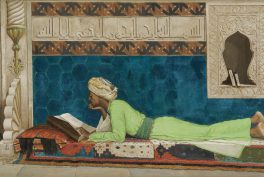
Osman Hamdi Bey, The Tortoise Trainer, 1906, Pera Museum, Istanbul, Turkey. Wikimedia Commons (public domain). Detail.
Osman Hamdi Bey’s The Tortoise Trainer shows an elderly man patiently working with a group of turtles. Drawing on his time in Paris and his interest in education and culture, Hamdi Bey created a work that’s both realistic and thought-provoking. It remains one of his most recognized and discussed paintings.
The Tortoise Trainer was created in 1906 by Osman Hamdi Bey (1842–1910). Influenced by his legal studies and extended stay in Paris during his artistic training, he drew inspiration from the academic salon painting style prevalent there, known for its historical and allegorical subjects, large formats, and heightened realism.

Osman Hamdi Bey. Wikimedia Commons (public domain).
As a museum founder, archaeologist, and art educator, Hamdi Bey created works that reflected his vision of a culturally enlightened and identity-shaping Ottoman state. His art was presumably never purely decorative or mythological like that of many salon painters of his time, but arguably carried a strong civilizational and educational message.

Osman Hamdi Bey, The Tortoise Trainer, 1906, Pera Museum, Istanbul, Turkey. Wikimedia Commons (public domain).
The painting was first exhibited in 1906 at a Parisian Salon. Later, Hamdi Bey produced variations of the motif, including a 1907 version dedicated to his late father-in-law. It wasn’t until two years after his death that the painting received public attention in the Ottoman Empire, when it was published as a black-and-white print in the journal Osmanlı Ressamlar Cemiyeti Gazetesi.

Osman Hamdi Bey, The Tortoise Trainer, 1906, Pera Museum, Istanbul, Turkey. Wikimedia Commons (public domain). Detail.
Osman Hamdi Bey did not see himself as a politician but as a cultural reformer. The elderly man with the ney flute, hands clasped behind his back, leaning over docile turtles, is often seen as a self-portrait—a scholar patiently attempting to inspire a hesitant and divided society through art and education. This interpretation is supported by art historian Wendy M. K. Shaw and by texts from the Pera Museum in Istanbul, where the work is housed today.
However, historical certainty remains elusive. Some historians, such as Edhem Eldem, argue that Osman Hamdi Bey himself never claimed an allegorical meaning—the metaphor of training or education emerged only posthumously.

Osman Hamdi Bey, The Tortoise Trainer, 1906, Pera Museum, Istanbul, Turkey. Wikimedia Commons (public domain). Detail.
In the politically polarized years following the Ottoman era, the painting was received differently by traditionalists and Kemalists. Some viewed the central figure as a metaphor for the state, attempting—like the trainer—to educate a resistant population. Others saw it as a critique of the Ottoman system’s inertia, incapable of accelerating progress. Both readings, however, go beyond the artist’s likely intent.
The painting’s current popularity is closely tied to its market value. In 1990, it was acquired by businessman Erol Aksoy for $700,000. In 2004, it was resold for $3.5 million, becoming at that time the highest price ever achieved for a painting of Turkish origin, purchased by the Suna and İnan Kıraç Foundation.
Whether or not any constitutional meaning was intended, his cultural sensitivity consistently revealed itself through his advocacy for artistic and archaeological education. There is no denying that Osman Hamdi Bey understood the Ottoman zeitgeist and distilled it through his most celebrated artwork.
Author’s bio:
Merlin Geller is a writer/artist based in Southern Germany. He always found himself deeply inspired by paintings and their implications. Using them to enrich his poems and short stories by exhibiting philosophical rigor. His first major novella is currently in the process of publication.
Get your daily dose of art
Click and follow us on Google News to stay updated all the time

DailyArt Magazine needs your support. Every contribution, however big or small, is very valuable for our future. Thanks to it, we will be able to sustain and grow the Magazine. Thank you for your help!

This is our guest profile for occasional authors. If you have an interesting story about art to tell, send it to our Editor-in-chief Kate at [email protected]. You might be the next here!

An admirer of antiquity, art, and architecture. An avid reader and amateur photographer. Always curious, always on an adventure.
With sweet putti, handsome gods, beautiful nymphs, vibrant colors, and elaborate compositions, The Setting of the Sun is a testimony to François...
James W Singer 8 February 2026
Among the Sierra Nevada, California, by Albert Bierstadt, is a majestic mountainous landscape filled with wild beauty and blissful idealism. Its...
James W Singer 25 January 2026
The Cardsharps is an early masterpiece of Baroque art by Caravaggio that explores the revolutionary theme of crooked card playing. Let’s delve...
James W Singer 11 January 2026
As Europe burned during WWII, Wassily Kandinsky, who had fled Nazi Germany in 1933, lived as a recluse in his Neuilly-sur-Seine apartment. In that...
Javier Abel Miguel 8 January 2026