

The Story of Dogs (and Humans!) in 10 Paintings
One cannot, while hoping to make a very valid argument, say dogs and humans are anything but almost entirely alike. After all, they share the same...
Guest Author 30 April 2026
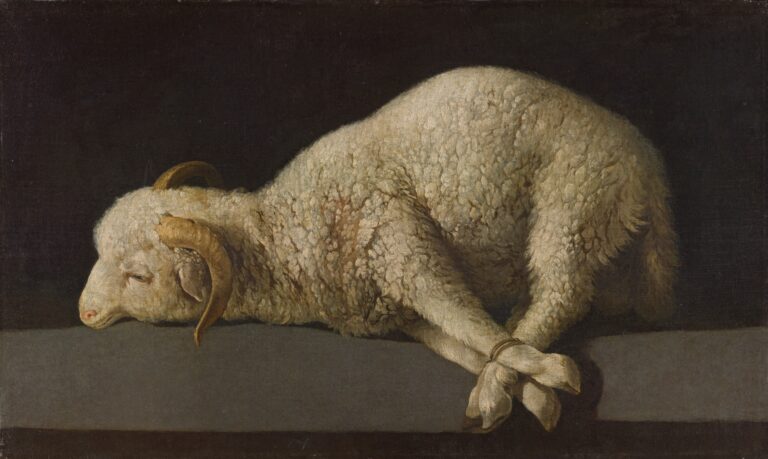
Francisco de Zurbarán, Agnus Dei (Lamb of God), 1635–1640, Museo del Prado, Madrid, Spain.
The lamb serves as an enduring and multifaceted symbol that connects ancient pre-Christian ritual with the long history of Christian art. Throughout the Bible, it has been a deeply symbolic figure, serving as a metaphor for believers and for Christ himself. This iconography holds a position of high significance within the Catholic Church, with a visual journey that spans from the clandestine paintings in Roman catacombs to the grand, detailed altarpieces of the Northern Renaissance.
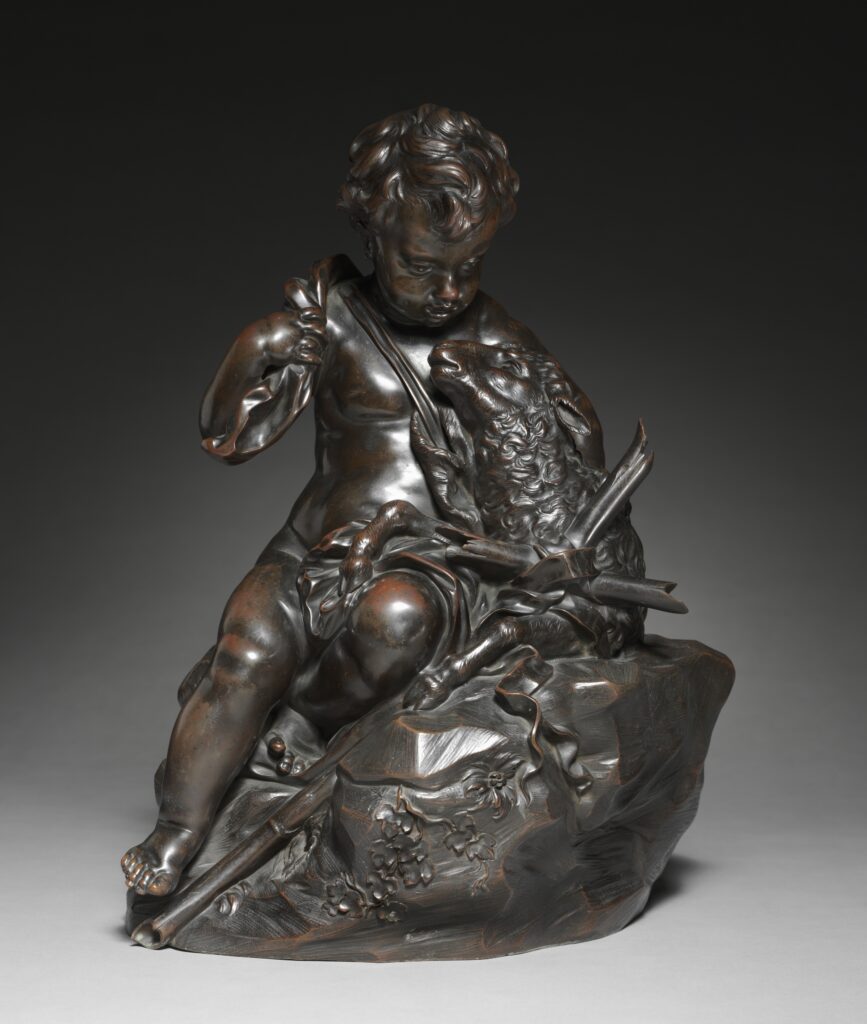
Attributed to Giuseppe Piamontini, Young Saint John and the Lamb, ca. 1680–1700, Cleveland Museum of Art, Cleveland, OH, USA.
The iconography of the lamb in art is a direct depiction of Jesus Christ. This connection is rooted in the Gospel of John, where John the Baptist sees Jesus and declares, “Behold, the Lamb of God, who takes away the sin of the world.” Known in Latin as the Agnus Dei, this title transformed the lamb from a mere animal into a divine persona.
In early centuries, before artists were comfortable depicting the human form of Christ on the cross, the lamb served as a dignified substitute. To distinguish the Agnus Dei from common livestock, artists often gave the lamb a cruciform nimbus, which is a halo containing a cross, or they depicted the lamb in a place of prestige and relevance within the composition.
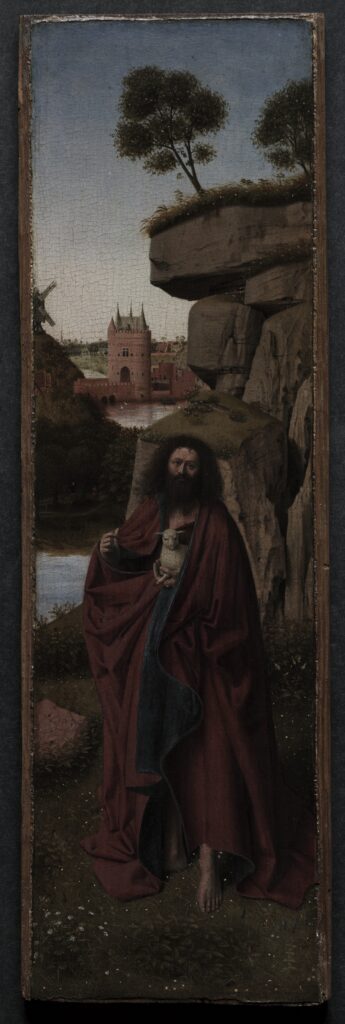
Attributed to Petrus Christus, Saint John the Baptist in a Landscape, ca. 1445, Cleveland Museum of Art, Cleveland, OH, USA.
The concept of the sacrificial lamb predates Christianity, finding its origins in the Jewish Passover. In the Old Testament, the blood of an unblemished lamb was used to protect the Israelites from the plague of death in Egypt. Christian art often pairs these Old Testament scenes of sacrifice with the Crucifixion to show that the “Old Law” has been fulfilled by Christ.
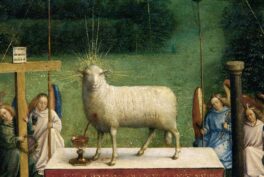
In many church paintings, a lamb is shown standing on an altar with blood flowing from its chest into a chalice. This visual representation of the Eucharist signifies Christ’s sacrifice, offering spiritual nourishment through bread and wine. This is still honored through the Holy Communion ritual, which allows adherents to partake in the body and blood of Jesus, strengthening the faith and unity of the congregation.
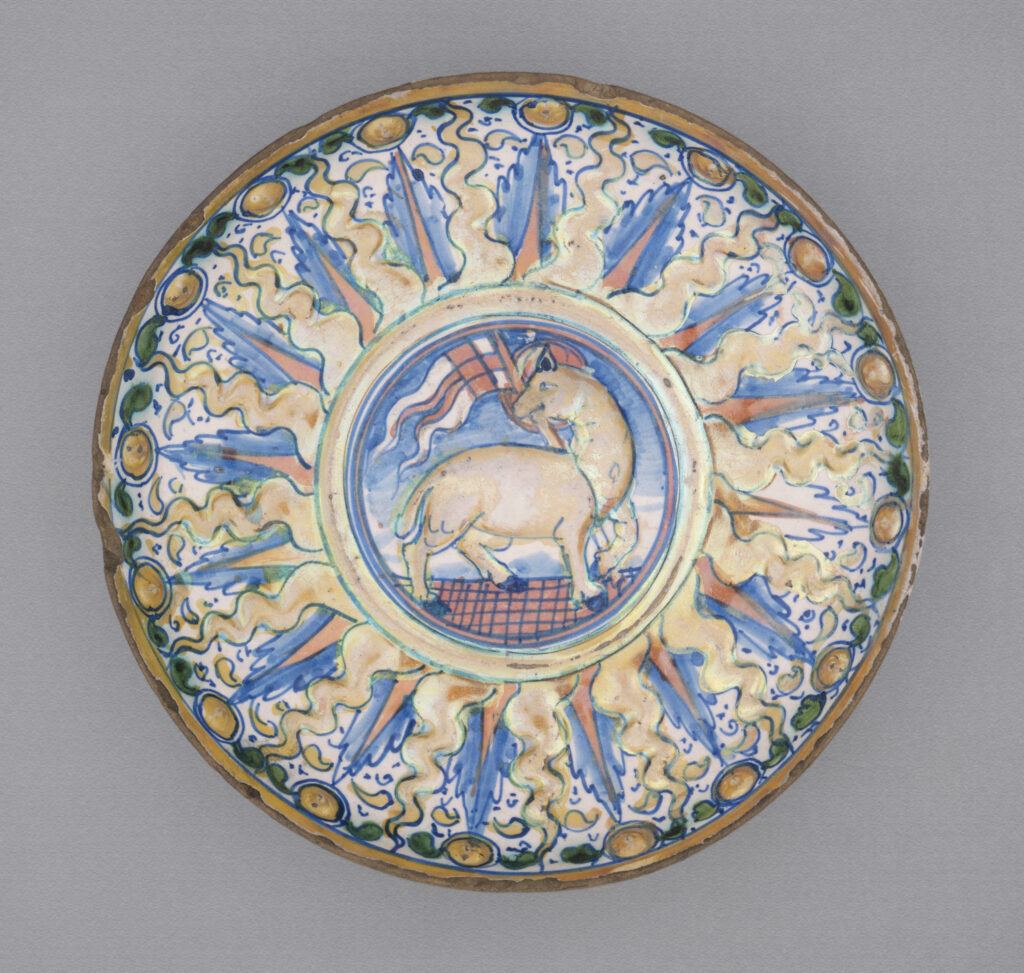
Footed dish with the Agnus Dei (Lamb of God), Italy, Gubbio, ca. 1530, Los Angeles County Museum of Art, Los Angeles, CA, USA.
Beyond the themes of sacrifice, the lamb is a common symbol of gentleness that is used to illustrate the character of Christ and his followers. Since Biblical law required a sacrificial lamb to be unblemished, artists usually depict the animal with pristine white wool to symbolize Christ’s moral perfection as well as his humility.
In many mosaics, a central lamb is surrounded by twelve smaller lambs, representing the twelve apostles and emphasizing that believers are expected to mirror the lamb’s virtue.
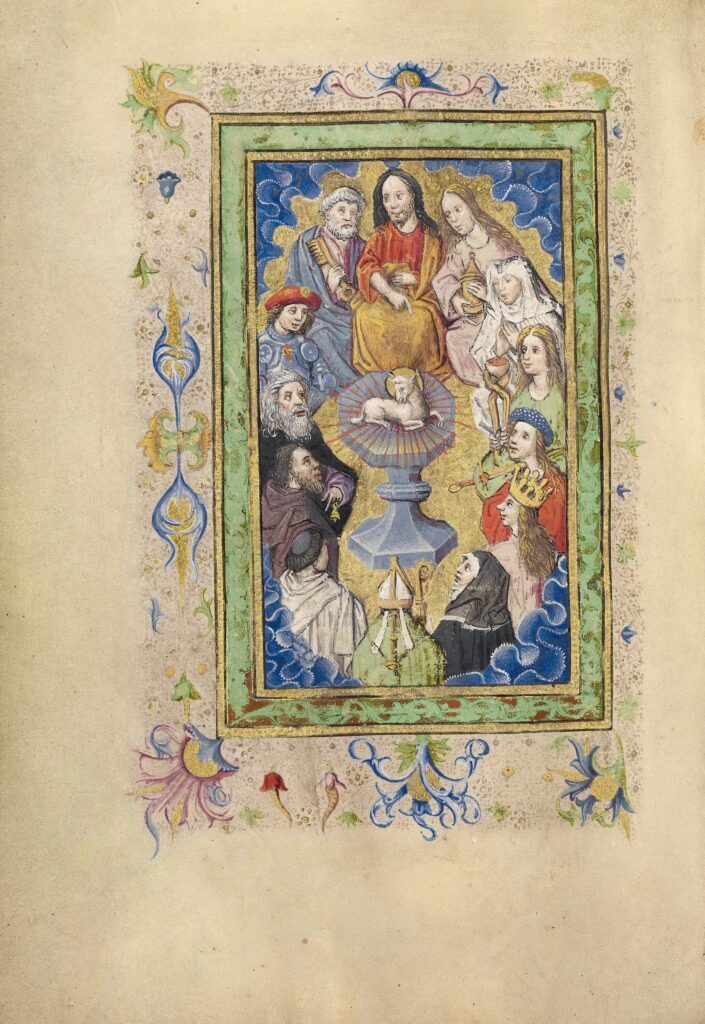
The Lamb of God with Saints in Book of Hours, after 1460, Getty Museum, Los Angeles, CA, USA.
One of the most striking uses of lamb imagery comes from the Book of Revelation. Here, the lamb is no longer just a victim but is depicted as a victor. Jesus Christ is presented as a central image representing victory through a paradoxical sacrificial death. Often depicted holding a vexillum or a flag of victory and resurrection, the lamb is portrayed as “slain yet standing.”
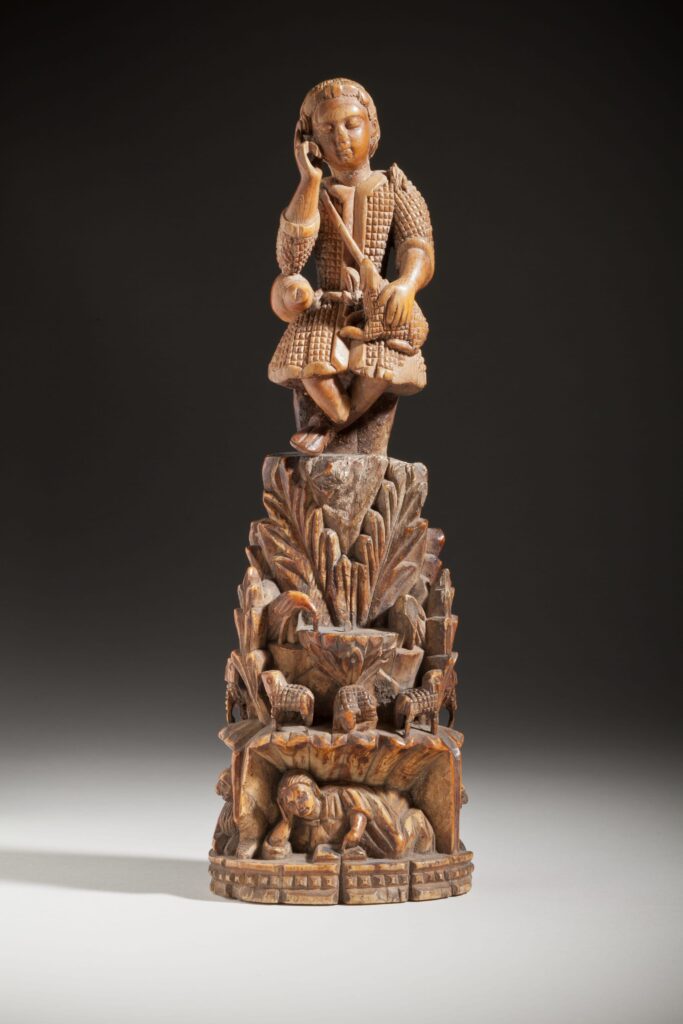
Christ the Good Shepherd, Goa, India, ca. 17th century, Los Angeles County Museum of Art, Los Angeles, CA, USA.
While the sacrificial lamb focuses on Christ’s death, the Good Shepherd focuses on his life and his mercy for his followers. In the early days of Christian art, particularly in the 2nd and 3rd centuries, the Good Shepherd was the most common way to represent Jesus. These images depict a young man carrying a lamb across his shoulders to evoke the parable of the lost sheep, highlighting God’s role as a shepherd to those in need of direction or protection, or to those who had been led astray.
For early Christians living under the threat of Roman persecution, this image provided immense comfort, symbolizing that their souls were safe in the hands of a benevolent protector.
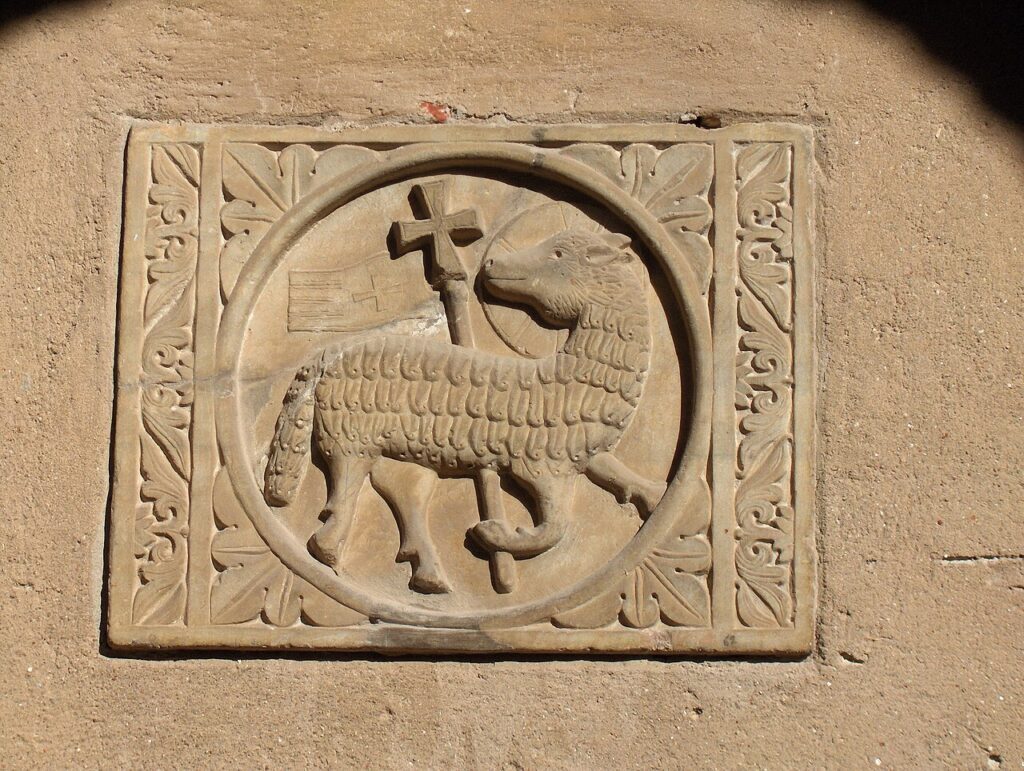
Agnus Dei with halo and cross, St. Euphrasius Basilica, Poreč, Croatia. Photograph by Georges Jansoone via Wikimedia Commons (CC BY-SA 4.0).
The symbolism of the lamb features frequently in Christian religious architecture. Since the lamb represents the path to salvation, its image is frequently carved above church entrances or the altar. It is also a common motif in areas where baptism occurs, as the sacrament washes away sin and welcomes the adherent into the kingdom of heaven. In this context, the lamb is revered as the bearer of sin, whose purity facilitates the believer’s spiritual rebirth.
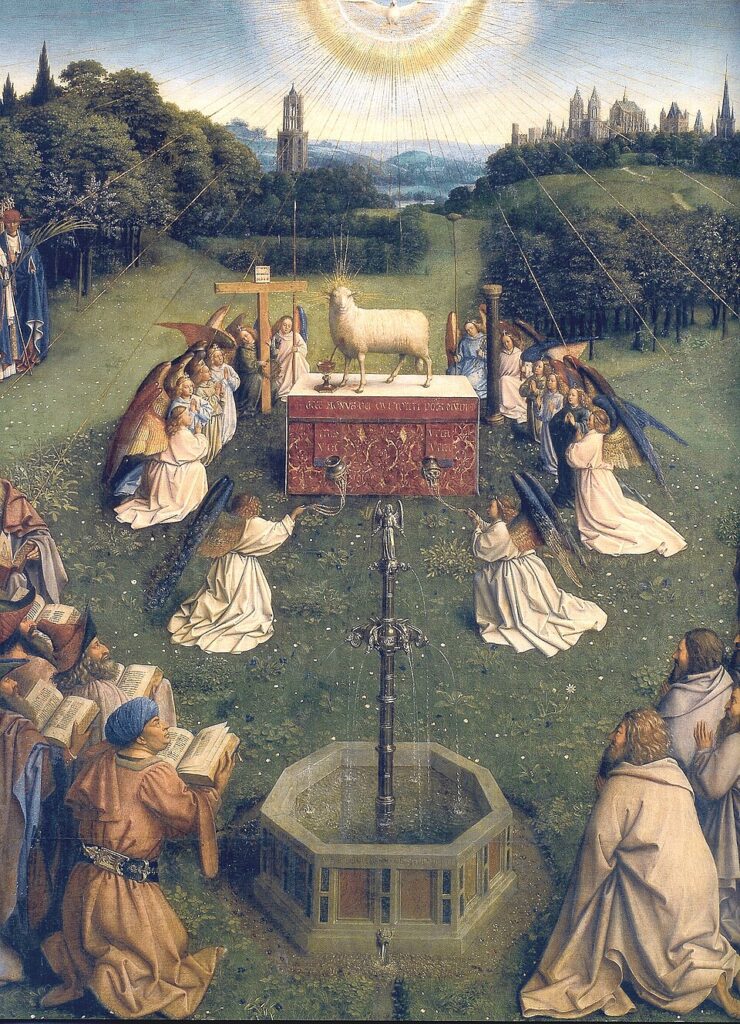
Jan van Eyck, Hubert van Eyck, Ghent Altarpiece, 1432, St. Bavo’s Cathedral, Ghent, Belgium. Wikimedia Commons (public domain). Detail of central panel.
Whether depicted as a vulnerable creature subject to sacrifice, on a shepherd’s shoulders, or even as a majestic figure on a heavenly throne, the lamb remains a powerful symbol of the Christian faith. It highlights the spiritual journey beginning in a humble stable, enduring through the violence of sacrifice, and ending in an eternal victory of the soul.
Get your daily dose of art
Click and follow us on Google News to stay updated all the time

DailyArt Magazine needs your support. Every contribution, however big or small, is very valuable for our future. Thanks to it, we will be able to sustain and grow the Magazine. Thank you for your help!

Maya Tola is a Dallas-based attorney, with a zest for art history. A time traveler at heart, Maya often finds herself consumed in the contemplation of life in antiquity. She has been sharing her infectious enthusiasm for art and history since 2018 through her posts and articles for the DailyArt App and DailyArt Magazine. When she's not working or writing, you'll find Maya obsessing over plants, animals, and food (in no particular order).

Univ. of New Orleans, Fine Arts and History; Fine Artist, Professional Graphic Designer, Art Historian, Historian, Musician, worked at the New Orleans Museum of Art and MS Museum of Art; learning enthusiast!
One cannot, while hoping to make a very valid argument, say dogs and humans are anything but almost entirely alike. After all, they share the same...
Guest Author 30 April 2026
Owls have captured the attention of artists since art began. Their knowing eyes, nocturnal wonderings, and global ubiquity have made them symbols of...
Theodore Carter 23 April 2026
There’s nothing like the bond between a passionate creator and their loyal four-legged friend. Let’s explore the heartwarming...
Jimena Aullet 10 February 2025
Unicorns, the enchanting and mythical beings, have been a captivating subject in art since ancient times, maintaining their inspirational allure for...
Ela Bobek 16 January 2026