



Halloween Monsters: What Our Fears Reveal About Society
Halloween monsters have long served as mirrors of human fear and imagination. From vampires and witches to zombies and digital phantoms, they reveal...
Errika Gerakiti 30 October 2025
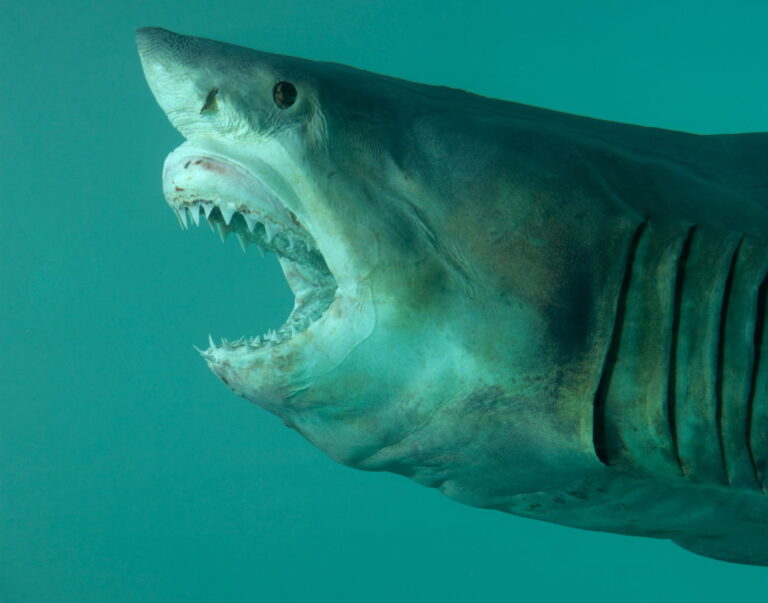
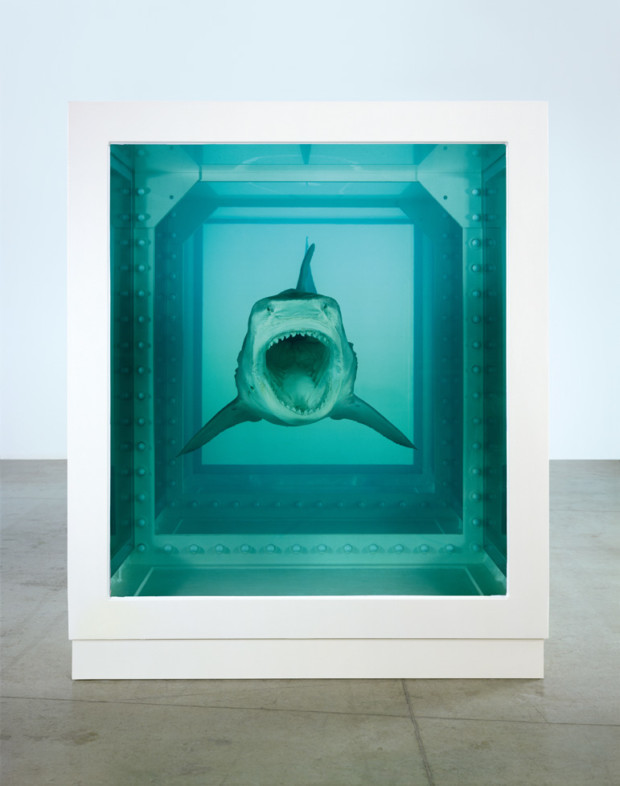
Damien Hirst, The Physical Impossibility of Death in the Mind of Someone Living, 1991. Artsper. Detail.
This shark is considered the iconic work of British art from the 1990s and has become a symbol of Britart worldwide. It was funded by Charles Saatchi who in 1991 offered to pay for whatever artwork the artist wanted to create. The shark itself cost Damien Hirst £6,000 and the total cost of the work was £50,000. In 2004 it was sold to Steven A. Cohen for an undisclosed amount, widely reported to have been $8 million but possibly up to $12 million. The shark was caught off Hervey Bay in Queensland, Australia, by a fisherman commissioned to do so. It was supposed to be something “big enough to eat you.”
Its technical specifications are: Tiger shark, glass, steel, 5% formaldehyde solution, 213 x 518 x 213 cm.
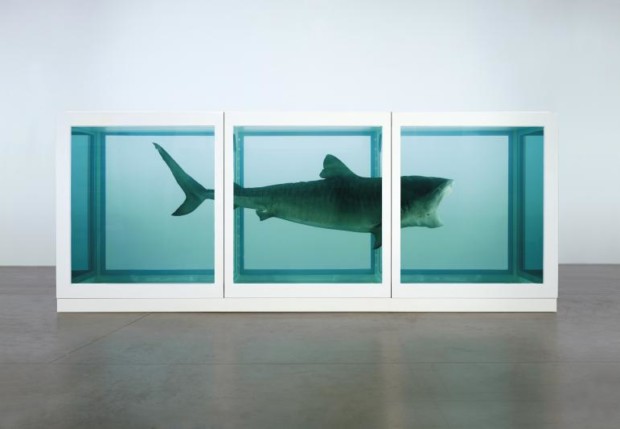
Created in 1991 by Damien Hirst, entitled The Physical Impossibility of Death in the Mind of Someone Living is an artwork that consists of a tiger shark preserved in formaldehyde in a vitrine.
Since the shark was initially preserved poorly, it began to deteriorate and the surrounding liquid grew murky. Hirst attributes some of the decay to the fact that the Saatchi Gallery added bleach to it. In 1993 the gallery gutted the shark and stretched its skin over a fiberglass mold, and Hirst commented:
It didn’t look as frightening … You could tell it wasn’t real. It had no weight.
Damien Hirst in: Swimming with Famous Dead Sharks, Carol Vogel, The New York Times, 2006.
When Hirst learned of Saatchi’s impending sale of the work to Cohen, he offered to replace the shark, an operation which Cohen then funded, calling the expense “inconsequential” (the formaldehyde process alone cost around $100,000).
As he said then:
I frequently work on things after a collector has them, I recently called a collector who owns a fly painting because I didn’t like the way it looked, so I changed it slightly.’
Damien Hirst in: Swimming with Famous Dead Sharks, Carol Vogel, The New York Times, 2006.
Another shark was caught off Queensland and shipped to Hirst in a 2-month-long journey. Oliver Crimmen, a scientist and fish curator at London’s Natural History Museum, assisted with the preservation of the new specimen in 2006. This involved injecting formaldehyde into the body, as well as soaking it for two weeks in a bath of 7% formalin solution. The original 1991 vitrine was then used to house it.
So, what is the shark about?
It is completely isolated from its natural setting. Instead of being in motion, in the water, we see it completely frozen and preserved. For most, it may be the first time we have come so close to a shark, with many of us only seeing them on television or perhaps at an aquarium. Here we have a direct experience of the shark, not filtered through any media. Thus we are forced to consider the shark in a new and different context and re-evaluate how we perceive the animal. In Hirst’s piece, we come face to face with the reality and physicality of this familiar image and are forced to consider it in a new setting.
DailyArt Magazine needs your support. Every contribution, however big or small, is very valuable for our future. Thanks to it, we will be able to sustain and grow the Magazine. Thank you for your help!

Art Historian, founder and CEO of DailyArtMagazine.com and DailyArt mobile app. But to be honest, her greatest accomplishment is being the owner of Pimpek the Cat.
Halloween monsters have long served as mirrors of human fear and imagination. From vampires and witches to zombies and digital phantoms, they reveal...
Errika Gerakiti 30 October 2025
When you picture Halloween, a flood of familiar images rushes in: glowing jack-o’-lanterns, fluttering bats, skeletons, and black cats. But the...
Errika Gerakiti 31 October 2025
Marian Henel’s tapestries are huge. The largest one measures over 6 m in length and 3 m in width (19 ft. 8 in. by 9 ft. 10 in.). Created in the...
Zuzanna Stańska 22 May 2026
Los Caprichos are some of the most disturbing of Francisco Goya’s works. A sharp critique of society and its values, there are plenty of monsters...
Edoardo Cesarino 31 October 2024