
Fanny Eaton—Pre-Raphaelite Muse from Jamaica
Fanny Eaton was a regular model for the Pre-Raphaelites during the 1860s and features in a number of famous works. Yet for most of the last century,...
Catriona Miller 19 February 2026
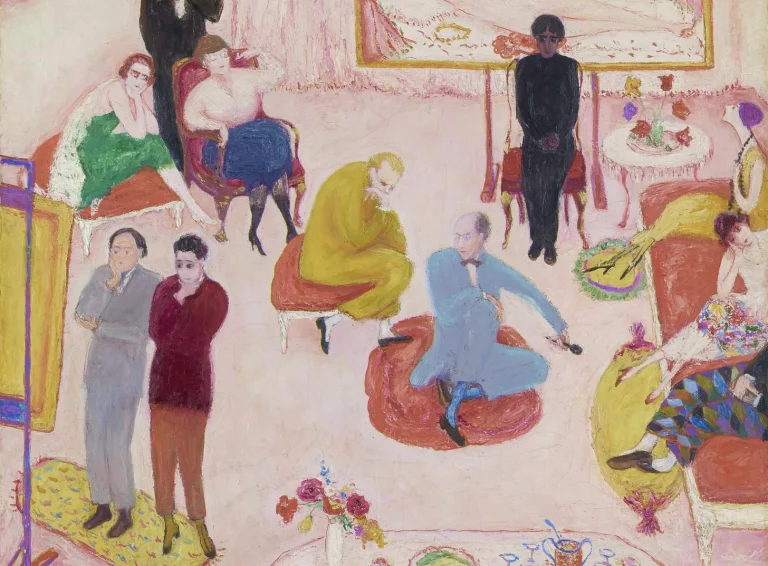
Florine Stettheimer, Studio Party (Soirée), 1917–1919, Yale University Art Gallery, New Haven, CT, USA. Detail.
Florine Stettheimer (1871–1944) was an American painter, designer, and poet, as well as a prominent member of New York City’s high society from the 1910s until her death. She was a modernist artist who frequently hosted salons for other artists, writers, and wealthy patrons in New York. Visitors to these lavish meetups included Marcel Duchamp, Georgia O’Keeffe, and Charles Demuth. Stettheimer often presented her artwork at these salons, preferring to exhibit it to her peers rather than sell it. She could afford to be skeptical of art dealers, as she was born to an affluent German-Jewish New York family. Privileged from the start, her artistic journey began on family travels in Europe.
After Stettheimer returned to New York in the 1910s, her artistic pursuits evolved into a distinct personal style. Her paintings are characterized by an almost experimental verve of Fauvist color, uneven perspectives, and sleek figures in a celebratory yet sardonic collage of myriad subjects. They put into focus, perhaps more so than any other painter’s work, the aesthetic of the Jazz Age—the Roaring Twenties. They would seem entirely at home in the Art Deco apartments, department store settings, and sensational newspaper headline montages riddled throughout Hollywood films of the 1930s.
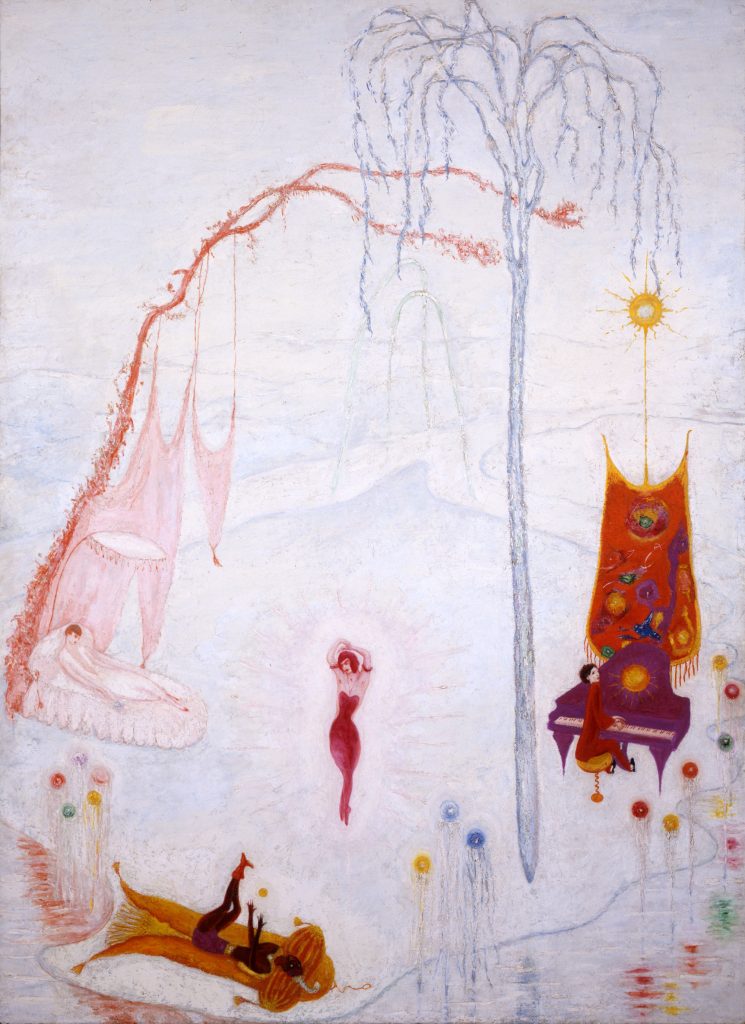
Florine Stettheimer, Music, 1920, Rose Art Museum, Brandeis University, Waltham, MA, USA.
Like most of Stettheimer’s paintings, Music portrays real people as sleek, elongated figures. Vaclav Nijinsky, a ballet dancer, is the seemingly centrifugal force of this composition. The curvature of her body is dynamic, representing the movements of her profession. There is a subtle, radiant glow around her, emphasizing the mystique of her craft. Stettheimer depicts herself to the left in her own bed, canopied with a lace covering.
Another figure plays the piano to the right while the bottom figure appears to be lying on an elegant cushion with legs in the air, perhaps in a performance art scene. The piece is almost surreal in its rhythm and movement, modernist in its space and lithe figures, and uniquely Stettheimer in its soft-hued colors and personal touch.
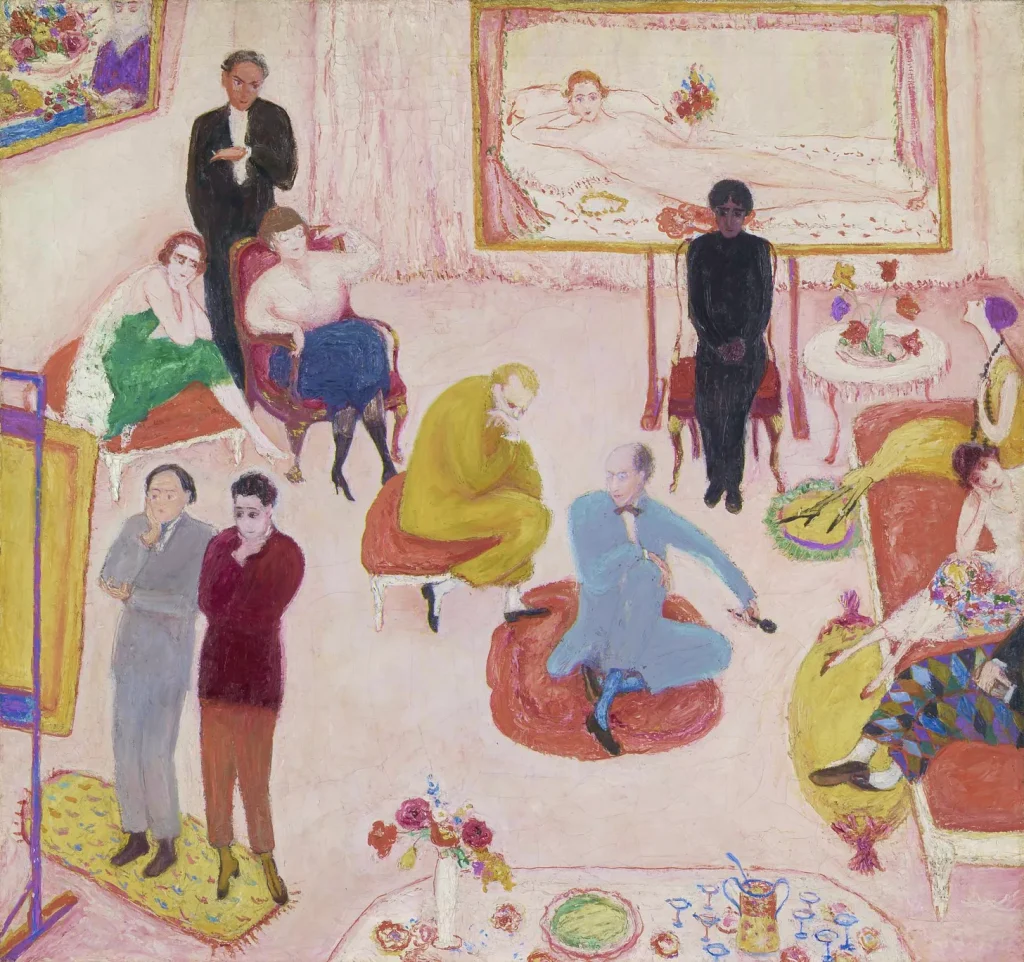
Florine Stettheimer, Studio Party (Soirée), 1917–1919, Yale University Art Gallery, New Haven, CT, USA.
Studio Party is Stettheimer’s depiction of one of the numerous parties she hosted for patrons and artists of the art world’s upper echelons. “Seen in color and design/It amuses me/To recreate them/To paint them,” she wrote in an accompanying poem. She called these VIP assemblages “birthday parties.” Rendered in Stettheimer’s signature pastel hues and subjective space, figures sit around on chairs, the couch, and even the floor, perhaps conversing about art.
Two men in the bottom left pensively study a canvas we cannot see. Knowing that Stettheimer displayed her work at these gatherings, it might be one of hers. The painting could also be a work in progress, as this party is taking place in her studio. The painting behind everyone, at the top of the composition, is Stettheimer’s nude self-portrait, which resembles Manet’s Olympia.
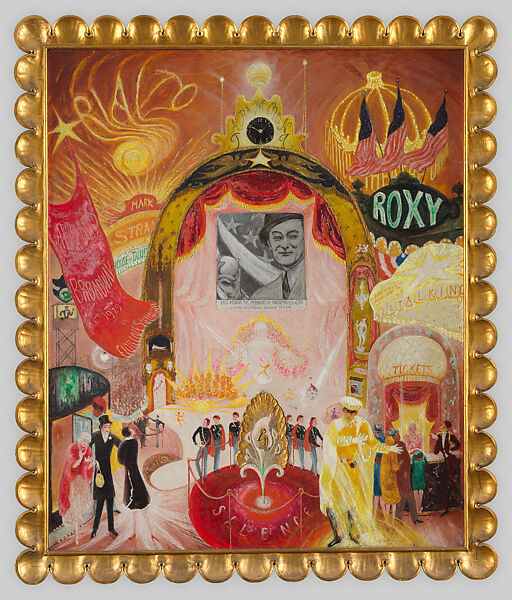
Florine Stettheimer, The Cathedrals of Broadway, 1929, Metropolitan Museum of Art, New York City, NY, USA.
The first painting of Stettheimer’s Cathedral series is an assortment of the majesty of Broadway in 1920s New York City. This work encapsulates the distractions that occupied Americans as the Great Depression began to wreak havoc. There are nods to both theater and cinema: great theaters of the time can be spotted, such as the Strand, Rialto, and the Roxy. Signs and marquees promote “talkies,” then the newest craze of Hollywood. The painting’s title and Stettheimer’s name can be seen on a red curtain in the top left.
Elegantly dressed patrons stand by the ticket booth or are ushered inside by decorous theater workers. The follies and live performances take center stage below a newsreel of Mayor Jimmy Walker inaugurating the new baseball season. This work is another brilliant example of Stettheimer’s ability to present the wonder of her subjects while undercutting them with a bite of contextual reality: the vibrancy of Broadway escapism cannot fully conceal the darkness of the Depression just around the corner.
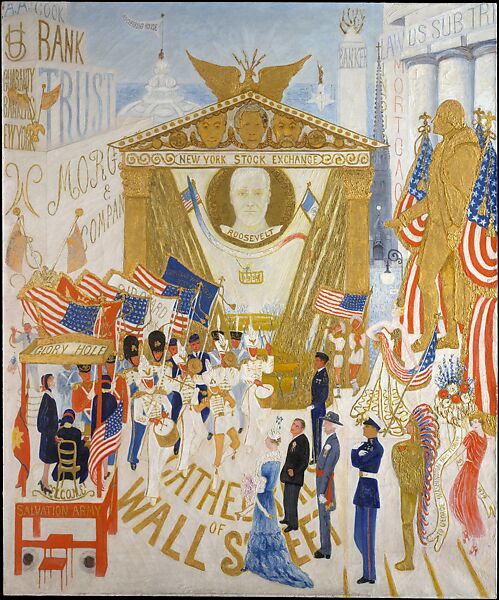
Florine Stettheimer, The Cathedrals of Wall Street, 1939, Metropolitan Museum of Art, New York City, NY, USA.
Capitalism is on full display in a later version of Stettheimer’s Cathedral paintings. The Great Depression that ravaged the 1930s did not completely stifle big business and all the major financial firms. Democracy and money go hand in hand in this imaginary, gilded collage of the New York Stock Exchange. Both facilitators and victims of American capitalism adorn the painting.
The Salvation Army is dwarfed by the names of J.P. Morgan and John D. Rockefeller. A marching band and U.S color guards march through the street. To their right is an affluent couple, respective Army and Navy officers, and a Native American chief. Stettheimer, again, adds a touch of the personal. She is the figure in red to the bottom right, handing a bouquet of flowers to the large George Washington statue outside of the Subtreasury Building (now the Federal Hall).
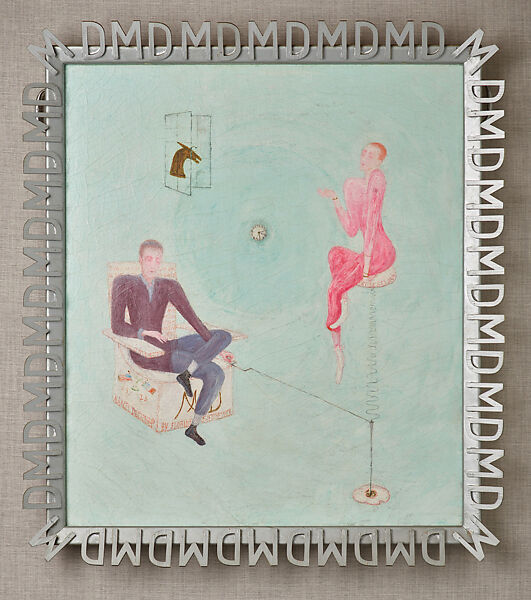
Florine Stettheimer, Portrait of Marcel Duchamp and Rrose Sélavy, 1923, Metropolitan Museum of Art, New York City, NY, USA.
This painting by Stettheimer is especially charming thanks to its subject. It is a portrait of both Marcel Duchamp and his female alter ego Rrose Sélavy. Duchamp sits in a chair emblazoned with his initials and the American and French flags. With his legs crossed, he holds a long, thin lever that appears to be handling the sturdy springs that hold up the chair on which Rrose Sélavy weightlessly sits. Just behind them is a large concentric circle with a minuscule clock at its center. A horse-head sculpture, framed by an open window, floats just above Duchamp—a clever homage to one of the founders of Dadaism.
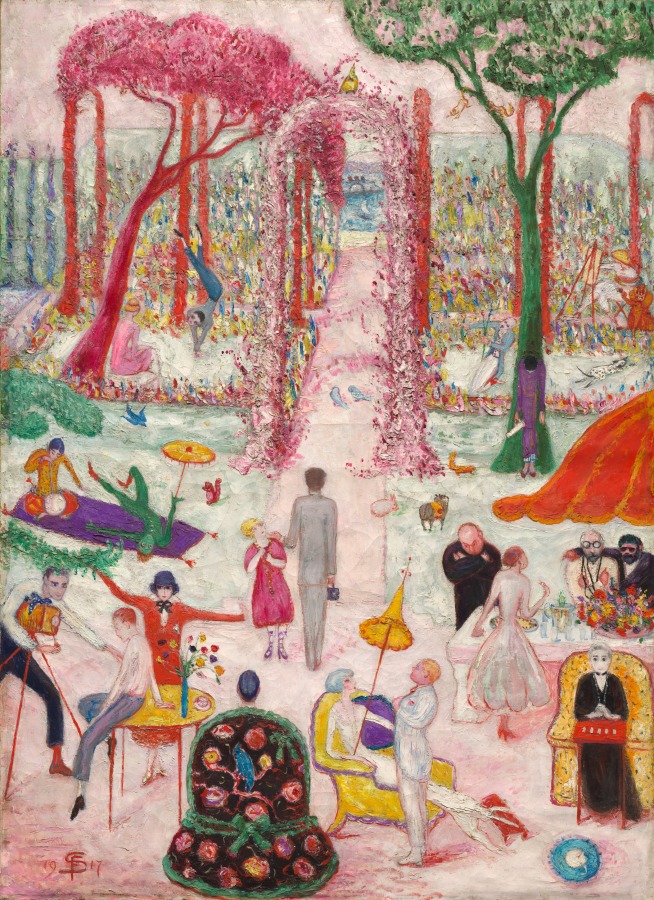
Florine Stettheimer, Sunday Afternoon in the Country, 1917, Cleveland Museum of Art, Cleveland, OH, USA.
A dog and a squirrel join the vignettes of slinky figures that grace the bottom of this composition. A pink path in the center leads to an arch, behind which is a colorful array of trees and park vegetation. The people here blend in with their surroundings, part of both nature and the lively fray below the arch. Just like all of Stettheimer’s paintings, this piece is as dazzling in its dynamism as it is in its confetti colors. Every figure is engaged in some activity, whether it is eating, drinking, socializing, playing a game or an instrument, or even doing a handstand.
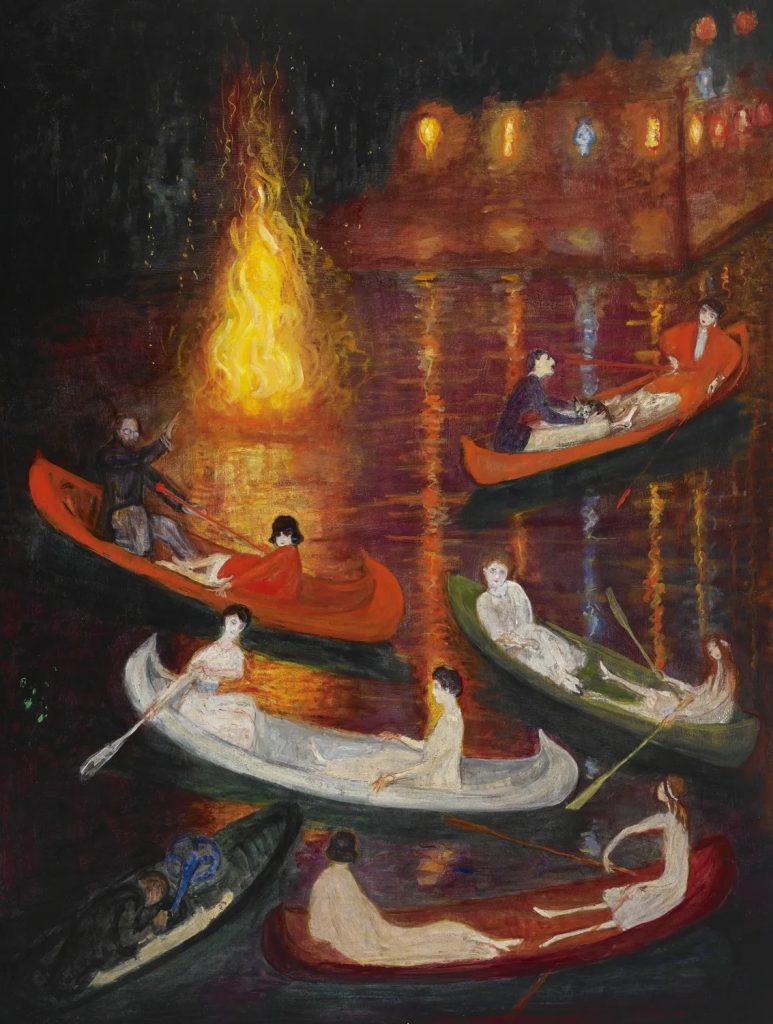
Florine Stettheimer, Fete on the Lake, Avery Architectural and Fine Arts Library, Columbia University, New York City, NY, USA.
A bonfire burns for an unknown celebration on a lake. Even for a scene in the dark, Stettheimer’s color palette is dazzling. The lighting is striking, coruscating off the lake as it reflects the fire and lights from a port in the background. Each canoe has one figure rowing and one resting leisurely. Some are bent, with legs splayed, others lean, with legs crossed. One wonders if this took place in a country home owned by one of Stettheimer’s wealthy friends.
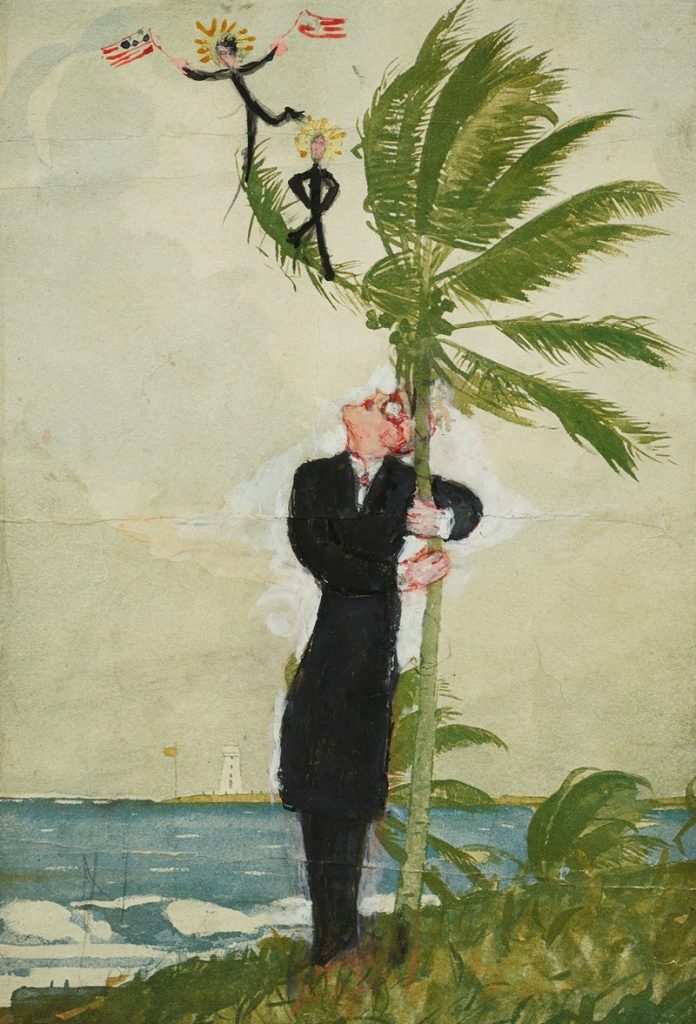
Florine Stettheimer, Henry McBride on Winslow Homer, 1924, Metropolitan Museum of Art, New York City, NY, USA.
This piece features the American critic Henry McBride, a prominent figure in the New York City art scene and an admirer of Stettheimer’s work. Winslow Homer was McBride’s favorite 19th-century painter. Therefore, in her typical droll style, Stettheimer places him in a reproduction of one of Homer’s paintings. In this mixed media on paper, McBride holds onto the titular palm tree seen in Winslow Homer’s painting, Palm Tree, Nassau, from 1898.
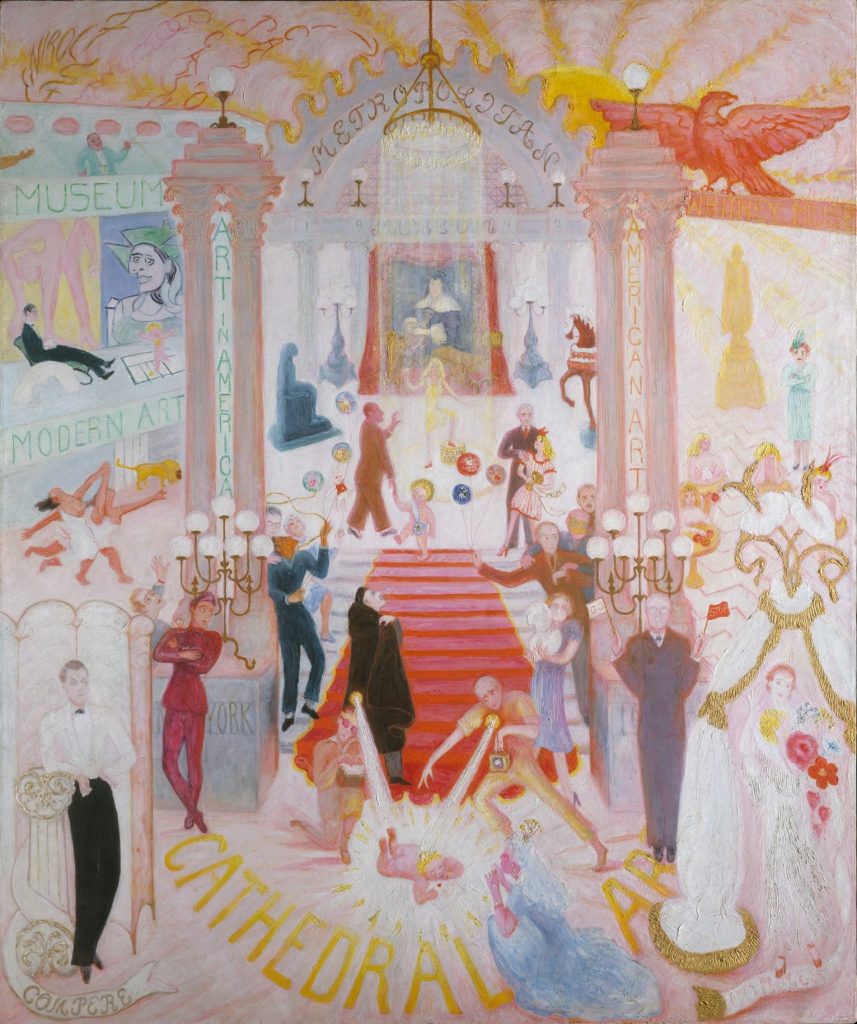
Florine Stettheimer, Cathedrals of Art, 1939, Metropolitan Museum of Art, New York City, NY, USA.
Just like the other works of her Cathedral series, Cathedrals of Art is Stettheimer’s manifestation of another distinct world of New York City—the art world. Naturally, all three major art museums of the city are represented: The Metropolitan Museum of Art, The Museum of Modern Art, and the Whitney Museum of American Art. A smorgasbord of figures, including art critics, photographers, museum workers, and artists, is portrayed in Stettheimer’s fluid brushstrokes and pale colors. The artist places herself amidst the ballyhoo. Painting the spectacle is not tribute enough; in the bottom right, she again proffers a bouquet of flowers.
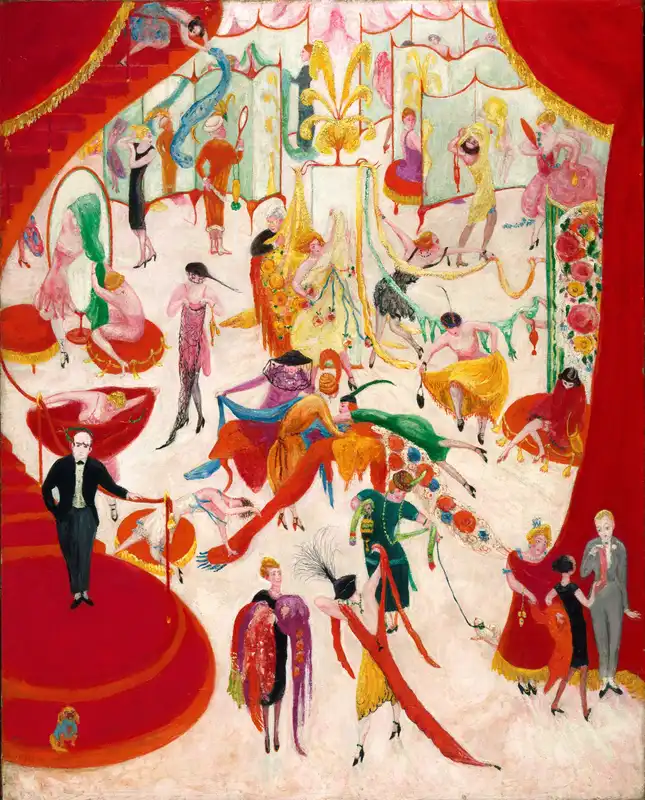
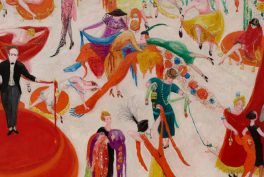
Florine Stettheimer, Spring Sale at Bendel’s, 1921, Norton Museum of Art, West Palm Beach, FL, USA.
Spring Sale at Bendel’s is the epitome of Stettheimer’s style and inclinations, perhaps even more so than the Cathedral paintings. The department store is a unique location for an artist to depict. While a critical, mocking eye can certainly be interpreted from this scene, it is counterbalanced by an evident affection for the chaos of shopping. Her signature sinuous figures are at their most contorted, colorful, and frenetic in this painting.
Women scan the store, pose before mirrors, struggle trying on dresses, and flaunt their splendid gowns. The red stairs to the left and the curtain to the right seem to close in on the shoppers, emphasizing the urgency to indulge in the purchase of a luxurious garment. Stettheimer’s two sisters, Ettie and Carrie, appear in her place this time. Stettheimer herself, however, undoubtedly partook in the frenzy of sales at deluxe stores such as Bendel’s.
Get your daily dose of art
Click and follow us on Google News to stay updated all the time

DailyArt Magazine needs your support. Every contribution, however big or small, is very valuable for our future. Thanks to it, we will be able to sustain and grow the Magazine. Thank you for your help!

A writer devoted to the arts with a Master's degree in English and a specialization in film studies/history. Ars longa, vita brevis.

Coffee-fueled writer, artist, and daydreamer.
Fanny Eaton was a regular model for the Pre-Raphaelites during the 1860s and features in a number of famous works. Yet for most of the last century,...
Catriona Miller 19 February 2026
From van Gogh’s sunflowers, through golden dresses, to tranquil landscapes—yellow lights up the scene. It is the color of the sun, associated...
Kinga Dobosz 26 February 2026
For centuries, artists interpreted the biblical story of Salome and turned it into a lasting theme in art. But where did this fascination come from?...
Edoardo Cesarino 22 January 2026
Olga Boznańska was one of the greatest Polish painters of the late 19th and early 20th centuries, known mostly for portraits with muted, elegant...
Kinga Dobosz 25 December 2025