5 Aboriginal Masterpieces from the National Gallery of Victoria
Founded in 1861, the National Gallery of Victoria is Australia’s oldest and most visited art museum. It is also a must-visit destination for...
Carlotta Mazzoli 25 November 2025

Emily Kam Kngwarray, Anwerlarr (Pencil yam), 1989, National Gallery of Victoria, Melbourne, Australia. © Emily Kam Kngwarray/Licensed by Copyright Agency, Australia. Museum’s website.
With her mix of acrylic painting and abstract Indigenous traditions, Emily Kam Kngwarray revolutionized Australian art and brought new life to Aboriginal art. This year, museums and galleries worldwide are celebrating her legacy.

Emily Kam Kngwarray, Yam awely, 1995, National Gallery of Australia, Canberra, Australia. © Emily Kam Kngwarray/Copyright Agency. Museum’s website.
With a career spanning only a couple of decades, Emily Kam Kngwarray and her work prove the fundamental role of art in shaping new perspectives and igniting change. A proud Anmatyerre woman from the remote community of Utopia in the Northern Territory of Australia, the artist was one of the leading voices redefining the global perception of Aboriginal art, and today she is widely regarded as one of the most important Australian artists of the 20th century.
Though she began her formal career in the 1970s, Kngwarray’s artistic legacy is both monumental and enduring, stretching far beyond her native Country and continuing to captivate artists, collectors, and art lovers around the world today.

Emily Kam Kngwarray near Mparntwe (Alice Springs) in 1980. Photograph by Toly Sawenko. The Art Newspaper.
Born around 1910 in Alhalkere, on Anmatyerre land, Emily Kam Kngwarray spent most of her life deeply immersed in the ceremonial and spiritual traditions of her people. For decades, she was a respected elder and cultural custodian, with deep knowledge of her Country’s Dreamings—ancestral narratives that shape Aboriginal relationships with land, life, and community.
The sister-in-law of fellow artist Minnie Pwerle, Kngwarray began her artistic journey in the 1970s through batik—a fabric dyeing technique introduced by non-Indigenous art center workers. In 1977, she became a founding member of the Utopia Women’s Batik Group. The batik process—slow, layered, and detailed—allowed her to begin translating her cultural knowledge into visual form. But it wasn’t until the late 1980s, when canvas and acrylic paint were introduced to her community, that her full artistic force was truly unleashed.

Emily Kam Kngwarray, Ntang Dreaming, 1989, National Gallery of Australia, Canberra, Australia. © Emily Kam Kngwarray/Copyright Agency. Museum’s website.
Despite beginning to paint only in her later years, Kngwarray produced over 3,000 works in less than a decade, many of which are monumental in scale. Her shift from batik to acrylic painting was more than a change of medium; it marked a powerful transformation in her visual language. Her paintings became increasingly gestural and expressive, blending intricate dotting techniques with sweeping fields of color that evoked the vastness of the desert landscape.
Importantly, Kngwarray’s art was never derivative of Western movements, though critics have often likened her bold abstraction to such traditions. In reality, her work is firmly grounded in Anmatyerre knowledge systems, each brushstroke a direct connection to the land, every pattern an expression of spiritual meaning. Her paintings often reference specific Dreamings, such as the Yam Dreaming, associated with growth, nourishment, and regeneration. Kngwarray’s art speaks of land and memory, resilience, and reverence. Through bold colors and rhythmic forms, she gave visual language to the spirit of Alhalkere.

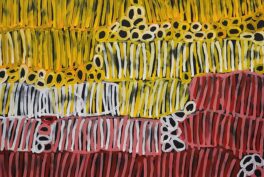
Emily Kam Kngwarray, Untitled (awely), 1994, National Gallery of Australia, Canberra, Australia. © Emily Kam Kngwarray/Copyright Agency. Museum’s website.
Emily Kam Kngwarray played a critical role in promoting Aboriginal art to a wider audience, redefining its place within modern and contemporary art. Her work helped challenge long-held perceptions, demonstrating that Aboriginal art is not simply ethnographic or historical; it is vibrant, innovative, and deeply relevant.

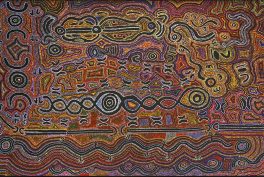
Emily Kam Kngwarray, Untitled, 1990, National Gallery of Victoria, Melbourne, Australia. © Emily Kam Kngwarray/Licensed by Copyright Agency, Australia. Museum’s website.
But Kngwarray’s influence extends beyond museum walls. Her work has inspired generations of Aboriginal artists, providing a model for how cultural tradition can coexist with personal expression and innovation. Her legacy also serves as a call for continued recognition, respect, and equity for First Nations artists and communities.
And nearly three decades after her passing, Emily Kam Kngwarray’s legacy continues to grow. Her works are held in major collections around the world, including the National Gallery of Australia and the National Gallery of Victoria, where her work sits in rich dialogue with other First Nations artists who depict Country and Dreamings through a wide range of visual languages.

Emily Kam Kngwarray, not titled, 1995, National Gallery of Australia, Canberra. © Emily Kam Kngwarray/Copyright Agency. Museum’s website.
Now, in 2025, the international art world is once again turning its gaze toward her legacy with a landmark solo exhibition at the Tate Modern in London. This retrospective will be the first large-scale presentation of Kngwarray’s work ever held in Europe, offering audiences a rare opportunity to experience the full depth of her vision, rooted in ancestral knowledge, yet powerfully modern in its execution.
Emily Kam Kngwarray is on view at the Tate Modern in London, UK, until January 11, 2026.
Get your daily dose of art
Click and follow us on Google News to stay updated all the time

DailyArt Magazine needs your support. Every contribution, however big or small, is very valuable for our future. Thanks to it, we will be able to sustain and grow the Magazine. Thank you for your help!

Carlotta Mazzoli is an independent curator and art advisor, currently based in Europe. Over the past ten years, she has collaborated with private and public institutions and art galleries in Italy, London, New York, and Shanghai. She specializes in public art, environmental and social issues, and the importance of art as a relational medium. In her free time she likes to write about art and travels on Artsy Travels.

Univ. of New Orleans, Fine Arts and History; Fine Artist, Professional Graphic Designer, Art Historian, Historian, Musician, worked at the New Orleans Museum of Art and MS Museum of Art; learning enthusiast!
Founded in 1861, the National Gallery of Victoria is Australia’s oldest and most visited art museum. It is also a must-visit destination for...
Carlotta Mazzoli 25 November 2025
Australia boasts a vibrant art scene shaped by its rich cultural heritage and unique landscapes. From ancient Indigenous traditions to contemporary...
Nikolina Konjevod 1 July 2024
Indigenous Australian (Aboriginal and Torres Strait Islander) culture is nowadays considered one of the most ancient in the world. Some historians...
Camilla de Laurentis 25 November 2025
At the end of the 18th century, the British Empire added Australia to its territory. Since the infamous arrival of Captain Cook white people have...
Jimena Escoto 25 November 2025