Sir Anish Kapoor is a British sculptor originally from Bombay. He has been based in London since the early 1970s, when he moved there to study art—first at Hornsey College of Art and later at Chelsea School of Art and Design. He is one of the most influential sculptors of his generation.
Perhaps most famous for public sculptures that are both adventures in form and feats of engineering, he manoeuvres between vastly different scales, across numerous series of work. There are resonances with mythologies of the ancient world–Indian, Egyptian, Greek, and Roman–and with modern times, where 20th-century events loom large.
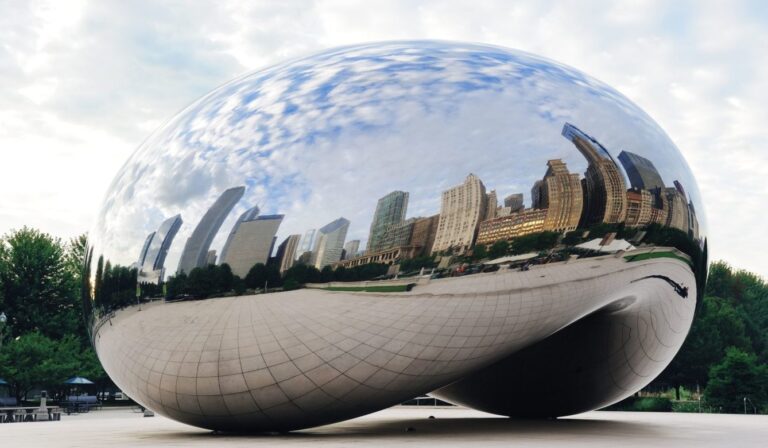
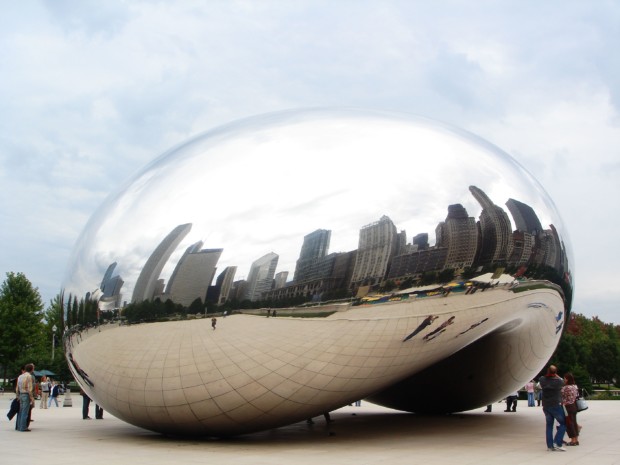
Anish Kapoor, Cloud Gate, 2004, Chicago, IL, USA. WikiArt.
For Anish Kapoor, scale is a tool. In one interview, he quoted Barnet Newman, who said eloquently: “scale is not a matter of size, it is a matter of content”. According to Kapoor, scale is not about how big a thing is but is about how meaningful a thing is.
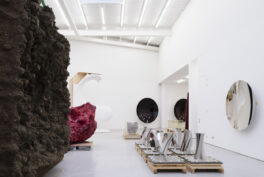
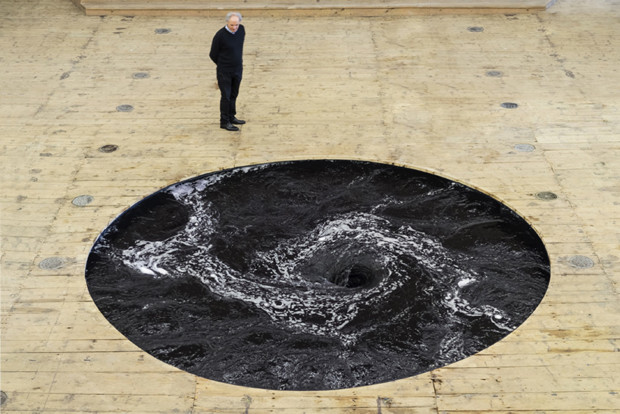
Anish Kapoor, Descension, Galleria Continua. Photograph by Ela Bialkowska, okno studio, courtesy the artist and Galleria Continua, San Gimignano / Beijing / Les Moulins.
The scale is connected to the idea of the immense. Kapoor said: “The immense inspires us all. Eyes wide open if you like. I think it’s not so far away from the problem of time. I think of Caspar David Friedrich’s two figures standing on the edge of the cliff and looking at the immense landscape; they’re lost in wonder, they are lost in time. Standing there in a timeless space, I think scale is the same thing.”
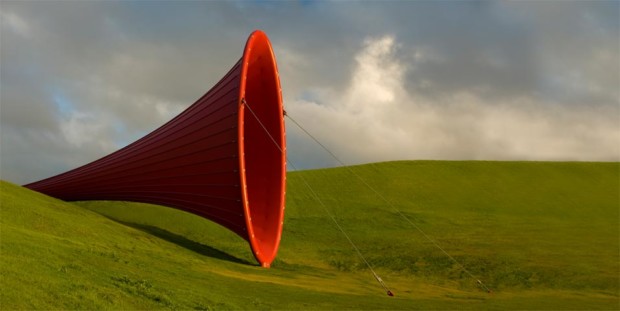
Anish Kapoor, Dismemberment, Site 1, 2009, Gibbs Farm, New Zealand. Curekids.
Here you can watch the interview where Kapoor talks about the significance of the element of scale in sculpture:
We love art history and writing about it. Your support helps us to sustain DailyArt Magazine and keep it running.
DailyArt Magazine needs your support. Every contribution, however big or small, is very valuable for our future. Thanks to it, we will be able to sustain and grow the Magazine. Thank you for your help!
Art Historian, founder and CEO of DailyArtMagazine.com and DailyArt mobile app. But to be honest, her greatest accomplishment is being the owner of Pimpek the Cat.