Summary
- Icons are theological images rooted in the Incarnation of God and understood in Orthodoxy as sites of divine presence rather than naturalistic artworks.
- The Iconoclastic Controversy shaped the Church’s defense of images, establishing the distinction between veneration and worship and affirming the icon as a visual expression of doctrine.
- Icon‑making follows a highly codified process and produces a visual language based on inverse perspective, color symbolism, and set gestures.
- Major icon types (e.g., Hodegetria, Eleusa, Pantocrator, Mandylion) structure how sacred figures are represented and interpreted.
- Russian iconography developed from Byzantine roots and flourished with artists such as Rublev, Dionisii, and Ushakov.
Icons anchor the spiritual and artistic history of Eastern Christianity and form one of the most continuous, richly documented bodies of devotional art. They also sit at the crossroads of Byzantine, Slavic, Mongol, monastic, imperial, Soviet, and modernist histories. Russian iconography in particular offers a uniquely coherent yet evolving visual language that will guide this article. So, whether you are encountering icons for the first time or returning with new questions, this is your guide to understanding how these images work and why they matter.
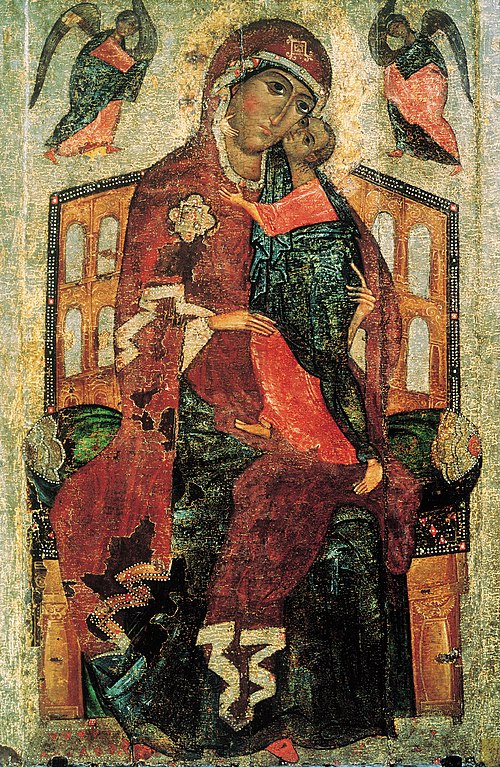
Mother of God of Tolga, 13th century, Tretyakov Gallery, Moscow, Russia.
What Is an Icon?
Within the history of Christian art, the icon occupies a distinct place. It is not simply a devotional picture but an object of theological significance whose very nature differs from that of Western religious paintings. In Orthodox thought, the icon is understood as a material locus of presence, meaning that it is a meeting ground between human sight and divine presence. This understanding derives from the Christological debates of the early Church, especially the Second Council of Nicaea (787), which affirmed that because Christ assumed visible, material form during His Incarnation on earth, sacred images could legitimately depict Him and the saints.
A foundational part of this theological interpretation is the Christian tradition that St Luke the Evangelist was the first icon-painter. According to early Christian sources, Luke painted portraits of the Virgin and Child from life, establishing the prototype of Marian imagery. This tradition is crucial: it anchors iconography in apostolic authority, situates the practice within the earliest Christian community, and frames the icon not as a later artistic invention but as a continuation of the Church’s living memory and its divinely inspired mission.
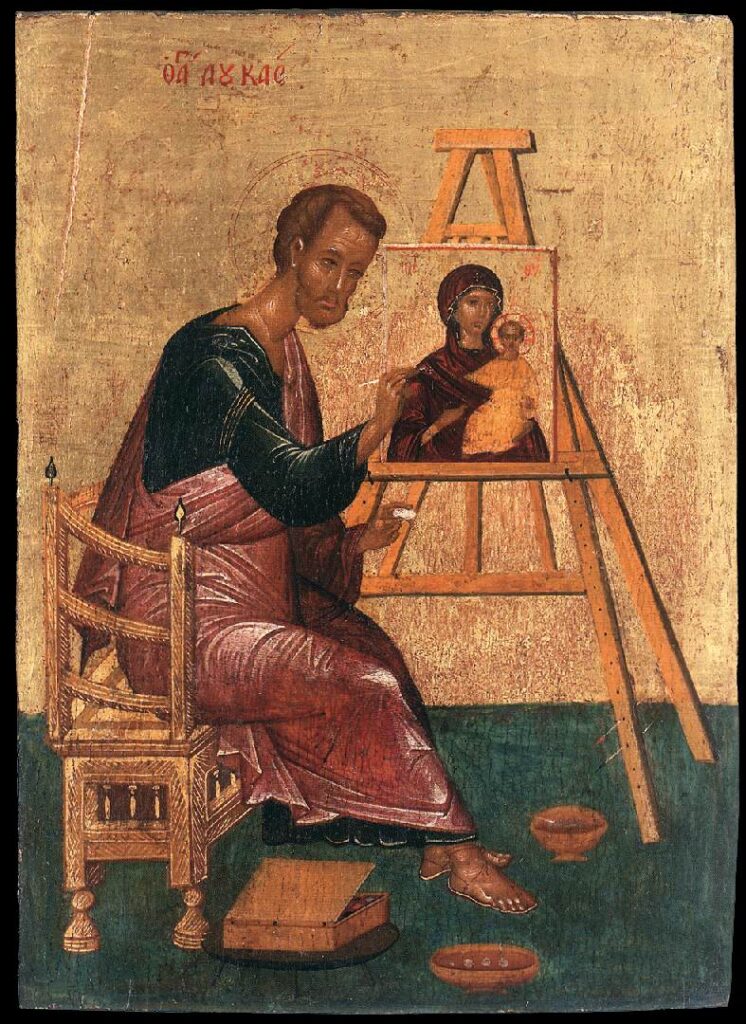
Luke Paints the Icon of the Mother of God Hodegetria, early 15th century, Ikonen-Museum, Recklinghausen, Germany.
Shown above is one of the oldest surviving icons of Luke painting the Hodegetria—a rare visualization of the legend that shaped Byzantine ideas about the origins of icon‑making.
This theological foundation also explains the icon’s characteristic visual restraint. The goal is not mimesis (i.e., imitation of a model) but manifestation of the divine. The icon is not a picture in the Western sense of the term; it is not an Albertian window onto the world, and its aim is not the illusionistic resemblance in the representation of holy figures. Instead, the icon is to be seen as an index, a shadow of the holy presence, a record of the spiritual world that makes the spiritual realm available to worshippers and communicates religious truth: it is a window into the divine realm. Thus, the stylized forms of an icon, its frontal poses, and gold grounds are not archaisms but deliberate strategies to signal that the viewer is encountering a divine presence that lies beyond what the human senses can perceive and represent.
The Iconoclasm Debate and Its Consequences
Yet the rise of icons did not come without controversy; the most significant being the Iconoclastic Controversy (726–787; 815–843), a conflict that lasted about 100 years and shaped the theology and practice of image‑making for centuries. Iconoclasts argued that sacred images violated the biblical prohibition against graven images, risked idolatry, and improperly represented the divine. Their opponents, the iconodules, presented a sophisticated defense of images grounded in Christology: because Christ became incarnate and, hence, took on visible, material flesh, the divine became depictable. To deny the image was, in their view, to deny the Incarnation itself.
The iconodule theologians—especially St John of Damascus and St Theodore the Studite—developed arguments that remain foundational to Orthodox aesthetics. They made an essential distinction between veneration (proskynesis), which is the respect and honor directed toward the image, and worship (latreia), which belongs to God alone. They insisted that honor shown to an icon passes to its prototype, meaning the respect is ultimately directed to the holy figure depicted, not to the material object. They also emphasized that the icon is not a portrait in the ordinary sense but a visual profession of faith. This theological image reveals doctrine and theological truth (such as the Incarnation and the Transfiguration) rather than individual likeness.
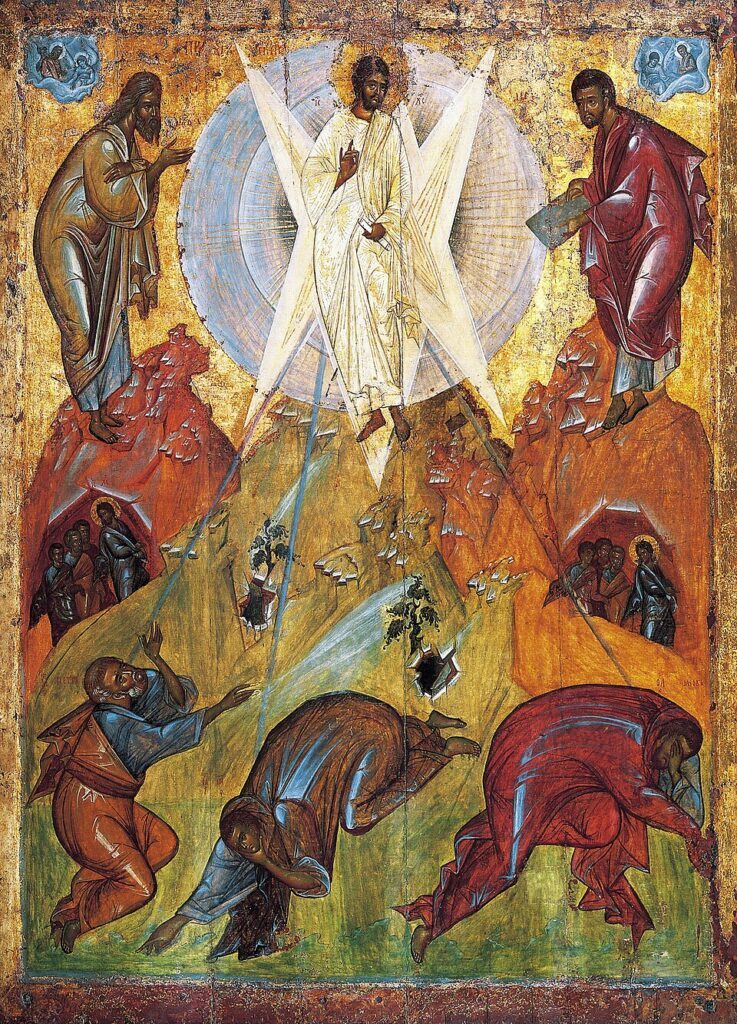
Theophanes the Greek, Transfiguration of Jesus, 15th century, Tretyakov Gallery, Moscow, Russia.
The resolution of the controversy at the Second Council of Nicaea (787) and the final restoration of icons in 843 (celebrated as the “Triumph of Orthodoxy”) established the doctrinal legitimacy of icons and codified many of the principles that would later shape iconography. The debates also reinforced the idea that icon‑making was not merely an artistic act but a theological one, a practice inseparable from the Church’s understanding of itself as the guardian of right belief. To paint an icon was to participate in the Church’s teaching, not merely to produce an image.
How to Make an Icon
The making of an icon followed a highly codified process, and every step carried symbolic meaning. First, a wooden panel was hollowed out to create a recessed central space that served as a visual threshold. Then, layers of gesso, composed of chalk and animal glue, were applied and sanded smooth to serve as the ground for the image.
The painter would then make an underdrawing of the composition, after which the image was built from dark to light. This inversion of Western pictorial logic reflected a theological understanding: light was not cast upon the figure from an external source but emanated from within, as a metaphor of divine illumination.
In terms of materials used for the painting itself, egg tempera was employed, producing the matte, velvety surfaces characteristic of Russian icons in particular. The use of gold or silver leaf—predominantly for backgrounds and halos—represented the eternal divine light emanating from God Himself.
Once the painting was complete, the surface was sealed with a traditional drying oil varnish that protected the tempera and produced the warm, translucent glow characteristic of icons. Its natural tendency to darken over time has caused many icons to appear far darker in tone today than originally intended.
Many icons were further adorned with what is called a riza in Russian (shaty in Ukrainian, or more generally, oklad), a metal cover that framed the painted face and hands while encasing the rest in relief. These metallic covers—made from precious metals for the most expensive icons, or from brass or copper for the more affordable ones—both protected the fragile tempera surface and intensified the sense of sacred radiance, transforming the icon into a hybrid of painting and precious metalwork.
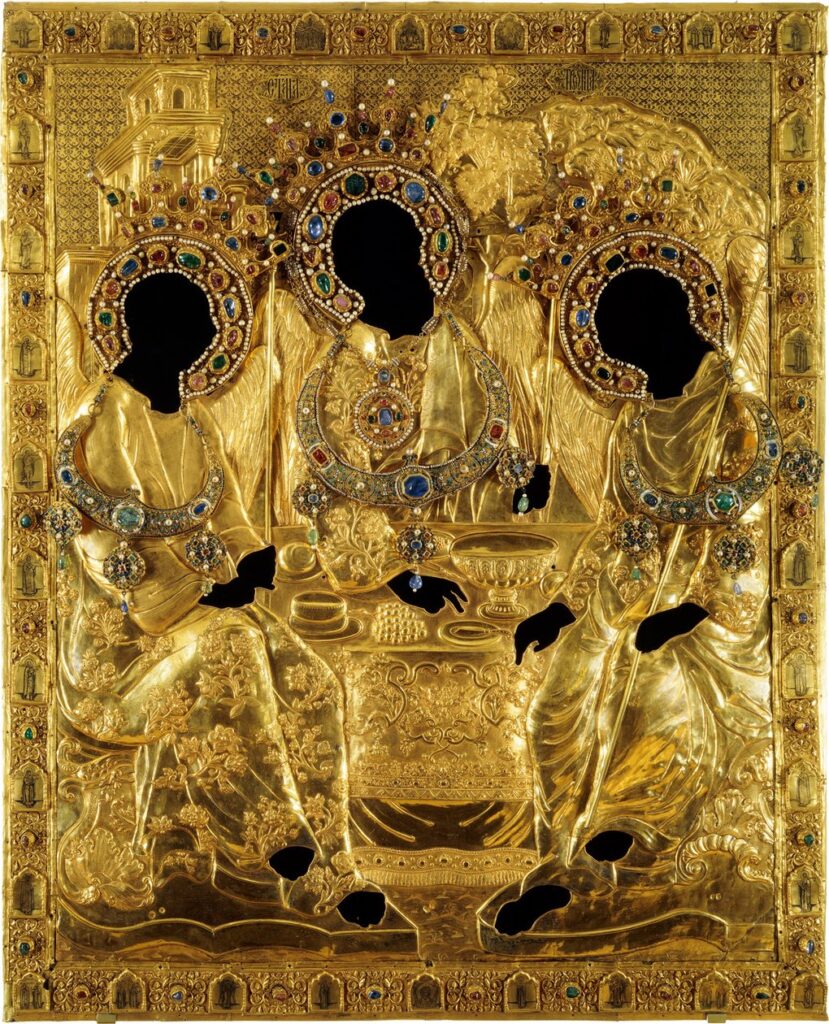
Cover for the Holy Trinity icon by Andrei Rublev, 1600-1625, State History and Art Museum-Preserve, Sergiyev Posad, Russia.
The oklad of Rublev’s Holy Trinity—a layered assemblage of engraved gold and gilded silver added over centuries—once covered the icon entirely except for the angels’ faces, hands, and feet. Donated by successive rulers from Ivan the Terrible to the early Romanovs, its engraved scenes, saints, and archangels form one of the most remarkable metal revetments in Russian art.
It is worth noting that this icon-making process was not merely technical. It was understood as a form of ascetic practice and was accompanied by prayer and fasting. Hence, the iconographer was not considered an autonomous artist but a mediator of a received tradition. This explains why many icon-painters have remained anonymous.
The Language of the Icon
Icons operate through a highly codified visual language that uses symbols and signs and follows an established canon of representation. The frontal gaze establishes a reciprocal relationship between viewer and image, collapsing the distance between the sacred figure and the beholder. Inverse perspective, in which the vanishing point converges toward the viewer, reinforces this dynamic by situating the beholder within the pictorial space rather than outside of it.
Light plays a crucial role as it is intended to represent the divine light. Because of this, you may notice in particular that, in icons, figures are shown without cast shadows. This is because, unlike earthly light, which falls from a single direction and produces darkness, divine light is understood to emanate from within the saint and to shine equally in all directions. The absence of shadows, therefore, signals that the figure exists not in ordinary space and time but in a transfigured, spiritual state.
Another point to cover in our icons guide is color, which also functions as a theological code. Red is associated with blood and martyrdom, but also has connotations of divine life and royal dignity. Blue tends to signify heavenly purity, especially in depictions of the Virgin. Green evokes creation, renewal, and—more strongly in the Russian tradition than in Byzantium—the life‑giving presence of the Holy Spirit. White is the color of the Transfiguration and of the prophets. Black is associated with the absence of divine light and, more generally, with hell. Gold signals eternity and the Kingdom of God.
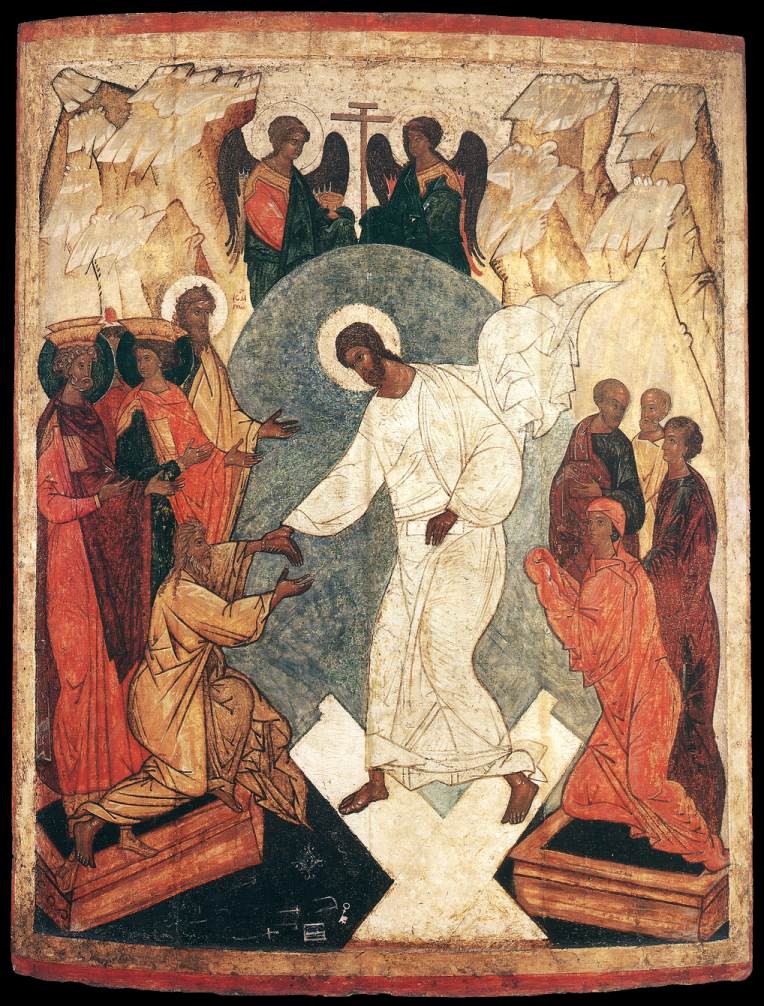
Resurrection of Christ and the Harrowing of Hell, early 16th century, Ikonen-Museum, Recklinghausen, Germany.
This icon shows the Harrowing of Hell—Christ’s descent to the realm of the dead, where He breaks open its gates and raises Adam, with Eve and the righteous looking on. As a central theme of Christian Resurrection imagery, it expresses Christ’s victory over death and the liberation of humanity.
Gestures, too, are codified. A raised hand in blessing, a scroll indicating teaching authority, or the tender inclination of the Virgin’s head in icons of the Virgin of Tenderness (Eleusa) all carry specific meanings.
This system of signs and symbols allows icons to communicate complex theological ideas with remarkable economy. Once the viewer becomes attuned to these conventions, the image reveals layers of meaning that transcend its apparent simplicity.
Types of Icons
To understand an icon requires a shift in visual habits. The viewer must begin with the inscription, which identifies the holy figure and situates the image within a specific iconographic type. Recognizing types—some of the main ones being Hodegetria, Eleusa, Pantocrator, and Mandylion—provides an interpretive framework, as each format carries its own theological and devotional charge.
Hodegetria
The Hodegetria (a Greek term meaning “She Who Shows the Way”) shows the Virgin holding Christ and gesturing toward Him, presenting Him as the path to salvation. Christ is often depicted as a small adult, symbolizing wisdom and divine authority. It’s a proclamation of Christ as guide and teacher, and of Mary as the one who leads the faithful toward Him.
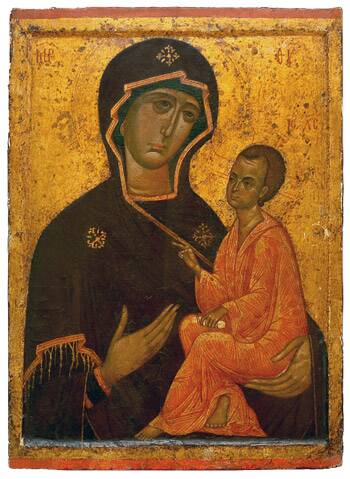
Mother of God of Tikhvin, c. 1300, Tikhvin Assumption Monastery, Tikhvin, Russia.
The Tikhvin Mother of God follows the Hodegetria type, with the Virgin directing the viewer toward Christ as the source of salvation. Widely copied, it is traditionally linked to St Luke and associated with miraculous appearances, as well as the founding of the Tikhvin Assumption Monastery.
Eleusa
The Eleusa (“Tenderness” or “Merciful”) shifts the emphasis to tenderness: the Virgin and Child press their cheeks together in a moment of intimate compassion that expresses divine mercy. Christ’s arm often encircles Mary’s neck or touches her face. The icon is meant to show the humanity of Christ and the Virgin’s maternal love; it is a visual theology of mercy and intercession.
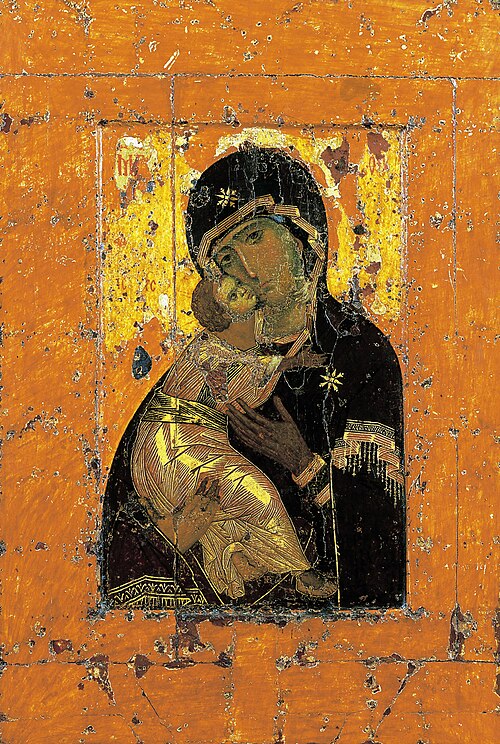
Mother of God of Vladimir, c. 1311, Tretyakov Gallery, Moscow, Russia.
The Theotokos (Mother of God) of Vladimir—one of the most venerated Orthodox icons of the Virgin and Child and a classic example of the Eleusa type—shows Christ pressing His cheek to His Mother’s. Long honored as a protectress of Russia and now housed in the Tretyakov Gallery, it has been copied for centuries, with many copies now carrying their own religious significance.
Pantocrator
The Pantocrator (Ruler of All), one of the most famous depictions of Christ, shows Jesus frontally as a cosmic ruler and judge, blessing with one hand while holding the Gospel in the other. It is a representation of Christ as the divine Logos (i.e., the divine Word) who sustains the universe.
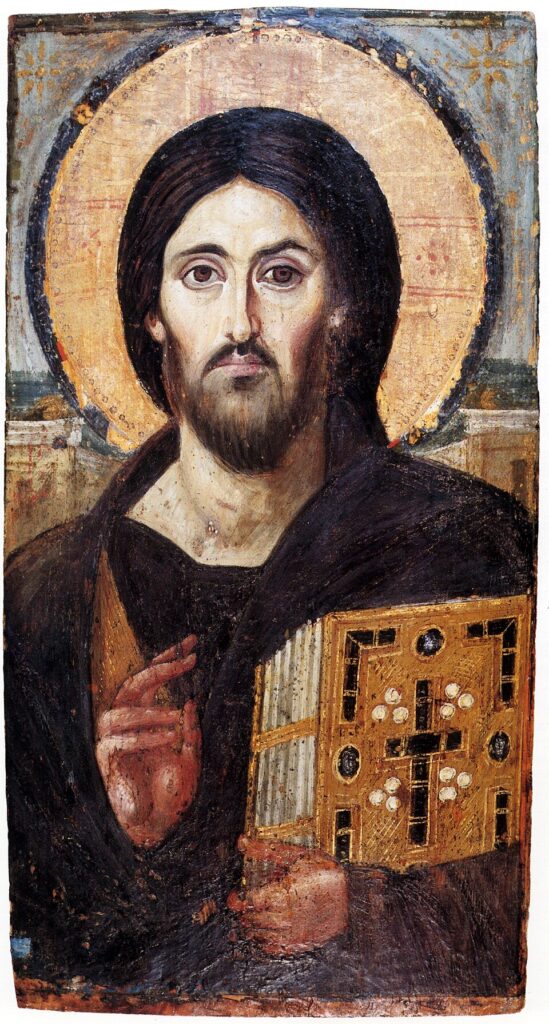
Christ Pantocrator, 6th century, St Catherine’s Monastery, Sinai, Egypt.
The Sinai Christ Pantocrator—one of the earliest surviving Byzantine icons—presents Christ as both divine judge and incarnate Savior. His asymmetrical face expresses the union of divinity and humanity. Preserved at St Catherine’s Monastery, it is a foundational image of Christian iconography.
Mandylion
The “Savior Not Made by Human Hands”—also called the Mandylion, from the Greek meaning “cloth” or “towel”—depicts Christ’s face imprinted on a cloth and serves as the prototype for all later portraits of Christ. Because the original image was considered acheiropoietos (“not made by human hands”), it served as a guarantee that later painted icons showed Christ as He truly appeared in His incarnate, human form. This type of icon, therefore, affirms both the Incarnation and the divine origin of Christ’s likeness in all later icons.
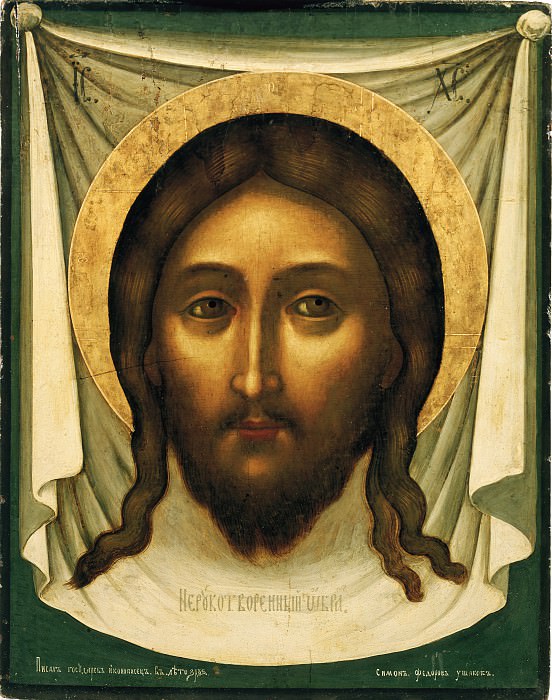
Simon Ushakov, Mandylion, 1658, Tretyakov Gallery, Moscow, Russia.
This Mandylion depicts the Holy Face in the “Not Made by Human Hands” type—the image believed to have been miraculously imprinted on a cloth and revered as the earliest, direct likeness of Christ, affirming His true Incarnation and presence.
These types of icons form a visual theology that shaped how viewers approached and understood the sacred image, and they continue giving us an interpretative key today.
It is also worth noting that the composition often compresses multiple temporal moments into a single scene, reflecting a theological understanding of sacred time, where time and space are one. Architectural and landscape elements are symbolic rather than descriptive. Hierarchy is spatial: central or enlarged figures indicate spiritual primacy.
Icons in Church and at Home: the Iconostasis and the Beautiful Corner
In a liturgical context, icons form part of a larger visual and ritual system. The iconostasis—the great screen separating and hiding the altar from the view of the faithful in an Orthodox church, which appeared in the 13th century—functions as a theological diagram of salvation history, with the order of its tiers guiding the viewer from earth toward heaven.
At the base, the Sovereign tier (also called the Local tier) places Christ and the Virgin on either side of the Holy Doors, flanked by the church’s patron saints. Above it, the Deesis presents Christ enthroned and surrounded by intercessors. The Festal tier, placed below the Deesis in certain cases, unfolds the major feasts of the liturgical year. The Prophets and Forefathers tiers, usually surrounding an icon of the Virgin of the Sign, gather the Old Testament figures who foretold and prepared for the Incarnation. Together, these tiers provide the visual framework within which the liturgy unfolds.
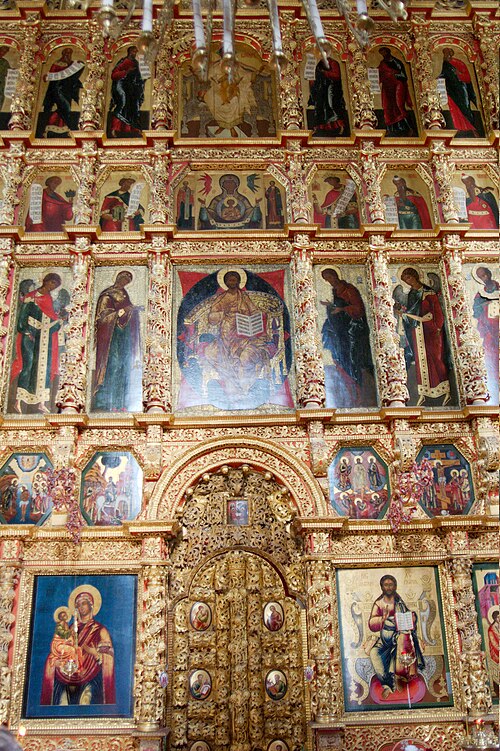
Iconostasis at the Ipatiev Monastery in Kostroma, Russia. Photograph by MatthiasKabel via Wikimedia Commons (CC BY-SA 3.0).
This 17th‑century iconostasis at the Ipatiev Monastery is arranged in ascending tiers: flanking the Holy Doors at the bottom are Christ Pantocrator on the right and the Mother of God Hodegetria on the left; above them, scenes from the Great Feasts; above these, the Deesis row with Christ enthroned between intercessors; followed by the Prophets surrounding the Virgin of the Sign; and at the top, the Apostles placed to either side of the Holy Trinity.
In Eastern Orthodox and Russian traditions, icons were not only to be seen in churches, though. They were an integral part of domestic life. Every home, from palace to peasant hut, kept its icons in a prominent place (what in Russian tradition was called the “beautiful corner”, krasnyi ugol, the first place one saw on entering a home), often lit by a small lamp and adorned with embroidered cloths. People bowed and crossed themselves before the images, and family prayers were said there, morning and evening. Each household kept icons of saints connected to their work or lineage, and icons accompanied every major life event: engagements, departures for war, the birth of a child, marriage, and burial. Travelers carried small personal icons, while the wealthy sometimes traveled with miniature iconostases so they could pray as if in church. In this way, icons shaped not only devotion but also the rhythms and identity of family life.
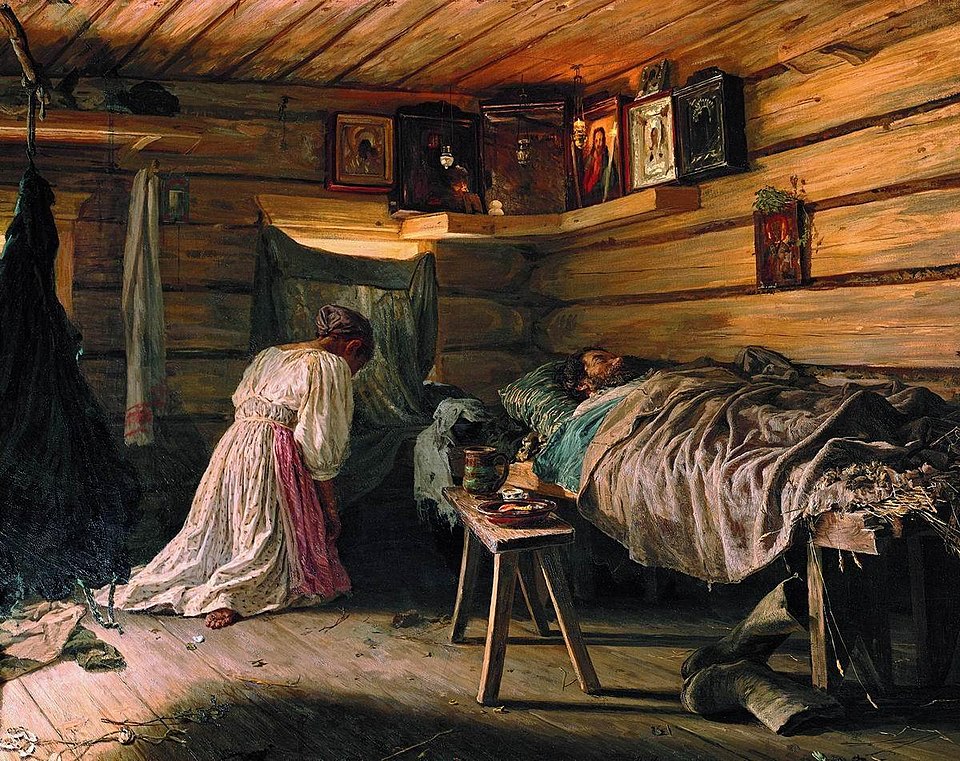
Vassili Maximov, The Sick Man, 1881, Tretyakov Gallery, Moscow, Russia.
The Emergence of the Icon in Kyivan Rus’ and the Golden Age of the Russian Icon
The history of Russian iconography begins with the Christianization of Kyivan Rus’ (a territory encompassing modern-day Belarus, Ukraine, and western Russia) in 988, when Byzantine missionaries introduced both the Christian faith and the visual culture of Byzantium. Early icons from Kyiv and Novgorod retained a strongly Byzantine character: monumental figures, austere expressions, and a palette dominated by deep reds and greens.
The Mongol invasions of the 13th century disrupted artistic production in the southern regions, shifting the center of icon painting to northern cities. Novgorod, relatively spared from destruction, developed a distinctive style marked by expressive line, minimalist composition, bold color contrasts, and a certain spiritual intensity.
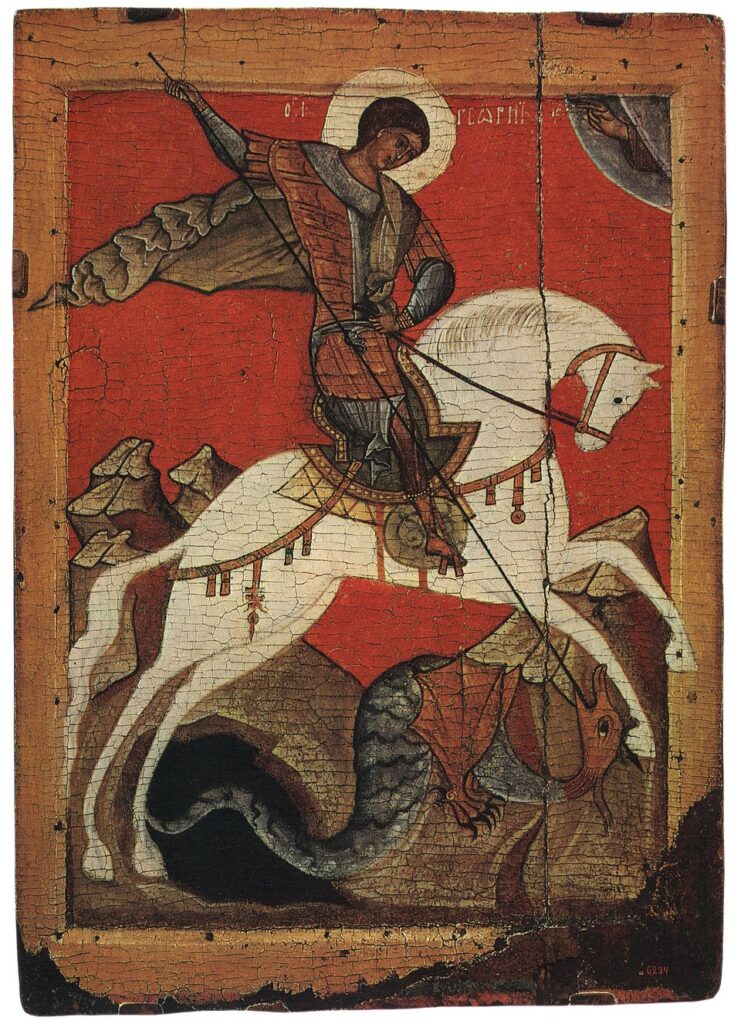
St George and the Dragon, 15th century, State Russian Museum, St Petersburg, Russia.
By the 15th century, Moscow had become the leading artistic center, ushering in the Golden Age of Russian icon-painting. This period lasted until the late 17th century and gave rise to some of the most celebrated iconographers. Among them was Andrei Rublev (c. 1360–1430), who is widely considered the greatest icon-painter of medieval Russia. A monk of the Trinity St Sergius Monastery and later the Andronikov Monastery in Moscow, he trained under Theophanes the Greek (a renowned Byzantine icon-painter who had moved to Russia in 1378) and contributed to major fresco cycles before developing a serene, distinctly Russian refinement of the Byzantine style. His icons, frescoes, and manuscript illuminations shaped the emerging Moscow school and set a lasting standard for Russian sacred art.
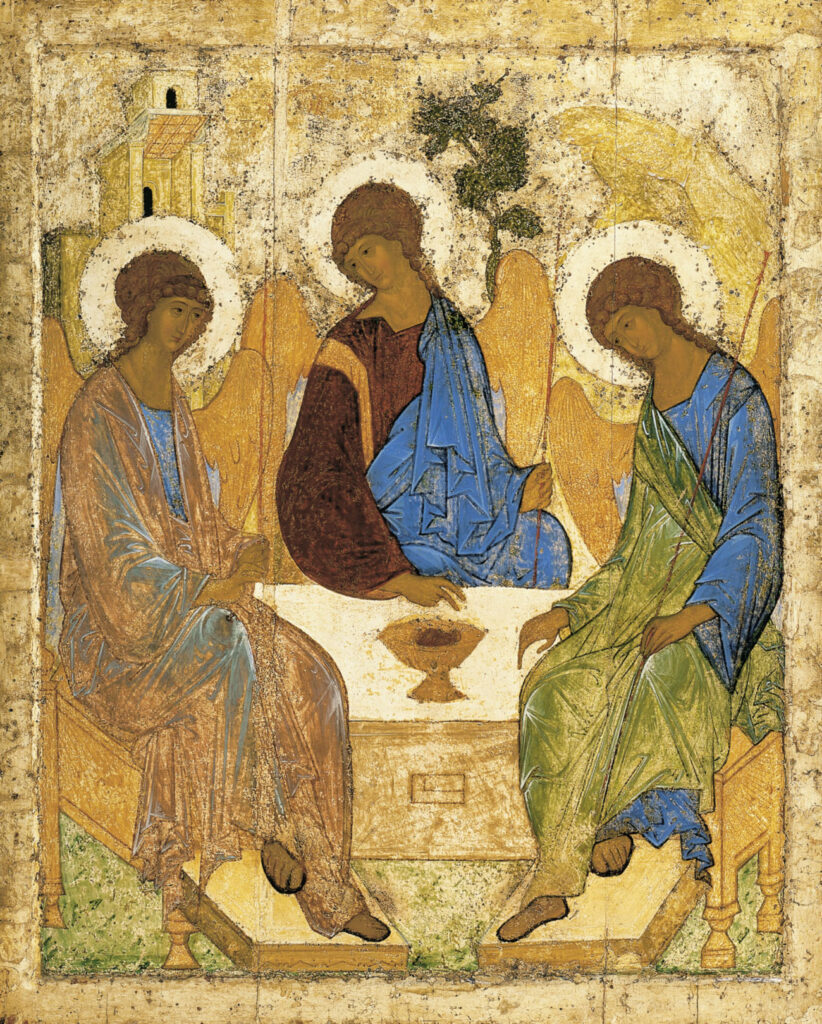
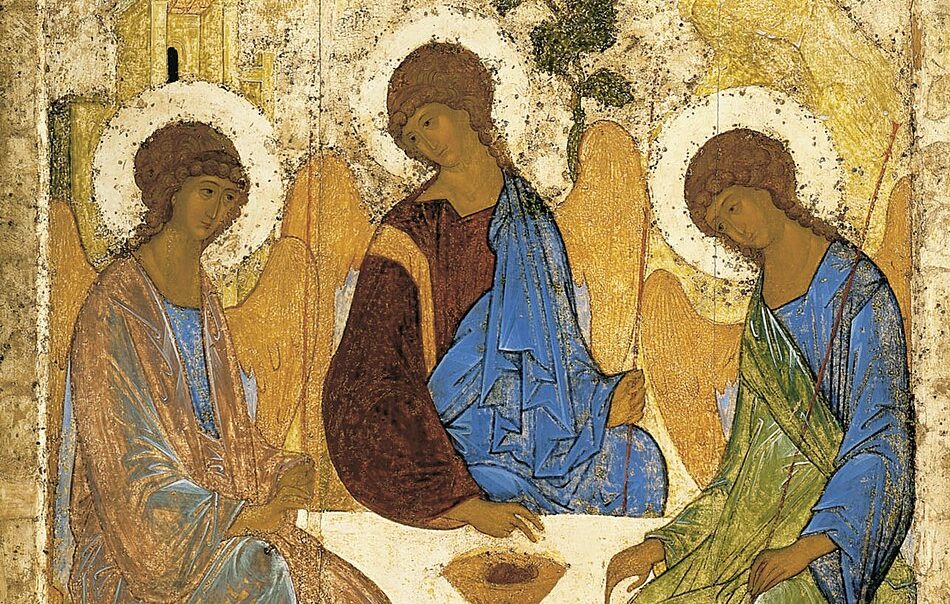
Andrei Rublev, Holy Trinity, c. 1411, Tretyakov Gallery, Moscow, Russia.
Rublev’s Holy Trinity turns the Genesis story of three angelic visitors—believed to be the Father, the Son, and the Holy Spirit—into a serene image of divine unity. By removing Abraham and all narrative detail, he focuses on the quiet harmony of the three angels around a Eucharistic chalice, creating a vision of spiritual communion and self‑giving love in the Holy Trinity.
In the generation following Rublev, Dionisii (c.1440–1508) emerged as the leading Russian icon-painter, known for his elegant, elongated figures and luminous, delicate colors. His frescoes and icons—especially those at the Ferapontov Monastery—embody a vision of sacred art that is both austere and graceful.
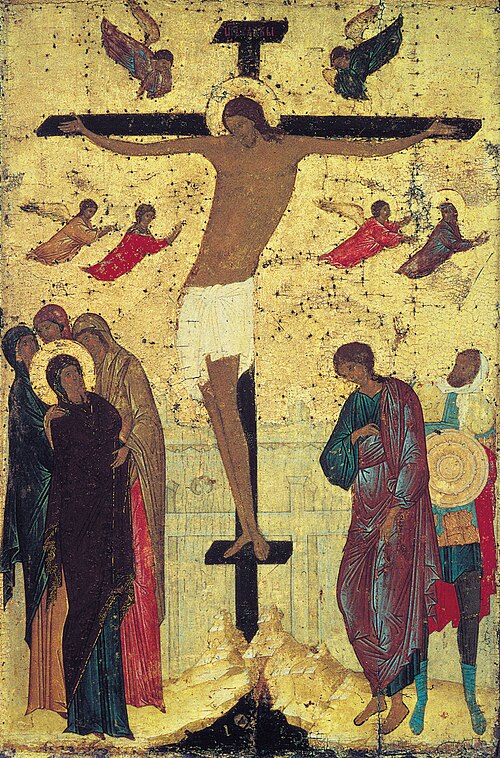
Dionisii, Crucifixion, 1500, Tretyakov Gallery, Moscow, Russia.
The 16th and 17th centuries witnessed increasing stylistic diversity in different regions, but the leading icon-painter of this late Muscovite period was Simon Ushakov (1626–1686). Ushakov became a pivotal figure in the transition from medieval iconography to a more Westernized style. Working for the Kremlin Armoury, he blended traditional Russian conventions with softer modeling, greater naturalism, and a new interest in individual expression. His icons—especially the Vladimir Mother of God and The Last Supper—mark a moment when Russian sacred art began to absorb Renaissance influences while still holding on to its devotional roots.
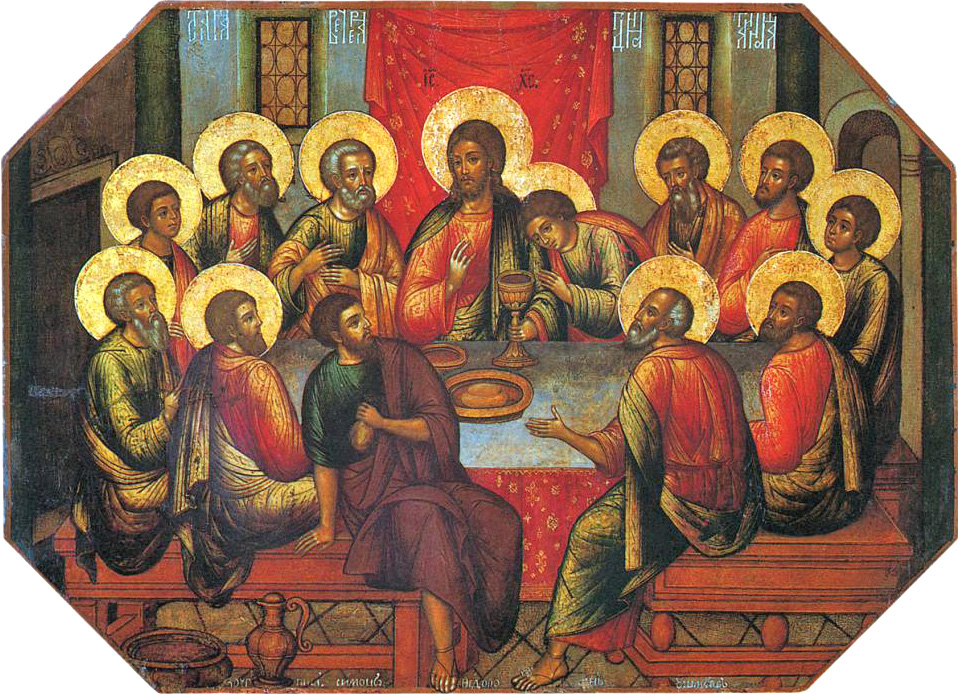
Simon Ushakov, The Last Supper, 1685, State History and Art Museum-Preserve, Sergiyev Posad, Russia.
Yet even as Ushakov and his circle embraced these new stylistic currents, the older icon tradition did not disappear. The schism of the Old Believers in the mid‑17th century had profound artistic consequences: rejecting liturgical reforms, Old Believers preserved earlier iconographic styles with remarkable fidelity, supporting a parallel visual tradition that carried the ancient style well into the modern era.
Demise and Revival of the Icon
With the reforms of Peter the Great in the early 18th century, the central place of the icon in Russian culture began to recede. Western artistic models were actively promoted, and religious painting shifted toward secularized, Europeanized forms that distanced themselves from the older iconographic canon. Icons themselves increasingly became mass‑produced objects from state workshops, losing much of the contemplative, handmade character that had defined them for centuries.
This marginalization deepened under Soviet rule, when religious art was suppressed, churches were closed or repurposed, and icon-painting survived largely in private hands. Yet despite these pressures, the icon tradition never fully disappeared; it endured quietly until its revival in the early 20th century, when its spiritual and artistic significance was once again recognized.
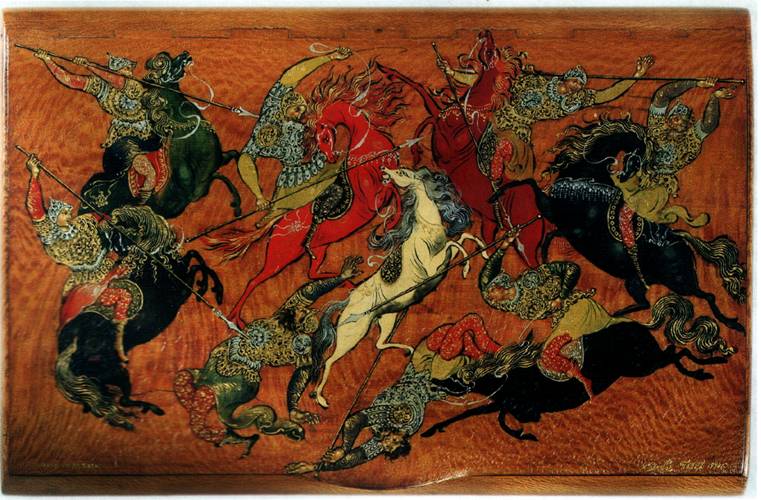
Cigarette case with Palekh miniature showing Ivan Golikov, The Battle, 1930. Photograph via Wikimedia Commons (public domain).
Ultimately, the history of icons shows a tradition that has endured across centuries of change without ever losing its grounding in faith. What is interesting is that, in the 20th century, certain formal qualities of the icon—its flatness, the emphasis on pure form, the refusal of naturalism—resurfaced in the work of avant‑garde artists such as Kandinsky and Malevich, who were on their path to radical abstraction. At the same time, in Palekh, one of the important centers for icon-painting in Russia, former icon painters adapted their skills to lacquer miniatures after 1917, carrying the elongated figures, rhythmic line, and luminous color of sacred art into a new secular craft.
These surprising afterlives of the icon—from modernist experimentation to new artisanal practices—reveal the remarkable adaptability of the icon’s visual language. Yet for believers, icons have never ceased to be what they fundamentally are: living objects of prayer, veneration, and encounter with the divine. In this continuity, the icon endures not merely as an art form but as a revelation, a place where image, ritual, and theology remain inseparably joined.