Celebrating Community and Resilience
But not everything told a story of rupture. Many of the exhibition’s strongest moments celebrated community and resilience. Vanley Burke’s portraits of multicultural Birmingham were vibrant with pride and intimacy, and Roy Mehta’s work explored the complexities of identity within these communities.
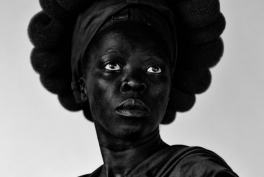
The show deftly interweaved the personal and political. Sutapa Biswas and Roshini Kempadoo employed portraiture to confront and reframe diasporic identities, their works layered with poetic defiance. Meanwhile, Joy Gregory and Maxine Walker created self-portraits to celebrate Black femininity. These demurely radical images communicated a defiance that refuses to be diminished.
The exhibition’s handling of queer representation was equally poignant, especially when viewed against the backdrop of the AIDS crisis and Section 28. Sunil Gupta’s ‘Pretended’ Family Relationships juxtaposed intimate portraits with oppressive legislative text, creating a deeply moving tension between presence and erasure. Ajamu X and Rotimi Fani-Kayode reclaimed the eroticized Black male body with fierce tenderness, their images vibrating with desire and defiance.
New Era of Creativity
As the exhibition wound toward its conclusion, it embraced the cultural vitality of countercultural movements. Ingrid Pollard and Franklyn Rodgers brought the riotous energy of underground performances and club culture to life. The exuberant creativity in these images felt like an act of resistance—a refusal to be silenced, even as the country struggles under the weight of conservative policies. This crescendo of energy led seamlessly into the fashion photography of Wolfgang Tillmans and Jason Evans, whose bold, youthful aesthetic signals the dawn of a new cultural era.
Portrait of a Nation
What emerged is not a neat narrative but a fractured, multifaceted picture of Britain—a nation in flux. This was the exhibition’s great triumph. It did not attempt to simplify the complexities of the 1980s but instead embraced them, presenting a decade as a series of shifting perspectives. Each photograph held a fragment of a larger truth, and together, they created a portrait of a country caught between despair and renewal. At Tate Britain, the lenses did not merely document; they transformed, reminding us that every image is an act of witness and a gesture of imagination.