
Chola Bronzes: Devotion in Metal
The bronze sculptures of the Chola period are among the most refined and enduring achievements of Indian statuary. Created between the 9th and 13th...
Maya M. Tola 12 June 2025
9 January 2026 min Read
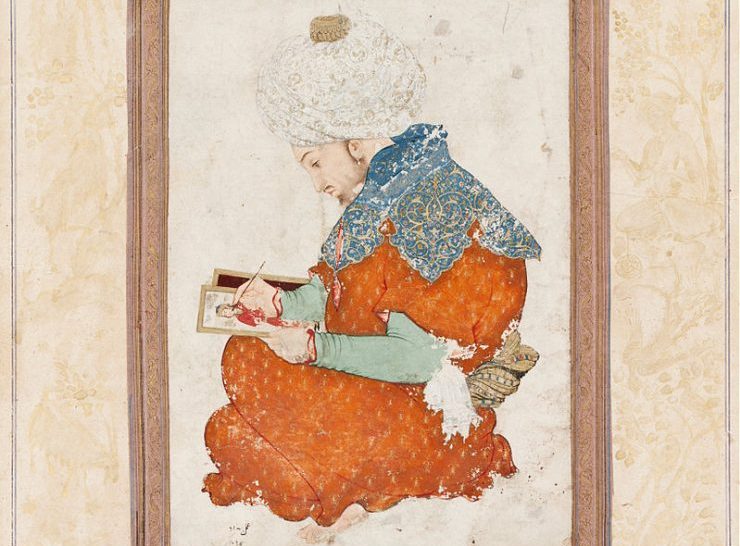
Kamal al-din Bihzad (attributed), Portrait of an Artist, 1001, Al Sabah Collection, Kuwait City, Kuwait. Detail.
Here we want to present you with the story of Kamal al-din Bihzad, a renowned Persian miniature painter and head of the royal ateliers in Herat and Tabriz. Bihzad is considered to be one of the leading artists in the history of Islamic miniature painting, so let’s delve together into the miniature world of Kamal al-din Bihzad!
Bihzad’s name has become synonymous with the high level of artistic skill displayed by the painters under the reign of Timurids and, later, the dynasty of Safavids in today’s Afghanistan and Iran, as he led an entire workshop (or kitabkhana) producing manuscript illuminations. Moreover, he came up with a new style that used geometry and architectural elements as the structural or compositional structures in which the figures are arranged. If you ever read a book that contained illustrations with architectural or optical illusions, you’ll soon see many similarities.
The figures are designed as idealized types that repeat across the manuscript and are featured in different stories. They are meant to convey a sense of mood and personality more subtle and expressive than in customary Persian manuscripts. However, the precision of drawing and control in execution is superb and was the hallmark of 15th-century painting in Herat, Afghanistan. The precision in the pattern, calligraphy, and design is Bihzad’s most important legacy, yet the subsequent generations broke with it, painting figures that were rigid and lifeless.
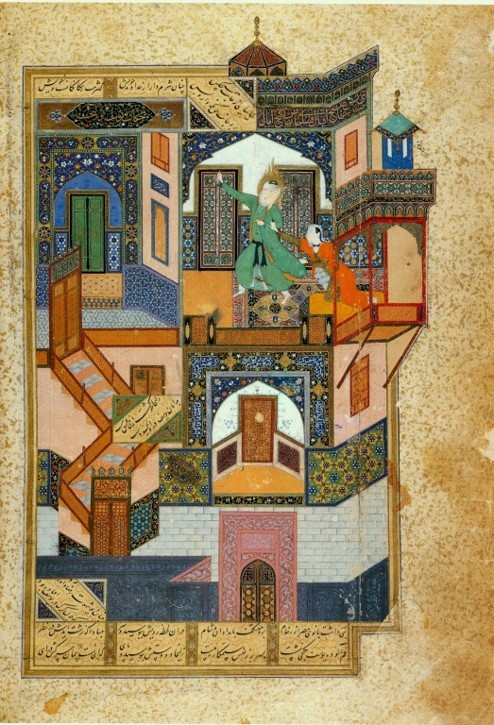
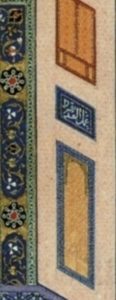
Sadly, not many of Bihzad’s signed works have survived, making the personal attribution of other works a matter of conjecture. Even though many manuscript illustrations and single paintings have been ascribed to his hand, only a few of these are officially certified as his work. In addition, Bihzad’s signatures are often either incorporated into architectural inscriptions or placed inconspicuously on an object in the painting, as we see above, making them hard to spot.
Get your daily dose of art
Click and follow us on Google News to stay updated all the time

DailyArt Magazine needs your support. Every contribution, however big or small, is very valuable for our future. Thanks to it, we will be able to sustain and grow the Magazine. Thank you for your help!

Magda, art historian and Italianist, she writes about art because she cannot make it herself. She loves committed and political artists like Ai Weiwei or the Futurists; like Joseph Beuys she believes that art can change us and we can change the world.

The bronze sculptures of the Chola period are among the most refined and enduring achievements of Indian statuary. Created between the 9th and 13th...
Maya M. Tola 12 June 2025
The Red Fort, or Lal Qila, stands as a commanding symbol of India’s rich cultural and political heritage. Commissioned by Mughal Emperor Shah...
Maya M. Tola 23 June 2025
The 2025 Lunar New Year, begins on January 29th. This is the Year of the Wood Snake, sixth animal of the Chinese zodiac, known for wisdom and intuition. Let us take a look at some of the East Asian art history that celebrates this awesome animal!
Candy Bedworth 28 January 2025
The lotus, a flower revered across many Asian cultures, holds a cherished place in Hindu art and spirituality. Found abundantly in sculptures,...
Maya M. Tola 14 March 2025


