Nakedness or Nudity? To Be a Woman Is to Perform
Throughout the centuries, women’s bodies have consistently been staged for display rather than simply allowed to exist. John Berger’s...
Guest Author 12 March 2026
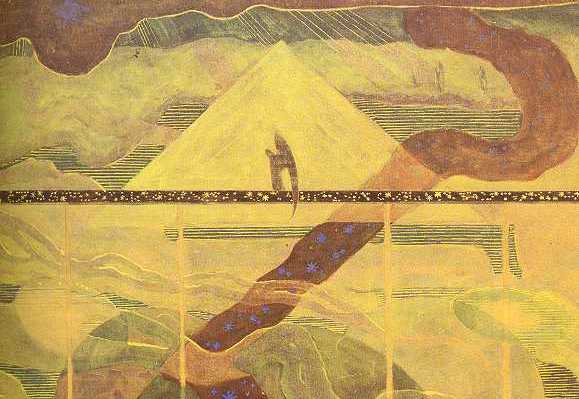
Mikalojus Konstantinas Čiurlionis, Adante from Sonata VI (Sonata of the Stars), 1908, M. K. Čiurlionis National Art Museum, Kaunas, Lithuania. Detail.
Unveiling the enigmatic ciphers they harbor, decoding symbols with concealed significance—these are the mysteries that wait to be unraveled. If you enjoy searching for secret meanings, you might want to take a closer look at the paintings of Mikalojus Konstantinas Čiurlionis.
Lithuanian Symbolist painter M. K. Čiurlionis (1875-1911) never signed his paintings. There are only two works that carry his signature: Allegro from Sonata No. 4 (Sonata of the Summer) and Finale of the Sonata No. 5 (Sonata of the Sea). And even in these cases, Čiurlionis’ initials are not easy to find!
Just take a look at Allegro from Sonata no. 4 (Sonata of the Summer) where he carefully places his (MKČ) and his fiancée’s initials (SK) perhaps as to solidify the memory of their engagement in Palanga (a seaside resort in Lithuania). At first glance, the initials are almost invisible. Can you spot them? Scroll down for the answer.
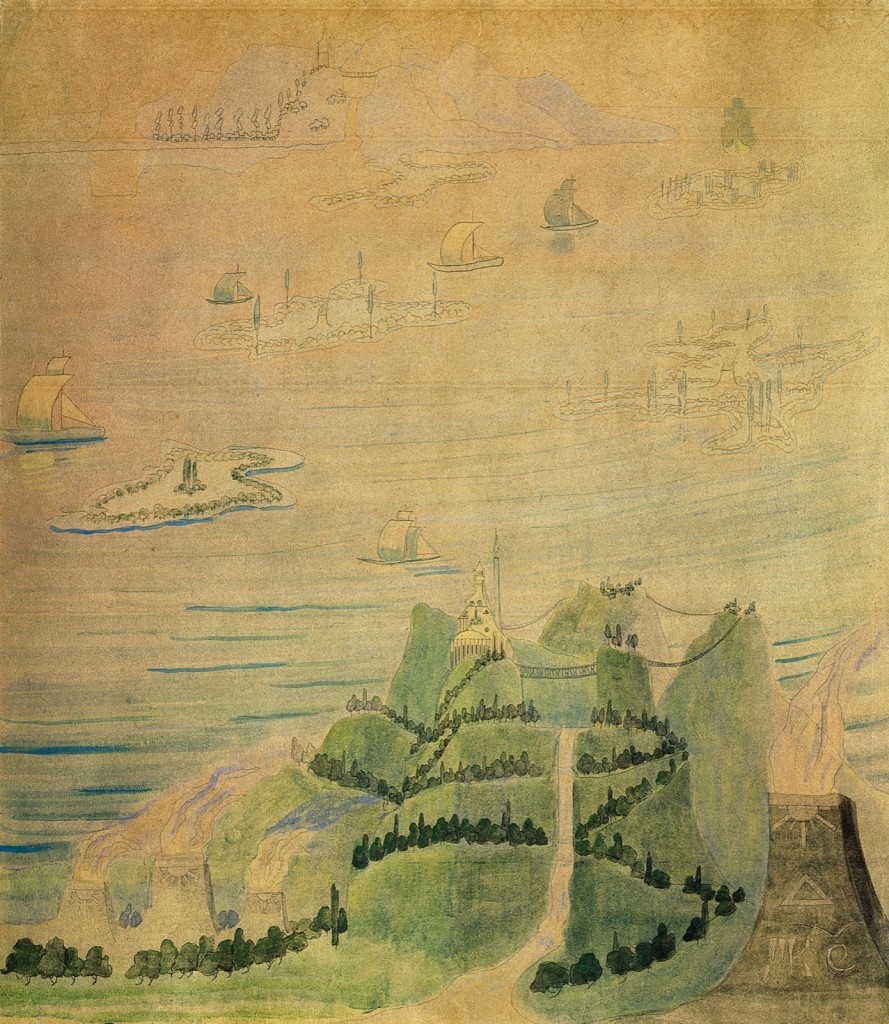
Mikalojus Konstantinas Čiurlionis, Allegro from Sonata no. 4 (Sonata of the Summer), 1907, M. K. Čiurlionis National Art Museum, Kaunas, Lithuania.
The artist’s initials (MKČ) are easier to find (on the altar in the bottom right corner). The search for SK letters is a bit more difficult. You can finally find them decorating the bridges that connect the mountains. The reason behind putting both of these initials this way remains a mystery as M. K. Čiurlionis rarely explained his ideas behind paintings.
However, the initials weren’t the only way in which M. K. Čiurlionis signed his paintings. Some believe that a symbol of a flying bird (similar to the accent on Č) was also his signature. We can find these birds at the bottom or in the corner of some of his paintings, such as Allegro of Sonata No. 1 (Sonata of the Sun) cycle or Fairytale (Castle’s Fairytale).
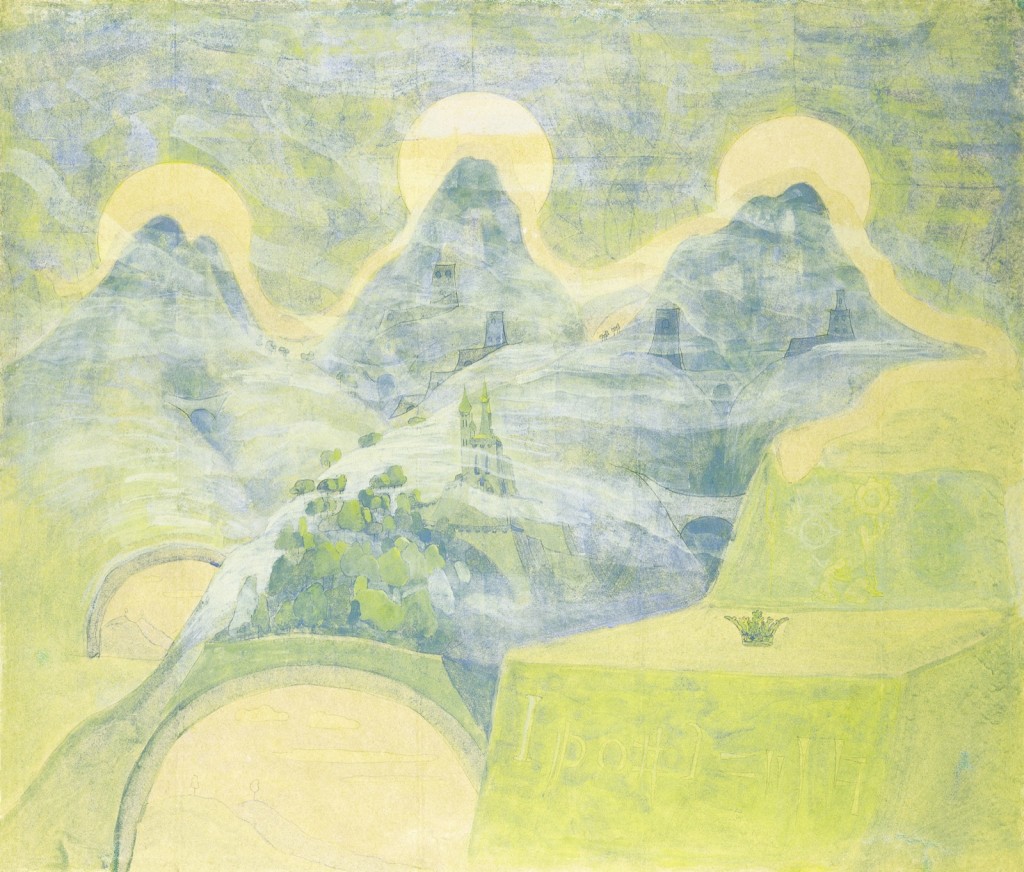
Mikalojus Konstantinas Čiurlionis, Finale from Sonata no. 3 (Sonata of the Serpent), 1908, M. K. Čiurlionis National Art Museum, Kaunas, Lithuania.
Sometimes Čiurlionis resorted to using symbols like in Finale of Sonata no. 3 (Sonata of the Serpent). Just look at the altar on the right side. In the bottom part, it has 9 symbols of unknown meaning. Čiurlionis researcher Rima Povilionienė believes that they stand for “Czurlanis“ – a Polish version of Čiurlionis last name.1
Above the altar, we can also find a square, triangle, and circle – three symbols that started appearing in his works in 1908. In general, these geometric figures had different meanings: a triangle would represent the human body, human beings, or the number 3, a circle – the mind, the heaven, or the number 1, and a square would serve as solidity or Earth, or the number 2. It is unclear in what way M. K. Čiurlionis uses these symbols, but Rima Povilionienė argues that this might have also been his signature as we find the circle and triangle around the letter K in his initial ex libris drawing.
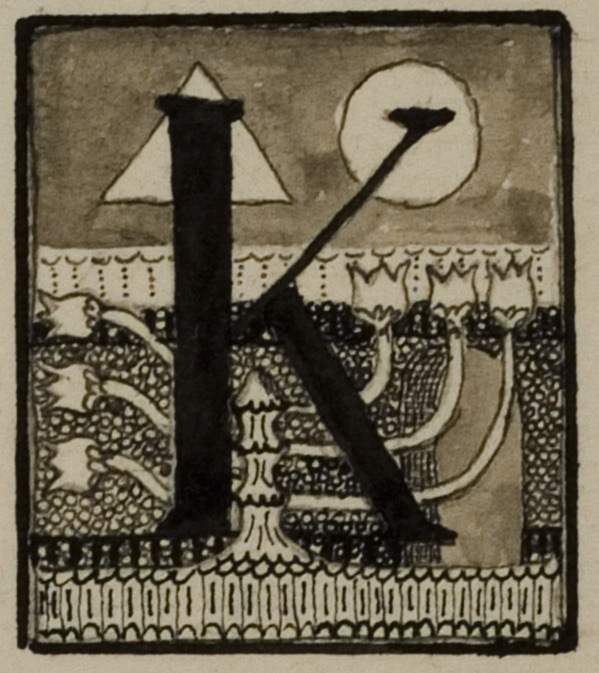
Mikalojus Konstantinas Čiurlionis, Initial K, 1908, M. K. Čiurlionis National Art Museum, Kaunas, Lithuania.
In this way, the triangle would mean the letter M, the square would be the letter K, and the circle – the letter Č. We see these figures in his last painting as well, but this time with a different meaning, since the last symbol is not the circle (as it would be if it was Čiurlionis’ signature).
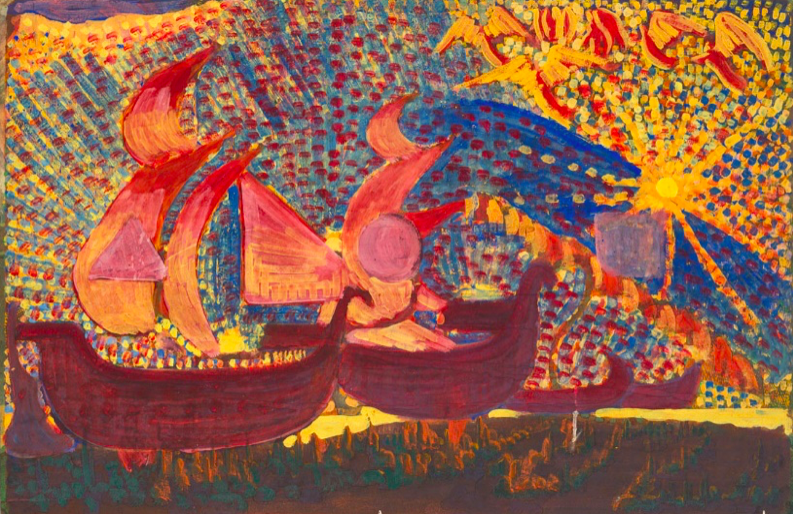
Mikalojus Konstantinas Čiurlionis, Ships, 1909-1910, M. K. Čiurlionis National Art Museum, Kaunas, Lithuania.
The Lithuanian Symbolist was fascinated by ciphers and codes so no wonder that his works are full of symbols that you might not even notice the first time you look at them. It is known that creating ciphered alphabets and codes was an activity that he indulged with his brothers. There is even a Čiurlionis alphabet that you can give a hand at using yourself.

Excerpt from Mikalojus Konstantinas Čiurlionis letter to Povilas Čiurlionis, 1905, M. K. Čiurlionis National Art Museum, Kaunas, Lithuania.

Excerpt from Mikalojus Konstantinas Čiurlionis letter to Povilas Čiurlionis, 1905, M. K. Čiurlionis National Art Museum, Kaunas, Lithuania.
If you decipher the messages, you will find that they were written in Polish. This comes as no surprise as Polish was Čiurlionis’ first spoken language. Despite having learned Lithuanian later in life, Polish was still more comfortable for him to write his thoughts in.
We can spot a piece of this alphabet also in his triptych Rex, which contains three symbols.
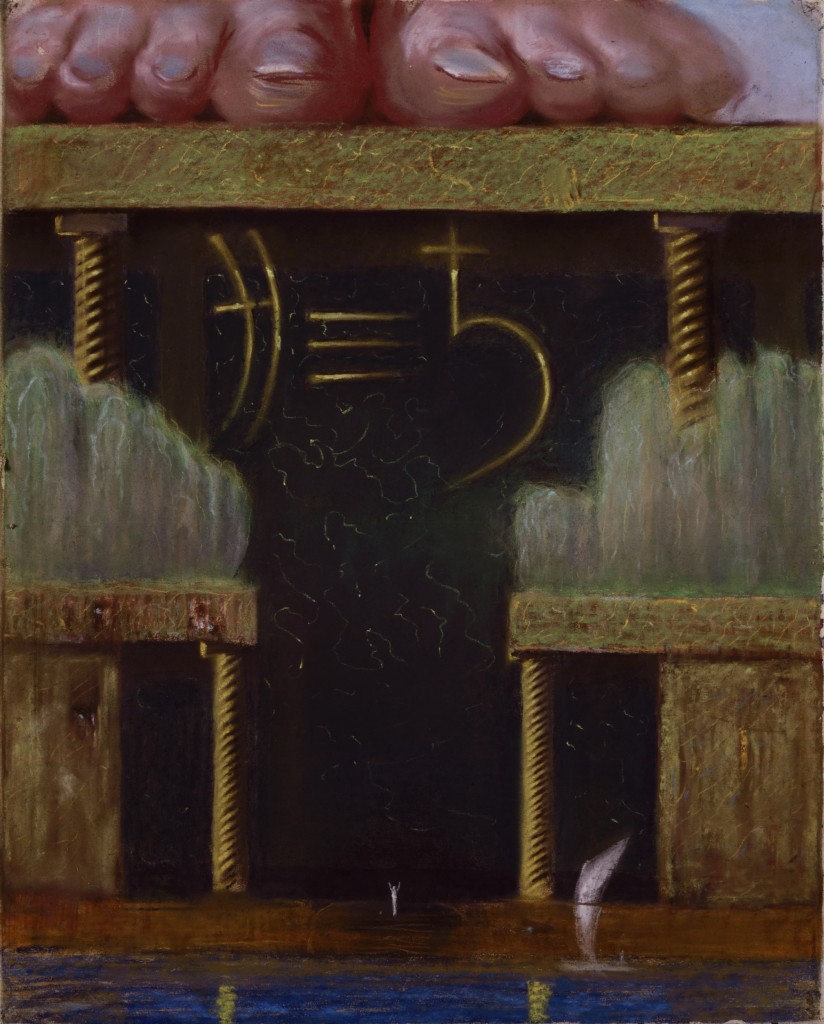
Mikalojus Konstantinas Čiurlionis, Rex (II), 1904/1905, M. K. Čiurlionis National Art Museum, Kaunas, Lithuania.
It is agreed that these three symbols stand for the title of the painting – R-E-X.
It is known that Čiurlionis liked using Zodiac signs as month names and we can find many of such symbols on the towers in Finale of Sonata II (Sonata of the Spring). The true meaning of the use of these symbols in this painting is again, unknown.
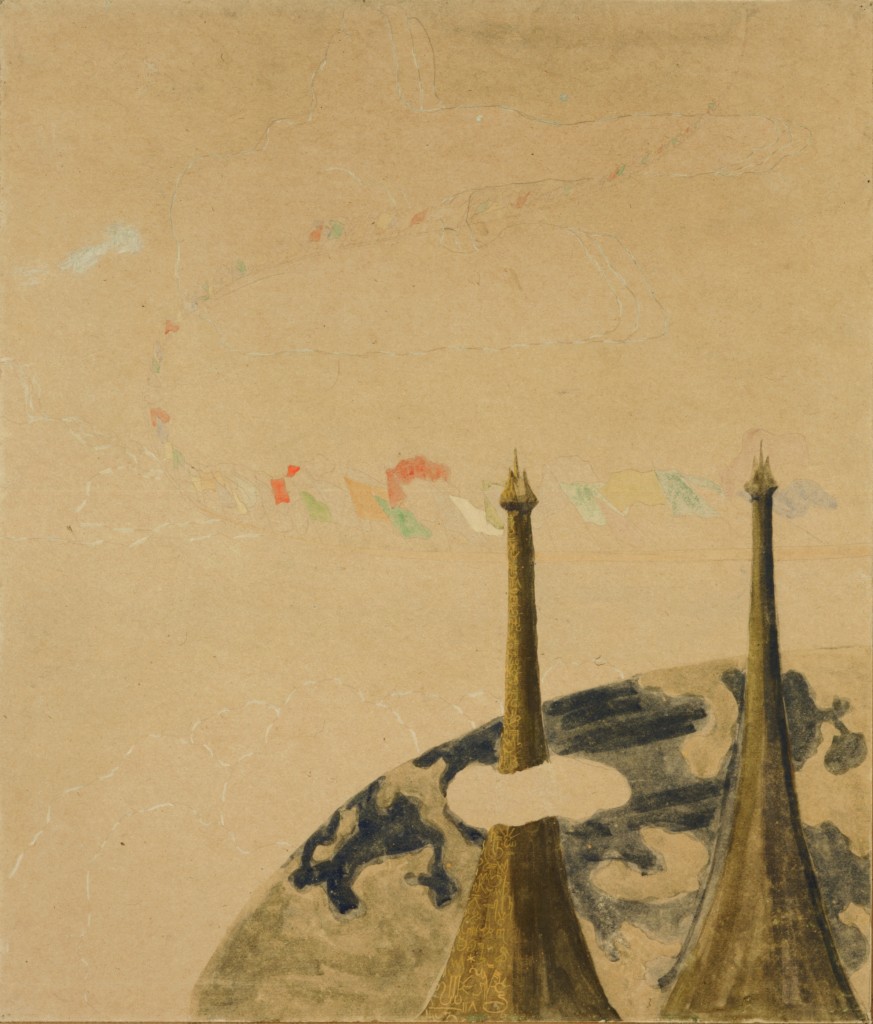
Mikalojus Konstantinas Čiurlionis, Finale from Sonata II (Sonata of the Spring), 1907, M. K. Čiurlionis National Art Museum, Kaunas, Lithuania.
Lastly, let’s take a look at Čiurlionis cipher that is still a mystery. This message is believed to be a quote, because of the multiple dots that begin the sentence, with the author’s name above it. Since Čiurlionis mostly spoke Polish, there is a lot of chance, that this could be a quote from a Polish author (or foreign author translated to Polish) hidden there. Take a look. Maybe you will be the one to decipher it?
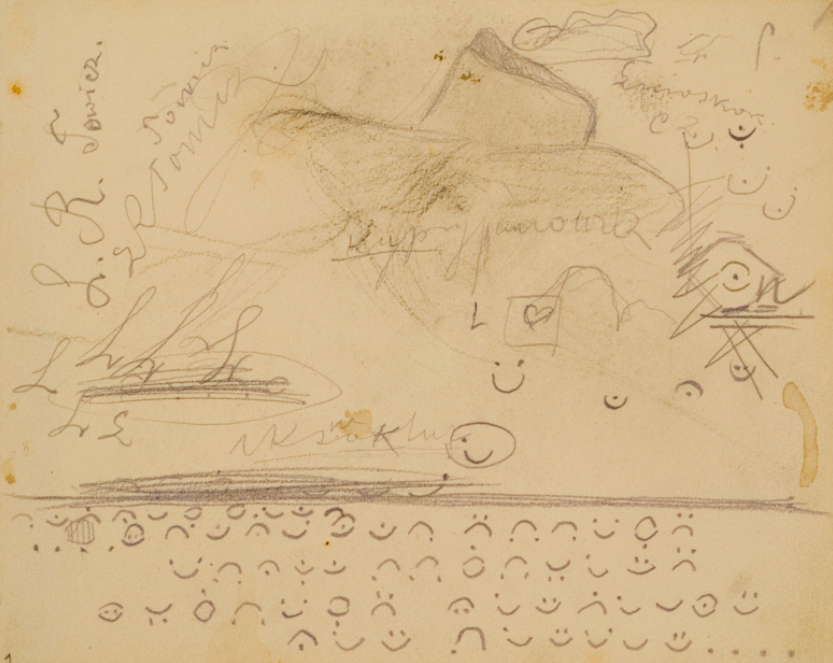
Mikalojus Konstantinas Čiurlionis, Cipher (Čg 22 p. 1), 1900s, M. K. Čiurlionis National Art Museum, Kaunas, Lithuania.
M. K. Čiurlionis left a lot of mysteries surrounding the meanings of his paintings and the symbols and ciphers used could be a way to understand some of them. Some of the ciphers have been unlocked, others are still waiting to be read. Take a look at the paintings, sketches, and letters yourself – maybe you will discover something that was hidden.
Guest Author’s bio:
Greta Katkeviciene is an employee of M. K. Čiurlionis National Museum of Arts, with a goal to introduce the undiscovered genius that was M. K. Čiurlionis to the world.
Rima Povilioniene, Search of Čiurlionis Signature and Dedication. Fugue in b: Structural and Semantic Analysis, 2013.
Get your daily dose of art
Click and follow us on Google News to stay updated all the time

DailyArt Magazine needs your support. Every contribution, however big or small, is very valuable for our future. Thanks to it, we will be able to sustain and grow the Magazine. Thank you for your help!

This is our guest profile for occasional authors. If you have an interesting story about art to tell, send it to our Editor-in-chief Kate at [email protected]. You might be the next here!
Throughout the centuries, women’s bodies have consistently been staged for display rather than simply allowed to exist. John Berger’s...
Guest Author 12 March 2026
As we are in the middle of the season of Great Lent, sacred imagery becomes a bridge between the material world and spiritual reflection. Even today,...
Guest Author 12 March 2026
Fanny Eaton was a regular model for the Pre-Raphaelites during the 1860s and features in a number of famous works. Yet for most of the last century,...
Catriona Miller 19 February 2026
From van Gogh’s sunflowers, through golden dresses, to tranquil landscapes—yellow lights up the scene. It is the color of the sun, associated...
Kinga Dobosz 26 February 2026