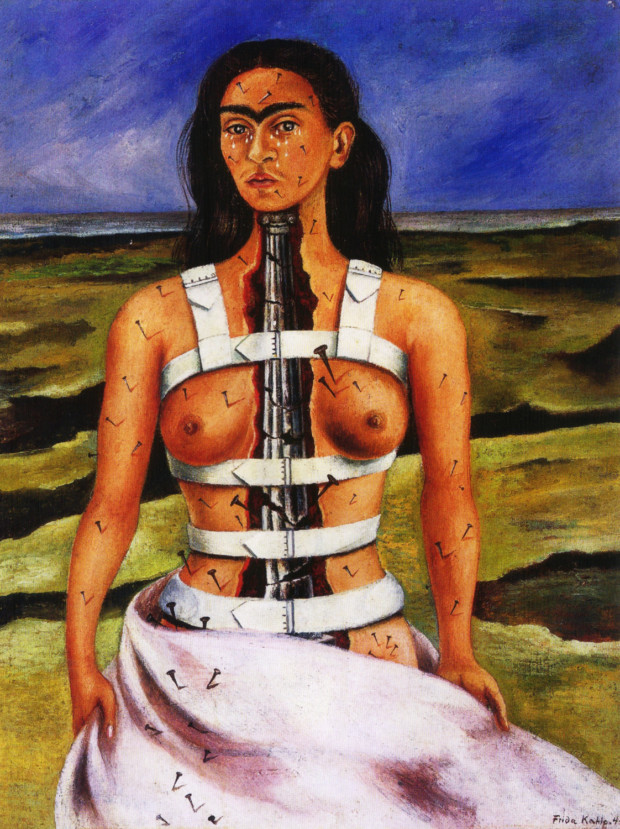
The Broken Column was painted shortly after Frida Kahlo had undergone another surgery on her spinal column. The operation left her bedridden and “enclosed” in a metallic corset, which helped to alleviate the intense, and constant pain she was in.
The pain was a constant companion of Kahlo’s life. On September 17, 1925, Kahlo and her boyfriend and fellow Cachuca, Alejandro Gómez Arias, were on their way home from school when the wooden bus they were riding collided with a streetcar. Several people were killed, and Kahlo suffered nearly fatal injuries—an iron handrail impaled her through her pelvis, fracturing the bone. She also fractured several ribs, her legs, and her collarbone. She spent a month in the hospital and two months recovering at home, before being able to return to work. As she continued to experience fatigue and back pain, her doctors ordered x-rays, which revealed that the accident had also displaced three vertebrae. Her treatment included wearing a plaster corset, which confined her to bedrest for part of the three months she spent unable to walk.
The accident ended Kahlo’s dreams of becoming a doctor and caused her pain and illness for the rest of her life.
In this painting she is depicted standing in the middle of a completely arid, cracked landscape. Her torso is encased in metal belts lined with fabric that provide pressure and support for her back. They help to prevent her body from collapsing, a possibility which is announced by the image running down the middle of her torso. There a completely fractured Ionic column on the point of collapse has replaced her spinal column. Frida’s head rests on the capital. Although her face is bathed in tears, it doesn’t reflect a sign of pain. The nails piercing her body are a symbol of the constant pain she faced.
By 1944, Kahlo’s doctors had recommended that she wear a steel corset instead of the plaster casts she had worn previously.
Find out more:
[easyazon_image align=”none” height=”160″ identifier=”0060085894″ locale=”US” src=”https://www.dailyartmagazine.com/wp-content/uploads/2017/10/51pCfS2C5fL.SL160.jpg” tag=”dailyartdaily-20″ width=”106″] [easyazon_image align=”none” height=”160″ identifier=”383650085X” locale=”US” src=”https://www.dailyartmagazine.com/wp-content/uploads/2017/10/51R6rCbxvlL.SL160.jpg” tag=”dailyartdaily-20″ width=”131″] [easyazon_image align=”none” height=”160″ identifier=”0547821840″ locale=”US” src=”https://www.dailyartmagazine.com/wp-content/uploads/2017/10/51cF82pblDL.SL160.jpg” tag=”dailyartdaily-20″ width=”128″]