

Masterpiece Story: Judith and Holofernes by Caravaggio
Judith and Holofernes is a Caravaggio masterpiece that captures Biblical murder and drama. Rarely has death been captured so intensely and violently...
James W Singer 13 September 2026
3 May 2026 min Read
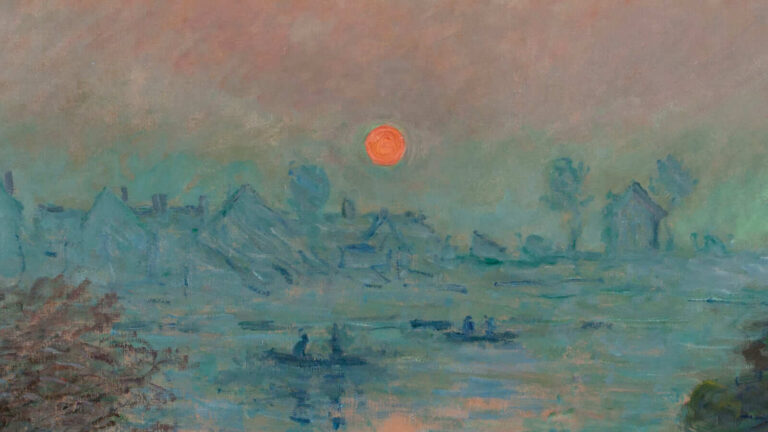
Claude Monet, Sunset on the Seine at Lavacourt, Winter Effect, 1880, Petit Palais, Paris, France. Detail.
Sunset on the Seine at Lavacourt, Winter Effect by Claude Monet is an Impressionist masterpiece filled with the cold of winter and the sadness of personal loss. Painted in 1880, it captures the quiet banks of the Seine near Lavacourt, where muted light and drifting fog dissolve the landscape into a fleeting, melancholic atmosphere.
Claude Monet (Paris, 1840–Giverny, 1926) is one of the most famous artists in Western art. His life and works form the cornerstone of Impressionism, which still enjoys incredible popularity today. Monet and his fellow Impressionist painters believed that the essence of painting was to capture fleeting moments. Their canvases were like oil-based photographs. They desired to suggest atmospheric effects through clouds, rain, and sunshine. Monet exemplifies his signature style through one of his masterpieces, Sunset on the Seine at Lavacourt, Winter Effect.
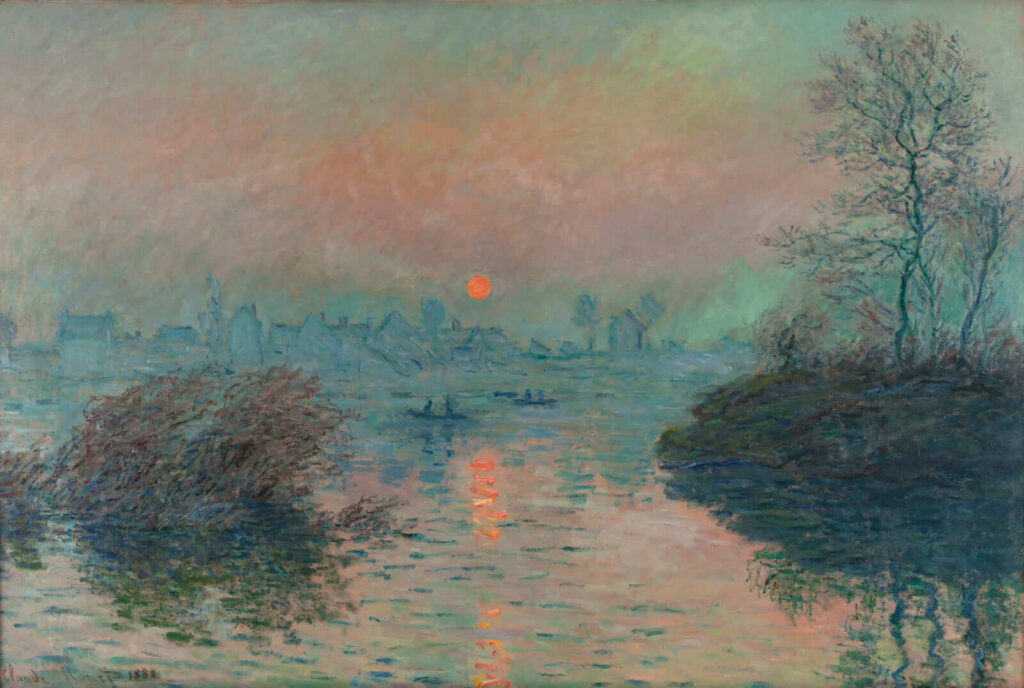
Claude Monet, Sunset on the Seine at Lavacourt, Winter Effect, 1880, Petit Palais, Paris, France.
This beautiful oil on canvas is a large-format landscape measuring 100 cm by 150 cm (3.28 ft × 4.92 ft). Its oversized dimensions make this piece quite rare for Claude Monet’s career during the 1880s, when he was primarily focused on small-format images. Holistically, reviewing Monet’s entire career, Sunset on the Seine at Lavacourt, Winter Effect remains one of his largest landscape images.
The painting is a riverscape with the Seine River dominating the foreground. Flanking the left and the right sides are small islands populated with bushes and trees. In the central mid-ground are two fishing boats, each with two fishermen. In the background are the hazy outlines of houses and trees of a distant village. Centrally, above everything, a bright, burnt-orange sun slowly sinks below the horizon line.
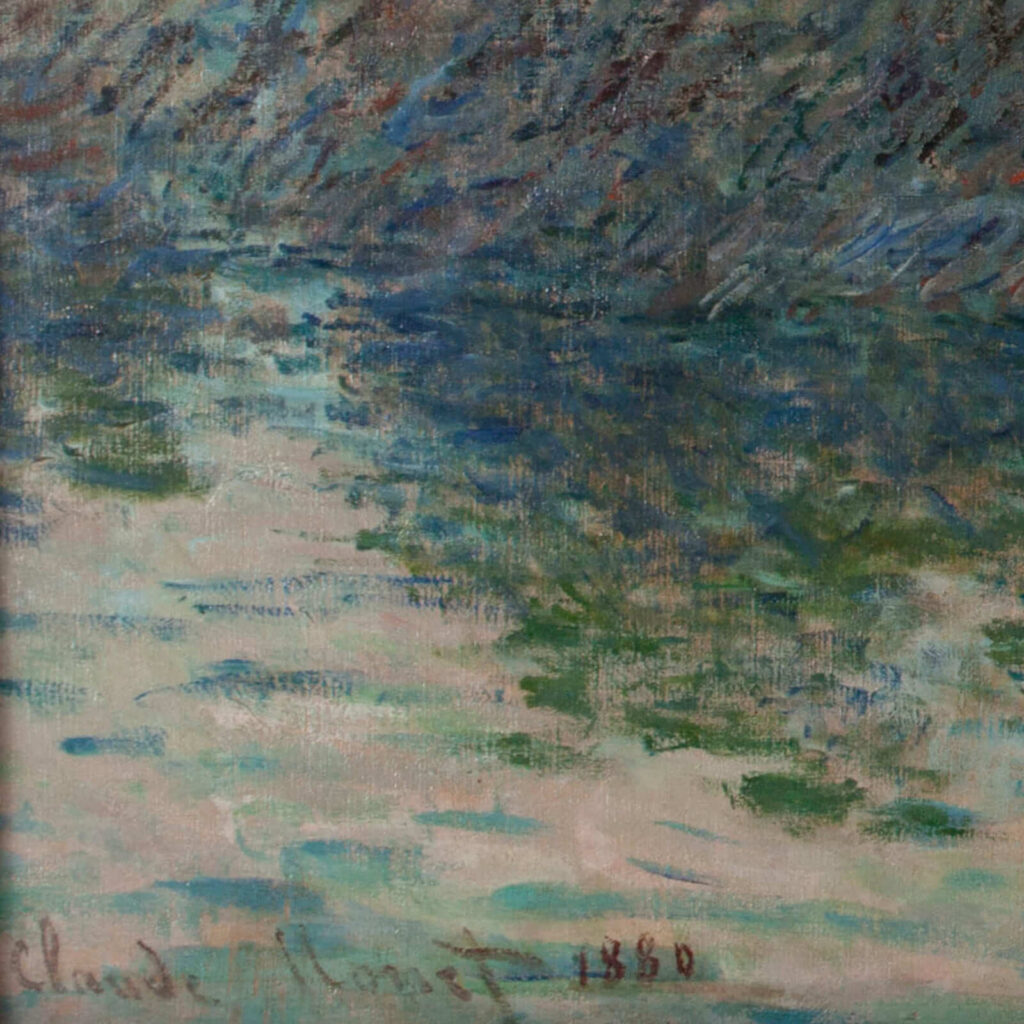
Claude Monet, Sunset on the Seine at Lavacourt, Winter Effect, 1880, Petit Palais, Paris, France. Detail.
The Seine River is the lifeblood of Paris and the surrounding region of Île-de-France. It has formed a cultural backbone to the French nation by connecting villages and towns to the nation’s capital. Claude Monet captures the slow-moving water with large fluid brushstrokes, highlighting blue and green against the mottled orange reflections of the sun.
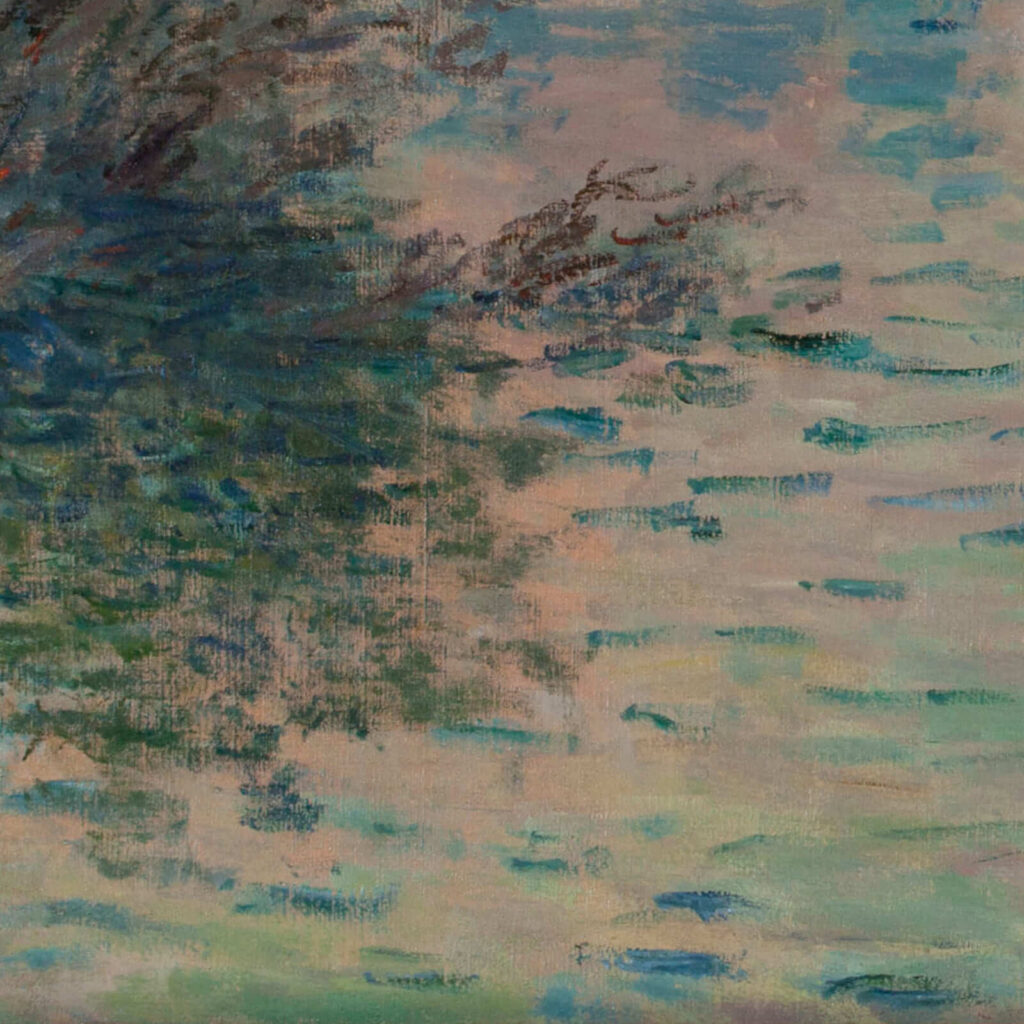
Claude Monet, Sunset on the Seine at Lavacourt, Winter Effect, 1880, Petit Palais, Paris, France. Detail.
Claude Monet continues his fluid brushstrokes with the islands to the left and right of the scene. However, the markings are finer and thinner to express the delicacy of the foliage. Small wispy brushstrokes imprint leaves and branches against the cloudy sky and reflective water.
The islands in the foreground provide a sense of depth to the waterscape, with their large heights overshadowing the small buildings in the background. They imply a linear perspective where closer objects to the viewer appear larger and smaller objects recede toward the horizon line.
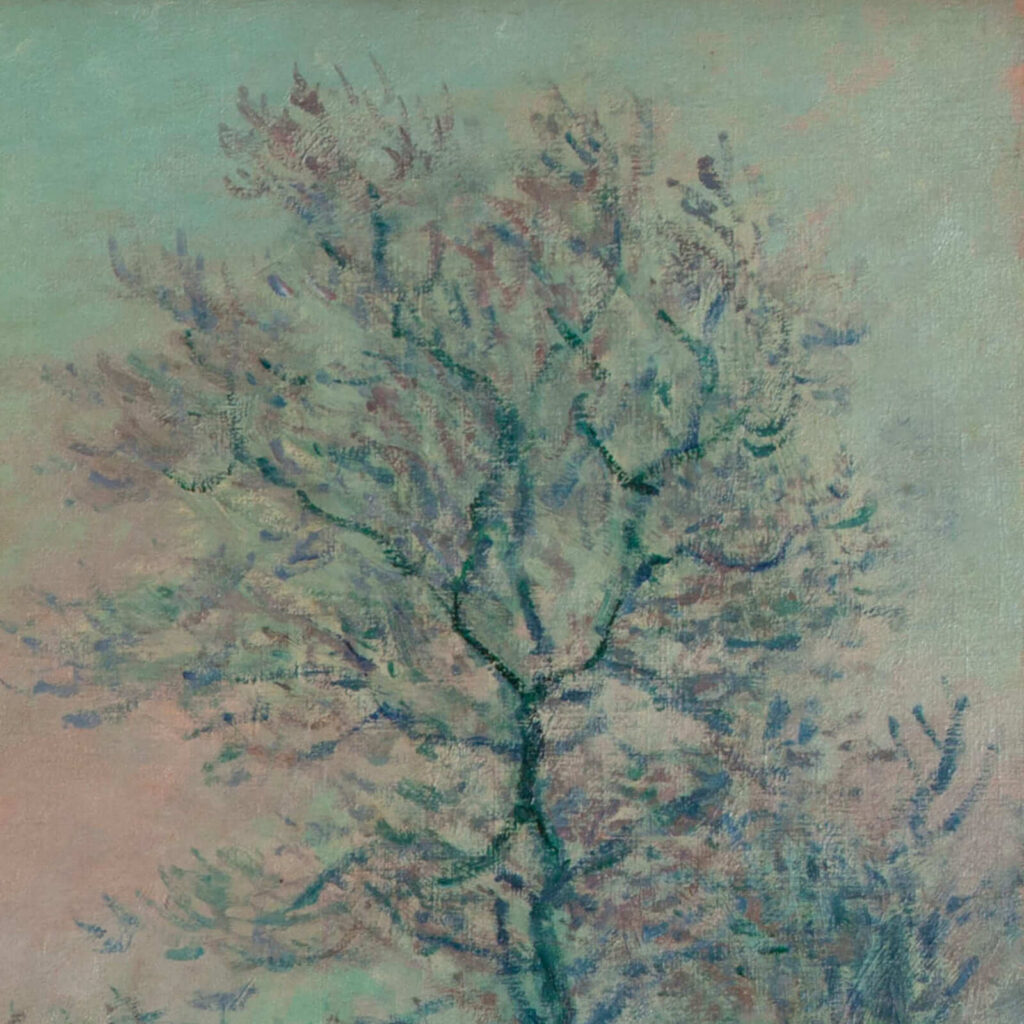
Claude Monet, Sunset on the Seine at Lavacourt, Winter Effect, 1880, Petit Palais, Paris, France. Detail.
Monet desires to transport the viewer to the late hours of a winter’s day. The fishermen in the central mid-ground have just finished a day’s work and are returning to the village. They are depicted in the same dark blue shades as the rippling brushstrokes of the foreground river, therefore blending them into the scene, as fishermen are directly linked to their natural watery surroundings. While in reality they are moving across the water’s surface, pictorially, they are frozen in time, sitting motionlessly. They are an element of the landscape.
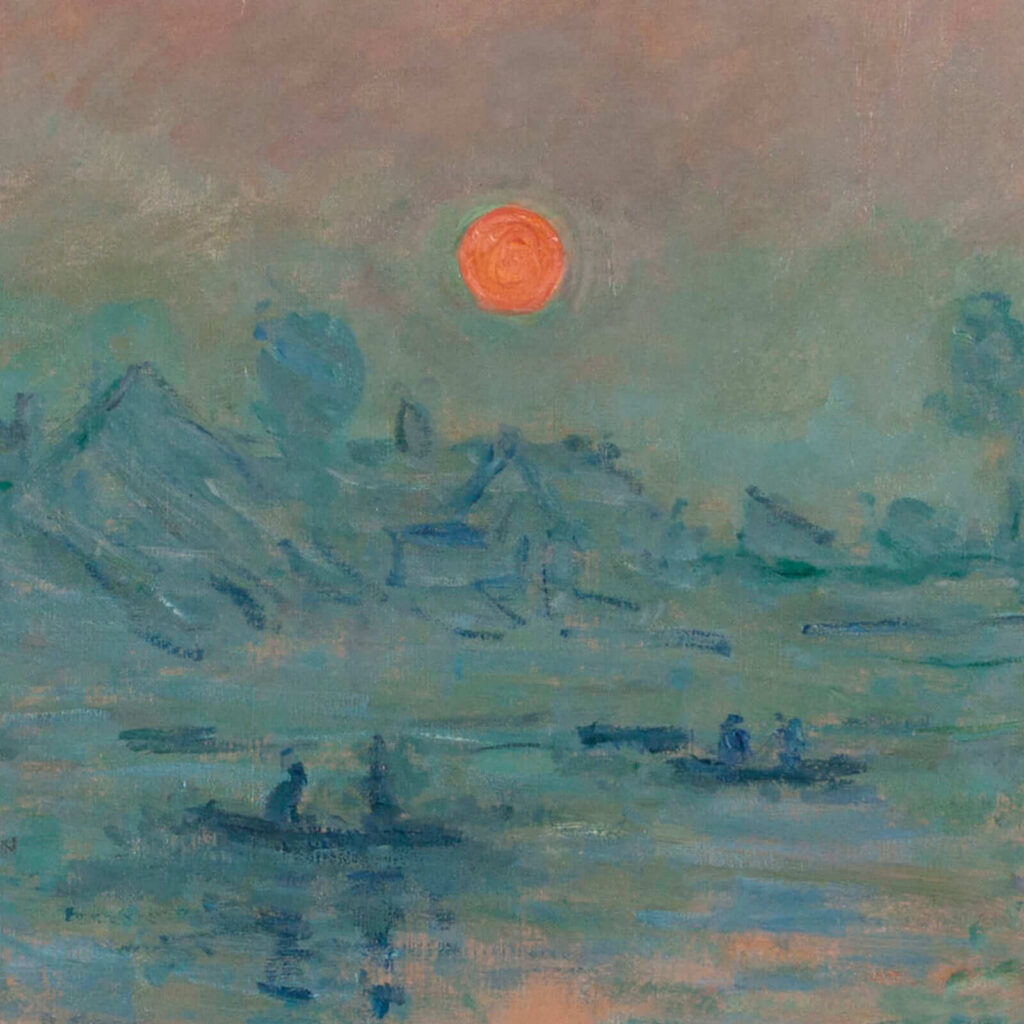
Claude Monet, Sunset on the Seine at Lavacourt, Winter Effect, 1880, Petit Palais, Paris, France. Detail.
The horizon line is populated by an assortment of buildings and trees that represent the village of Vétheuil. Monet installed himself in the village of Lavacourt in September 1878, which faces the village of Vétheuil on the opposite bank of the Seine. Therefore, while the painting’s title mentions Lavacourt, it is not Lavacourt presented, but rather the perspective of Lavacourt.
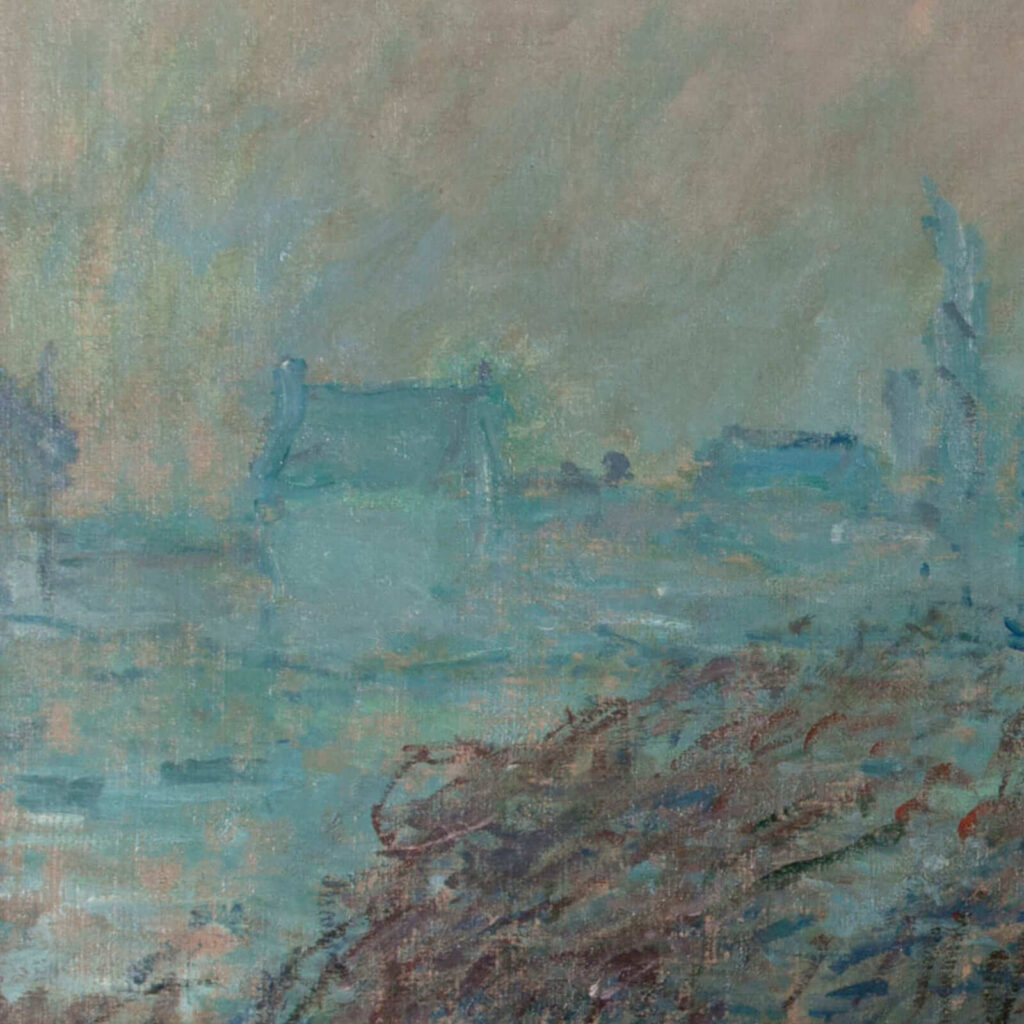
Claude Monet, Sunset on the Seine at Lavacourt, Winter Effect, 1880, Petit Palais, Paris, France. Detail.
Vétheuil, like the fishermen, is depicted in shades of blue that are tied with the bluish mistiness of the wintery atmosphere. The viewer can almost imagine thin layers of ice clinging to the roof lines. The winter of 1879–1880 was an extremely cold season in the region of Île-de-France, where Parisians and the surrounding countryside were paralyzed by ice and snow. People did not leave their homes for days, transportation regularly stopped, and a hermit-like existence threw a sense of loneliness and isolation everywhere. This feeling of cold melancholy is felt throughout the painting.
Claude Monet was deeply emotionally affected by this bitter winter due to the recent death of his beloved wife, Camille Monet. The painter was naturally depressed and melancholic as he mourned for his wife. Therefore, he sought distraction in the early months of 1880 by painting over 20 canvases of the surrounding Lavacourt landscape and its perspectives.
He found a particular interest in the melting ice on the surface of the Seine, almost as if he was correlating the hopes of his depression eventually melting away one day. When viewed through the understanding of a recent widower, Sunset on the Seine at Lavacourt, Winter Effect has a tragic beauty, like a bittersweet ending.
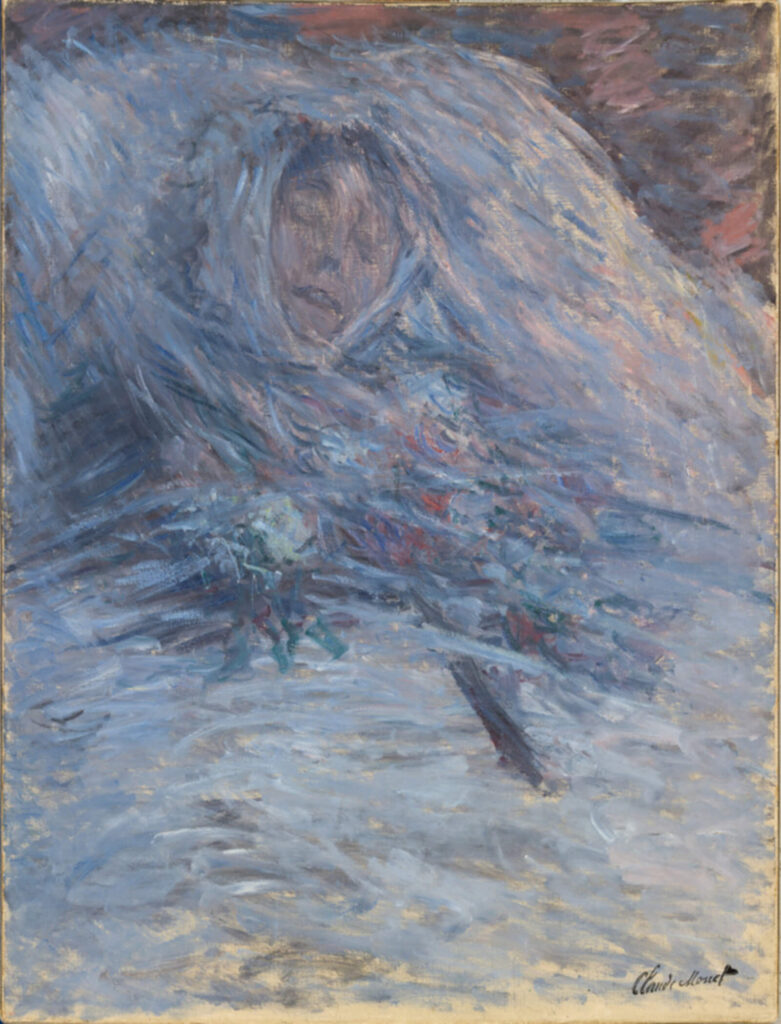
Claude Monet, Camille on Her Deathbed, 1879, Musée d’Orsay, Paris, France.
Centrally located is a bright burnt-orange sun that, according to the title, is in the motion of sunset. Its prominent warmth is reflected below in the multiple orange brush strokes on the water’s surface, and throughout the hazy warmth surrounding the cloudy sky. It boldly contrasts against the dominating elements of air and water, which fill almost equal halves of the scene. The sun is filled with thick impasto, which echoes the impasto of the Seine water.
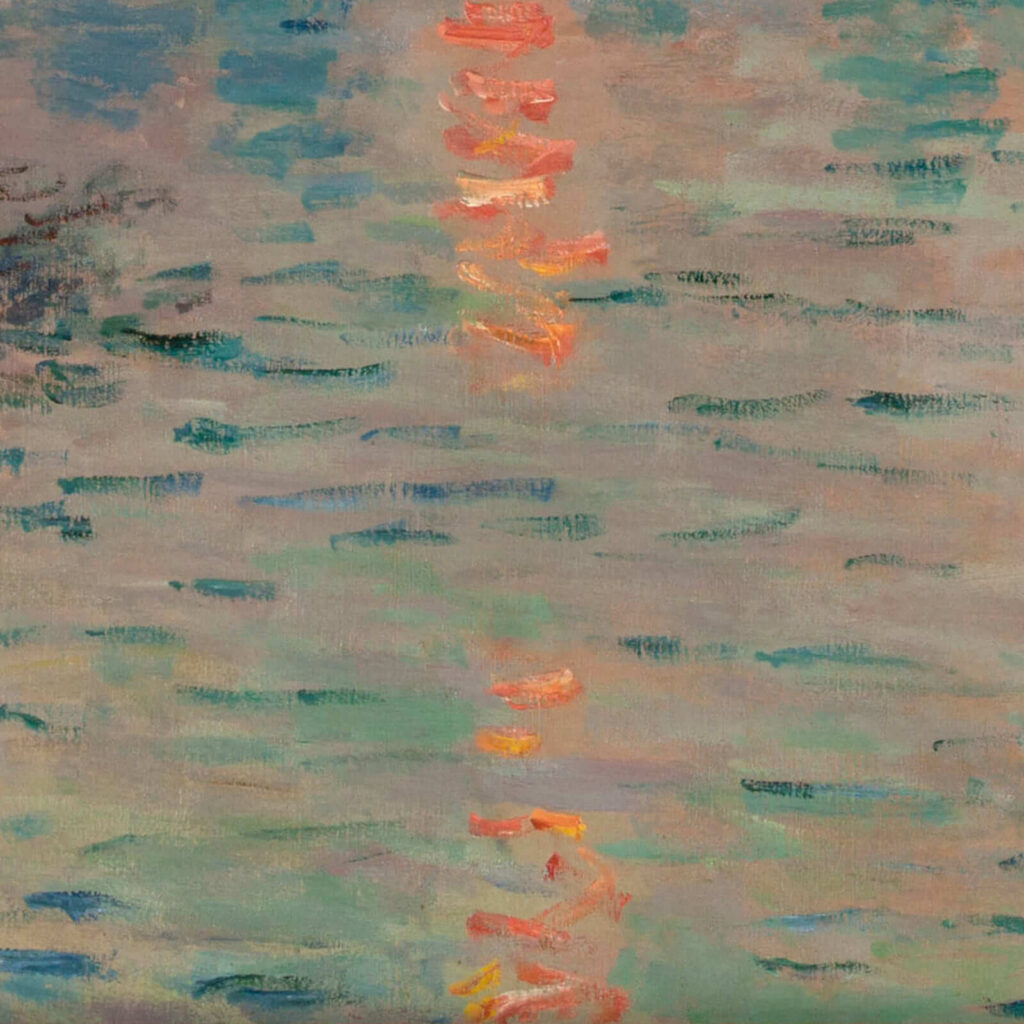
Claude Monet, Sunset on the Seine at Lavacourt, Winter Effect, 1880, Petit Palais, Paris, France. Detail.
However, it contrasts with the fluid and blended brush strokes of the cloudy sky. Through its similarities and contrasts found throughout the composition, it forms the nucleus and unifies the waterscape.
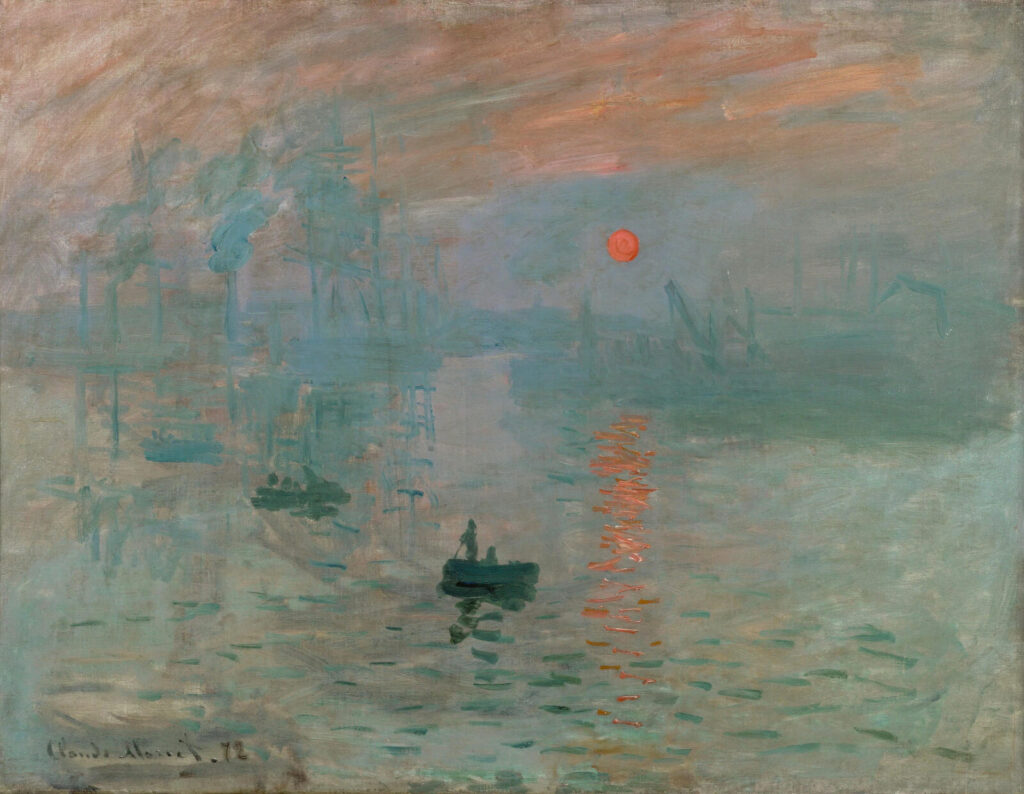
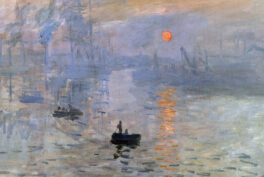
Claude Monet, Impression, Sunrise, 1872, Musée Marmottan Monet, Paris, France
The general composition of a centrally located orange sun above a water landscape echoes the earlier composition of Impression, Sunrise, painted in 1872. This now famous painting was scathingly denounced by an unimpressed art critic who then famously coined the word Impressionism, and inadvertently named an entire art movement.
Claude Monet was particularly fond of Sunset on the Seine at Lavacourt, Winter Effect. Some art historians believe that he never submitted it to the scrutiny of a jury at the famous Paris Salons. However, some historians believe that he did submit it to the Paris Salon of 1880, but descriptions of the presented paintings are sometimes vague and therefore open to interpretation.
Regardless if the image was officially displayed or not, Monet kept the painting for many years at his private home until it was later acquired by a collector. Since the painting was created during a moment of intense emotional loss, perhaps Monet kept it while mourning but eventually sold it once he had gained peace and closure? We may never truly know Monet’s feelings about this masterpiece, but viewers can hypothesize by viewing the image, with free entry, at the Petit Palais in Paris, France.
DailyArt Magazine needs your support. Every contribution, however big or small, is very valuable for our future. Thanks to it, we will be able to sustain and grow the Magazine. Thank you for your help!

James W. Singer is an art historian and fine art photographer. He earned a Bachelor of Arts in Art History from the University of Florida. He later moved to Paris, France. He currently writes “Masterpiece” articles for DailyArt Magazine.

Judith and Holofernes is a Caravaggio masterpiece that captures Biblical murder and drama. Rarely has death been captured so intensely and violently...
James W Singer 13 September 2026
Winslow Homer (1836–1910) was one of the leading American Realist painters. His painting The Veteran in a New Field is a masterpiece of late...
James W Singer 30 August 2026
At first glance, A Goldsmith in His Shop (1449) appears to depict an ordinary visit to a jeweller. Yet Petrus Christus transformed an ordinary...
Shivani Gupta 23 August 2026
With Virgin and Child as a cornerstone of her reputation, Elisabetta Sirani should be recognized as an important Italian Baroque artist. Far more...
James W Singer 16 August 2026