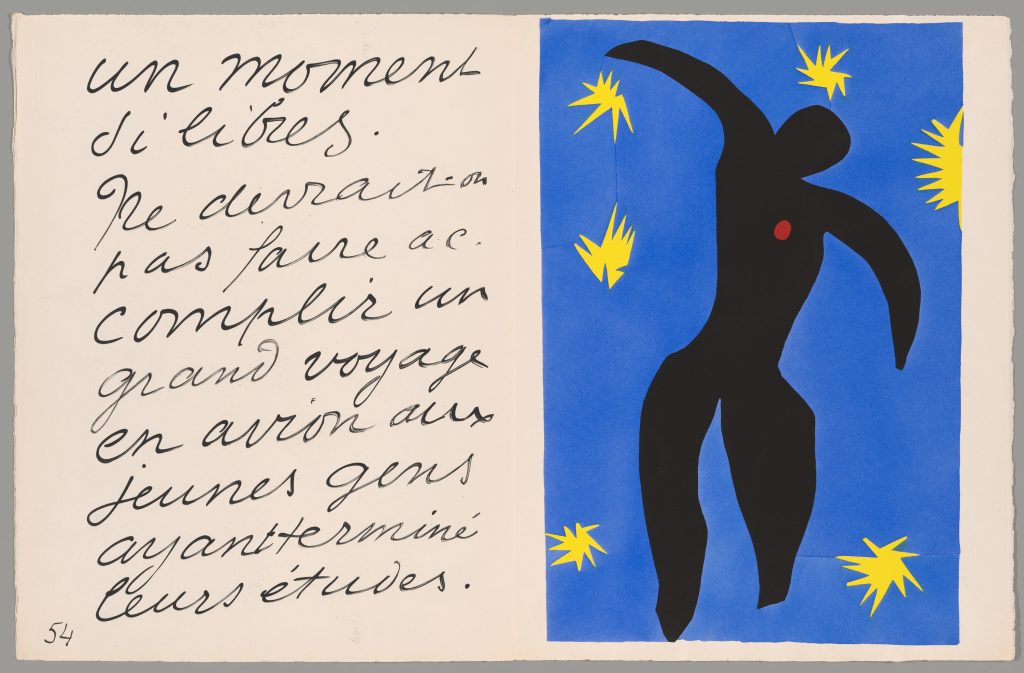
Icarus is a tragic character from Greek mythology. His father, Daedalus, was the most famous innovator of their time. One of his inventions was two sets of wings that were supposed to help him and his son escape from a tower, where they were held prisoners. He made them out of fragile natural materials and warned his son to be careful not to fly too close to the water nor the sun to keep the wings from damage. Unfortunately, after taking off, Icarus was so amazed by the idea of flying that he got too close to the sun, causing his wings to melt. The young man fell into the sea and was never found again.
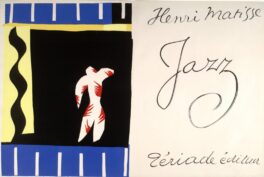
Icarus has been a significant figure in Western art for centuries. He is the symbol of people’s vanity and arrogance, representing the idea of always wanting more than we can actually have. Jazz was published in 1947, but Matisse started working on the project in 1941, during the height of German occupation in France. As the curators of the exhibition point out, even if the artist was not openly political in his work, it is quite impossible not to think of the historical context while looking at it.
Therefore, we could imagine Icarus as a fallen soldier who is fighting in the name of his leaders’ ambitions. Matisse achieved something extraordinary with only a few shapes and colors, making his image a double metaphor. The movement of the figure could be read at the same time as dancing and falling. The irregular shapes around him can be seen as stars or lights, but also as fired shots or explosions. Icarus is at the same time a dancer and a soldier, an artist and a fighter—just like in his origin story.
2. Daisies
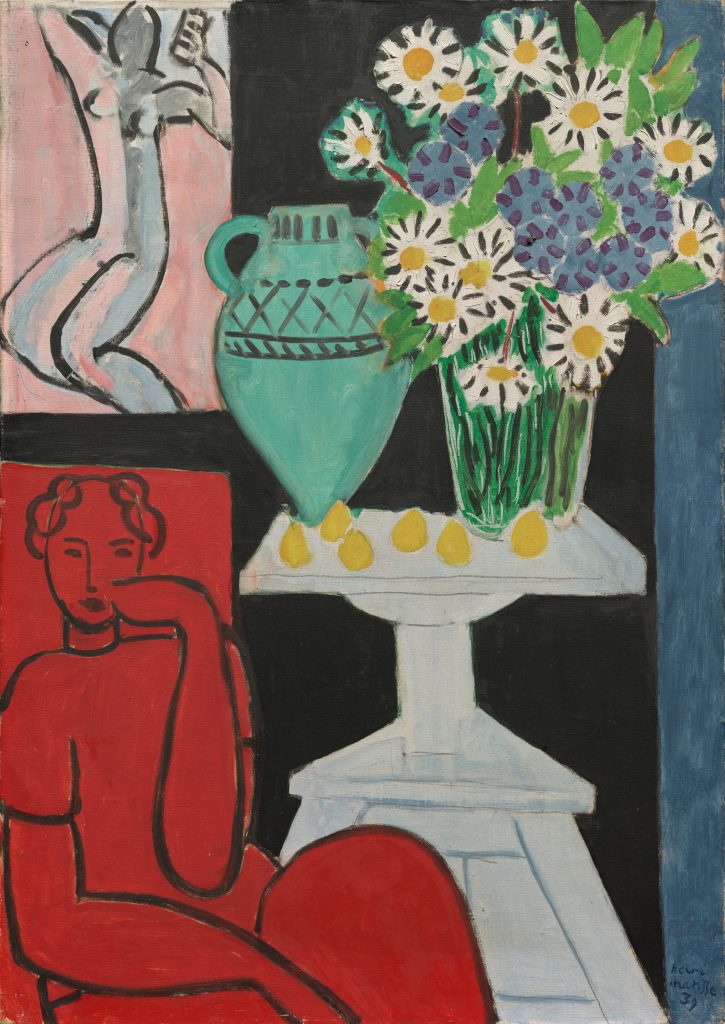
Matisse painted Daisies in 1939. The composition is a perfect union of abstraction and realism. We can name the objects and figures appearing in the painting—a green vase, a bouquet of flowers, lemons, and two women. However, if we were asked to describe what is actually happening in the scene, it might appear as a slightly more challenging task. These “realistic” objects create a composition whose role is not to represent “reality.”
The history of Daisies becomes particularly absorbing after leaving Matisse’s studio. The artwork’s first owner was Paul Rosenberg, one of the most important art dealers of the time, specializing in modern art. He represented Matisse, Picasso, and Braque, among others. His fame was international; even the Art Institute of Chicago purchased its first work from him as early as 1924. However, because Rosenberg was Jewish at the time of purchasing Daisies, his gallery was on the radar of the Nazis’ art looting project.
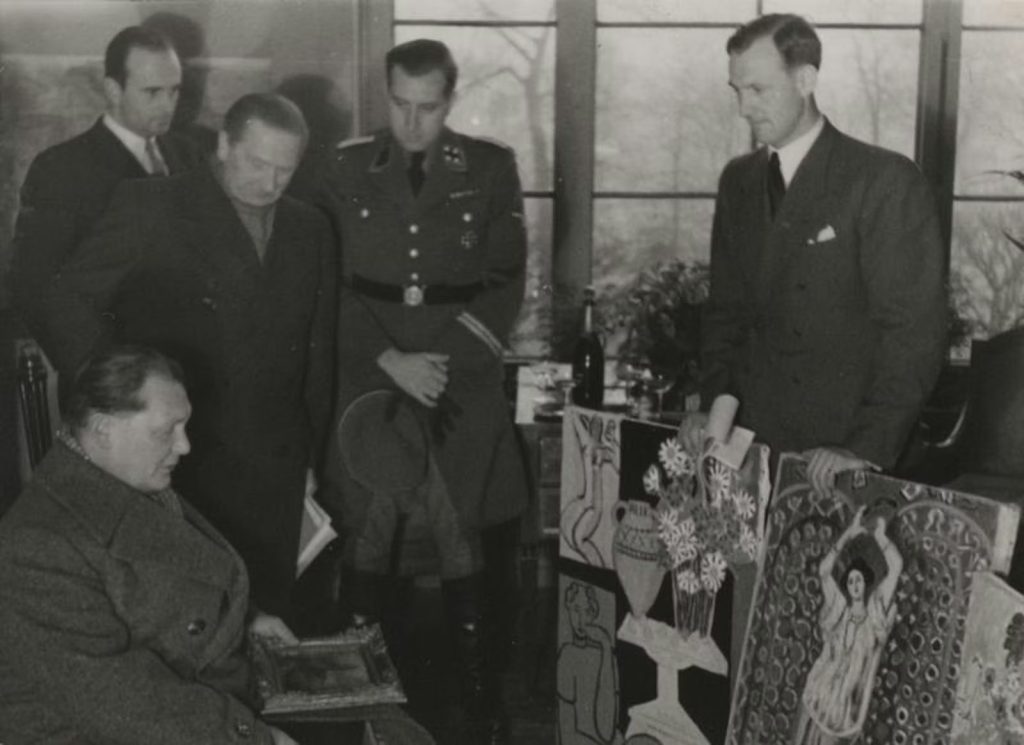
The gallery was plundered by the Nazis in 1940, and many works (among them Daisies) were stolen and taken to Jeu de Paume, which served as a warehouse for all the looted art. The man responsible for filtering which artworks were to be destroyed and which were to enter the collection of the Third Reich was Hermann Göring. Remarkably, there is a photo in which he is looking at some paintings, including our Daisies.
Thankfully, the painting survived the war, and because the stolen art was very well documented by the looters, it made its way back to Rosenberg, who moved to New York in 1940, five years later. Afterwards, it was purchased by the Art Institute, where it remains to this day.
3. A Few Sonnets
Apart from paintings and cut-outs, you can also enjoy some prints. Among them, the first artist’s book Matisse ever created was Poems of Stéphane Mallarmé. Stéphane Mallarmé (1842–1898) was one of the most important poets in France in the 19th century. The book was published by Albert Skira, who was a Swiss art dealer and the founder of his own publishing house, Skira, which prints art books and catalogues to this day.
The work is titled A Few Sonnets: With Her Pure Nails… and illustrates a poem with the same name (original title: Ses purs ongles très haut). Here is the first strophe of the sonnet:
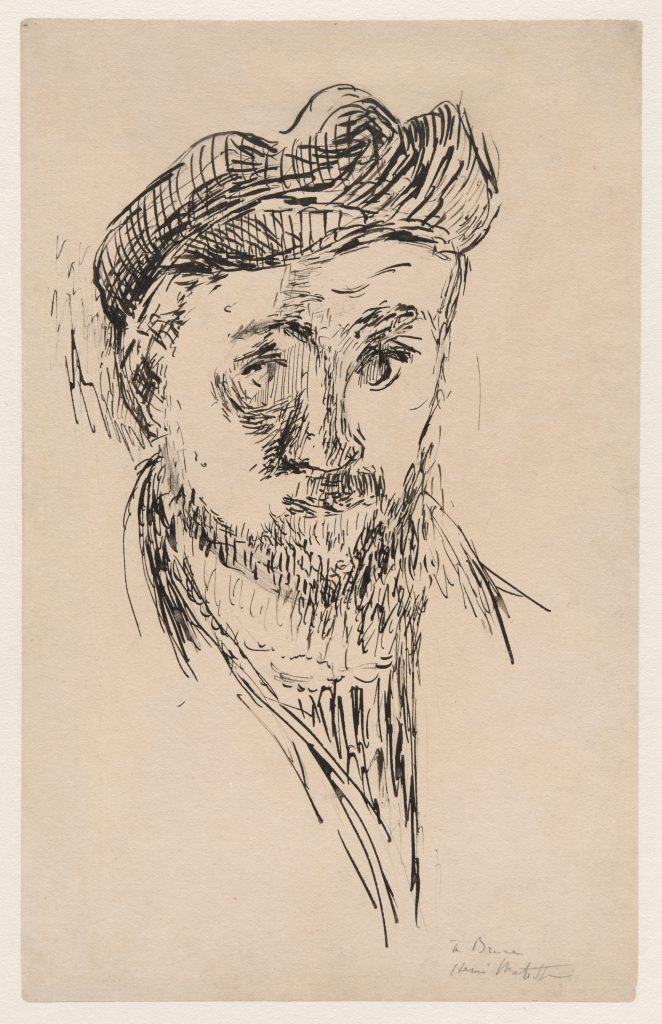
With Her Pure Nails… is a tragic love sonnet. The woman, who is the main character of the text, is dead, and the poet evokes the image of her reflection in a mirror. It might be why Matisse decided to draw her head upside down; this way, he distinguished her imagined likeness from the portrait of a man in the lower right corner of the composition.
The print has an incredible lightness to it. Contrary to the cut-outs, which are all about colored shapes, this print is focused on the weightlessness of line. A perfect companion to a collection of poems, which does not distract the reader but rather complements their interpretations.
4. Interior at Nice
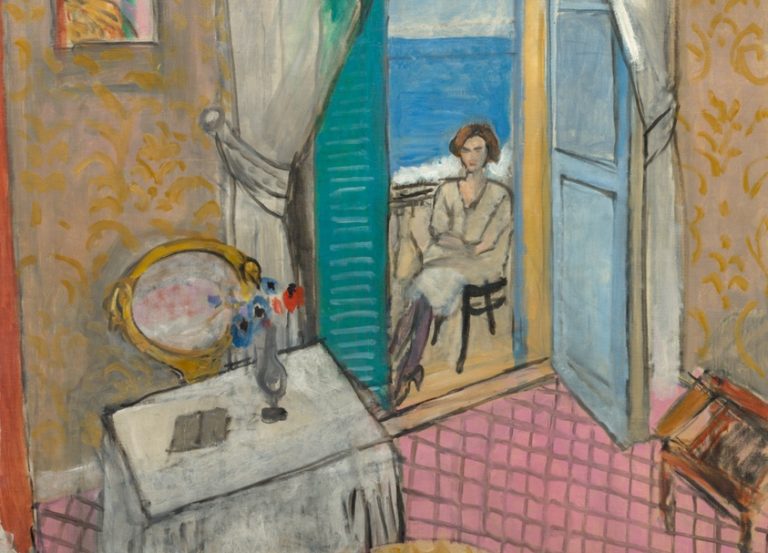
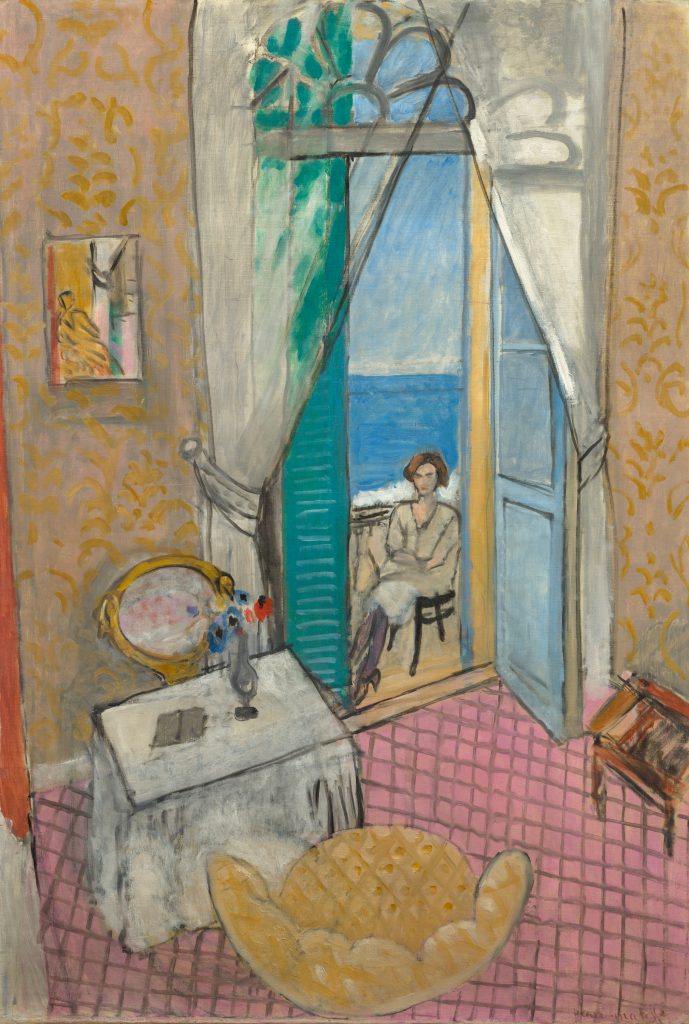
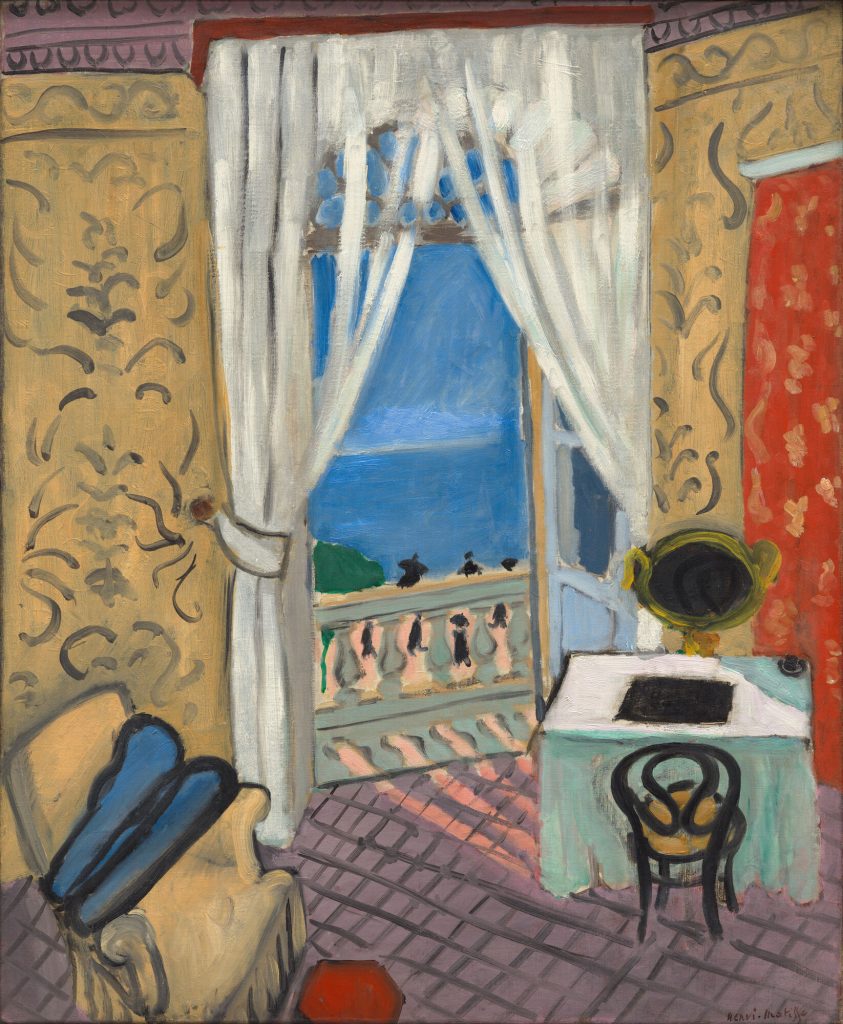
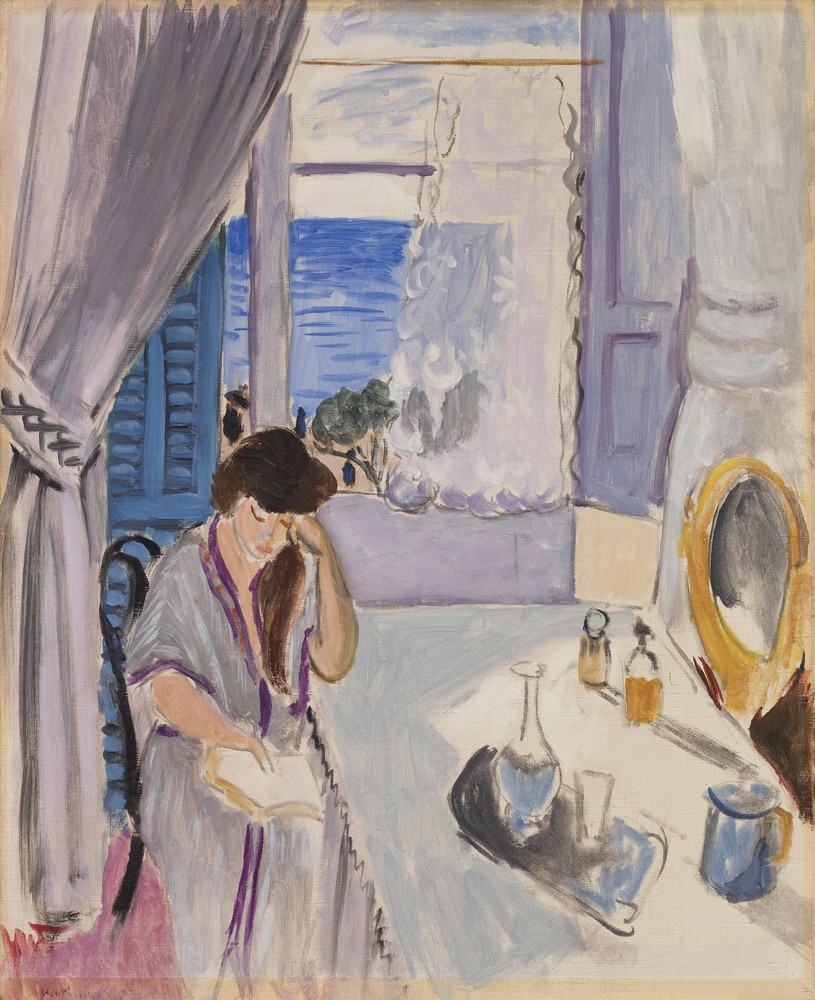
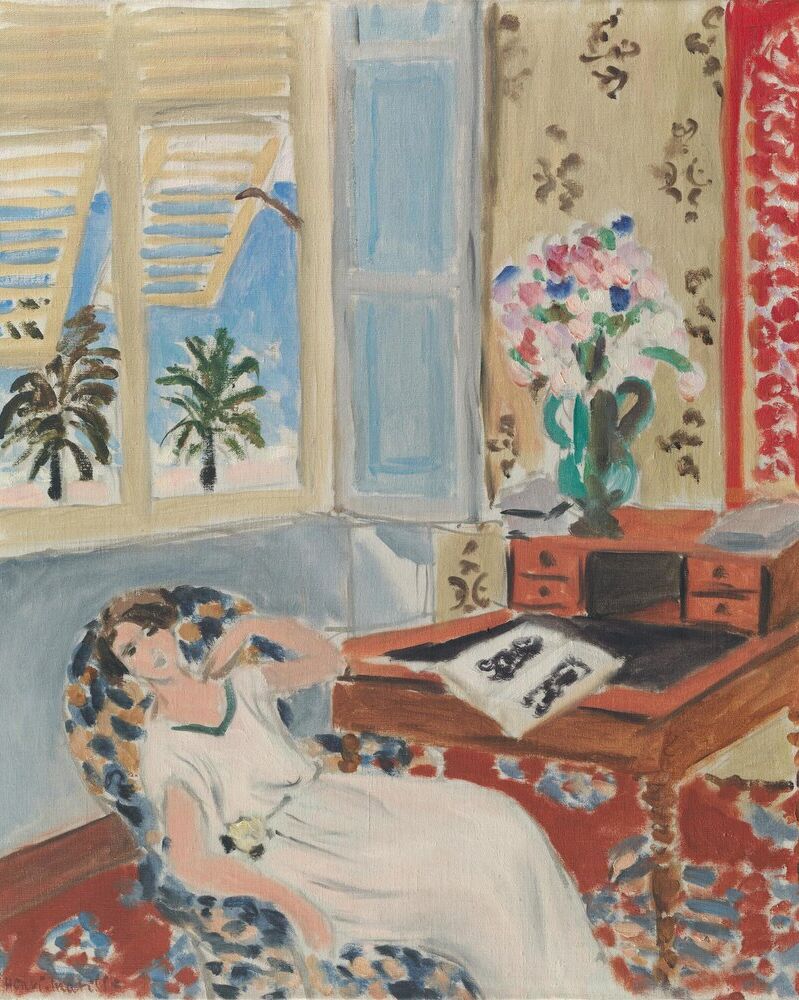
Interior at Nice is one of many paintings Matisse made in his hotel room at the Hotel de la Méditerranée in Nice. The building still exists today and is located on the Promenade des Anglais, which is probably in the top 10 of the most beautiful streets in France. The promenade is located right on the seashore. No wonder Matisse painted this view so many times—it is breathtaking!
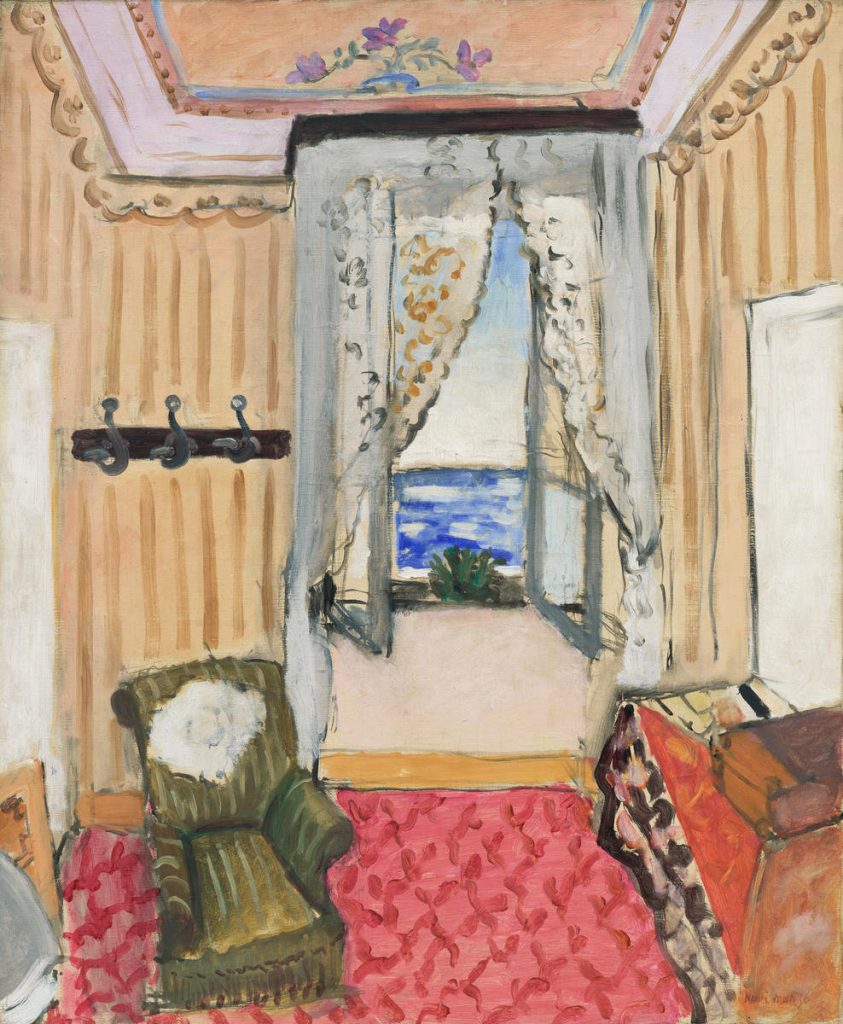
The main character of the painting is undeniably the room itself. We see a vanity table next to the balcony window with a painting hanging above. Even though Matisse placed a woman in his composition (as the wall text suggests it might be his frequent model Antoinette Arnoux), her presence is not as significant. It is not her portrait, but a portrait of the room. Matisse painted the interiors of his rooms in Nice on multiple occasions. Here is a gallery of a few of them: