
Discover Gilded Age Fashion with Elizabeth Block
Art historian Elizabeth L. Block turns her scholarly gaze again to the intersection of fashion, society, and cultural identity in her latest...
Errika Gerakiti 30 March 2026
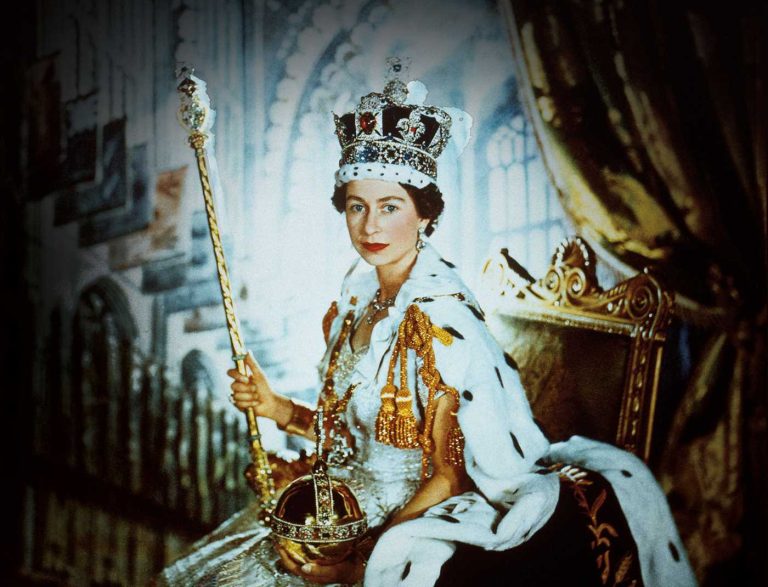
Book cover of Justine Picardie, Fashioning the Crown: A Story of Power, Conflict, and Couture, 2026. Simon & Schuster. Detail.
Fashioning the Crown: A Story of Power, Conflict, and Couture is Justine Picardie’s latest book. She explores all the ways haute couture and fashion have intersected with high-stakes statecraft connected to a history of the House of Windsor so far unknown. Fashion has always been a form of soft diplomacy, and this book reveals exactly how this worked for the world’s most famous royal family.
In one of the opening chapters of Fashioning the Crown, Picardie reminds us of Queen Elizabeth II‘s famous quote: “I have to be seen to be believed.” This quote usually justifies the late Queen’s choices of bold colors and patterns. However, the author’s research proves that the politics behind these choices are not that simple. In fact, they are not only meticulous but also loaded. From the founding of the House of Windsor in 1917 until the early 1960s, Picardie argues that the British monarchy survived abdications, world wars, and the rise of fascism precisely because it mastered the soft power of image-making.
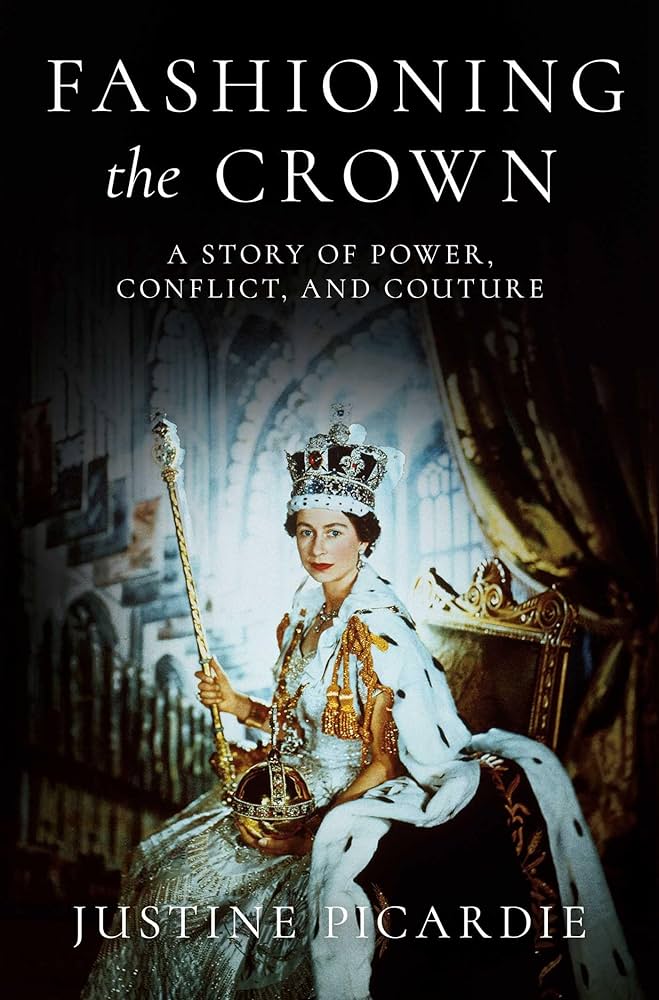
Book cover of Justine Picardie, Fashioning the Crown: A Story of Power, Conflict, and Couture, 2026. Simon & Schuster.
The most interesting details in the book are not about the royals themselves. They are about the designers who dressed them. Picardie reveals the secret lives of couturiers such as Hardy Amies and Edward Molyneux, and states that their precision with a needle was often matched by their skill in wartime espionage. For example, Hardy Amies was also a high-level officer in the Special Operations Executive (SOE), navigating the Belgian resistance while simultaneously sketching silhouettes for the future queen.
Picardie’s investigative background shines here. She connects the dots between the “disciplined line” of royal tailoring and the rigid requirements of military secrecy, suggesting that the fashion houses of London and Paris were essential—if not invisible—in the British intelligence apparatus.
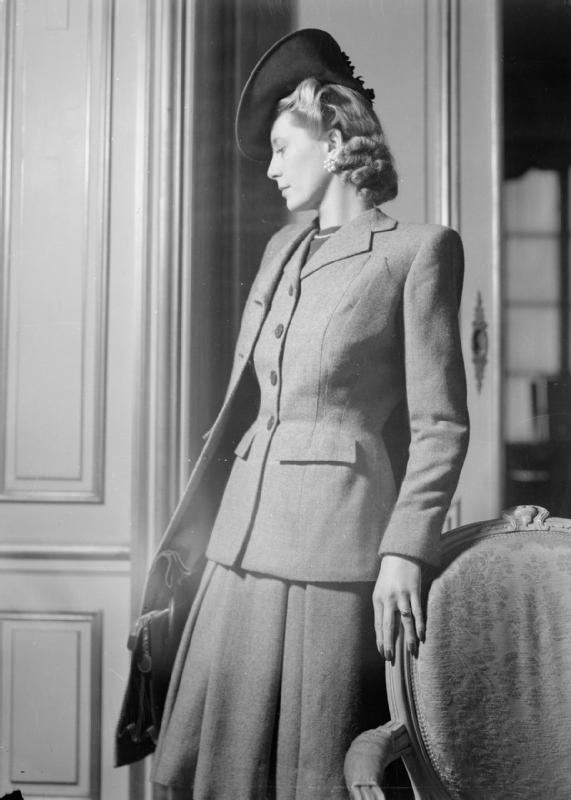
Utility suit designed by Hardy Amies, February 1945. Wikimedia Commons (public domain).
Another interesting element of the book is Picardie’s ability to profile the psychology of the characters through their fashion choices. This gives us further insight and even funny anecdotes about historical figures that we wouldn’t have known. For example, we learn about the “sartorial warfare” between traditionalists and outsiders. Using archives and records, Picardie describes how the Duchess of Windsor used Elsa Schiaparelli’s surrealist designs as a weapon of rebellion. Wallis’s wardrobe wasn’t just chic; it was a deliberate middle finger to the dusty, Victorian expectations of the palace.
In another chapter, we learn a surreal anecdote regarding the Windsors’ meeting with Hermann Göring in 1937. While Wallis was dressed impeccably, the Nazi commander was not. In fact, he had a weird thing for Elizabeth Arden products, so… he wore bright red varnish on his toenails—a jarring detail that highlights the grotesque decadence of the era.
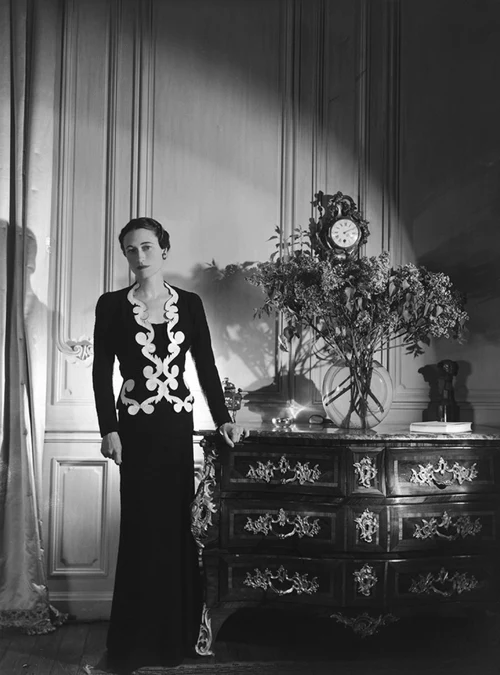
Cecil Beaton, photograph of Wallis Simpson modelling a Schiaparelli outfit from her trousseau, May 1937. Maison Schiaparelli.
This is a historical book, based on true archives and records. With over 100 images, many never before published, Fashioning the Crown is a cinematic, atmospheric work that proves the most powerful weapons in the Royal Arsenal were often made of silk and lace. It is definitely worth reading, especially if you are interested in how fashion becomes a soft power and how it can shape cultural diplomacy, particularly in times of crisis.
Fashioning the Crown: A Story of Power, Conflict, and Couture will be published on February 24, 2026, by Pegasus Books.
Get your daily dose of art
Click and follow us on Google News to stay updated all the time

DailyArt Magazine needs your support. Every contribution, however big or small, is very valuable for our future. Thanks to it, we will be able to sustain and grow the Magazine. Thank you for your help!

Errika has a Master's degree in curatorial practices. She has been a writer for DailyArt Magazine since 2019 and loves sharing what she loves: weird, unusual art, female artists, and contemporary creations.

Art historian Elizabeth L. Block turns her scholarly gaze again to the intersection of fashion, society, and cultural identity in her latest...
Errika Gerakiti 30 March 2026
Gabrielle “Coco” Chanel did not just design clothes. She rewrote the rules of what women could wear, feel, and demand from fashion. All of the...
Errika Gerakiti 19 March 2026
Renowned photographer Annie Leibovitz once again proves to us that when art and fashion meet, the result is always striking. Together, they can...
Nikolina Konjevod 15 September 2025
Turbans are one of the most enduring forms of headwear in human history. Though associated today with Sikh and Muslim communities, turban and...
Maya M. Tola 3 July 2025