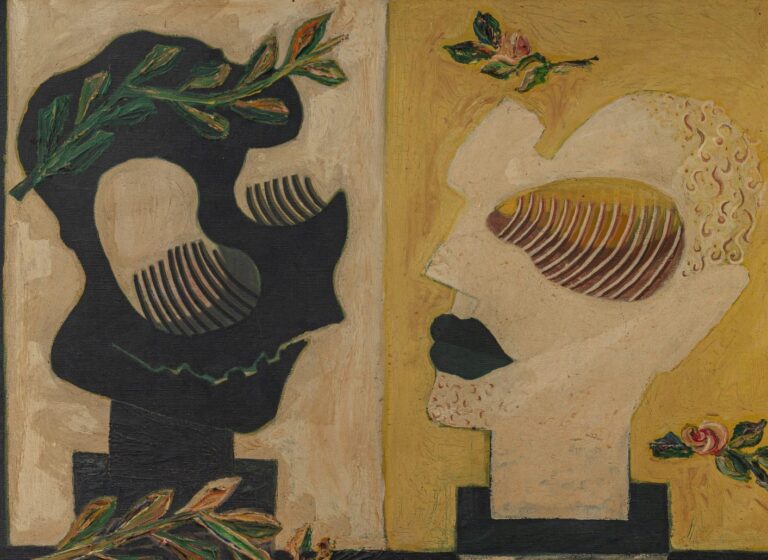
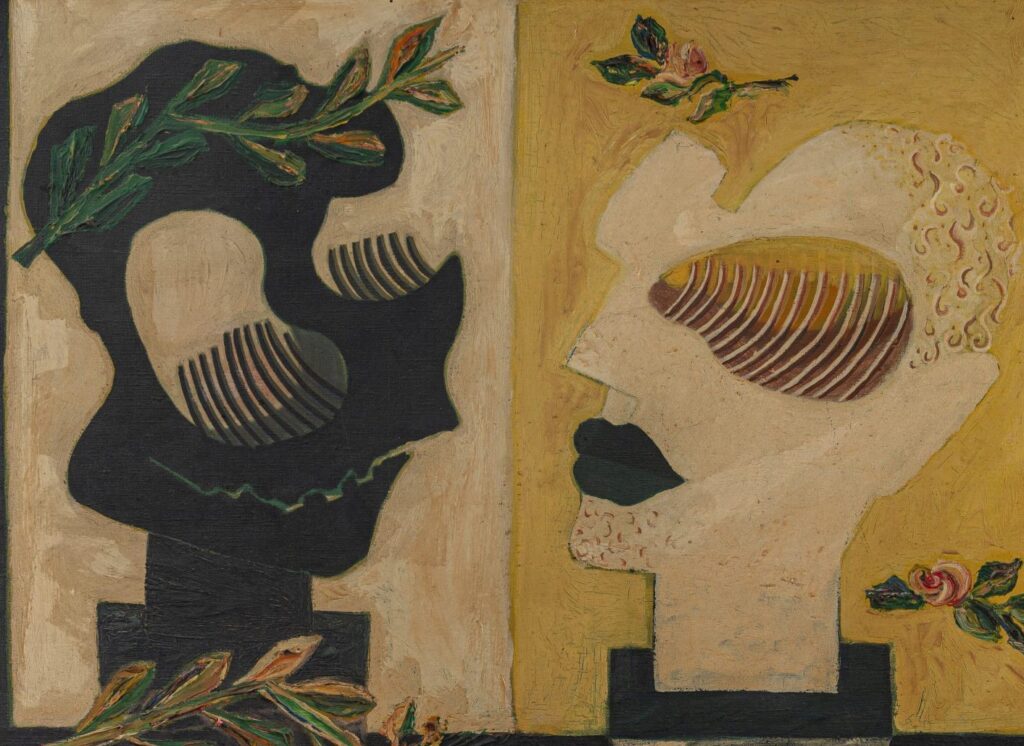
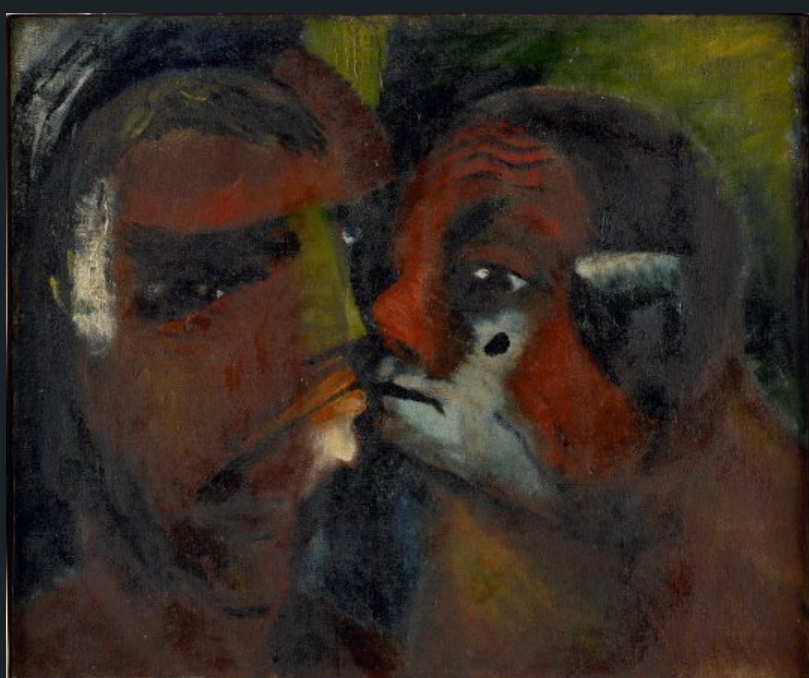
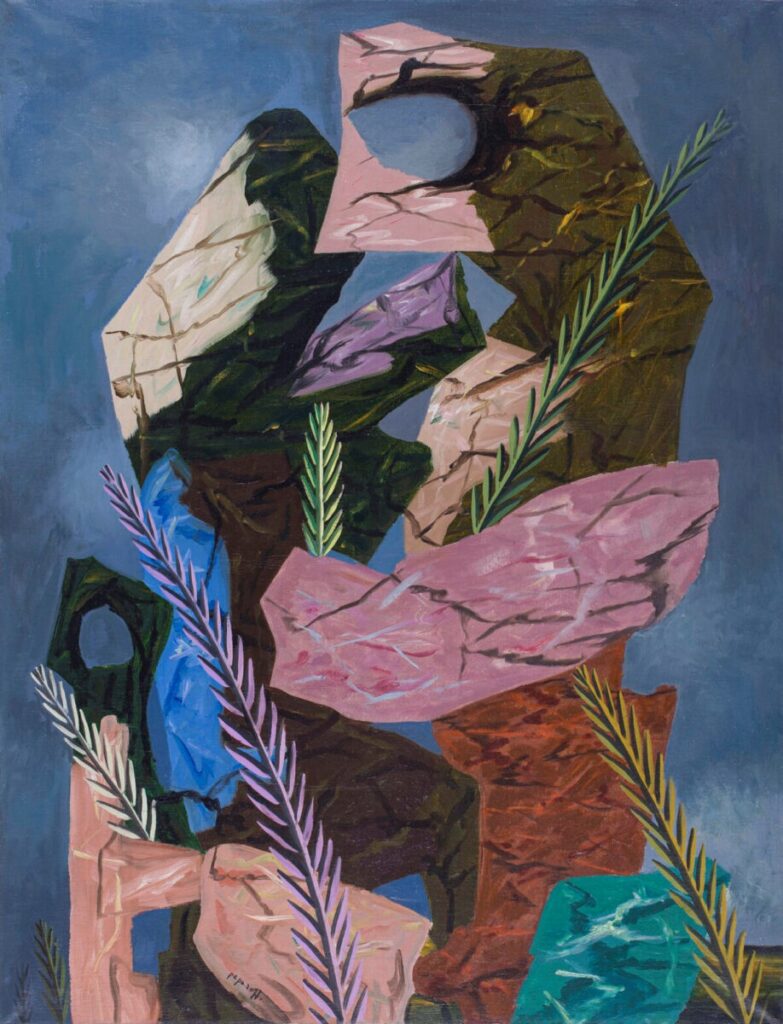
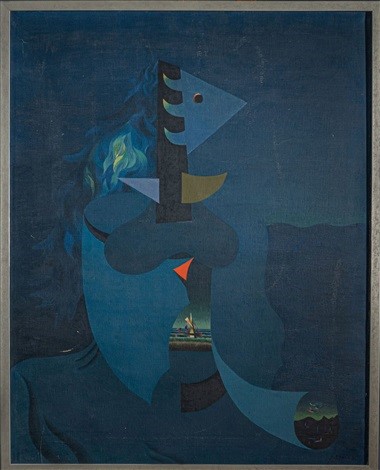
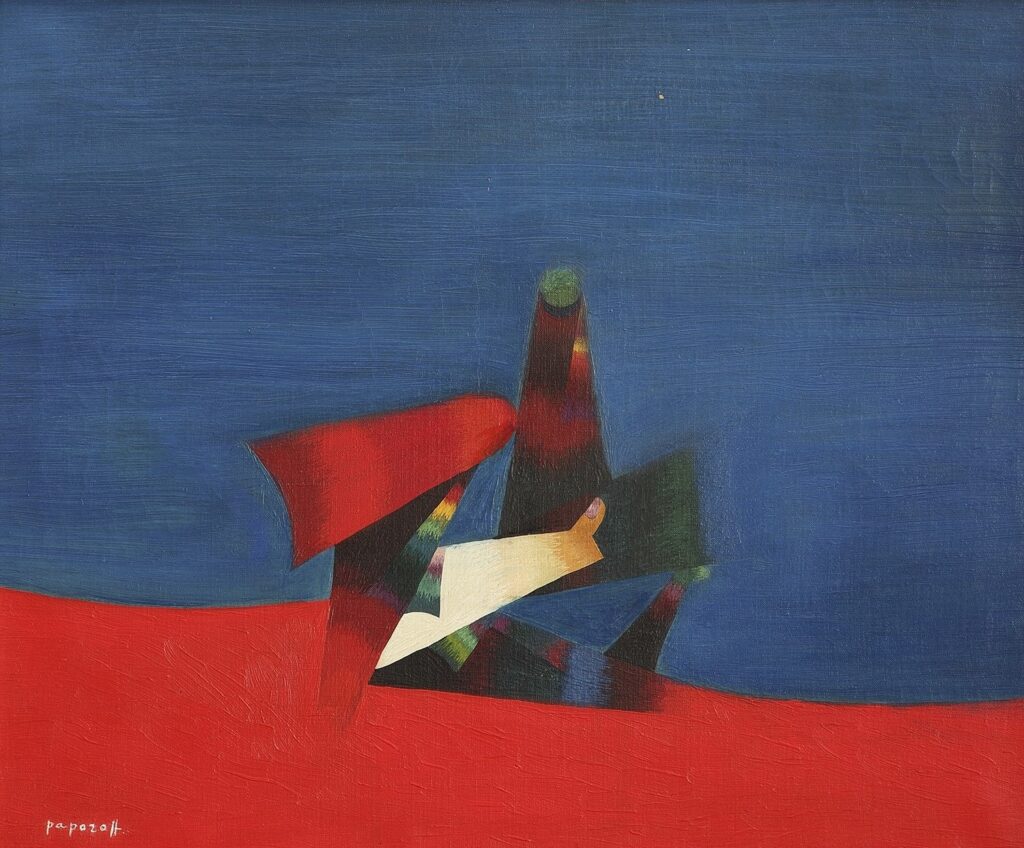
But what exactly can the viewer encounter in Papazoff’s works? Is there a recurring unconscious motif? Are there obsessions that the eye has to decode in his deconstructed compositions? Or did he paint with systematic juxtapositions, producing a kind of sentimental joy and dreamlike effects?
Georgi (Georges) Papazoff was born in Yambol, Bulgaria, in 1894, during a period of political upheaval following Bulgaria’s independence from the Ottoman Empire. From volunteering in the Balkan War to moving to Munich and Berlin after World War I, his life was marked by multiple shifts in experience, influence, and artistic signature, placing him alongside Joan Miró, Max Ernst, and other prominent painters.
In his earliest period, Papazoff was influenced by a more classical approach, evident in his paintings which often featured realistic landscapes and Bohemian houses. Between 1916 and 1918, Papazoff’s brushstrokes would borrow Impressionistic contours, figure compositions, and more dynamic principles that shaped the German aesthetics at that time.
Expressionism and Cubism also left their mark on Papazoff’s artistic style, leading him to try abstract images rather than depicting real-life subjects. His transitions led him to Paris, where he was supported by Jules Pascin, another Bulgarian painter of the Paris school, known as the “Prince of Montparnasse.”
Here’s when Papazoff’s works were finally discussed in the context of Surrealism, although he received credit from only a few critics. When he held a solo show of 57 paintings at the Modern Gallery in Zagreb in 1934, the Croatian Art Association hailed Papazoff as:
Although he was admired by some, including André Breton himself, he was still considered too avant-garde by many others. In his 1971 autobiography, Papazoff writes that the public at that time was “somewhat scandalized” by his art.
Perhaps the most controversial aspect of Papazoff is his understanding of Surrealism. Although classified as a Surrealist painter, he discarded many of its principles.
He didn’t reject it as an artistic language, but as a composition of internal discipline, movement’s rules, and manifestos. The Bulgarian Surrealist kept his distance from established art collectives, and when approached by Breton, Papazoff refused to sign the Surrealist manifesto and submit to what he viewed as artistic dogmas.
Later on, in his own words, Papazoff acknowledged, “But finally I learned that when I refuse to accept the rules of the Surrealists, I condemn myself. To date, no Surrealist wants to remember or admit that I was the first one who showed some a-real, or, if you want, ‘surreal,’ paintings in Paris.”
Throughout his artistic cycles, Papazoff developed his own trademark elements and recurring motifs: the moon, stairs, stylized dogs, and many other symbols stripped of anecdotes. He used the sea as a symbol of mystery and freedom, and floating biomorphic and amoebic forms to signifying the unconscious life before identity.
With intricate detailing, bold colors, and thoughtful compositions, the works of the enigmatic Georges Papazoff reveal a mind of artistic independence unbound by norms and a hand that drew borders between reality and the unconscious world.