



10 Harlem Renaissance Paintings That Defined a Cultural Movement
The Harlem Renaissance paintings capture one of the most influential cultural movements in American history. These extraordinary artists transformed...
Errika Gerakiti 20 July 2026
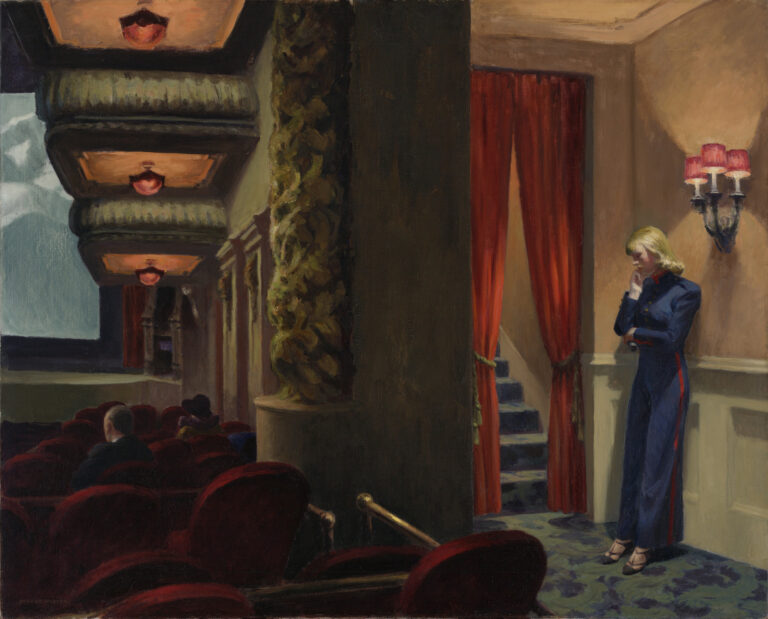
Edward Hopper, New York Movie, 1939, Museum of Modern Art, New York City, NY, USA.
Edward Hopper was one of the most iconic American Realist painters and printmakers. He was celebrated for his striking portrayals of American life, from isolated gas stations and motels to restaurant scenes and rural landscapes. Today, we want to focus on one of his favorite American themes. Edward Hopper was a lifelong devotee of cinema and theater, both of which became subjects for his paintings. Let’s explore the dimly lit cinema halls and theater interiors, and the moments Edward Hopper quietly captured in his paintings.
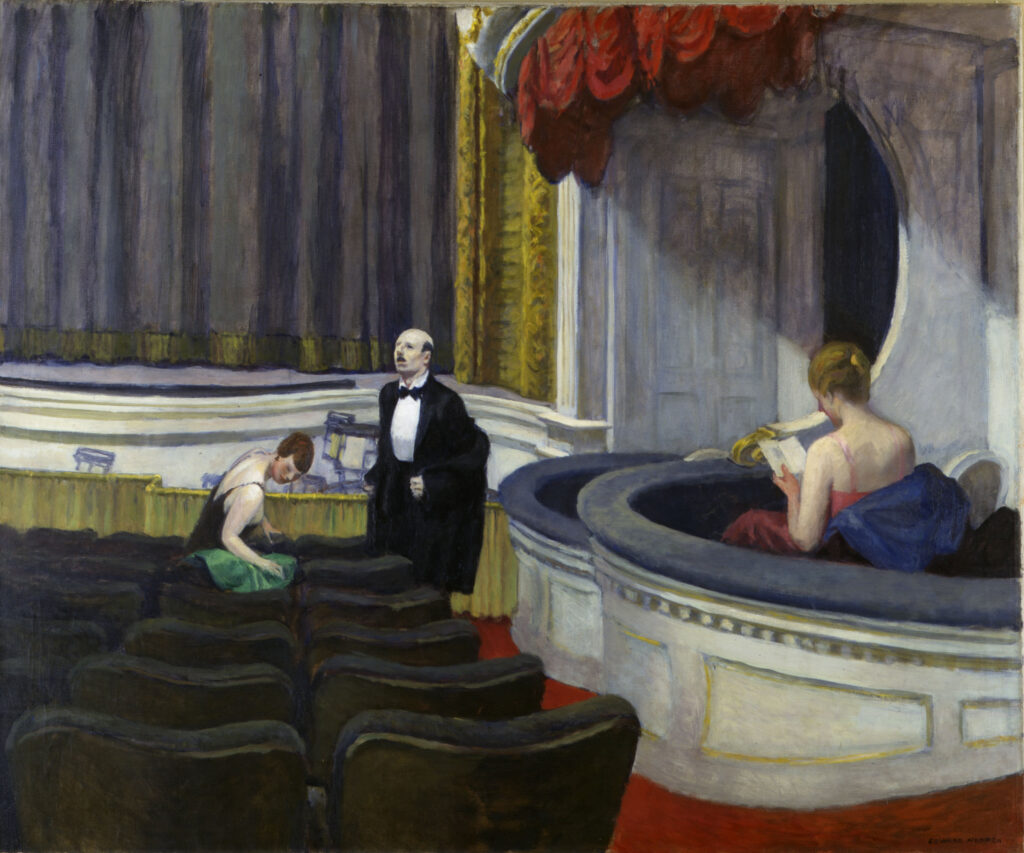
Edward Hopper, Two on the Aisle, 1927, Toledo Museum of Art, New York City, NY, USA.
Edward Hopper‘s 1927 painting Two on the Aisle was his first major work featuring a scene set in a theater. The composition seems simple: three figures settle into their seats in the still-empty theater, removing coats and preparing for the performance. Typically for the “master of solitude,” Hopper chooses to focus on the quiet moment before the performance. We don’t see any action on the stage or a bustling crowd. It’s the details that invite us into the story. What are these people thinking? What is their story? We become the voyeurs, or perhaps another theater patron about to take a seat and enjoy the performance. The scene seems almost like a still from a movie.
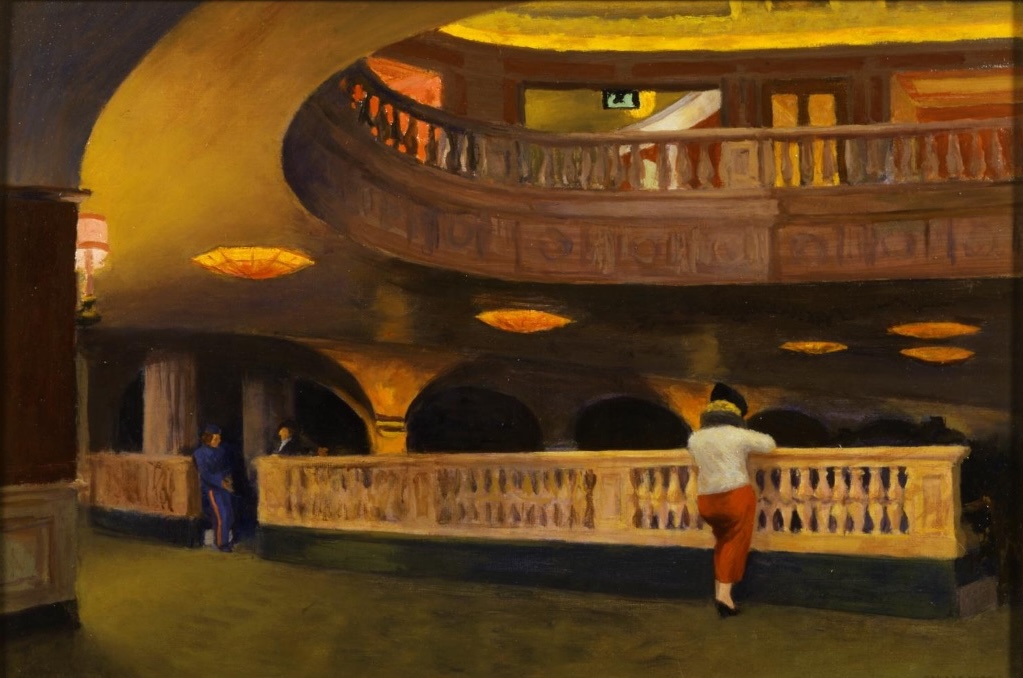
Edward Hopper, The Sheridan Theater, 1937, The Newark Museum of Art, Newark, NJ, USA
Hopper was a great observer of modern American life. Yet again, in this painting, he deliberately chose to depict an empty movie theater instead of a crowded scene. A devoted moviegoer, Edward Hopper witnessed a thrilling era in cinema history: the introduction of electricity and sound, followed by the subsequent rise of Hollywood as a film industry. Dark halls of theaters were transformed into luxurious movie palaces. The Sheridan Theater, which seated 2,000 guests, was one very close to his house.
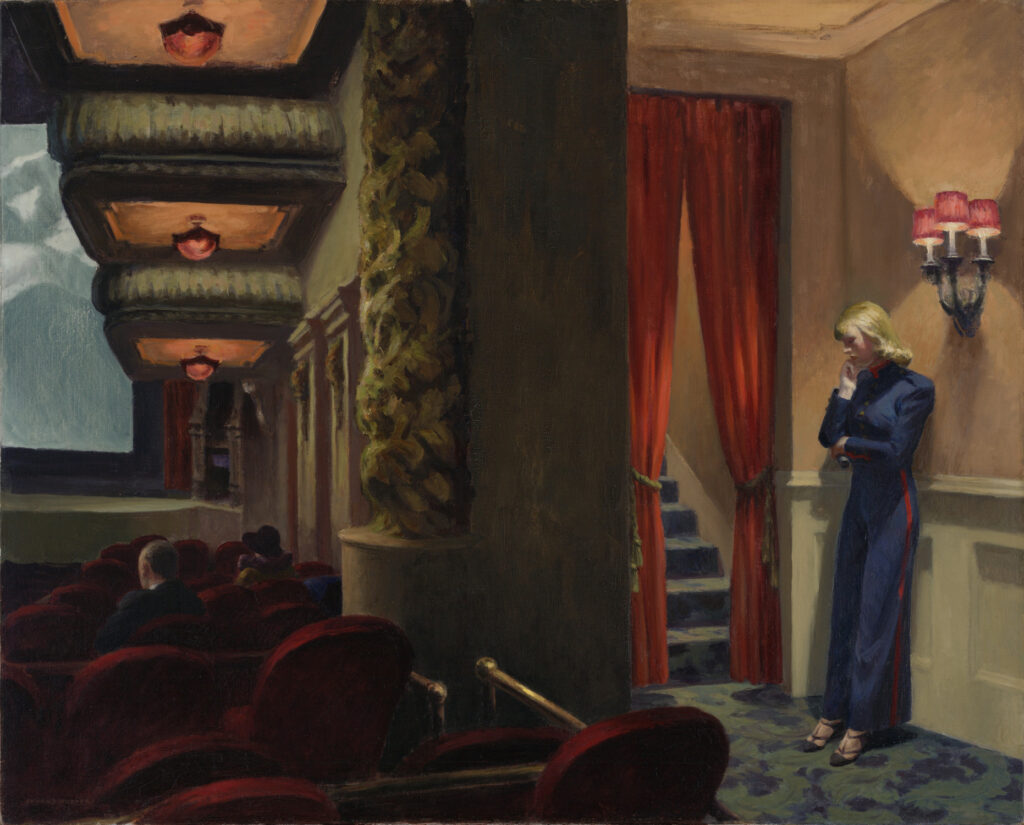
Edward Hopper, New York Movie, 1939, Museum of Modern Art, New York City, NY, USA.
This is probably Edward Hopper’s most famous cinema scene. As with many of Hopper’s female subjects, this figure was inspired by his wife, Jo, who posed under a lamp in the hall of their apartment. Drawing from the numerous sketches of his favorite movie houses, such as the Palace, Republic, Globe, and Strand, Hopper designed every tiny detail of this interior to faithfully reflect the real venues, including the pattern of the carpet. The star of this scene, however, is the usherette lost in her own thoughts. Edward Hopper had a rare gift for capturing the theater in all its quiet allure—captivating, glamorous, and hauntingly empty.
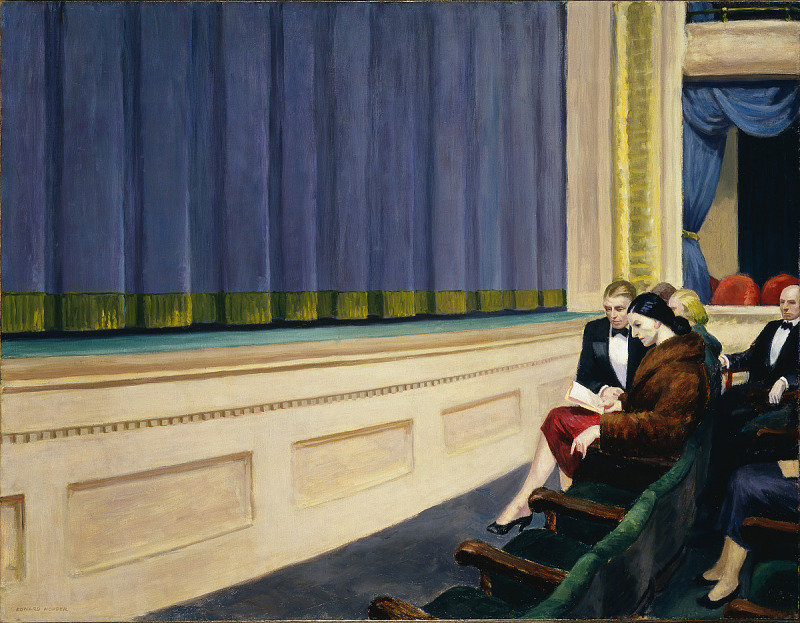
Edward Hopper, First Row Orchestra, 1951, Hirshhorn Museum and Sculpture Garden, Washington, DC, USA. Smithsonian.
Here we encounter a scene very much like Two on the Aisle: people await the start of a concert, while an elegant lady seems closed off from the outside world. The vast curtain and stage dominate most of the canvas, stretching across it with a weighty presence. As in many of Hopper’s works, we glimpse the scene only from the corner of our eye.
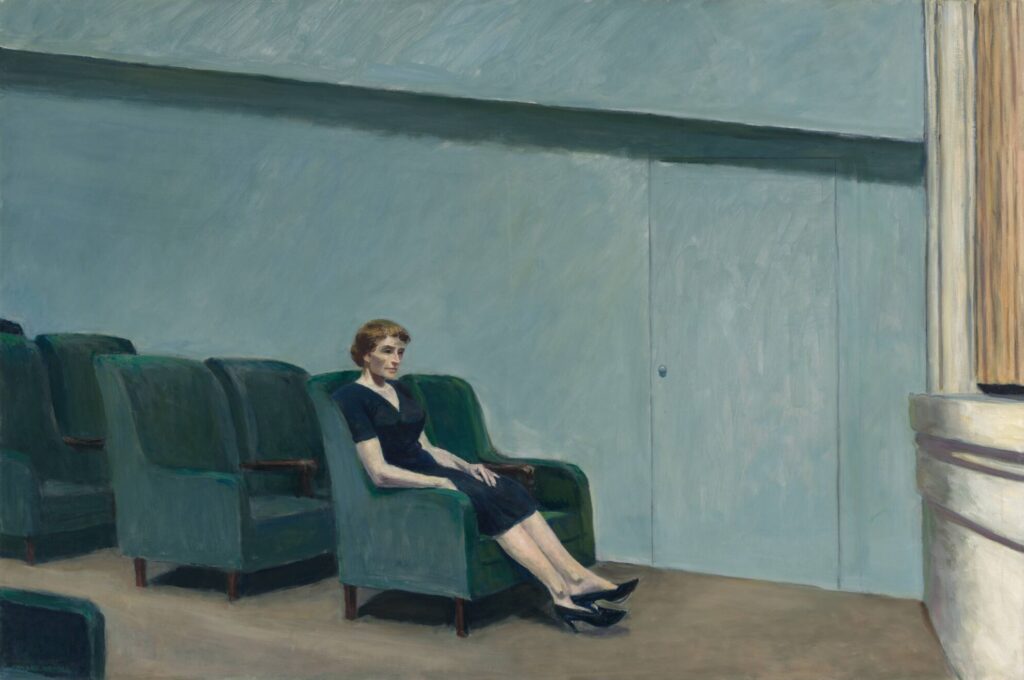
Edward Hopper, Intermission, 1963, San Francisco Museum of Modern Art, San Francisco. CA, USA.
Intermission is one of Hopper’s largest works. Once again, Hopper came up with the idea for it while watching a movie. Josephine Hopper, who also modeled for this piece, arranged for him to work in an empty theater. Unlike the previous painting, here the composition includes only the edge of the stage. At its center sits a solitary woman in the first row of a side aisle. She anticipates the return of others from intermission, her mind elsewhere as she looks into the distance. A surviving preparatory sketch indicates that Hopper had briefly considered including another figure in the third row.
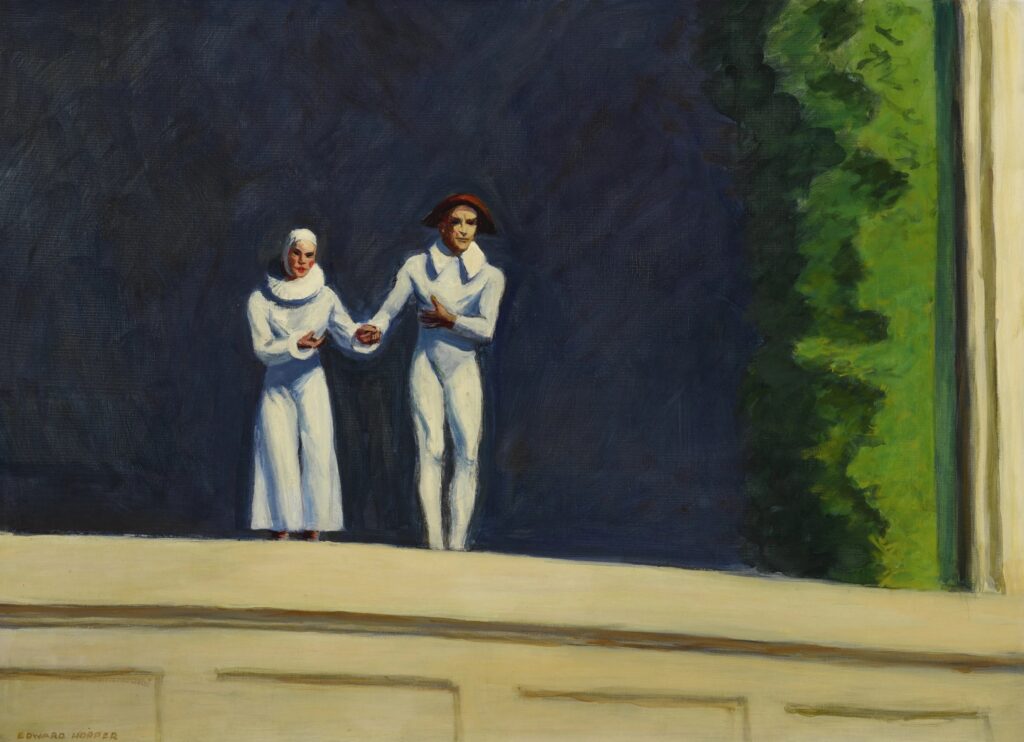
Edward Hopper, Two Comedians, 1965, Bruce Museum, Greenwich, CT, USA. Sotheby’s.
At 83, Hopper created Two Comedians, a deeply personal work that can be considered as a farewell. According to Jo Hopper, the painting reflected the two of them gracefully bowing out. Both were in their eighties and fighting illness. Edward Hopper would pass away less than two years later, with Jo following the next year. They are depicted as actors on the stage, evoking Pierrette and Pierrot—the young lovers from the commedia dell’arte. The two pale figures are set against the black void of the stage background, as if at life’s close, Hopper seemed to want Jo at his side.
DailyArt Magazine needs your support. Every contribution, however big or small, is very valuable for our future. Thanks to it, we will be able to sustain and grow the Magazine. Thank you for your help!

Art Historian, founder and CEO of DailyArtMagazine.com and DailyArt mobile app. But to be honest, her greatest accomplishment is being the owner of Pimpek the Cat.

Architecture nerd, art historian, museum professional, fascinated by pre- and post-WWII modernism in Central/Eastern Europe.

The Harlem Renaissance paintings capture one of the most influential cultural movements in American history. These extraordinary artists transformed...
Errika Gerakiti 20 July 2026
By transforming discarded objects into part of an organic environment and turning personal experience into visual language, Nellie Mae Rowe created...
Carlotta Mazzoli 11 May 2026
William H. Johnson’s paintings show a breadth of styles ranging from realism to Post-Impressionism, and later a folk art aesthetic that would...
Theodore Carter 12 February 2026
For many of us, the word “pirate” evokes images of an era full of gallant white-sailed ships, skull and crossbones flags, red bandanas, gold...
Theodore Carter 4 December 2025