

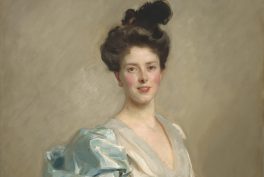


Fashion Is Art: 13 Beautiful Dresses in Art History
“Who Wore What” has fascinated artists for centuries because few things convey status, identity, and history as effectively as fashion.
MJ Rivera 18 June 2026
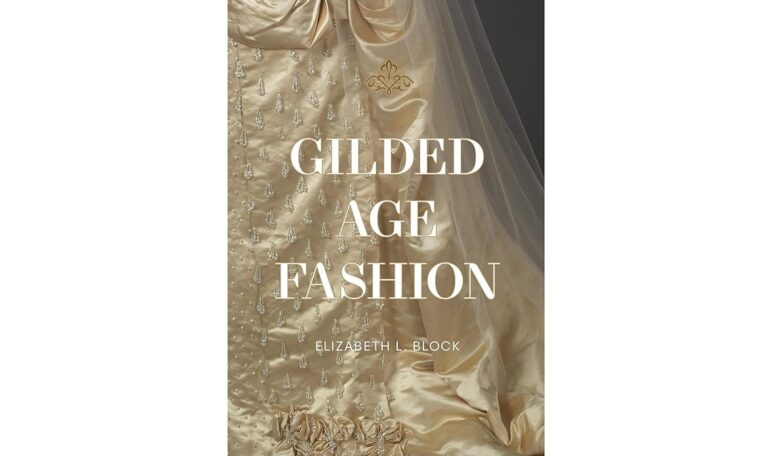
Book cover of Elizabeth L. Block, Gilded Age Fashion, 2026, Hardie Grant Books. Press materials.
Art historian Elizabeth L. Block turns her scholarly gaze again to the intersection of fashion, society, and cultural identity in her latest publication, Gilded Age Fashion (Hardie Grant Books, 2026). This latest work from the senior editor at the Metropolitan Museum of Art illuminates the spectacular wardrobes of America’s most privileged class. Lush, meticulously researched, and visually stunning, Gilded Age Fashion is a feast for the eyes and the mind alike.
The term “Gilded Age” was Mark Twain’s sardonic take on an era that prized surface over substance. Wealth in America in the 1870s, 1880s, and 1890s was not quietly accumulated. Rather, it was performed, displayed, and worn. The book is anchored by 50 extraordinary gowns from multiple museums, including the Metropolitan Museum of Art. Each one reflects the life in the wealthiest families of New York City, Boston, Philadelphia, and Cleveland.
To dress well in this world was not simply a matter of personal taste. It was a social obligation, a declaration of status, and, at times, a carefully choreographed act of diplomacy. The great French fashion houses of the time—the House of Worth, Maison Félix, the House of Doucet, and the House of Paquin—dressed America’s most prominent women. Locally in New York, the store of dressmaker Catharine Donovan on Madison Avenue was frequented by the Four Hundred, a coveted list of the city’s most desirable guests.
Block details not only the garments themselves but also the elaborate social etiquette and customs that governed sartorial choices across each occasion. The result is a book that reads as much as a cultural history as it does a catalog of breathtaking fashion.
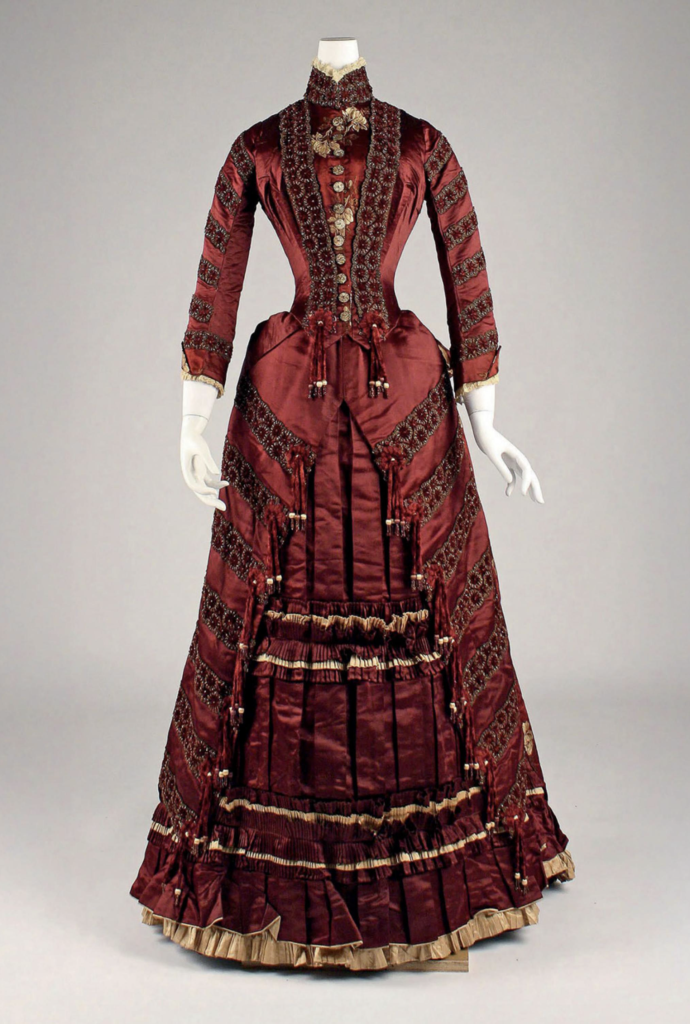
A pleated and embroidered beauty in maroon satin embellished with glass beads, 1879, Leroyer & Ducas of Paris, France. Elizabeth L. Block, Gilded Age Fashion, 2026, Hardie Grant Books, p. 19.
Gilded Age Fashion moves through seven thematic chapters, each following the rhythms of a Gilded Age woman’s day and life. The first chapter, Modish Mornings, opens with the quieter, more private hours of the day. Next, Genteel Afternoons brings the world of daywear into sharp focus. Here, Block offers a fascinating glimpse into the economics of elegance. A custom-fit corset from Maison Félix, which was considered one of the most expensive dressmakers, cost 10 dollars, equivalent to over 300 dollars today. Furthermore, the garments themselves are a study in refined ornament: bustled skirts adorned with bows, pleats, tassels, and delicate layers of detail.
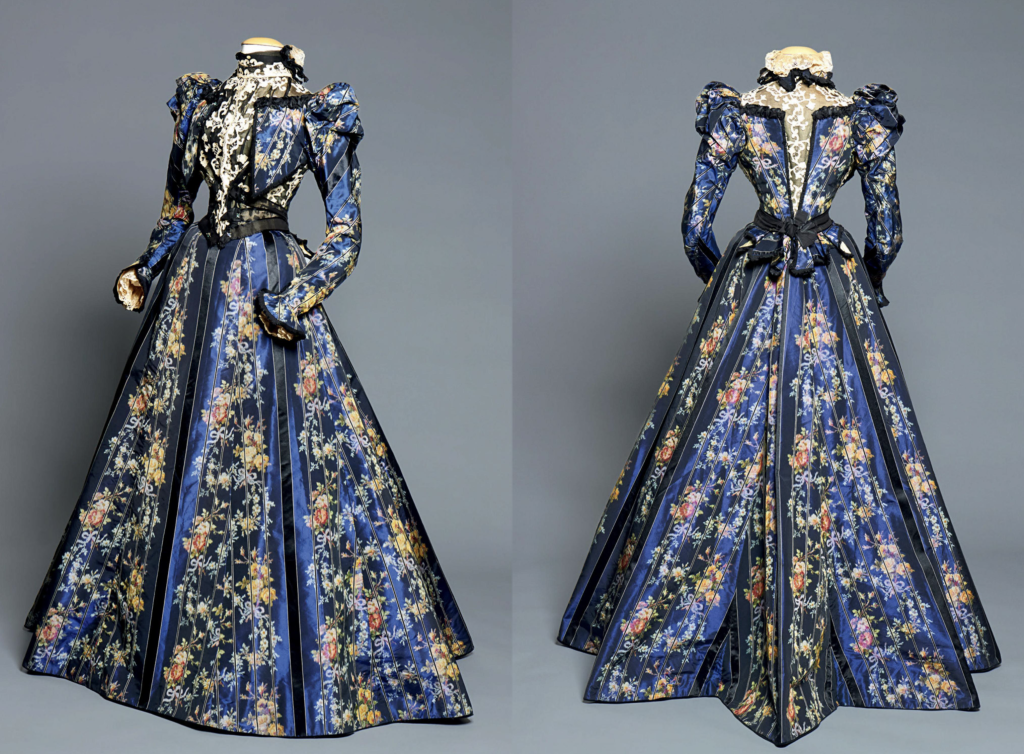
An ensemble of floral trellises, striped pleats, and lace for Annie Otis Sanders. Elizabeth L. Block, Gilded Age Fashion, 2026, Hardie Grant Books, p. 28-29.
As the day turns to evening, Elegant Evenings ends the day in silk, lace, and diamonds. Deeper, richer tones signal the heightened drama of after-dark dressing. Subsequently, Stately Weddings is devoted to the grandeur of matrimonial dress with yards of satin, Belgian lace-trimmed veils, and matching satin slippers. The fifth chapter, Opulent Affairs, takes a more theatrical turn. Rhinestones, statement sleeves, and sequins take center stage. These were garments designed to be seen.
Royal Couples, the sixth chapter, reveals a striking shift in register. When Gilded Age women were presented to European royalty, everything changed. The studied ostentation of domestic society gave way to something rarer. Precious stones, intricately constructed corsets, and sweeping court trains communicated a different, older language of luxury entirely.
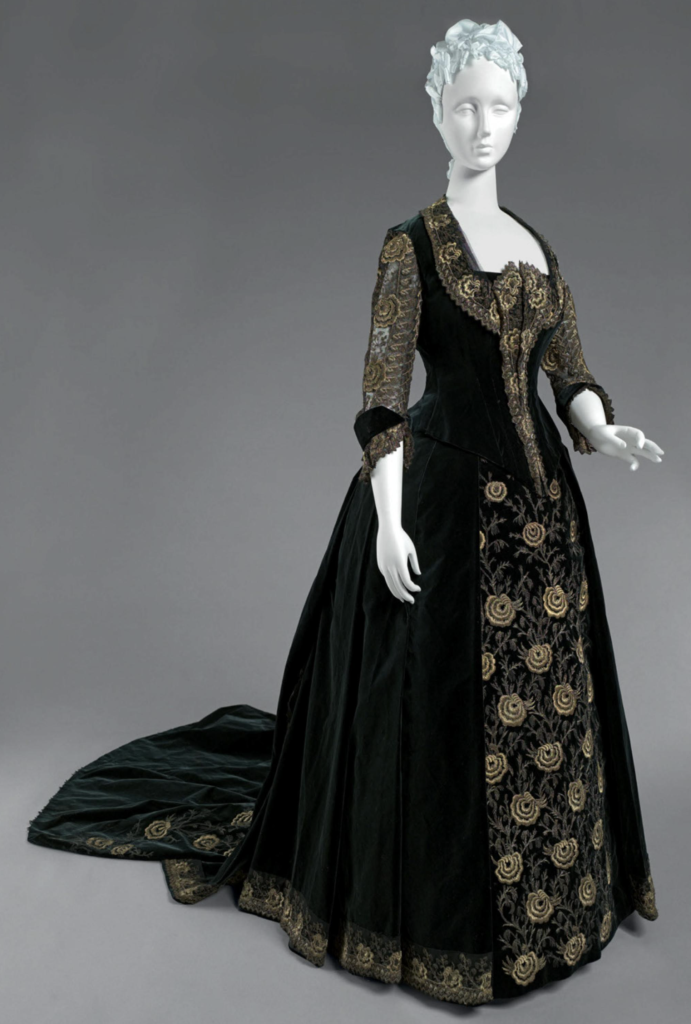
Sarah Mahon Roebling’s dress in black velvet, mid-1880s. Elizabeth L. Block, Gilded Age Fashion, 2026, Hardie Grant Books, p. 41.
Finally, Luxury and Legacy zooms out to ask what all of this extravagance ultimately meant. Block’s answer is compelling: The women of the Gilded Age were not simply spending money on beautiful clothes. Instead, they were building a visual culture and a set of standards. Their devotion to aesthetics and craftsmanship was, in its own way, a form of ambition.
Fashion has always been one of the most immediate ways through which people communicate who they are or who they wish to be, without uttering a single word. It encodes class, aspiration, belonging, and rebellion. In that sense, Gilded Age Fashion is a compelling reminder of this truth. Through Block’s lens, every pleat and every gemstone becomes a piece of evidence in a larger social argument.
Fans of The Gilded Age series will find in this book something extraordinary: a real-life, American gilded world. The gowns are just as magnificent. The social stakes, as Block shows, were just as high.
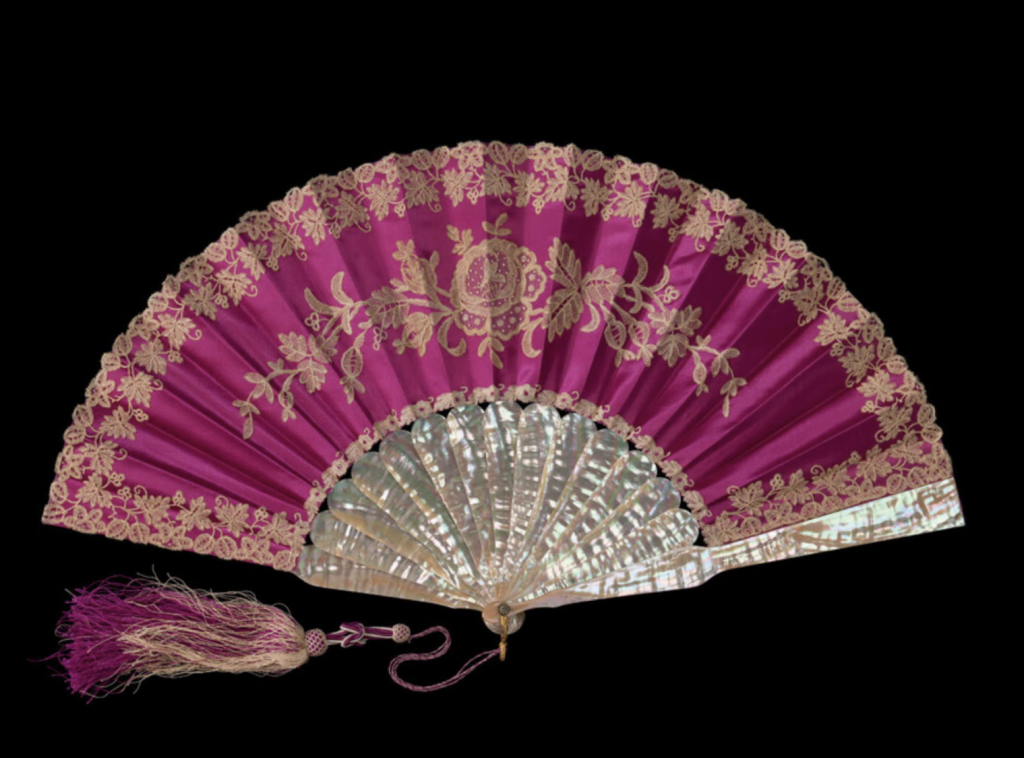
Fan in purple satin, Tiffany & Co, 1890s. Elizabeth L. Block, Gilded Age Fashion, 2026, Hardie Grant Books, p. 90.
Gilded Age Fashion is precisely the book one hopes Block would write. Her scholarship is at once rigorous and deeply pleasurable. Her ability to extract the cultural significance out of objects that others might treat as mere decoration is, once again, on full display. With every new work, Block finds a fresh way to remind us why these stories matter.
Gilded Age Fashion by Elizabeth L. Block is published in March 2026 by Hardie Grant Books. You can get a copy of the book through the publisher’s website.
DailyArt Magazine needs your support. Every contribution, however big or small, is very valuable for our future. Thanks to it, we will be able to sustain and grow the Magazine. Thank you for your help!

I'm Errika Gerakiti, an art writer and curator based in Athens. I write about modern and contemporary art, fashion, and cinema — with a particular interest in the overlooked, the uncomfortable, and the underrepresented. When I'm not writing, I'm curating exhibitions, reading, painting, sculpting, or reading. For longer reads, personal essays, and an occasional science-fiction or horror story, find me on Substack.

“Who Wore What” has fascinated artists for centuries because few things convey status, identity, and history as effectively as fashion.
MJ Rivera 18 June 2026
Gabrielle “Coco” Chanel did not just design clothes. She rewrote the rules of what women could wear, feel, and demand from fashion. All of the...
Errika Gerakiti 19 March 2026
Fashioning the Crown: A Story of Power, Conflict, and Couture is Justine Picardie’s latest book. She explores all the ways haute couture and...
Errika Gerakiti 23 February 2026
Renowned photographer Annie Leibovitz once again proves to us that when art and fashion meet, the result is always striking. Together, they can...
Nikolina Konjevod 15 September 2025